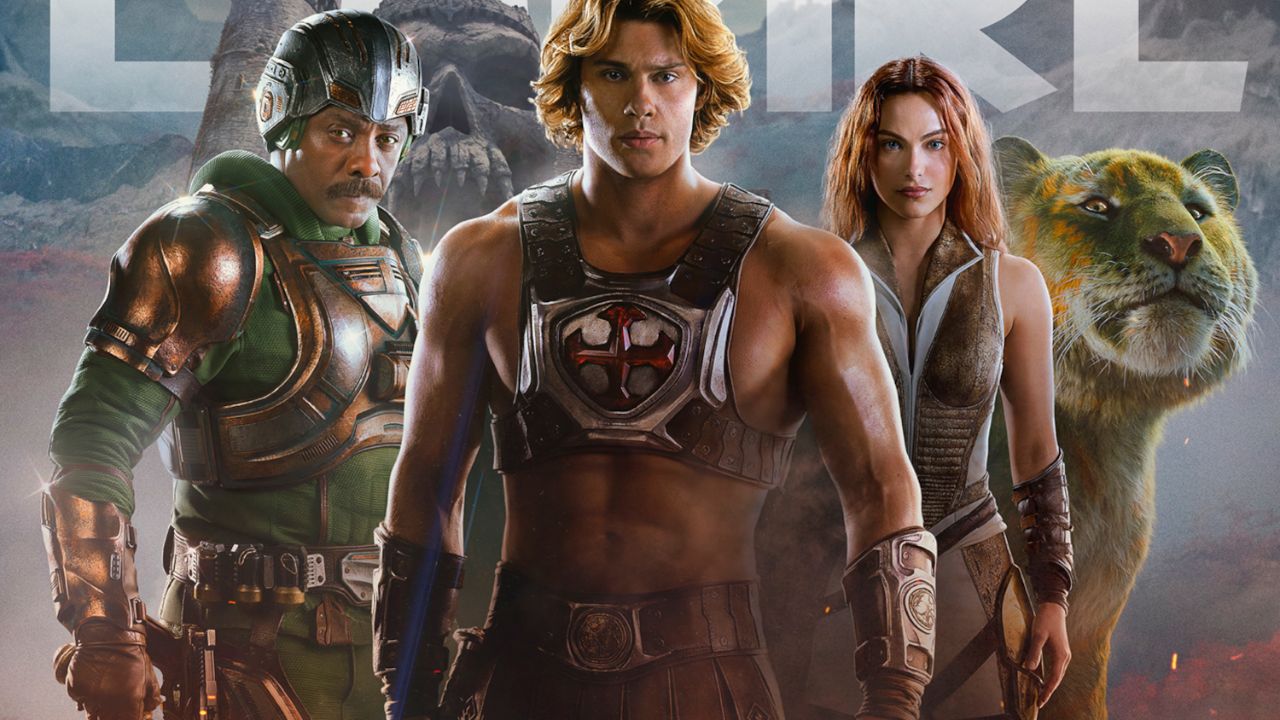
There’s something almost cosmic about the staying power of Masters of the Universe. Think about it — a franchise born from a toy line in 1983, kept alive through a Saturday morning cartoon that was barely a glorified commercial, and yet here we are, decades later, still arguing on the internet about whether Skeletor deserved better writing and what exactly Castle Grayskull is supposed to be on the inside. That kind of cultural staying power doesn’t happen by accident. It happens because something in those stories — something primal and weird and genuinely exciting — got lodged in people’s imaginations and never quite left.
Now, with a new live-action film in development and the franchise once again at the centre of Hollywood’s endless nostalgia mining operation, Masters of the Universe fans find themselves in a familiar but precarious position: hopeful, skeptical, and loudly opinionated. Which, honestly, is exactly how it should be.
So what do fans actually want from a new era of He-Man and friends? Let’s get into it — properly, without the usual corporate-speak or vague promises of “staying true to the source material.”
Take Eternia Seriously (But Not So Seriously You Forget the Fun)
Here’s the tightrope every Masters of the Universe adaptation has to walk: the world of Eternia is genuinely, wonderfully strange. You have a sword-wielding prince who transforms into the most powerful man in the universe. His villain is a blue-skinned sorcerer with a skull for a face who lives in a snake-shaped mountain and monologues at his henchmen daily. There’s a sorceress who turns into a falcon. There’s a character called Man-At-Arms. Another one called Buzz-Off.
The temptation — especially in the post-Transformers Michael Bay era of toy adaptations — is to either play all of this completely straight and hope grit covers up the inherent goofiness, or to wink at the camera constantly and make everything a joke. Both instincts are wrong.
The sweet spot is something closer to what Thor: Ragnarok got right, or what Guardians of the Galaxy understood intuitively: you can have genuine stakes, real emotional weight, and characters who matter and still let a tiger-riding anthropomorphic warrior crack a one-liner. Commitment to the world doesn’t mean humourlessness. It means trusting the audience to hold both things at once.
Eternia deserves to feel like a real place — one with history, geography, political tension, and consequences. But it also deserves to be a place where a character named Orko can exist without the film stopping to apologise for him.
Give Skeletor His Due
Let’s be honest: Skeletor is the draw.
He-Man is the hero, sure. He’s noble and strong and has arguably the most awkward secret identity in fiction (his disguise is a haircut and a tan). But Skeletor? Skeletor is the reason people remember this franchise. He is a masterclass in theatrical villainy — cackling, bitter, brilliant, and endlessly humiliated by his own incompetence and the incompetence of everyone around him. He’s simultaneously terrifying and deeply, deeply funny.
The original cartoon’s Skeletor, voiced with gleeful menace by Alan Oppenheimer, was a comedic genius who somehow still managed to feel dangerous. The 1987 film gave us Frank Langella’s take, which leaned hard into genuine menace and delivered one of the more underrated villain performances of that decade. And Kevin Conroy’s Revelation brought a quiet, aching tragedy to the character that reframed everything fans thought they knew about him.
What fans want is not a carbon copy of any one of these interpretations. What they want is a Skeletor who is taken seriously as a dramatic character — someone with a real history, real motivations, real pain beneath the bravado — while also being allowed to be the deliciously theatrical monster he’s always been at his best.
The best version of Skeletor is not a generic dark lord. He’s a brilliant, scorned sorcerer with a personal vendetta against a royal family and a tendency toward petty vengeance. He deserves a film that understands what makes him fascinating: the contradiction between his enormous power and his almost compulsive need for approval. He rules Snake Mountain, commands dark armies, and wields ancient magic — and still can’t get a single plan to go right. That tension, played correctly, is gold.

Castle Grayskull Needs to Feel Like a Mystery Worth Solving
Castle Grayskull is one of the stranger MacGuffins in pop culture history because it’s never quite clear what it is or what it does beyond “contains immense power.” In various iterations, it’s a repository of ancient wisdom, a dimensional gateway, a prison for evil, the source of He-Man’s transformation, and the home of the Sorceress who guards all of the above. It is, essentially, narrative shorthand for “the most important place in the universe, trust us.”
That vagueness is actually an opportunity.
A new adaptation could make Castle Grayskull genuinely mysterious — a place with a history that predates the current conflict, that holds secrets even the Sorceress doesn’t fully understand, that feels dangerous to visit even when you’re on the right side. The best fantasy locations aren’t just settings; they’re characters. Think of Hogwarts, or Mordor, or the citadel in Mad Max: Fury Road. The place tells you something about the story it contains.
Grayskull, at its most interesting, should feel ancient. Not cleaned-up-ancient, not ancient-as-aesthetic — genuinely, unsettlingly old. A fortress from before the current age of the world, holding something vast and unpredictable at its core. Something that chose Adam for reasons that maybe even the Sorceress doesn’t fully grasp.
Give Grayskull lore. Give it danger. Make it feel like the kind of place where the rules of the world don’t quite apply the way they do outside. Fans will thank you.
The Sword of Power Shouldn’t Be an Afterthought
“By the Power of Grayskull—”
Those four words have lived rent-free in the heads of an entire generation. The transformation sequence — Adam raising the sword, lightning cracking, He-Man emerging with that classic battle-cut and impossibly broad shoulders — is one of the most recognisable moments in Saturday morning animation. Which makes it all the more puzzling that adaptations keep fumbling what should be the franchise’s most iconic element.
The sword matters. Not just as a plot device or a special effect, but as a symbol of what the franchise is actually about: the idea that power and responsibility come together, that transformation is earned and not just inherited, that the person you become doesn’t erase the person you were.
Adam’s journey — a prince who feels inadequate to his destiny until a cosmic power tells him otherwise, and who then has to carry that secret alone — is genuinely compelling when it’s written with care. The sword is the physical embodiment of that journey. It should feel mythic. It should feel heavy. It should feel like it means something every single time it’s raised.
Don’t Flatten the Supporting Cast
One of the great unspoken crimes of franchise adaptations is what happens to the supporting cast. In the rush to establish the hero and the villain, everyone else gets reduced to a function. Teela is “the love interest/mentor figure.” Man-At-Arms is “the wise old soldier.” Ram Man is “the one who headbutts things.” Sorceress is “the exposition deliverer.”
The Masters of the Universe roster is genuinely rich — peculiar, varied, and often deeply weird — and that weirdness deserves space to breathe. Teela, in particular, has been done dirty across multiple adaptations. She is a warrior, a leader, a woman with her own complicated relationship to Grayskull’s secrets, and she deserves a story that centres her perspective rather than treating her as a satellite around He-Man’s orbit. The Revelation series nodded at this, to significant fan controversy, but the instinct was right even if the execution divided people.
Man-At-Arms — Duncan — deserves to be more than a quartermaster with good advice. He’s a father figure, a military man with an engineer’s mind, someone caught between loyalty to the royal family and the growing suspicion that they may not be telling him everything. That’s a character with actual dramatic potential.
Even the weirder, less central characters — Stratos, Mekaneck, Faker — exist in the toy mythology for a reason. Not all of them need major screen time, but the ones who do appear should feel like they have lives outside the frame.
Acknowledge the Legacy Without Being Held Hostage by It
Every major reboot walks the same knife’s edge: honour the original enough that fans feel respected, but don’t be so enslaved to nostalgia that you can’t tell your own story.
Masters of the Universe has an advantage that some other franchises don’t: its continuity has always been loose and contradictory. The Filmation cartoon, the DC comics, the minicomics that came with the original toys, the 2002 cartoon reboot, the Revelation Netflix series, the He-Man and the Masters of the Universe CGI reboot — none of these agree with each other on major points of lore, and fans have largely made peace with that. The character designs and relationships are sacred. The specific plot points are negotiable.
This means a new adaptation has room to manoeuvre. You can reimagine where Skeletor came from, or what the relationship between magic and technology looks like on Eternia, or how Adam’s transformation actually works, without betraying anything essential. The skeleton of the mythology is sturdy. The flesh can be new.
What fans resist is not change — it’s carelessness. Change that comes from creative vision is exciting. Change that comes from executives who haven’t actually engaged with the source material is what burns cities down on social media.
Respect the Emotional Core
Strip away the fantastical trappings and Masters of the Universe is, at its heart, a story about a young man who doesn’t feel worthy of the power he’s been given, trying to be good enough — as a prince, as a defender, as a son who can never quite explain where he keeps disappearing to. It’s a story about secrets and sacrifice and the particular loneliness of a destiny you didn’t choose.
That’s worth taking seriously. Not ponderously — not the grimdark, joy-stripped version of “serious” that mistake navel-gazing for depth. But the kind of serious that lets a character’s face tell you something real, that lets a moment breathe, that trusts the audience to feel something without being beaten over the head with it.
He-Man at his best isn’t just a power fantasy. He’s a reluctant hero — someone who would rather be ordinary but keeps choosing the extraordinary anyway, not because he has to, but because he believes in what Grayskull stands for. That’s the character worth fighting for.

The Bottom Line
The fans who still care about Eternia after forty-plus years aren’t asking for perfection. They’re asking for sincerity. They want a version of this story made by people who actually understand why it mattered — who grasp the weirdness, the warmth, the thunder-and-cheese spectacle of a franchise that should have no right to still be culturally relevant and yet somehow is.
Give us a Skeletor who earns his menace. Give us a Grayskull that feels ancient and alive. Give us Adam carrying the weight of a secret that actually costs him something. Give us Teela as a protagonist in her own right. Give us Eternia as a real world — strange and beautiful and worth fighting over.
And for the love of Grayskull, give us the transformation scene. Full commitment. No irony. By the power of Grayskull.
Do it right, and this franchise can matter to a whole new generation. Do it carelessly, and it’ll be another cautionary tale about Hollywood raiding the toy chest without reading the instructions.
We know which one we’re rooting for.