There is something about Prometheus that feels uncomfortably modern. He is a god who defies authority for the sake of humanity. He steals not for himself, but for those who had nothing. He suffers endlessly for what he believes in and refuses to recant even when the pain becomes eternal. If you strip away the togas and the thunderbolts, you are left with a figure who would feel right at home in any story of rebellion, sacrifice, or moral courage told today. But long before he became a symbol of the Romantic poets or a metaphor in every second philosophy lecture, Prometheus was a Titan — an ancient, pre-Olympian deity — whose actions, according to Greek mythology, quite literally changed the world. Not metaphorically. Not symbolically. Actually changed it. Let’s explore how.
Who Was Prometheus, Really?
Before we can understand what Prometheus did, we need to understand who he was — because his identity is more layered than most people realize.
Prometheus was a Titan, born from the union of Iapetus and the Oceanid Clymene (or in some versions, Themis). He was the cousin of Zeus, belonging to the generation of gods that existed before the Olympians seized power. When the great war between the Titans and the Olympians — the Titanomachy — broke out, Prometheus did something that would define his entire character: he chose the winning side. He sided with Zeus, not out of cowardice, but because his gift of foresight (his very name means “forethought” in Greek) told him the Titans would lose.
This matters. From the very beginning, Prometheus was someone who thought ahead, who weighed consequences, who played the long game. He was not impulsive. He was not reckless. Everything he did, he did knowingly — which makes his eventual rebellion all the more striking.
The Creation of Humanity: More Than Just Clay and Breath
Ask most people about Prometheus and they’ll tell you he stole fire. But in many versions of the myth, the story begins even earlier than that — with the creation of human beings themselves.
In Ovid’s Metamorphoses and in several Greek traditions, it is Prometheus — not the Olympians — who shapes humanity from clay and earth, mixing the soil with water and forming creatures in the image of the gods. He breathes life into them, molds their bodies with his own hands, and stands back to observe what he has made.
Think about what this means. Prometheus is not just a benefactor of humanity. He is, in a very real sense, humanity’s parent. His investment in us is not charitable — it is paternal. Everything he suffers later carries this weight: he is not just a rebel who took pity on strangers. He is a father who cannot watch his children suffer when he has the power to help.
Some scholars argue this is precisely why the Greeks made Prometheus the creator rather than a distant observer. It raises the stakes of every choice he makes and makes every punishment he endures that much more profound.
The First Act of Defiance: Tricking Zeus at Mecone
Before fire, there was meat.
The first great confrontation between Prometheus and Zeus happened at a place called Mecone, where gods and mortals gathered to negotiate the terms of ritual sacrifice — specifically, which portions of a sacrificial animal would belong to the gods and which would go to humans.
Prometheus, ever the advocate for humanity, slaughtered an ox and divided it into two piles. In the first, he placed the bones — the useless, inedible parts — but wrapped them beautifully in gleaming white fat so they appeared rich and generous. In the second pile, he hid the actual meat and organs beneath the stomach lining, making it look unappetizing.
He then offered Zeus the choice.
Zeus, despite being the all-knowing king of the gods, chose the pile that looked better — and so from that day forward, mortals burned the bones and fat at altars as offerings to the gods, while keeping the nourishing meat for themselves.
This might seem like a small trick, a bit of mythological sleight of hand. But its implications are enormous. Prometheus had established a precedent: humans were not simply servants to be bled dry by divine demands. They deserved to eat. They deserved to live well. And if the gods were too proud to see that, then perhaps they needed to be outmaneuvered.
Zeus was furious. And so he did what angry, wounded authority always does — he punished the powerless instead of the powerful. He withheld fire from humanity.

The Theft of Fire: One Small Flame, One Giant Act of Defiance
Here we arrive at the act that defines Prometheus across thousands of years of storytelling.
Without fire, human beings were wretched. They shivered in the cold. They ate raw food. They had no forge, no kiln, no warmth, no light after dark. They were alive, technically — but barely thriving. Fire, to the ancient Greeks, was not just a tool. It was the symbol of civilization itself: the thing that separated humanity from the animals, the thing that made art and craft and community possible.
Zeus knew this. That’s why he took it away.
Prometheus watched his creation suffer and made a decision that would cost him everything.
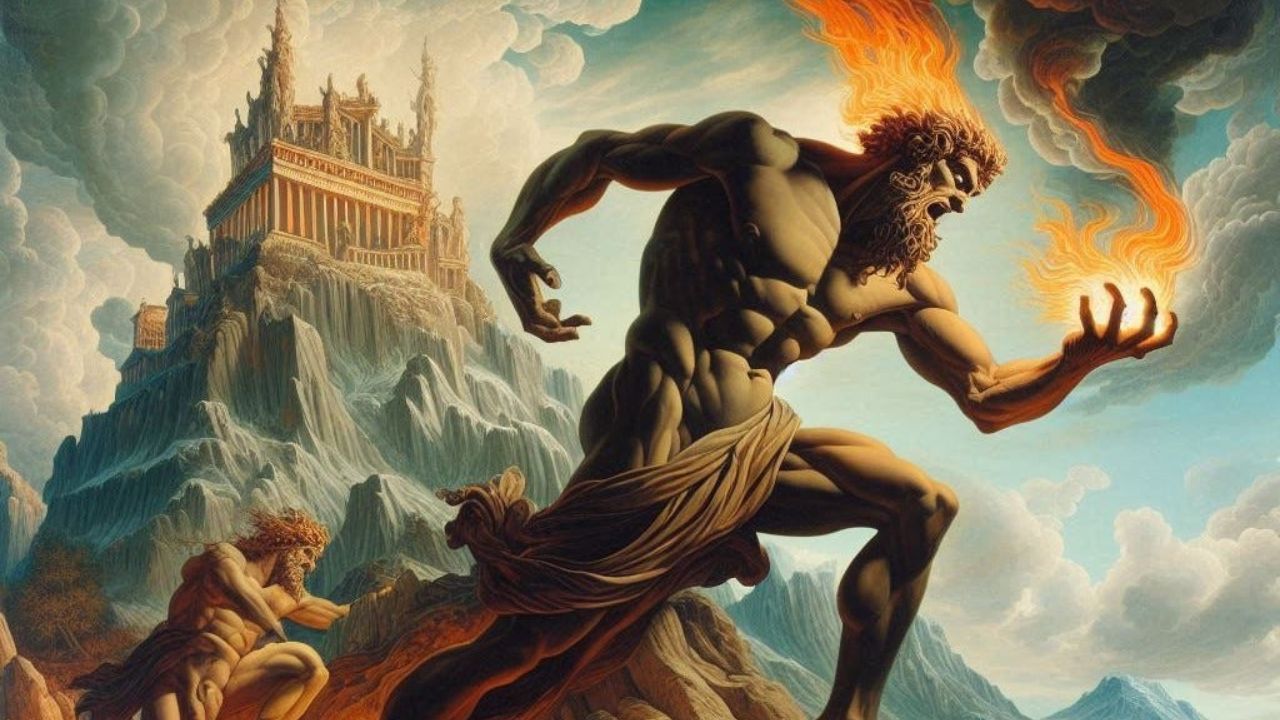
He climbed to the heights of Olympus — or, in some versions, to the fiery chariot of the sun god Helios — and he stole a spark. He hid it inside the hollow stalk of a fennel plant and carried it back down to earth, where he gave it to human beings.
The simplicity of the image is breathtaking. A god, sneaking fire in a piece of fennel. No grand army, no divine weapon, no apocalyptic confrontation. Just one Titan, one flame, and the quiet, determined conviction that humanity deserved better.
What followed that gift was nothing less than civilization as the Greeks understood it. With fire came the ability to cook food, making it safer and more digestible. With fire came metallurgy — the forging of tools, weapons, and eventually the infrastructure of cities. With fire came warmth that pushed back the darkness, both literal and metaphorical. With fire came the hearth, and around the hearth came family, community, story, and culture.
In giving humanity fire, Prometheus gave them the capacity to become something more than animals wandering in the cold. He gave them the seed of everything they would ever build.
The Wrath of Zeus: A Punishment Designed for Eternity
Zeus’s punishment was designed with a kind of cold, architectural cruelty.
Prometheus was seized and dragged to the edge of the world — to the Caucasus Mountains, in most accounts — where he was chained to a rock with unbreakable bonds forged by Hephaestus. Every day, an eagle — Zeus’s own sacred bird — would swoop down and tear open his abdomen, feasting on his liver. Every night, because Prometheus was immortal, his liver would regenerate completely. And every morning, the eagle would return.
Day after day. Year after year. Century after century.
This is not just punishment. This is a statement. Zeus was telling Prometheus — and through him, all of creation — that defiance has infinite consequences. That the gods are not to be outwitted. That the natural order, as the Olympians defined it, was non-negotiable.
What makes the punishment so philosophically rich is that Prometheus does not break. He does not recant. In Aeschylus’s Prometheus Bound — one of the greatest surviving tragedies of ancient Greece — we see Prometheus chained, bleeding, and still defiant. He knows Zeus’s secrets. He knows a prophecy about a future marriage that would bring Zeus down. And he refuses to share it. Not because he lacks the words, but because he refuses to be made small.
There is a line in the play, paraphrased across many translations, where Prometheus essentially declares: I knew what I was doing. I chose this. I would choose it again.
That is not the voice of a victim. That is the voice of someone who understands exactly what they sacrificed and considers it worth every moment of pain.
Pandora: The Other Half of Zeus’s Revenge
If chaining Prometheus to a mountain was Zeus’s punishment for the Titan himself, Pandora was Zeus’s punishment for humanity.
Hephaestus, on Zeus’s orders, fashioned a woman from clay and water — beautiful, curious, irresistible. The gods each gave her a gift: Aphrodite gave her desire, Hermes gave her cunning speech, Athena gave her skill. She was called Pandora, meaning “all-gifted,” and she was given to Prometheus’s brother, Epimetheus — whose name, fittingly, means “afterthought.”
Prometheus had warned his brother never to accept gifts from Zeus. But Epimetheus, captivated, ignored the warning and took Pandora as his wife.
She came with a jar — mistranslated in later centuries as a “box,” thanks to Erasmus — which she was told never to open. But curiosity, that most human of qualities, won out. When Pandora opened the jar, all manner of suffering escaped into the world: disease, hardship, misery, labor, and death. Humanity, which had lived in relative ease before, was now burdened with the full weight of mortal struggle.
Only one thing remained in the jar when Pandora slammed it shut: Elpis. Hope.
The Greeks left this deliberately ambiguous. Is hope a comfort, the one gift that allows humanity to endure suffering? Or is hope itself a kind of suffering — the cruelest illusion, the thing that keeps us reaching for what we may never have? Different thinkers across the centuries have answered differently, and perhaps that uncertainty is precisely the point.
What’s striking, mythologically, is that Pandora’s jar completes a kind of circle. Prometheus gave humanity fire — the capacity to thrive. Zeus, in response, gave humanity Pandora — a being who would introduce suffering. The world after Prometheus is not paradise. It is the complicated, difficult, beautiful mess of actual human existence.
The Liberation of Prometheus: Hercules and the End of Suffering
The story does not end on the mountainside.
Thousands of years into his torment — the myths are vague on exactly how long — the hero Heracles (better known by his Roman name, Hercules) arrives. He is passing through the Caucasus on one of his twelve labors, and when he sees Prometheus chained and suffering, he does what heroes do: he acts.
Heracles kills the eagle with an arrow and breaks Prometheus’s chains.
Zeus, in most versions of this story, allows it — partly because Heracles is his own son, and partly because Prometheus has finally agreed to reveal the secret prophecy he’d been guarding. (The prophecy, as it turns out, warned Zeus not to pursue the sea goddess Thetis, who was destined to bear a son greater than his father. Zeus, suitably warned, arranged Thetis’s marriage to a mortal man — Peleus — and from that union came Achilles, the greatest hero of the Trojan War.)
The liberation of Prometheus is philosophically satisfying in a way that feels almost too neat. Wisdom, in the end, is exchanged for freedom. The rebel and the ruler find a kind of truce. The eternal punishment turns out not to be eternal after all.
But there is a catch, a small and poignant detail from the myth: Prometheus was required to wear forever a ring set with a piece of the rock he had been chained to, and a wreath of willow around his head. The suffering was over, but its memory was made permanent.
Even in liberation, the mark of what he endured remained.
What Prometheus Actually Changed
It’s worth pausing here to catalogue, concretely, what the myth of Prometheus says humanity gained from his intervention — because it’s more than just fire.
- Civilization. Fire enabled metallurgy, pottery, cooking, and heating — the physical foundations of settled human life. Without it, civilization as the Greeks imagined it could not exist.
- Arts and crafts. Aeschylus’s Prometheus, in Prometheus Bound, claims credit not just for fire but for all the arts — mathematics, writing, navigation by stars, the domestication of animals, the use of medicine. He describes himself as humanity’s teacher in every meaningful sense.
- Dignity. Perhaps most importantly, Prometheus established that humans were worth fighting for. His willingness to suffer on humanity’s behalf is a cosmic statement that we are not merely playthings of the gods, that our wellbeing matters enough to justify divine sacrifice.
- The capacity for hope. Even the story of Pandora, as dark as it is, ends with hope remaining in the world. The suffering is real, but so is the antidote.
- The precedent of defiance. Prometheus demonstrated that power — even divine, absolute power — is not automatically right. That sometimes the moral course is to disobey. This idea would echo through Greek tragedy, through philosophy, through thousands of years of human storytelling.

Why Prometheus Endures
Here is the question worth sitting with: why does this myth, this specific story, refuse to leave us?
Prometheus has appeared in the works of Hesiod and Aeschylus, in the poetry of Percy Bysshe Shelley (Prometheus Unbound), in Mary Shelley’s subtitle for Frankenstein (The Modern Prometheus), in Beethoven’s ballet The Creatures of Prometheus, in Ridley Scott’s film, in countless paintings, sculptures, and novels across thirty centuries of Western culture.
He keeps coming back because he represents something we recognize in ourselves — or something we want to recognize in ourselves.
He is the part of us that looks at an unjust rule and cannot quite bring ourselves to follow it. He is the scientist who shares knowledge the powerful would rather keep secret. He is the whistleblower, the dissident, the teacher who gives students the tools to think for themselves even when the institution would prefer otherwise. He is anyone who has ever paid a personal price for doing what they believed was right.
And crucially, unlike many mythological heroes, Prometheus is not triumphant in the conventional sense. He doesn’t win. He suffers, enormously, for an almost incomprehensible length of time. The myth doesn’t promise that doing the right thing will be rewarded, or even that it will be acknowledged. It only suggests that some things are worth doing regardless.
That is an unsettling idea. It is also, possibly, the most honest thing mythology ever gave us.
A Final Thought
There is a version of the Prometheus myth in which none of this needed to happen. In which Zeus shared fire willingly, or in which Prometheus asked nicely, or in which humanity found its own way to warmth and civilization without divine intervention. Perhaps in that version, everyone would have been happier.
But the Greeks didn’t tell that version. They told the story of a god who looked at the suffering of beings he had made with his own hands and decided that he could not stand by. They told the story of someone who stole what the powerful hoarded, gave it to those who had nothing, and accepted the consequences without flinching.
They told that story because, deep down, they understood something that we are still trying to articulate today: that civilization is not something that gets handed to us. It is something that someone — always someone — pays for.
Prometheus changed the world in Greek mythology by giving humanity the tools to build one. But the more lasting gift, perhaps, is the story itself: the reminder that the people who change the world rarely do so safely, comfortably, or with the approval of those in power.
And yet they do it anyway.