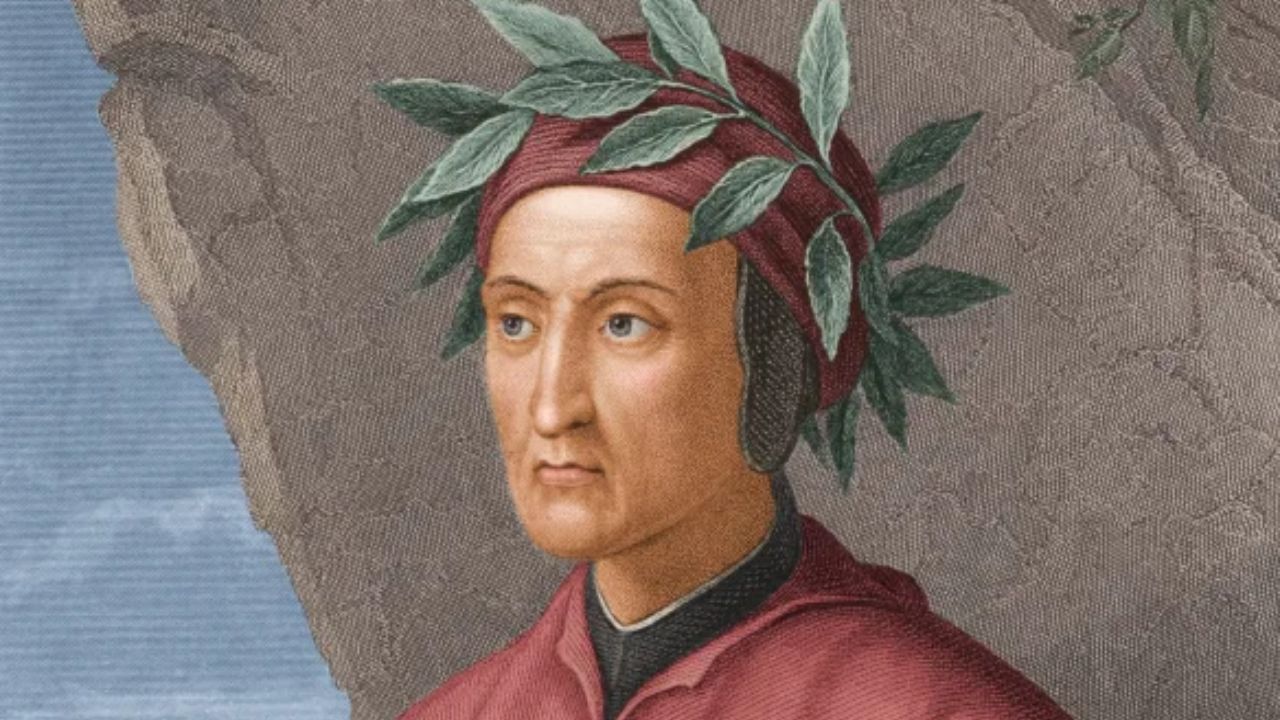
In the year 1300, a Florentine poet found himself lost in a dark wood. That simple beginning — Nel mezzo del cammin di nostra vita, “Midway through the journey of our life” — launched the most elaborate geography of the imagination the medieval world ever produced. Dante Alighieri’s Divine Comedy, composed between roughly 1308 and 1320, describes a pilgrim’s journey through three vast and precisely organized realms: Inferno, Purgatorio, and Paradiso. It is simultaneously a theological statement, a political satire, a personal elegy, and a cosmological blueprint. That last quality is what concerns us here.
Seven centuries have passed since Dante completed his poem, and yet something curious has happened: it refuses to leave us alone. Fantasy novelists borrow its architecture. Comics artists raid its imagery. Video game designers recreate its circles. Filmmakers keep returning to its fire-lit corridors. In ways both subtle and flagrant, the Divine Comedy has become one of the founding texts of modern speculative fiction — not because everyone has read it (far from it), but because its structures are so deeply embedded in Western storytelling that writers absorb them almost without knowing.
This essay traces that inheritance — from the medieval poem’s original design, through the classical fantasy tradition, into the ink-and-panel world of comics, and out the other side into contemporary fiction. It is not a comprehensive survey. It is, rather, an attempt to understand why a poem about death and divine justice still teaches the living how to build imaginary worlds.
A Blueprint Carved in Fire and Stone
Before tracing Dante’s influence, it helps to understand what exactly he invented. The Comedy was revolutionary not simply because it imagined the afterlife in vivid detail — that had been done before, in Virgil’s Aeneid, in the Aeneid‘s own Greek antecedents, in Irish immrama tales — but because it systematized the imagination with a rigour that had never been attempted.
The Inferno alone is a masterwork of architectural thinking. Hell is a cone-shaped pit beneath Jerusalem, narrowing as it descends through nine concentric circles, each devoted to a specific category of sin. The principle of organisation is brilliant and counterintuitive: the deeper you go, the worse the sin — not in terms of violence or disgust, but in terms of rational corruption. Sins of appetite (lust, gluttony, greed) occupy the upper circles; sins of malice and betrayal fill the very bottom. Fraud and treachery, Dante argues, are worse than murder, because they represent deliberate perversions of human reason.
The Nine Circles of Hell — Dante’s Original Schema
I
Limbo
The virtuous unbaptised — Homer, Virgil, Aristotle — exist in painless sadness, denied heaven through no fault of their own.
II – V
Sins of Appetite
Lust, gluttony, avarice, wrath — punishments mirror the sin in symbolic symmetry (the lustful are blown in endless wind; the wrathful fight in mud).
VI – VII
Heresy & Violence
Heretics burn in fiery tombs; the violent are submerged in rivers of boiling blood, proportionate to the harm they caused.
VIII – IX
Fraud & Treachery
The deepest and worst. Betrayers of all bonds — family, country, guests, benefactors — are frozen in a lake of ice at the very centre of creation.
This architecture — hierarchical, morally coded, spatially coherent — is what fantasy borrowed most hungrily. It offered a template for world-building that goes beyond mere invention of strange places. Dante’s Hell has a logic. Its geography expresses an ethical philosophy. And that combination — strange setting, moral order — is the structural DNA of almost all subsequent fantasy world-building.
Fantasy does not merely steal Dante’s imagery. It steals his method: the idea that an imaginary world should be the physical expression of moral truth.
— The Dantean Inheritance

The Fantasy Tradition and Its Florentine Ghost
The connection between Dante and modern fantasy is not always a straight line. It runs through the Romantics, through Victorian medievalism, through the generation of writers who created what we now call “secondary world fantasy” in the first half of the twentieth century. But the Florentine presence is detectable at each stage.
C. S. Lewis and the Theological Cosmos
C. S. Lewis was a Dante scholar before he was a fantasy novelist, and it shows. His posthumously published lectures, gathered in The Discarded Image, spend considerable time reconstructing the medieval cosmological model — the same model Dante used. The Narnia chronicles bear its imprint in obvious ways: Aslan’s Country as an analogue of Paradise; the Dark Island of the voyage of the Dawn Treader, where dreams come true (nightmares included), echoing the psychological torments of the deeper circles. But it is The Great Divorce (1945) where the debt is most explicit.
In that short masterpiece, Lewis imagines a bus journey from a grey, drizzly, quarrelsome city (clearly a version of Dante’s Ante-Hell) to the radiant outskirts of Heaven. The inhabitants of the grey city are literally insubstantial: they cannot touch the grass of Heaven without pain, cannot bear the weight of reality. Lewis takes Dante’s central insight — that damnation is ultimately a choice, a withdrawal from reality into the self — and renders it in twentieth-century psychological language. The book’s epigraph is Milton, but its structure is pure Dante.
J. R. R. Tolkien and Moral Geography
Tolkien’s connection to Dante is less direct but no less real. Both were writing within a Catholic intellectual tradition that understood the physical world as shot through with moral significance. In Tolkien’s legendarium, geography is explicitly ethical: the Undying Lands in the West are literally, cosmologically better than mortal lands; Mordor is a wasteland not because of volcanic activity alone but because evil corrupts the land itself. The Mines of Moria — dark, descending, full of increasingly ancient and terrible things — follow Dante’s logic of deepening horror.
More interestingly, Tolkien shares with Dante the conviction that linguistic precision is a moral act. Both men were philologists who believed that naming things correctly matters. Dante’s Inferno is full of precise names, precise addresses, precise measurements. Tolkien’s legendarium has the same compulsive exactitude. For both writers, the invented world is not a playground but a responsibility.
Niven and Pournelle: The Direct Adaptation
In 1976, Larry Niven and Jerry Pournelle published Inferno, one of the most audacious acts of literary appropriation in American science fiction. A science fiction writer named Allen Carpentier falls from a hotel window and wakes in Hell — specifically, Dante’s Hell, unchanged. The novel follows the structure of the original almost exactly, circle by circle, but reimagines who the sinners are: politicians, televangelists, actuaries who ran the numbers on preventable deaths. The sequel, Escape from Hell (2009), has Carpentier returning to liberate the poet Sylvia Plath.
What makes the Niven-Pournelle adaptation fascinating is its literalism. Rather than using Dante as a mood board, they actually walk through his Hell and ask: if this were real, who would be here today? It is a strategy that respects the original’s moral seriousness even while updating its cultural references.
1945
The Great Divorce
C. S. Lewis
1976
Inferno
Niven & Pournelle
1993
Dante’s Inferno
Matthew Pearl (2003)
2007
Gil’s All Fright Diner
A. Lee Martinez
Ink and Fire: The Dantean Comic
If fantasy literature absorbed Dante’s architecture slowly, over centuries, comics arrived at him in a rush. The medium — visual, sequential, capable of rendering impossible spaces with clarity — turns out to be extraordinarily well-suited to the Divine Comedy. An infernal geography that readers have to imagine in prose can be drawn, mapped, made immediately legible.
Sandman and the Dream of Hell
Neil Gaiman’s Sandman (1989–1996) is probably the most Dantean work in the history of mainstream American comics, though the connection is diffuse rather than structural. Gaiman absorbed the Comedy at a thematic level: the idea that stories are how consciousness makes meaning; that death is not an ending but a door; that the truly terrible thing is not suffering but the loss of the capacity for love. His version of Hell, explored most extensively in the arc “Season of Mists,” inverts Dante’s model fascinatingly: Lucifer simply abandons it, locking the gates and handing the key to Dream of the Endless. Hell is not a place of divine punishment but a psychological construct that loses its power the moment those inside it stop believing in their own damnation.
That revision of Dante is itself very Dantean in spirit. Dante’s Hell is, at its deepest level, a place of chosen isolation. Lucifer and his angels didn’t fall — they refused Heaven. Gaiman takes that insight and runs it to its logical conclusion.
Mike Carey’s Lucifer
Mike Carey’s Lucifer (2000–2006), a spin-off from Sandman, engages even more directly with Dante’s cosmology. The series follows the Morningstar after his retirement from Hell, as he attempts to build a new creation entirely separate from God’s. Its treatment of morality — every action rippling outward with unintended consequence; the past as a weight that shapes but does not determine the present — owes as much to Dante’s understanding of sin and consequence as it does to Milton’s Satan.
What is remarkable about Carey’s series is that it recovers Dante’s central ambivalence: the pilgrim in the Inferno is not a detached observer. He weeps for the damned. He faints from horror and pity. Moral certainty and emotional empathy are in constant, productive conflict. Carey’s Lucifer is surrounded by the same tension — a character we admire for his intelligence and autonomy while watching him cause devastation on a cosmic scale.
Gustave Doré’s Shadow on the Page
Before these modern comics artists, there was already a visual tradition of Dante that shaped them, even if indirectly. Gustave Doré’s engravings for the Divine Comedy (published between 1861 and 1868) created the dominant visual language of Hell in the Western imagination: figures in tormented poses, chiaroscuro lighting so extreme it approaches abstraction, architectural spaces that combine the grandiose with the claustrophobic. Artists from Jack Kirby to Mike Mignola to Bernie Wrightson carry Doré’s visual DNA whether they acknowledge it or not. The grotesque angels and massive infernal landscapes that fill superhero comics trace their lineage through Doré back to Dante.
Direct Adaptations
Beyond thematic influence, the Inferno has attracted numerous direct adaptations in comics form. Seymour Chwast’s graphic novel Dante’s Divine Comedy (2010) places the pilgrim in a twentieth-century suit and renders the journey in a clean, elegant line style that deliberately deflates the epic into something almost whimsical — a valid reading, given how much dark comedy Dante’s original actually contains. Hunt Emerson’s cartoon adaptations take an even broader approach, rendering the infernal suffering as slapstick without erasing the moral seriousness underneath.
More recently, Vanna Vinci’s Italian-language adaptation (2021) brought a feminist lens to the material, questioning the gendered gaze of the original while maintaining its structural magnificence. The Divine Comedy keeps producing new visual children because its architecture is sturdy enough to support radically different aesthetic approaches.
Comics is perhaps the medium most naturally suited to Dante. Where prose must describe space sequentially, the comic panel makes it immediate — you can see all nine circles at once, feel the descent in a single page turn.
— On Visual Adaptations
Mike Mignola and the Hellboy Universe
Mike Mignola has never produced a straight Dante adaptation, but his entire visual universe — Hellboy, B.P.R.D., Abe Sapien — is saturated with Dantean imagery. The recurring motifs of descent, of ancient evil mapped into specific physical locations, of moral accountability that persists beyond death — all of these emerge from the same cultural soil that produced the Comedy. Mignola’s Hell is architecturally specific in the Dantean manner: different regions, different rulers, different systems of damnation. His characters descend repeatedly into underworlds that have the quality of Dante’s Inferno: strange, precise, organised by a logic that is internally consistent even if morally alien.

Why the Dark Wood Never Empties
Having surveyed so much Dantean territory, a question demands an answer: why? Why has this single poem, written in a fourteenth-century dialect of Italian, by a man who was politically irrelevant within his own lifetime, become so central to modern imaginative literature?
Part of the answer is historical accident. Dante wrote at a moment when the Christian theological tradition was achieving its greatest intellectual synthesis — Aquinas, Bonaventure, Albertus Magnus — and he incorporated that synthesis into verse of extraordinary beauty. The Comedy preserved a whole system of moral philosophy in memorable form long after the philosophical schools had moved on.
But there is something deeper. The Divine Comedy takes the question of how to live seriously in a way that modern secular literature often cannot quite manage. Dante genuinely believes that choices matter — that they have consequences that extend beyond the individual life, beyond death, into the permanent structure of reality. Whether or not one shares his theology, that belief in consequence gives the poem an urgency that resonates across centuries.
Fantasy and comics, at their best, share this urgency. The genre — maligned as escapism — is actually, when it works, doing exactly what Dante did: using an imagined world to make the moral questions of the real world more visible. The stakes in fantasy are literally cosmic. When Frodo fails, the world ends. When the Dream King abdicates, reality destabilizes. The genre’s apparent distance from the mundane is not evasion but emphasis. It says: these questions — about good and evil, about love and betrayal, about what survives death — are so important that we need a bigger canvas to paint them on.
Dante built that canvas first. He built it so well that seven centuries of imaginations have not exhausted it.
Still Lost, Still Descending
There is a moment near the beginning of the Inferno when the pilgrim, staring at the gates of Hell, reads the famous inscription: Lasciate ogne speranza, voi ch’intrate — Abandon all hope, ye who enter here. His guide Virgil’s response is startling: he tells the pilgrim not to be afraid, but to gather his courage, because this is the place where he must put aside all cowardice.
The same instruction might be issued to the fantasy writer, the comics artist, the any storyteller who wishes to go where Dante went: into the depths of what human beings do to themselves and each other, into the question of whether moral order is real or illusory, into the very centre of darkness to see what is frozen there. It requires courage, because the truth down there is uncomfortable. But the alternative — staying in the forest, not beginning the descent — means remaining lost.
Dante’s influence on modern fantasy and comics is not, finally, a matter of borrowed imagery or borrowed monsters, though there is plenty of that. It is a matter of borrowed courage. The willingness to take the imaginary world as seriously as the real one. The conviction that where a character stands — literally, spatially — says something true about who they are. The understanding that the way down is also the way through, and that the stars are visible only from the very bottom of the abyss.
Seven centuries after a Florentine exile began his impossible poem in a dark wood, we are still finding our way through it. And we are still grateful that he left the map.