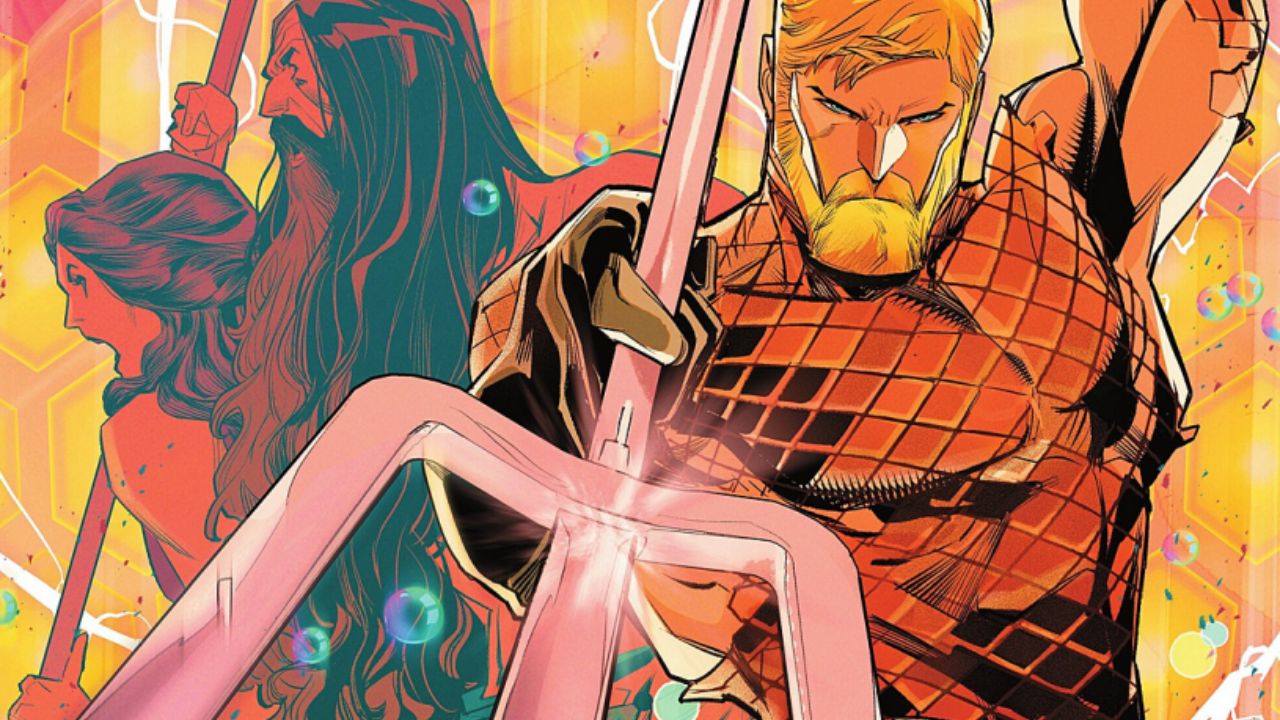
Marvel’s newest Doctor Doom series doesn’t waste a single panel. DoomQuest #1 arrives like a gauntlet thrown at the feet of every other comic on the rack — ambitious, operatic, wickedly funny, and packed with enough plot for three issues. Written by Ryan North (the mastermind behind the beloved Squirrel Girl and Fantastic Four runs) with jaw-dropping art by Francesco Mobili, this debut issue takes Victor Von Doom from the golden streets of Latveria to the icy North Atlantic in one breathless, time-bending ride. Here is every beat, every scheme, and every Richards!!! — explained in full.
The Greatest Man to Ever Live (Just Ask Him)
The issue opens not with action, but with adoration. We see Doctor Doom standing atop a golden, ornate chariot, arms raised wide as the crowds of Latveria cheer wildly around him. The caption box tells us exactly what the people believe — that “Doctor Victor Von Doom is the greatest man to ever live.”

It’s a masterfully ironic opening. Ryan North immediately plants the reader inside the propaganda machine of Doom’s Latveria. Through a gorgeous collage of panels on the following pages, we get a kind of visual biography of how Doom is mythologized by his own people: his humble origins in Latveria, his “fabled first experiments in America,” his rise to king, his battles against enemies who are framed as petty villains driven only by jealousy. In this version of history — Doom’s version — every act of violence is righteous, every opponent is a lesser man, and Latveria has been transformed from a forgotten backwater into a utopia entirely through his will and genius.
The final line of this propaganda montage says it all: “Our country — our planet — owes a debt to this intrepid soul.”
It’s brilliant storytelling. North lets the reader feel the cult of personality before a single word of criticism lands.
Doom Ponders His Legacy — And Finds It Lacking
We cut to Doom himself, sitting alone in a stone window alcove of his castle, gazing out over the city. His minister, Hanák, approaches nervously and delivers the actual national report — one that contradicts the propaganda entirely. Despite all the pomp and ceremony, Latveria “continues to find herself challenged.” Too small, too poor, and — outside of Doom himself — too inconsequential on the world stage.

Doom snatches the report from Hanák’s hands with a resounding SNATCH! and reads it with evident displeasure. His country, by objective international measure, is underdeveloped and overlooked.
Hanák tries to help, suggesting a grand statue — “more immense than any, to awe and inspire all who—” Doom shuts him down instantly. “Silence. Latveria does not want for statuary.” What Latveria wants, Doom says, is something grander. More ambitious.
He can see its shape, he tells Hanák, but not yet its details. Frustrated, he dismisses the minister. “Begone, Hanák. I must ponder.”
And so Doom ponders.
Richards Gives Doom His Answer
The answer comes, of all places, from Reed Richards.
A security alert fires off in Castle Doom — “Code Blue detected.” The origin? Amsterdam, the Netherlands. The source? A televised summit called the “Minds of Tomorrow” conference, where — impossibly, insultingly — Reed Richards of the Fantastic Four has been invited to give the keynote address.

Doom watches the broadcast in barely contained fury. Richards lays out a sweeping philosophical vision to the assembled crowd: that the universe is finite, that humanity has wasted trillions of lives on “avoidable, meaningless conflict,” and that there is an ethical imperative to do something about it. He calls it “the ultimate optimization of history” — inspired by the Cosmist movements of the 19th century.
The idea is this: time, Richards explains, has a preferred form — a shape it tries to return to, which is why so many alternate universes end up eerily similar. To permanently change history, you would need a new kind of time machine — one that doesn’t send a body back, but a mind. This mind would chamber each change it made to the past, and once all changes were ready, release them all simultaneously, so that time’s corrective nature couldn’t undo any single one. He calls it “humanity’s retirement project.”
The audience erupts in applause. Richards basks in it.
Doom nearly destroys a monitor.
“The unmitigated hubris of that man! Richards proposes to rewrite all of history to his desire — and those fools applaud him!”
Then he stops himself. Because — of course — the idea is brilliant. The only problem is who thought of it.
“None but Doom could truly be capable of wielding such power.”
He calls Hanák back. Doom has found his nation-building project.
Building the Doom Engine
What follows is one of the comic’s most visually spectacular sequences — a double-page spread showing the secret construction of something Doom’s people quietly call the Doom Engine.
The project dwarfs the pyramids in both ambition and secrecy. Every resource Latveria possesses — human, mineral, computational, and technological — is poured into it. Workers toil under Doom’s personal supervision, and each of them sees only the tiniest glimpse of what is actually being assembled. Doom himself is shown welding and forging components with his own armored hands, surrounded by glowing machinery. The Engine is built at speeds not seen in generations, using innovations that the outside world won’t develop for decades.

“Nobody outside their nation even knows it exists.”
The result? A colossal, stacked disc-shaped structure hidden deep in the forests of Latveria — the Doom Engine, fully operational. It spins up for the first time, functioning precisely as Reed Richards described in that long-ago broadcast. By maddening coincidence, it matches his parameters exactly.
Doom announces the machine’s true purpose to Hanák as they stand in the Engine’s control chamber. It is a time machine unlike any before it — one that will send Doom’s mind into the body of anyone in history, giving him total control over their actions and choices. With it, he can correct every injustice done to Latveria, starting with the Paris Peace Conference of 1919, where Latverian land was stripped away by foreign diplomats “who cared not for her people, nor her culture — nor her dignity.”
Hanák, to his credit, wisely asks no further questions about the machine’s purpose. “I need know only what you tell me I need know.”
“Good, Hanák. Good.”
The Avengers and the X-Men Crash the Party
Reed Richards, of course, has been watching.
It turns out he’s suspected Doom of building something sinister for over a year. A massive, mysterious power drain — bad enough to cause blackouts across most of Europe — confirms it. Reed tells his teammates: there is only one use for that much energy. He believes Doom has built the machine he only dared speculate about. Their best hope is to stop him before he uses it.
And so the heroes come — and they come hard.
Captain America, Iron Man, She-Hulk, Spider-Man, Wolverine, the Human Torch, the Invisible Woman, Thor, the Thing, Storm, Cyclops, Doctor Strange, Black Panther, Quicksilver, and more — an enormous combined Avengers and X-Men assault force descends on Latveria in full force.
Doom deploys every Doombot he has — all of them. Every. Single. One. And unlike their usual appearances, these Doombots fight like their lives depend on it, which, as Captain America grimly notes, is not normal. Cap and Iron Man serve as decoys, drawing the bots’ fire and absorbing brutal punishment so the other team — led by Reed — can reach the Engine.
The battle is enormous. A full page spread shows dozens of heroes tangling with hundreds of Doombots in chaotic, gorgeous carnage.

Inside the Engine facility, the Invisible Woman and the Human Torch break through to confront Doom directly. Sue Storm (the Invisible Woman) catches Doom with a force-field blow — SMAK! — and delivers one of the issue’s best lines: “You have to expect a little insolence from us by now.”
Doom is enraged. “The insolence…!”
But Sue presses him: “You’re not as complicated as you think you are, Victor. In fact, you’re really rather simple… You’re trying to rewrite history.”
Doom fights back with everything he has, launching magical energy blasts — KRAZAAAAAKK! — but Sue and Johnny hold their own. It’s a delicious sequence: two founding members of the Fantastic Four trading blows with their greatest nemesis in the heart of his greatest creation.
But Doom breaks free. He reaches the machine’s controls.
Richards Arrives Too Late — Or Does He?
Reed Richards himself makes it into the chamber, stretching his elastic form through the chaos outside. He pleads with Victor to stop.
“Please, Victor, listen! You can’t alter history to your image! That idea was for the future, when we’d evolved past these petty—”
“Petty?!” Doom’s reaction is volcanic. “Petty?!”
The argument crystallizes everything about their relationship. Reed conceived the idea of the perfect time machine as a gift to a peaceful future — something to be used when humanity had grown beyond war and pettiness. Doom has simply decided he is the one who gets to make that call now, for everyone, without their consent.
Doom fires up the Engine. The machine roars. A blinding golden vortex tears open inside the chamber.
“You cannot stop me, Richards. You never could. And now — you never will.”
Reed, caught in the moment, knows he can’t stop Doom from making the jump. But he did something clever earlier — something before the battle. He whispers to the fallen Doom: “I’m sorry, Victor, but a Doom unchained throughout history is simply too dangerous. I couldn’t stop you here, true: You left me no time. But I could, nevertheless… stop you there.”
The machine fires. Doom’s mind is launched into history.
“It Worked.” — And Then, the Horror
The issue’s final pages deliver one of the most satisfying and funny gut-punches in recent Marvel memory.
Doom finds himself in a body. He’s at a breakfast table. A cup of tea sits before him. In the rippling surface of the liquid, he can see the reflection of the face he now occupies — a man with a moustache, wearing early 20th-century clothing. “It worked,” Doom says.
But this is not the Paris Peace Conference of 1919. The room around him is wrong. There are portholes in the walls. The crockery has a distinctive logo on it — a white star on a pennant flag. The White Star Line.
Doom looks down. He kicks over his tea in horror.
“No. No.”

APRIL 14TH, 1912.
The final splash page — mirroring the very image the reader first sees — shows the RMS Titanic sailing through a star-filled night on the North Atlantic, a speech bubble rising from somewhere deep within the ship:
“Richards!!!”
And at the very bottom, a red teaser banner: Next: The RMS Titanic!
Reed Richards, unable to stop Doom from activating the machine, had just enough time to redirect where Doom ended up. Instead of the halls of the Paris Peace Conference, Doom has been sent to the most famously doomed ship in history — the night before it strikes the iceberg.
Without his armor. Without his technology. Without his robots. Stranded in the body of some random passenger on the Titanic, hours before it sinks into the ocean.
Doom — the man who once held the power of God-like beings in his gauntlet — is about to have to survive steerage.