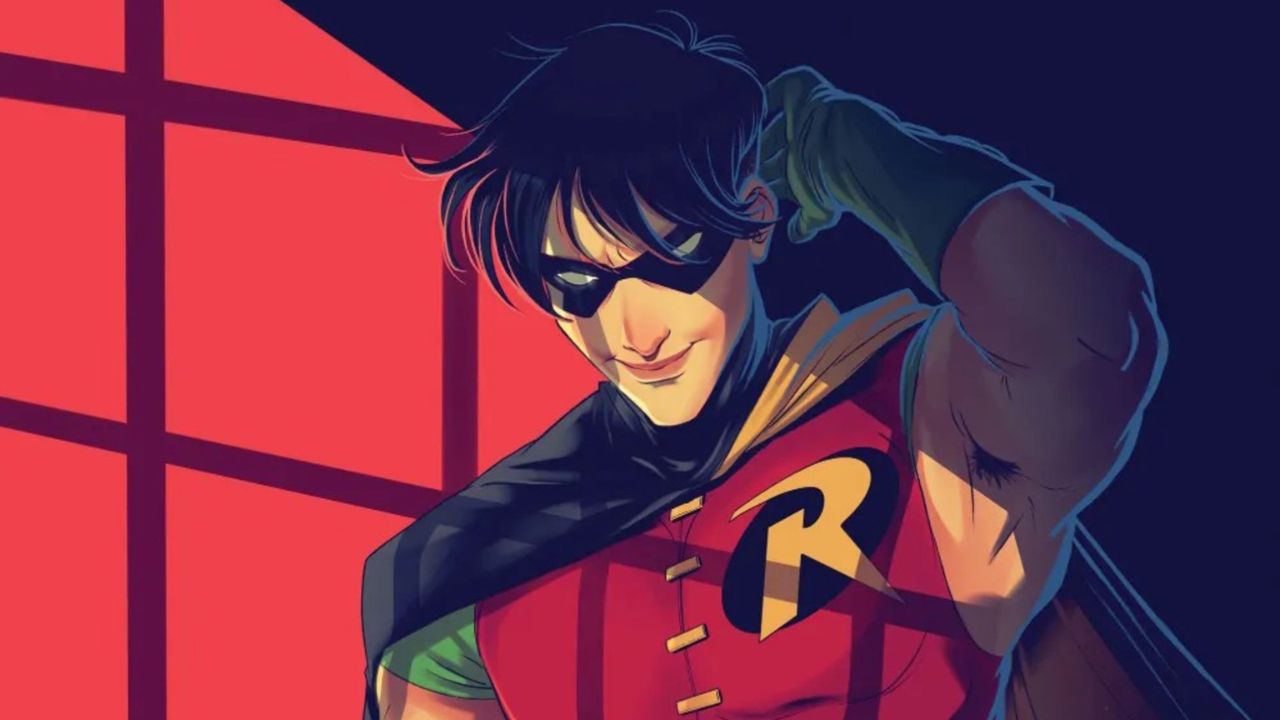
There have been five Robins in the main DC continuity. Each one has a devoted following, passionate defenders, and their own compelling slice of the Batman mythology. Dick Grayson, the original. Jason Todd, the firebrand. Stephanie Brown, the scrapper. Damian Wayne, the heir. And then there’s Tim Drake — the boy who, by almost every metric, wasn’t supposed to be Robin at all.
He had no personal tragedy directly connected to Batman. No parents killed in a warehouse, no desperate street life. He was a regular kid from a comfortable home who, through sheer intellectual curiosity, figured out one of the most guarded secrets in the DC universe — and then decided that what he did with that knowledge was go save Batman’s life.
That is, in essence, why Tim Drake resonates so deeply with so many fans. He chose this. Completely, freely, and with full awareness of what it would cost him.
The Detective Who Found the Detective
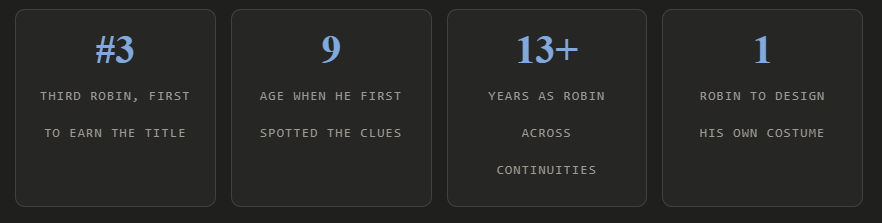
What makes Tim’s origin story so extraordinary is that it begins not with a death, but with a deduction. As a young child attending Haley’s Circus, Tim witnesses Dick Grayson perform a signature acrobatic maneuver — the same move he would later see Batman execute on the news. That observation, filed away in a nine-year-old’s memory, becomes the seed of something remarkable.
Years later, Tim does what very few people in the DC universe have ever managed: he sits down, works through the evidence methodically, and figures out that Bruce Wayne is Batman. Not because he was told. Not because he was in the room when the cowl came off. Because he reasoned his way there. And then, just as impressively, he figures out that Dick Grayson was the first Robin.
Tim Drake didn't stumble into the Bat-family. He knocked on the door, presented his credentials, and made a case for why Batman needed someone in that role. And he was right.
This matters more than it might seem. Every other Robin was, in some sense, reactive — responding to their circumstances, found by Batman in a moment of grief or need. Tim is proactive. He arrives at Batman’s metaphorical door during the period after Jason Todd’s death, when Bruce Wayne has become dangerously reckless, practically suicidal in his approach to crime-fighting. Tim doesn’t just want to be Robin. He argues, persuasively and accurately, that Batman needs a Robin to stay grounded, to stay human.
That is not the logic of a thrill-seeker or a traumatized kid trying to process pain. That’s someone who genuinely understands Bruce Wayne better, in some ways, than Bruce understands himself.
The Four Robins: A Honest Comparison

This isn’t to diminish the others. Dick Grayson is, arguably, the greatest hero the Batman mythos has ever produced — a man who became something more than his mentor without ever losing his warmth. Jason Todd’s story is one of the most emotionally complex in comics. Damian Wayne’s arc from cold-blooded assassin’s heir to genuine hero is deeply moving when written well.
But Tim occupies a unique space among them. He is, in the truest sense, the most complete Robin — the one who most fully embodies what the role was always supposed to represent.

Not Broken. Just Brave.
There is something almost radical about Tim Drake’s origin when you place it next to the others. The traditional Robin formula involves tragedy as a prerequisite. Bruce takes in broken children and, in trying to protect them, sometimes perpetuates the cycle of trauma. It’s a critique the comics themselves have wrestled with for decades.
Tim is the exception. He comes from a loving, intact family. His parents are alive when he first approaches Batman. He is not channeling grief. He is not trying to fill a void. He makes a rational, values-driven decision that being Robin — protecting people, solving crimes, standing for something — is what he wants to do with his life.
Tim Drake didn't become Robin because the world broke him. He became Robin because he looked at the world and decided it needed fixing.
And then — because the universe is not kind, and because the comics are committed to putting their characters through the wringer — he does experience tremendous loss. His mother is killed. His father is murdered. His best friend, Conner Kent, dies in his arms during Infinite Crisis. Tim carries grief eventually. But crucially, it didn’t create him. He was already whole before the tragedy arrived. That distinction matters. It means his heroism is rooted in something cleaner than pain.
The Mind That Rivals the Bat
Bruce Wayne is frequently described, in-universe, as the world’s greatest detective. Tim Drake is the only Robin who gets to share that distinction. Multiple writers, across multiple storylines, have had Batman himself acknowledge that Tim is the most naturally gifted detective he has ever encountered — perhaps even more than himself.
That is not a small thing in a universe populated by superhumans, demigods, and alien conquerors. Tim’s most powerful superpower is his mind. He plans. He anticipates. He considers twelve angles before he acts. His approach to crimefighting is methodical, strategic, and marked by a precision that sometimes makes Bruce look impulsive by comparison.
This translated brilliantly into his solo title, Robin, which ran for nearly fifteen years and is still cited as one of the most consistently excellent Batman-family books ever published. Tim’s stories had a different texture than Bruce’s — younger, wittier, more socially embedded. He had friends. He went to school. He maintained real human relationships even while juggling the demands of the cape. That balance, never perfectly achieved but always earnestly attempted, made him extraordinarily relatable.
The Friendships That Made Him Human
Ask any Tim Drake fan what they love most, and a significant number will bring up Young Justice. The original animated series, yes, but more specifically the comic book lineup that preceded it: Tim, Conner Kent (Superboy), and Bart Allen (Impulse), three teenage heroes trying to save the world while also being genuinely, authentically fifteen years old.
Tim’s friendship with Conner Kent in particular is one of the great relationships in DC’s history. Two boys who came to heroism through completely different paths, who should have had nothing in common, who became brothers in every sense but biology. When Conner died during Infinite Crisis, Tim’s grief was so consuming that he spent months attempting — in deeply uncharacteristic, Batman-esque obsessive fashion — to clone his friend back to life. The readers who loved both characters understood exactly why. It didn’t feel like a villain’s plot. It felt like love that didn’t know where else to go.
Tim's friendship with Superboy showed us something rare in superhero comics: that vulnerability and genuine care between heroes can be just as compelling as any battle.
These friendships humanized Tim in ways that made him feel like the most real person in a universe full of mythological figures. He wasn’t just Batman’s sidekick. He was somebody’s best friend. Somebody’s teammate. Somebody’s son. The layers accumulated across his publication history into a character of surprising emotional depth.
The Robin Who Earns Every Inch
Tim Drake had to fight for the mantle in ways his predecessors did not. Dick was essentially adopted into it. Jason was recruited impulsively. Tim had to make his case. And even after Batman agreed, Tim was required to train — properly, extensively — before being allowed in the field. He earned the costume through months of rigorous preparation. He was never simply given it.
That process produced something valuable: a Robin who understood, on a bone-deep level, that the role was a responsibility rather than a reward. He wore the red and green not as a prize or a birthright but as an ongoing commitment. Even when he was offered the chance to stop — when Bruce, wracked with guilt after Tim’s father died, essentially tried to fire him — Tim refused. He argued, again, persuasively, that being Robin was not something he did for Bruce. It was something he did because it mattered.
There is a version of Tim Drake that exists in the minds of longtime fans as the definitive Robin — not despite his lack of tragedy at the start, but because of it. He represents the possibility that heroism can be a genuine vocation. That you can choose the difficult, dangerous, meaningful thing not because you’re broken and don’t know what else to do, but because you looked clearly at the world and decided this is how you want to live in it.
A Legacy Bigger Than the Mask
Tim eventually hung up the Robin mantle — first becoming Red Robin, then Drake, navigating the complicated politics of the Bat-family’s shifting roster with his characteristic thoughtfulness. His evolution beyond Robin has been uneven across different creative teams, but the foundation laid during his years as the third Robin remained solid through it all.
The animated Young Justice series brought Tim to a new generation, capturing his intelligence and his heart even while adjusting certain details of his history. New readers who discovered him there often went back to the source material and found a character even richer than the show suggested.
His coming-out as bisexual in recent years — explored in the Tim Drake: Robin solo series — added yet another dimension to a character who has always been, at his core, about knowing yourself clearly enough to make intentional choices. That self-knowledge, that capacity for reflection, runs like a thread through everything Tim Drake has ever been.

Why He Stays With You
Characters stick with us when they reflect something true about how we want to move through the world. Dick Grayson shows us the possibility of grace. Jason Todd shows us that anger is understandable, even if it’s destructive. Damian Wayne shows us that inherited cruelty is not destiny.
Tim Drake shows us something quieter and, for a lot of readers, more personally resonant: that the choice to do good, made freely and consciously and repeatedly, even when it costs you, is itself a kind of superpower. He is not the most powerful Robin. He is not the most tragic. He is not the flashiest or the most mythologically significant.
He is simply, consistently, genuinely good. And he chose it — every single day, with full knowledge of what it would ask of him.
That is why, for many fans, when you ask which Robin is the best, the answer comes easily and completely: Tim Drake. The one who picked up the mantle because the world needed someone to, and decided that someone might as well be him.
The Third Robin. The First Choice.
Tim Drake didn’t inherit the legacy of Robin — he defined what it could be when someone with a clear mind and a full heart decides to carry it.