Let’s be honest about something. At some point, probably on a lazy Sunday or after watching a documentary that lit a small fire in you, you made a reading list. You typed or scribbled down titles with the quiet confidence of someone who was absolutely, definitely going to read all of them.
And then life happened. The pile grew. The titles you’d forgotten started to outnumber the ones you remembered adding. One day you looked at the list and felt something closer to guilt than excitement.
Sound familiar? You’re not alone — and more importantly, it’s not a character flaw. It’s a design problem. Most reading lists are built like wish lists, not like systems. This post is about fixing that.
“A reading list without a strategy is just a library you’ll never visit.”
Why Reading Lists Fail (And It’s Not What You Think)
The usual suspects get blamed here — busyness, short attention spans, social media. And sure, those are real. But the deeper reason reading lists die is simpler: they’re built for acquisition, not completion.
We add books the way we add things to a cart we’ll never check out. The act of adding feels like progress. We’ve done something about that interesting recommendation. We’ve filed the feeling. And then, satisfied, we move on — and never come back.
The second big culprit is ambition mismatch. Your list might contain everything from War and Peace to a 60-page essay collection, all lined up as if they’re equivalent tasks. They aren’t. When the next item on your list looks like climbing a mountain, you start checking your phone instead.
The core insight
A good reading list isn't a record of what you want to read someday. It's a curated, honest map of what you're actually going to read — right now, in this season of your life.
Start With a Ruthless Audit
Before you build anything new, look at what you already have. Go through your existing list — the notes app, the Goodreads shelf, the dog-eared magazine stack — and ask yourself honestly: Would I pick this up right now if it were in front of me?
Not “Would I want to have read this someday?” That’s a trap. The question is whether this book fits where you actually are — your current curiosity, your available headspace, your mood as a reader.
Be willing to let go. This is harder than it sounds. We carry a lot of moral weight around unread books, as if not finishing Capital is a failure of citizenship. It isn’t. Removing a book from your active list isn’t giving up on it forever — it’s being honest about now.
- Keep only books you could describe to someone else today — if you can’t remember why you added it, remove it or archive it.
- Separate “aspirational” reads (things you feel you should read) from “energized” reads (things that actually excite you). Your active list should be almost entirely the latter.
- If a book has been on your list for more than two years untouched, archive it. You can always bring it back — but the list needs to breathe.

The Three-Tier System That Actually Works
Here’s the shift that makes everything easier: stop keeping one big flat list. Instead, organize your reading into three distinct layers.
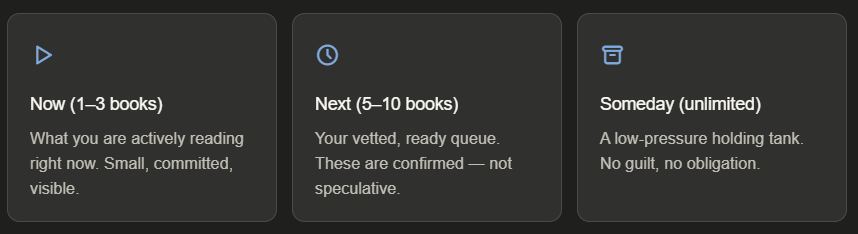
The “Now” list is where you put your full attention. One book is ideal if you’re a slow or distracted reader. Two or three works if you naturally rotate between genres — something light for evenings, something dense for mornings.
The “Next” list is your pipeline, but it’s not open-ended. Every book on it should be one you’d start tomorrow with genuine enthusiasm. This is where the magic happens: when you finish something, you don’t stare at 80 options in paralysis — you pull from a short, already-considered list.
The “Someday” list is guilt-free. It’s not a queue. It’s a garden of ideas you might revisit. The psychological relief of having this bucket is real — you no longer feel like every book you add is a commitment you might fail.
“Constraints aren’t limits on your reading life. They’re what make it possible.”
Build a Reading Rhythm, Not Just a Reading Habit
Habit advice often fixates on streaks — read every day, track your minutes, gamify the process. And for some people, that works. But for many, it turns reading into a chore that has to be checked off, and the moment life breaks the streak, the whole thing collapses.
A rhythm is different. A rhythm bends without breaking. It’s not about every day — it’s about most of the time, in ways that fit the natural texture of your week.
Think about when reading already happens easily for you. Long commutes. The gap between dinner and sleep. Saturday mornings before anyone else wakes up. Identify those pockets and design around them, rather than trying to force a reading habit into a time that fights you.
Match the book to the moment
Not every book is right for every context. A dense philosophy text isn’t the right thing to crack open when you have 12 minutes on a noisy train. But a sharp essay collection or a fast-moving novel? Perfect. Keeping books at different levels of density and intensity in your “Now” pile lets you always have the right read for the moment you’re actually in.
Practical setup
Keep your current book physically close — on your desk, on your nightstand, in your bag. The books you see are the books you read. If it's buried in an app three taps deep, it's already losing to whatever's easier to reach.
Give Yourself Permission to Quit (And to Slow Down)
Two of the biggest reading list killers are powered by the same false belief: that finishing a book you’re not enjoying is a virtue, and that reading slowly is a sign you’re not really a “reader.”
On quitting: Life is too short for books that are draining you without rewarding you. If you’ve given a book 50–80 pages and it still hasn’t given you anything — not ideas, not pleasure, not even the friction of a real challenge — put it down. Return it to the Someday pile, or let it go entirely. A finished bad book is not a trophy. It’s time you could have spent on the next good one.
On speed: Reading fast is only useful if comprehension and retention travel with you. Most people read more slowly than they think they should, feel vaguely embarrassed about it, and rush in a way that leaves nothing behind. Slow reading, lingering reading, re-reading a passage because it was beautiful — this is not failure. It is the whole point.
- Use the “50-page rule” — give every book at least 50 pages before deciding. Some books are slow starters that become essential.
- Mark the page where you stopped enjoying a book. If you don’t come back to it within two weeks, it’s a quit.
- Track what you’ve finished, not just what you’ve started. Completion is the metric that matters for your reading identity.
How to Fill Your List With the Right Books
A reading list is only as good as what’s on it. The best ones aren’t random accumulations of every recommendation you’ve ever heard — they’re intentionally curated around who you are right now and who you want to become.
One useful practice: every time you finish a book, let that book suggest the next one. Not always — sometimes you just want to change direction completely — but often a book will point you somewhere: a writer it references, a period of history it glosses over, a question it raises but doesn’t answer. Following that thread keeps reading feeling like exploration rather than homework.
Another underrated source: people who know you well. Not a bestseller list, not an algorithm, not a podcast host promoting their own recommendations — but a friend who knows your taste and says, “I think you specifically would love this.” That’s worth more than a thousand algorithmic suggestions.
Balance your list intentionally
Pay attention to the texture of your queue. If your Next list is six heavy nonfiction books in a row, you might hit a wall. Mix in a novel, a short story collection, something funny, something short. Your reading life should have its own rhythm of intensity and relief, the same way a good playlist moves through energy levels.

The Reading List as a Mirror
Here’s something worth sitting with: your reading list, over years, becomes a portrait of your intellectual life. The things you kept returning to. The questions that kept surfacing. The periods when you read nothing but history, or nothing but fiction, or went deep into one writer’s entire body of work.
Keeping a simple reading log — even just a running note with titles and months — gives you something money genuinely can’t buy: a record of your own curiosity, and the strange, beautiful way it evolved.
That log also helps practically. When someone asks what you’ve been reading lately, you’ll actually remember. When you want to revisit an idea but can’t place which book it came from, you’ll be able to trace it. When you’re feeling stuck or uninspired, you can look back at what used to light you up and use that as a map back.
The goal was never to finish every book ever written. It was to live a reading life — imperfect, personal, and genuinely yours. Build the list that serves that life, and let the rest go.