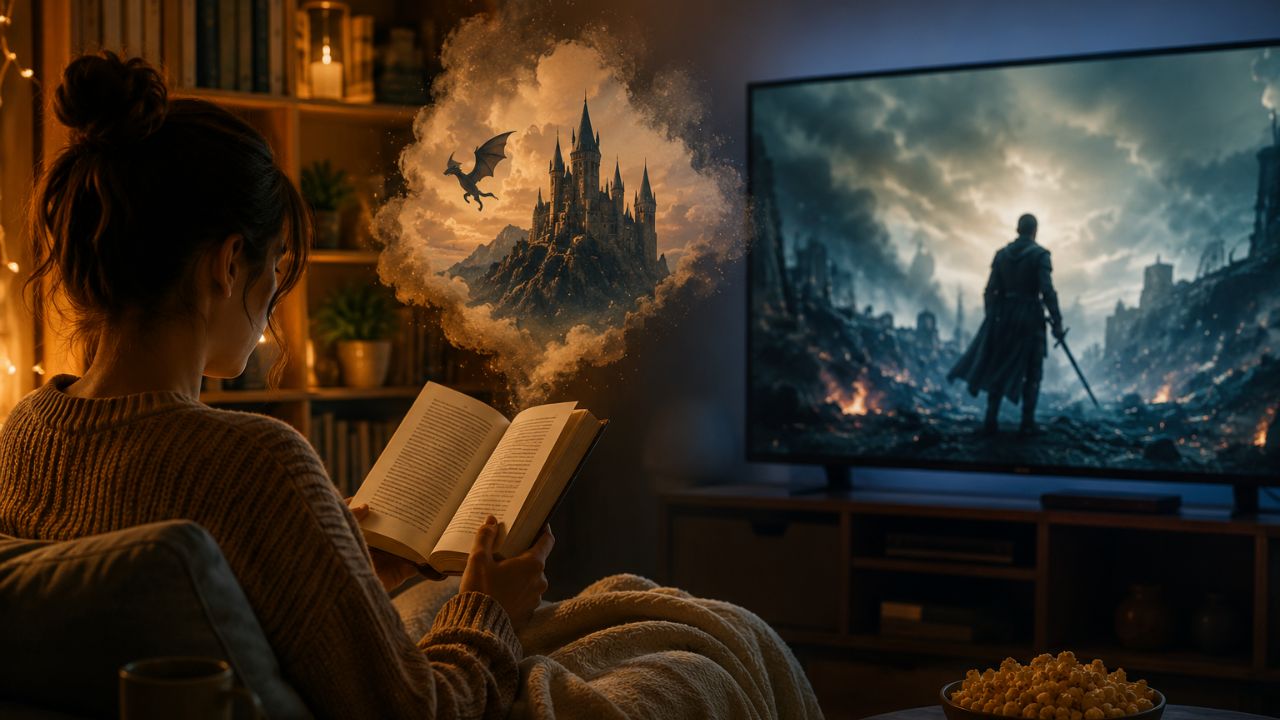
There is a question that keeps circling around dinner tables, comment sections, and the dusty back-of-the-mind of anyone who has sat down with a novel and then watched its adaptation: why bother? We live in an age of $200 million productions, streaming libraries the size of small libraries, directors who can translate the interior architecture of a novel into something you can see and feel in under three hours. Why, then, do people still crack open books?
It’s a fair question. And yet the global publishing industry moves over $100 billion worth of books a year. BookTok turns obscure literary fiction into overnight bestsellers. Libraries in countries where you’d expect print to be dead are reporting record borrowing. Something is clearly happening that has nothing to do with stubbornness or nostalgia. Something about reading — the actual practice of it, the peculiar intimacy of text on a page — is irreplaceable. Not because books are superior to movies. But because they are doing a fundamentally different thing.
The Movie in Your Head Is Always Better
When you read the word “forest,” your brain doesn’t load a generic stock image of trees. It loads your forest — that specific arrangement of light and shadow that has been accumulating in your memory your entire life. The character described as “tall, with tired eyes and a laugh that arrived too late” will look, in your mind, exactly like the person your subconscious knows this person must look like. It might be someone you loved. It might be someone you half-remember. It will never be a casting choice.
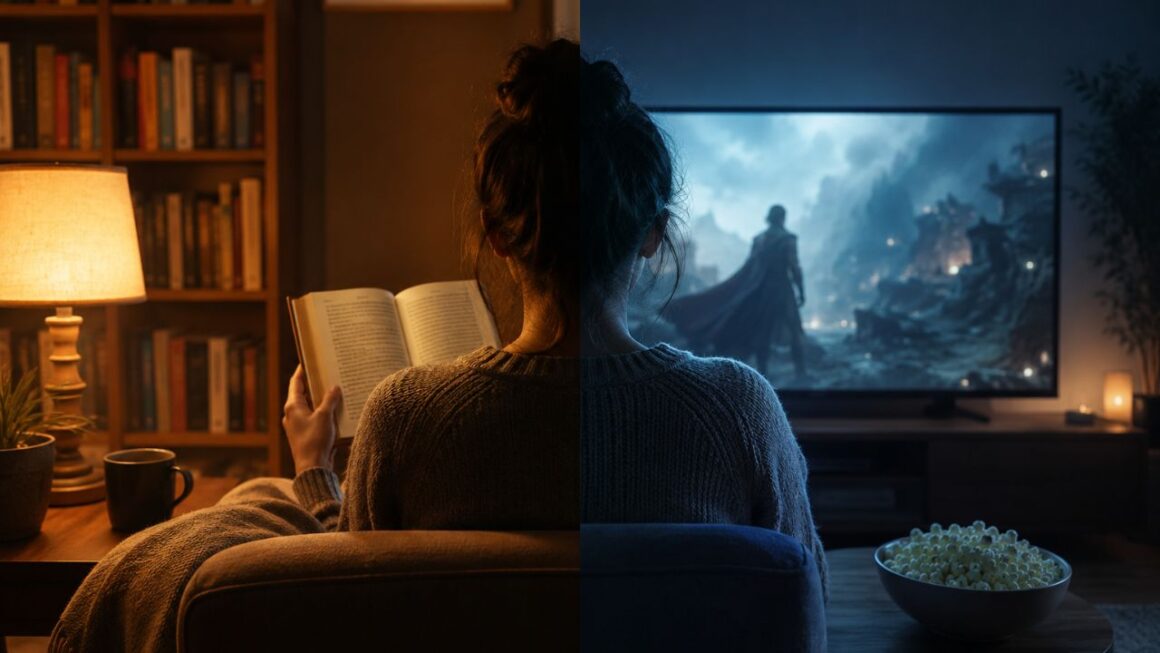
This is the quiet superpower of text. It doesn’t dictate the image. It seeds it. And because you are the one doing the rendering, the result is something deeply personal — a version of the story that belongs to you and nobody else. A film’s forest will be beautiful. But it will be some director’s beautiful. Reading hands the camera to you.
“Reading hands the camera to you. The images are always, always yours.”
Neuroscientists have a name for what happens to the brain during deep reading: transport. When readers are absorbed in a narrative, the brain activates regions associated with sensory experience and motor activity, not just language processing. You’re not just decoding symbols. You’re simulating a world. That’s not a metaphor — it’s measurable brain behaviour. Films are designed to trigger the same thing through visual and auditory stimulus, and they do it well. But reading triggers it from the inside out, which produces a different texture of experience, one that feels less received and more constructed.
🧠
Deep Transport
Research shows readers activate sensory and motor cortex regions during immersive reading — building the story from the inside, rather than receiving it from outside.
⏱️
Your Pace, Your World
You control the speed. You can linger on a sentence. Re-read a paragraph. Sit with an image before turning the page. Film runs on a fixed clock.
💬
Inner Voice
Books give you access to consciousness in a way no other medium can. A character’s unspoken thought, their self-deception, their private grammar — books are the only stage for it.
The One Thing Film Can Never Quite Steal
Here’s a challenge: adapt a character who is lying to themselves. Someone who believes one thing while doing another, who narrates their own life with a bias they are entirely unaware of. Kazuo Ishiguro built a career on this. His novel The Remains of the Day is, on the surface, the quiet story of a butler travelling across England. Beneath it, it’s the devastating portrait of a man who spent his entire life refusing to feel anything, and is only beginning to understand what he lost. The whole tragedy lives in the gap between what Stevens says and what he means. The 1993 Anthony Hopkins film is magnificent — but it must show us what the book only implies. The moment it shows us, it changes.
Interior monologue — real, unguarded, unreliable interior monologue — is the territory where literature has no competition. A film can imply a character’s private world through performance, music, framing, silence. Great filmmakers have done extraordinary things with these tools. But the interior of the mind is always, in film, a translation. In a novel, it is the original.
This matters especially when the character in question is strange, or morally complex, or broken in ways that are hard to stage without melodrama. Books can hold a character’s full contradictions simultaneously, in a way that running time and visual grammar make nearly impossible. The intimacy of first-person narration — of being inside a consciousness for three hundred pages — creates a relationship with a character that no amount of screen time can fully replicate.
A film shows you what a character does. A book shows you why they told themselves they did it — and those are two very different stories.
The Luxury of Slowness
We are not slow people. We binge, we scroll, we double-tap, we skip intros we’ve seen a hundred times. Against all of this, the decision to sit with a book for two or three or ten hours is almost an act of defiance. And maybe that’s part of it. Reading is one of the few remaining things that asks something from you — genuine attention, unhurried, uninterrupted — and then pays you back in a currency that’s harder to name than entertainment.
The French critic Roland Barthes wrote about the difference between what he called “readerly” and “writerly” texts — between stories that let you sit back and consume, and stories that make you an active participant in the construction of meaning. Books, almost by definition, require a kind of active readership that passive viewing doesn’t. You are always doing something when you read. You are always building.
There’s also the matter of time spent with a character. A novel might give you 400 pages with a single consciousness. That is not something cinema can offer, and the effect of that duration is real. Readers of Tolstoy’s Anna Karenina don’t just know Anna — they have spent time with her in a way that is genuinely different from watching a film adaptation, however brilliant. The slow accumulation of detail, the return to the same voice across weeks of reading, produces something closer to an actual acquaintance than a two-hour encounter can.
Some Things Are Made of Words, Not Images
Virginia Woolf wrote sentences that do not translate to any other form. Not because the ideas are untranslatable, but because the sentences themselves are the ideas. The rhythm, the interruption, the way a thought doubles back on itself halfway through a clause — this is not decorative. It is the meaning. To film a Woolf sentence, you’d have to replace it with something. And whatever you replaced it with would be something else.
Language has textures that images cannot carry. A sentence can be hesitant, or cold, or self-conscious about being written. A paragraph can undermine its own argument in its final clause. Prose style is not just a vehicle for story — it is a sensory experience in its own right, as physical as a melody. Writers like Cormac McCarthy, Toni Morrison, Vladimir Nabokov built worlds that are inseparable from the way they chose to arrange their syllables. You cannot photograph a sentence.
“Prose style is not just a vehicle for story — it is a sensory experience in its own right, as physical as a melody.”
This isn’t elitism. It’s a genuine difference in what the medium can do. A film can be as formally daring as any novel — the jump cuts of Godard, the long silences of Tarkovsky, the fractured timelines of Nolan. But formal daring in film works with light, sound, and duration. In literature, it works with words. These are different raw materials producing different effects, and readers know — even if they’ve never articulated it — that there are things they get from a page of good prose that they cannot get anywhere else.
Reading Is Still the Most Private Thing We Do
Watching a film, even alone, is a social experience. It was made to be watched — optimised for an audience, tested on focus groups, cut to keep the attention of a room. Reading is different. A book doesn’t know you’re there. It was written in a room, by one person, often in conditions of great solitude, for a reader who would also be alone. There is a private channel between the writer and the reader that excludes everyone else. You are not watching the story happen. You are being spoken to, directly, in your own interior voice.
This is why people reach for books during grief, illness, and upheaval. Not because fiction solves anything, but because the particular intimacy of reading — being alone with a voice that understands — is a comfort that collective entertainment cannot replicate. Films are for being taken out of yourself. Books are for going deeper in.
There’s a reason people keep certain novels the way others keep letters. Not on a shelf but somewhere more private. Because those books didn’t just tell them a story. They said something to them — something they couldn’t quite find anywhere else, at a moment when they needed it.
It Was Never a Competition
The people who kept books alive through every wave of technological anxiety — through cinema, television, the internet, streaming, TikTok — were never holding out against progress. They were holding onto something specific: the particular quality of attention that reading demands and rewards, and the particular kind of world that only language, at its most intentional, can build.
Films and books are not competitors any more than music and painting are. They are different rooms. They produce different kinds of feeling. The question “why still read when you can watch?” assumes that watching fully replaces reading, and it simply doesn’t — not because one is better, but because they are not doing the same thing. A film adaptation of a novel is a new work that responds to, interprets, and diverges from its source. Both can be brilliant. Both can fail. Neither cancels the other out.
People still read because some stories are made of words and can only be entered that way. Because the version of the world you build inside your head while reading is yours in a way no film can be. Because sitting with a book for an hour — phone in another room, the world at arm’s length — has become one of the few experiences that is genuinely irreplaceable. Not in spite of everything else that exists, but alongside it.