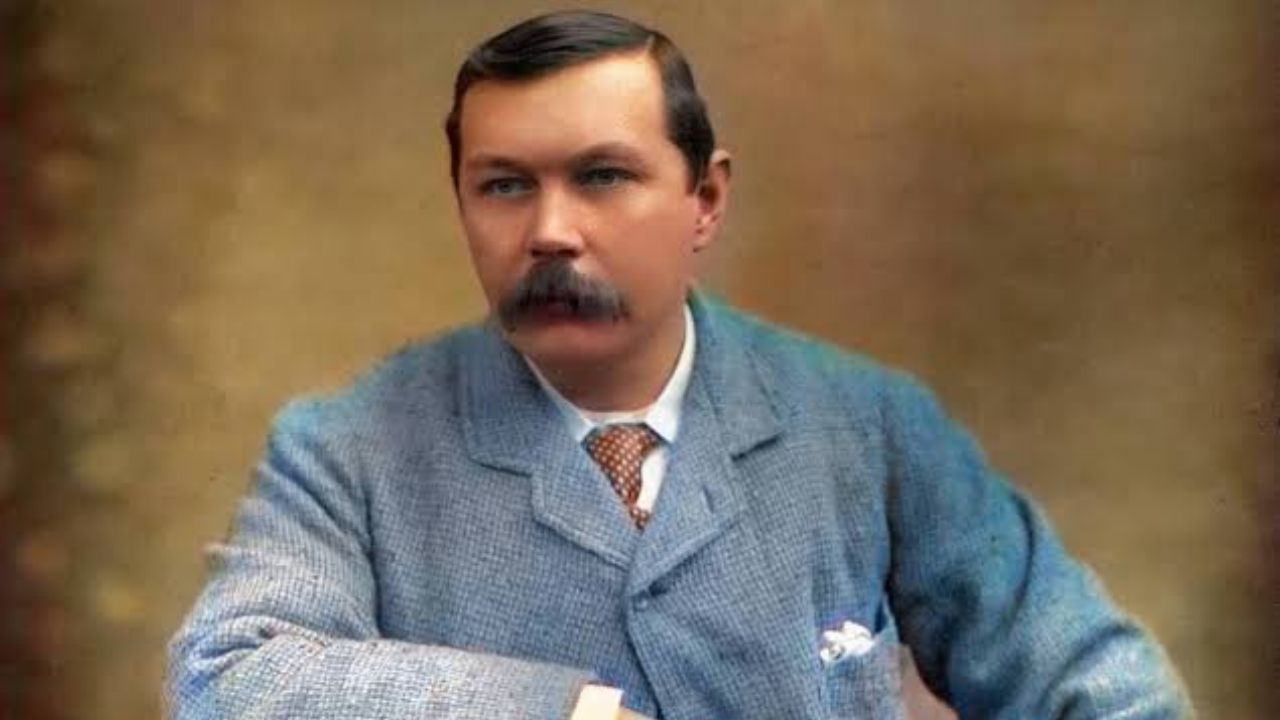
Some fictional characters become so iconic that they eclipse the people who created them. That was the fate of Arthur Conan Doyle. Long before he was celebrated as a physician, historian, spiritualist, or even a knight, he had become, in the public imagination, the father of one man alone: Sherlock Holmes. What readers adored, however, became an increasing burden for Doyle. By the early 1890s, he had grown deeply frustrated with the detective’s overwhelming popularity, believing Holmes had consumed the time and attention he wanted to devote to more meaningful literary pursuits. Determined to reclaim his career, Doyle made a startling decision in 1893. At the edge of the roaring Reichenbach Falls, he sent Sherlock Holmes to his apparent death, convinced that one final plunge would free both author and creator from an inescapable legacy.
The fact that it didn’t work — that Holmes came back, that the public wouldn’t let him stay dead, that Doyle himself eventually surrendered — makes the whole episode one of the strangest and most human stories in the history of literature. It is a story about pride and commerce, about a writer’s desperate need to be taken seriously, and about the terrifying moment a fictional character becomes bigger than the person who invented him.
A Timeline of the Conflict
- 1887
Holmes debuts in A Study in Scarlet. It is largely ignored at first. - 1891
TheStrand Magazine begins publishing Holmes stories. Circulation explodes. Doyle writes to his mother saying he wants to kill Holmes off. - 1893
“The Final Problem” is published in December. Holmes falls at the Reichenbach Falls. Readers are devastated. - 1895–1900
Doyle writes historical fiction. Holmes stays dead. The public sulks. - 1901
The Hound of the Baskervilles is published as a prequel — Holmes lives, but the “death” still stands. - 1903
Doyle resurrects Holmes in “The Adventure of the Empty House.” The explanation involves a fictional martial art. - 1927
The final Holmes story, “The Adventure of Shoscombe Old Place,” is published. Doyle is 68.
The Man Who Wanted to Be a Serious Writer
To understand Doyle’s frustration, you have to understand what he actually wanted out of his career. He was not a man who set out to write detective fiction. He trained as a doctor, practiced medicine in Southsea on the English south coast, and filled the long empty hours between patients by writing stories. He admired historical fiction — the sweeping, serious kind written by Walter Scott and Thomas Carlyle — and believed, not without reason, that this was the form of literature that endured. Mystery stories were entertainment. History was art.
Holmes arrived almost as an accident. Doyle drew the detective from two real sources: his mentor at Edinburgh Medical School, Dr. Joseph Bell, who was famous for deducing patients’ occupations and backgrounds from the smallest physical details; and Edgar Allan Poe’s detective C. Auguste Dupin, whose method of cold reasoning Doyle admired and quietly borrowed. The character that emerged from these sources — tall, mercurial, relentlessly logical, with a gift for disguise and a devastating contempt for stupidity — was something quite new. But Doyle didn’t think so. He thought Holmes was a decent popular creation. He did not think he was a masterpiece.
A Study in Scarlet, the first Holmes novel, was published in 1887 in a cheap annual and earned Doyle twenty-five pounds. It didn’t set the world on fire. Neither did the second, The Sign of Four, published in 1890. What changed everything was the Strand Magazine — a middlebrow Victorian monthly aimed at the newly literate, educated middle classes — and the format of the short story. From July 1891 onwards, Holmes appeared there in monthly instalments, and the magazine’s circulation leapt with each new story. Newsstands in London would queue out the door. When an issue with a Holmes story arrived, people read it on the street.
I am weary of his name. To my eyes, Holmes is becoming one of those characters who runs away with his author.
— Arthur Conan Doyle, in a letter to his mother, 1891
Doyle found this alarming rather than gratifying. He was writing these stories fast — sometimes one in a week — and he could feel the quality of his other work suffering. Worse, he could feel his reputation narrowing. People who met him wanted to talk about Holmes. Literary editors wanted Holmes. His publisher wanted Holmes. The Strand wanted Holmes. Every conversation, every commission, every letter from a reader steered him back to Baker Street, when what he desperately wanted to do was write The White Company, his big medieval adventure novel, and be taken seriously as an historical chronicler. He felt, with some justification, that the whole world was colluding to keep him small.
The Decision at the Falls
By the autumn of 1893, Doyle had made up his mind. Holmes would die. Not retire, not emigrate, not take a long sabbatical in Tibet — die, definitively, in a way that made resurrection impossible. He needed an antagonist equal to the task, someone so formidable that readers would accept Holmes’s death as not just plausible but inevitable. He invented Professor James Moriarty.
Moriarty is, in many ways, Holmes turned inside out. Where Holmes uses his extraordinary intellect to maintain order, Moriarty bends it toward chaos. He is, Holmes explains to Watson in ominous tones, the Napoleon of Crime — a spider at the centre of a web so intricate that Scotland Yard can barely see it, let alone untangle it. He is also, notably, the only villain who feels like a genuine match for Holmes’s mind. Doyle needed him to be that. The death had to be earned.
Doyle chose Switzerland for the final confrontation, and specifically the Reichenbach Falls near the village of Meiringen — a place he had visited and found genuinely terrifying. The falls are enormous: a great roaring column of black water dropping into a gorge of wet rock, surrounded by spray and noise. You can stand at the railing now and understand immediately why Doyle chose it. It feels like the end of something.
It is with a heavy heart that I take up my pen to write these the last words in which I shall ever record the singular gifts by which my friend Sherlock Holmes was distinguished.
— Dr. Watson, “The Final Problem,” 1893
In the story, Holmes and Moriarty struggle at the edge of the falls and go over together. Watson, who has been lured away by a false note, arrives to find only Holmes’s alpine-stock, a cigarette case, and a farewell letter written on the path. It is, genuinely, one of the most elegantly constructed pieces of misdirection Doyle ever wrote. The reader experiences the same horror as Watson — the realisation of absence, the reconstruction of what must have happened, the terrible finality of the landscape.
Doyle sent it to the Strand and felt, by all accounts, something close to relief.

Britain Goes Into Mourning — and Gets Angry
The public reaction to “The Final Problem” was not the mild disappointment Doyle had perhaps anticipated. It was a national event. The Strand lost twenty thousand subscribers almost overnight. Londoners reportedly wore black armbands in the street as genuine mourning. Letters of outrage poured into the magazine’s offices — one addressed simply to “You Brute.” Men wrote in fury. Women wrote in grief. A few people wrote threatening letters to Doyle personally.
This response says something interesting about the Victorian reading public that we sometimes forget. Holmes was not merely popular entertainment to them — he was a companion. Watson’s narrative voice, with its warmth and its fidelity and its slightly doting admiration for Holmes, had created something that felt like friendship extended to the reader. People who read the Strand every month had been living with Holmes for two years. They had argued about his methods, discussed his cases, wondered about Irene Adler and the curious business of the speckled band. His death felt personal.
Doyle was, to some degree, baffled by the intensity. He later wrote in his autobiography that he had not fully reckoned with what Holmes meant to people — though, crucially, this realisation did not make him change his mind immediately. He spent the next several years doing exactly what he had wanted to do: writing historical fiction, lecturing, pursuing his interests in spiritualism, playing cricket. Holmes stayed dead.
The Quiet Years, and the Compromise
The irony of the post-Holmes years is that Doyle got what he wanted and found it wasn’t quite enough. The White Company did well. Rodney Stone was praised. His historical novels found an audience. But they never commanded the fevered, anxious love that Holmes generated. Critics admired them politely. Readers bought them steadily. Nobody queued outside a newsstand for them.
The first crack in his resolve came not from guilt or public pressure but from money and a particular kind of cunning compromise. In 1901, Doyle published The Hound of the Baskervilles — and here is the sleight of hand that makes it fascinating. The novel features Holmes prominently and is the most atmospheric, gothic, and genuinely frightening Holmes story he ever wrote. But it is set before the Reichenbach Falls. Holmes is alive in it because it takes place in an earlier time. The death still stands, technically. Doyle found a loophole in his own story.
The pressure on me to revive him was enormous. I had perhaps been too hasty. Holmes had more life in him than I had supposed when I led him over that waterfall.
— Arthur Conan Doyle, Memories and Adventures, 1924
The success of Hound was, in a sense, the beginning of the end for Doyle’s position. It demonstrated that Holmes could still make the Strand sing. American publishers began offering extraordinary sums — sums that, by 1903, were simply too significant to decline. The figure usually cited is £100 per thousand words, which in today’s money is enough to make anyone reconsider a principled artistic stand. Doyle reconsidered.
The Empty House, and the Return of the Dead
“The Adventure of the Empty House” was published in October 1903 in both the Strand and Collier’s Weekly simultaneously. The plot is not particularly remarkable — a murder, a retired colonel, a dummy figure in a window — but the framing story is one of the most reader-conscious things Doyle ever wrote. He knew, returning to Holmes after a decade, that he had to explain the survival in a way that didn’t insult his audience’s intelligence.
Holmes’s explanation, delivered to a near-fainting Watson, is characteristically breezy. He had not fallen, he explains. He had used his knowledge of “baritsu” — a fictional Japanese martial art, loosely based on the real Bartitsu practiced in Edwardian London — to break Moriarty’s grip and allow himself to cling to the rock face while Moriarty fell. He had then spent three years dead to the world: travelling through Tibet, visiting Persia and France under an assumed name, conducting research in a Norwegian town, staying hidden because Moriarty’s surviving henchmen still wanted him killed.
It is, if you examine it closely, a fairly audacious piece of narrative convenience. Doyle essentially asks you to believe that Holmes watched Watson grieve for three years rather than send a telegram. Readers accepted this with barely a murmur because they were too busy being delighted. The Strand‘s print run sold out almost immediately. Letters poured in expressing relief rather than anger. A fictional man had come back from the dead, and the Victorian reading public treated it as something close to a resurrection.
Doyle, for his part, seems to have made a kind of peace with it. He continued writing Holmes stories for another quarter century, producing some of his finest work in the process. “The Adventure of the Bruce-Partington Plans,” “The Devil’s Foot,” “His Last Bow” — these are stories written not with resentment but with genuine craft. Whatever he once felt about Holmes, the antagonism seems to have softened into something more like grudging respect. Holmes had, after all, survived every attempt to end him.