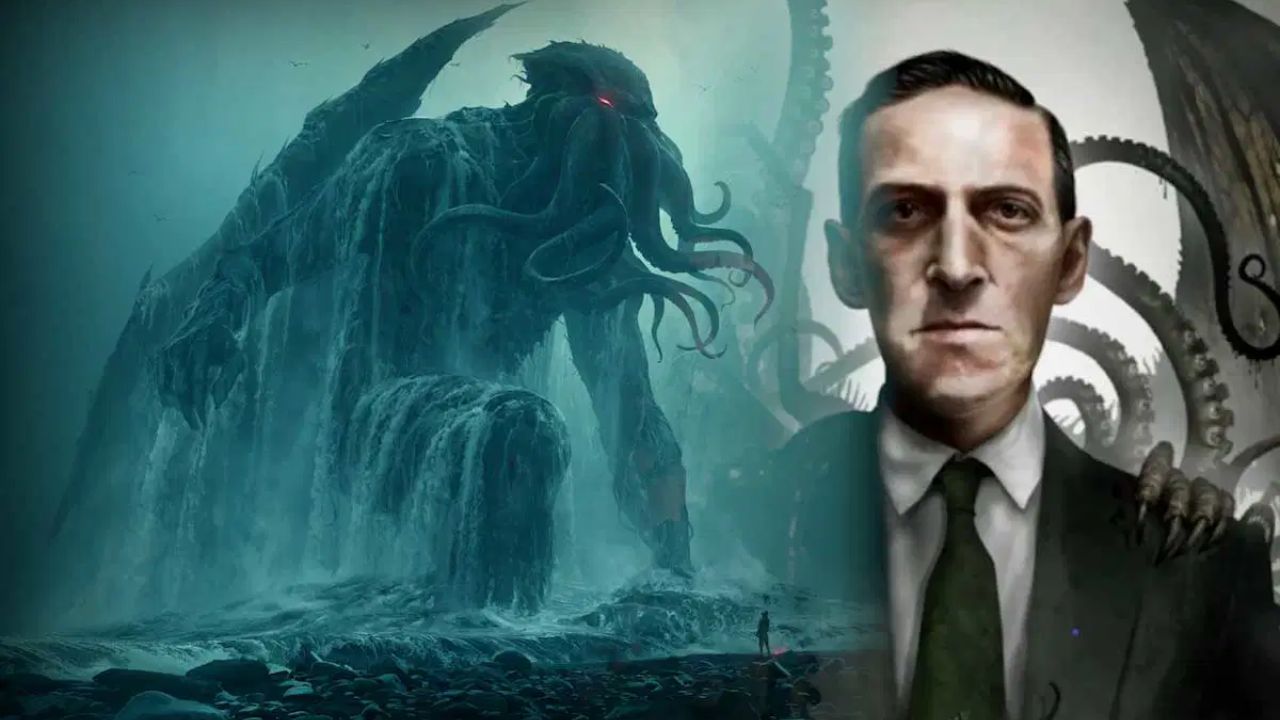
It began, as so many strange things do, with a man who couldn’t sleep. Howard Phillips Lovecraft — sickly, anxious, and almost pathologically isolated from the world — spent much of the 1920s writing pulp horror fiction for a magazine called Weird Tales. He was not famous. He was not wealthy. He did not, by most accounts, particularly enjoy being alive. And yet somewhere inside that restless, troubled mind, he conjured something that would outlive him by nearly a century and show no signs of stopping.
In 1926, Lovecraft wrote a short story called “The Call of Cthulhu.” It was published in Weird Tales in February 1928. The story is structured as a found document — a narrator piecing together notes left by his deceased granduncle — and it reveals, through fragments and testimonies, the existence of a sleeping cosmic entity that lurks at the bottom of the Pacific Ocean. The entity is ancient. The entity is vast. The entity is barely describable. And it is called Cthulhu.
That story, just a few thousand words long, became the seed of what Lovecraft would later call the Cthulhu Mythos — a loose shared universe of gods, monsters, forbidden texts, and doomed protagonists that stitched together many of his works. He wasn’t the first person to write horror, or even cosmic horror. But he was, by any honest measure, the person who dragged it somewhere truly strange.
“The oldest and strongest emotion of mankind is fear, and the oldest and strongest kind of fear is fear of the unknown.”
— H.P. Lovecraft, Supernatural Horror in Literature (1927)
The idea at the heart of the Mythos is almost philosophical: that the universe is not a place designed for human beings, that our minds are simply too small to comprehend what really exists out there, and that direct contact with genuine cosmic truth would not enlighten us — it would break us. Lovecraft called this concept cosmicism, and it made his horror feel different from everything else. There was no heroic resolution. No monster defeated. Just the dawning, terrible awareness that we were never in control to begin with.
So, What Actually Is Cthulhu?
Here’s where it gets interesting — because Lovecraft was always deliberately vague. He understood, perhaps intuitively, that the scariest thing is what you can’t fully picture. Cthulhu is not described cleanly. It is assembled from impressions, from wrong-feeling comparisons, from the fact that no human language quite has the right words. Which, of course, is precisely the point.
Entity Profile: Cthulhu
Classification
Great Old One — an ancient cosmic deity predating humanity
Form
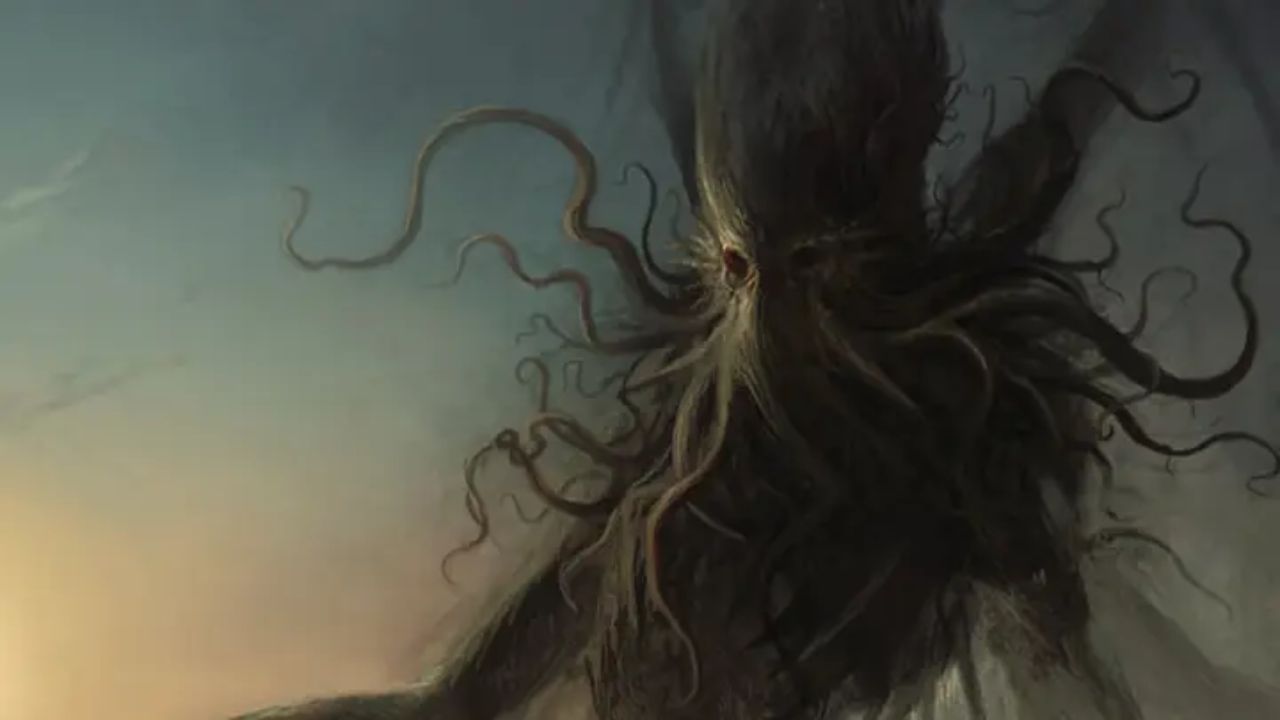
Colossal humanoid body; octopus-like head with writhing tentacles; vast rubbery wings; estimated hundreds of feet tall
Location
R’lyeh — a sunken, non-Euclidean city in the Pacific Ocean, now submerged beneath the waves
Status
“Dead but dreaming” — technically inert, but its psychic emanations reach sleeping humans worldwide
Pronunciation
Intentionally unpronounceable; Lovecraft suggested something like Khlûl’-hloo, but insisted no human throat could manage it
Worshippers
A scattered global cult awaiting the moment when the stars align and R’lyeh rises again
Goal
Unknown — possibly none that a human mind can parse. That’s rather the problem.
What’s crucial to understand is that Cthulhu is not evil in any conventional sense. Evil implies a choice, a motivation, a relationship to human morality. Cthulhu has none of those. It is indifferent. It doesn’t hate us. It doesn’t notice us. We are, at most, incidental. This is what separates Lovecraftian horror from almost every other kind — there is no villain to outwit, no plan to foil. There is only scale, and our own smallness.
Cthulhu’s physical description — tentacled, winged, vaguely humanoid but wrongly proportioned, its geometry somehow off — is almost secondary to what it represents psychically. Those who dream of it go mad. Artists begin painting things they don’t understand. Sailors hear it in the silence beneath the waves. Its influence spreads without intent, the way a radio tower broadcasts without caring who listens.

The Mythos — A Universe Built on Dread
Cthulhu is not alone. That would almost be too simple. Lovecraft populated his cosmos with an entire pantheon of entities, each one a fresh angle on the same idea: that consciousness in the universe is the rule, not the exception, and most of it is so different from ours that the comparison barely holds.
👁️
Azathoth
The “Blind Idiot God” — the ultimate centre of all existence, an amorphous chaos that sits at the heart of ultimate confusion and plays a discordant pipe with no awareness of anything at all.
🌀
Nyarlathotep
The Crawling Chaos — the only Great Old One who seems to enjoy human contact. A shapeshifter, trickster, and messenger god who walks among us in disguise, often just to watch things unravel.
🌲
Shub-Niggurath
A dark fertility deity associated with grotesque abundance and the generation of monsters. Often invoked in cult rituals throughout the stories.
📖
The Necronomicon
A fictional grimoire referenced throughout the Mythos — a book of forbidden knowledge whose contents drive readers toward dangerous truths. Possibly the most famous fictional book ever written.
🏙️
Arkham & Miskatonic
Lovecraft’s fictional Massachusetts city and its infamous university — a recurring setting where scholars study things they very much shouldn’t.
🐟
The Deep Ones
Amphibious humanoid creatures who dwell beneath the sea and interbreed with coastal humans — appearing most memorably in The Shadow Over Innsmouth.
What made this mythology so durable — even before pop culture got hold of it — was the collaborative spirit behind it. Lovecraft actively encouraged his writer friends to use the same gods, the same books, the same fictional geography. Clark Ashton Smith, Robert E. Howard (who also created Conan), August Derleth, and others all added to the lore. The Mythos became a creative commons of cosmic dread, with no single author owning the whole.
That collaborative DNA is, arguably, why it survived. The Mythos was designed to be extended. Every new writer who touched it was following a tradition Lovecraft himself established.
Why Does a Tentacled Eldritch God Have a Fanbase in 2025?
Here’s the honest answer: Cthulhu’s popularity has almost nothing to do with horror anymore. At some point — probably sometime in the 1990s, and definitely accelerated by the internet — something interesting happened. The thing that was supposed to make you feel small and terrified became, somehow, adorable and funny. You can buy Cthulhu plushies. You can find Cthulhu coffee mugs, baby onesies, and Christmas ornaments. There is a Cthulhu for President campaign that reappears every election cycle with the tagline “Why settle for the lesser evil?”
This is either the most ironic thing imaginable, or a perfectly logical endpoint, depending on how you look at it. Let’s break down both the serious and the silly reasons this creature won’t go away.
The idea that the universe simply doesn’t care about us — that our entire civilisation is a momentary flicker — hits differently in an era of climate anxiety, political chaos, and social media exhaustion.
— The Appeal of Cosmic Horror in the Modern Age
1. The Philosophy Still Lands
Lovecraftian cosmicism — the idea of human insignificance on a cosmic scale — turns out to be genuinely resonant in the twenty-first century. We now know enough astronomy to genuinely grapple with the incomprehensible scale of the universe. We’ve looked at the Pale Blue Dot. We’ve mapped billions of galaxies. And most of us have, at some 3 a.m. moment, stared into the ceiling and felt the familiar dread. Lovecraft just put a name and tentacles on it.
2. It’s Flexible as a Concept
One of the strangest things about the Mythos is how well it adapts. It can be straightforward horror. It can be action-adventure (see almost every video game that uses it). It can be dark comedy. It can be philosophical science fiction. It can be used to comment on colonialism, ecological destruction, the hubris of science, the limits of sanity, or the absurdity of existence. That kind of conceptual elasticity is rare, and it’s a big part of why writers keep returning to it.
3. It Hit the Internet at Exactly the Right Time
Cthulhu became genuinely memeable before memes were a cultural category. “In his house at R’lyeh, dead Cthulhu waits dreaming” has the rhythm of a phrase that gets lodged in your head. The creature’s sheer visual absurdity — this enormous, tentacled, winged thing that is the most powerful entity in existence but just… sleeps — is inherently comedic when removed from its original context. The internet ran with it. And the more people joked about it, the more people encountered Lovecraft’s original work, and the cycle kept going.
Cthulhu Across Pop Culture
By the mid-twentieth century, the Mythos had escaped pulp fiction entirely and started bleeding into every other medium. Here’s a sense of the spread — not exhaustive, but enough to make the point.
1940s – 1960s
August Derleth Keeps It Alive
After Lovecraft’s death in 1937, writer August Derleth co-founded Arkham House, a publishing company devoted to preserving and expanding the Mythos. He wasn’t a perfect steward — he imposed a more conventional good-vs-evil framework Lovecraft would have found limiting — but he kept the flame burning through the lean decades.
1970s – 1980s
Film, Music, and Tabletop Gaming
The Mythos found its way into horror cinema, inspired the aesthetic of countless metal bands, and became the backbone of Call of Cthulhu — a tabletop roleplaying game published in 1981 that remains one of the most respected RPGs in the world, beloved for the fact that winning is almost impossible and going mad is practically guaranteed.
1990s – 2000s
Literature and Games Explode
Authors like Neil Gaiman, Stephen King, and Alan Moore all cite Lovecraft as a significant influence. Video games like Eternal Darkness and Amnesia: The Dark Descent built entire sanity mechanics around Lovecraftian concepts. The Mythos wasn’t niche anymore — it was infrastructure.
2010s – Present
Mainstream Saturation
Stranger Things lifts the Mythos aesthetic wholesale for its Upside Down. HBO’s Lovecraft Country uses the source material to explore American racism through a cosmic horror lens. Bloodborne becomes one of the most celebrated video games ever made by adapting the Mythos into pure visual and mechanical poetry. The creature appears in South Park, The Simpsons, hundreds of novels, and approximately one thousand webcomics.
What’s notable about this cultural spread isn’t just the volume — it’s the diversity. Cthulhu has been wielded by serious literary authors, exploitation filmmakers, avant-garde game designers, comedy writers, and merchandise companies with equal enthusiasm. It’s a rare cultural artefact that manages to mean something different depending entirely on who’s using it, without ever losing its essential identity.
The Lovecraft Problem
This section matters, and shouldn’t be skipped.
H.P. Lovecraft was, by any modern standard, a racist. Not just casually bigoted in the way that was common for his era — he was specifically, vocally, and repeatedly prejudiced against Black people, Jewish people, immigrants, and virtually everyone outside the very narrow idea of Anglo-Saxon culture he clung to. Some of his most famous works contain explicitly racist language. His fear of “the other” — which powers so much of his cosmic horror — was not merely abstract.
This is not a footnote. It is a real, serious issue that contemporary readers, writers, and critics have grappled with honestly and at length. The World Fantasy Award used to be a bust of Lovecraft’s face until 2015, when it was replaced following sustained criticism. Authors like Nnedi Ofofor and others have written about the discomfort of loving an art form that was shaped, in part, by someone whose worldview they would have been a target of.
The most thoughtful response to this isn’t to erase Lovecraft, nor to pretend the problem doesn’t exist. It’s to do what Lovecraft Country did so brilliantly — to take the tools of his mythology and turn them against the very fear and hatred that partly animated them. To recognize that cosmic horror is a framework that belongs to everyone now, and can be pointed in any direction the writer chooses.
The Mythos survived its creator, and in many ways it survived him by becoming something he never intended: a shared creative language that anyone can speak. That transformation is part of what makes the whole story worth telling.
Why Cthulhu Won’t Stop Existing
There’s a certain irony in Cthulhu’s popularity that Lovecraft himself might have appreciated, had he lived to see it. He wrote about the terror of humanity confronting the incomprehensibly vast. And yet his creation has become, in its own way, incomprehensibly vast — spreading through culture the way a dream spreads, without fully understanding why.
Part of the answer is simply that cosmic horror scratches an itch nothing else quite reaches. Standard horror gives us something human to fear. Cthulhu gives us something that makes “human” feel like a limited category. There’s a perverse comfort in that — in the idea that our anxieties and ambitions and Monday morning problems are so small that the universe doesn’t even notice them. It’s the same comfort some people find in looking at stars.
Part of it is the openness of the framework. Because the Mythos was always collaborative, always designed to be built on, it never calcified. It kept evolving. Every generation that found it brought something new — new anxieties, new aesthetics, new uses for the raw material. It remains genuinely useful in a way that most ninety-year-old fiction simply isn’t.
And part of it — let’s be honest — is that a giant tentacled god who sleeps at the bottom of the ocean and accidentally drives sailors insane is just an extremely good bit. The line between the terrifying and the absurd has always been thinner than people pretend.
In his house at R’lyeh, dead Cthulhu waits dreaming. And apparently, so does the rest of us — waiting for the next story, the next game, the next strangely affectionate plushie.
— On the Enduring Appeal of Things That Should Not Be
Cthulhu endures because it represents something real: the gap between what we know and what exists. That gap isn’t shrinking. If anything, the more we learn, the wider it gets. Every new telescope image, every quantum paradox, every moment of late-night existential vertigo feeds the same well Lovecraft was drawing from in 1926.
He wrote a story about something that couldn’t be named, couldn’t be described, couldn’t be defeated. And somehow, a century later, that unnamed, indescribable thing is everywhere. That’s either deeply ironic, or the most perfectly Lovecraftian outcome imaginable.