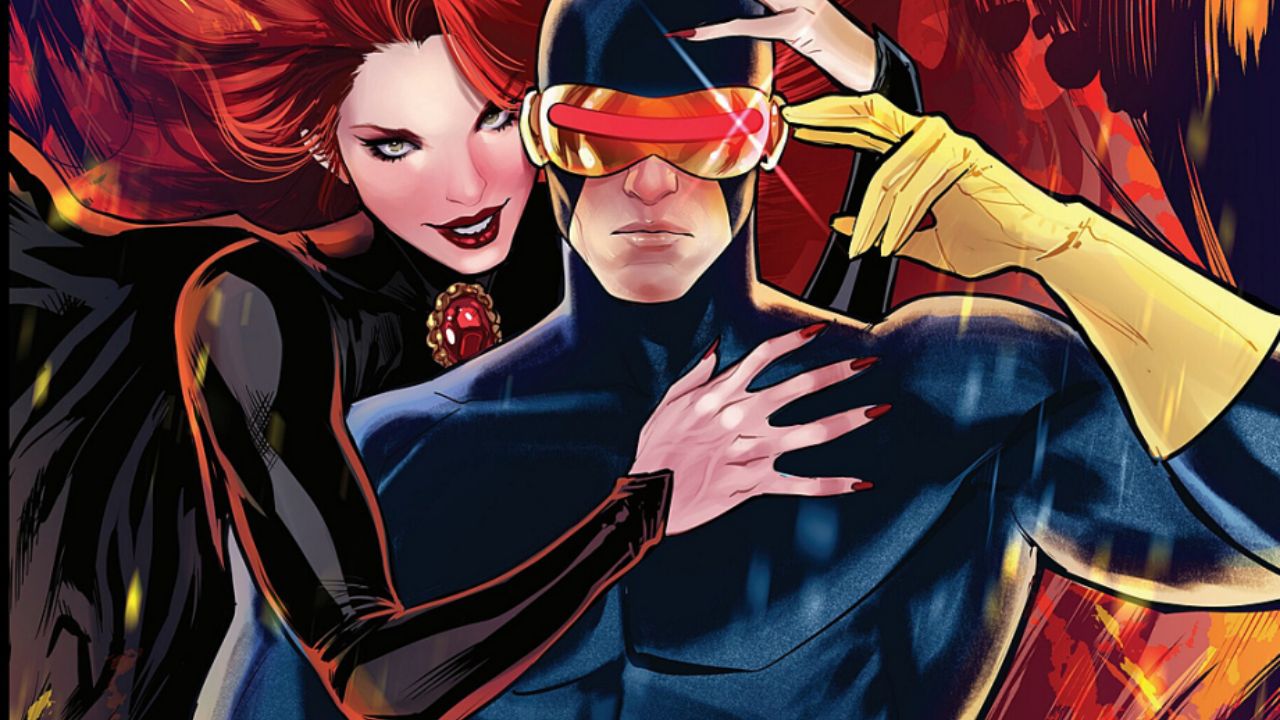
Marvel’s What If…? line has always thrived on one irresistible question: What if one small choice had led somewhere completely different? In What If…? The Uncanny X-Men #1 (2026) — released as part of the X-Men’s 50th-anniversary celebrations and dedicated in memoriam to Jacopo Camagni — writer Gerry Duggan and artist Jan Bazaldua craft one of the most heartbreaking alternate-history stories in X-Men lore.
The premise seems almost hopeful: What if Scott Summers, better known as Cyclops, had chosen to remain with his wife, Madelyne Pryor, instead of leaving her for Jean Grey? Yet by the story’s final page, that single act of loyalty sets off a chain reaction that culminates in the nuclear destruction of Earth itself. Here is the complete story, page by page.
The Watcher Sets the Stage
The comic opens not with action but with the familiar cosmic grandeur of Uatu the Watcher, the all-seeing guardian who has observed civilizations rise and fall across countless galaxies. Floating above a deep-space vista with Earth’s blue curve below him, Uatu delivers his signature address: “I am the Watcher. I have observed the rise and fall of civilizations — of worlds — of galaxies. I know all that IS — most that HAS BEEN — and much of what WILL BE. I can also see WHAT MIGHT HAVE BEEN.”

He makes clear the central premise. In the world we know, Madelyne Pryor — a woman who was secretly a clone of Jean Grey, engineered by the sinister geneticist known as Mr. Sinister — unleashed demonic forces upon the world during the catastrophic event known as the Inferno, and ultimately lost her life in that chaos. But in this timeline, something different happened: Madelyne Pryor was saved by X-Factor.
As the Watcher explains the divergence, we see quick flashback panels — Madelyne cradling a newborn Nathan (the boy who in the main timeline would become the time-traveling warrior Cable), and Cyclops himself standing before his old X-Factor teammates, telling them plainly: “I gave my heart to her. And… now she’s giving me a son.”
The key backstory is delivered economically. Mr. Sinister created Madelyne as a clone of Jean Grey, intending to use her to breed a powerful mutant child. In the standard Marvel timeline, Jean’s return prompted Scott to abandon Madelyne and their infant son Nathan, a betrayal that helped push Madelyne over the edge into villainy. But here? Scott stayed. And everything changed because of it.
The Aftermath: Jean Grey, Alone and Angry
With Scott firmly committed to Madelyne and Nathan, the rest of the original X-Men — Cyclops, Iceman, Beast, Angel, and Marvel Girl — must sort out the emotional wreckage. Jean Grey is furious, and rightfully so. She has learned that Mr. Sinister cloned her without consent, that this clone married the man she loved, and that she now has a sort of shadow family she never asked for.
Scott tells Jean directly that he cannot lead X-Factor anymore and cannot keep adventuring. He knows what it cost him to have an absent father — a father who was out saving worlds instead of building his son’s — and he refuses to repeat that cycle. Iceman gently tells Jean to give Scott time. She doesn’t take it well.
Jean’s fury reaches its peak when she confronts Mr. Sinister himself. In a breathtaking action sequence, she flies at the pale, diamond-marked geneticist with the full force of her telepathic gifts unleashed. Sinister screams at her to “Stay out of my mind, mutant scum!” — but Jean does not kill him. Instead, she does something arguably more consequential: she reaches into his mind and strips away some of his worst, most dangerous knowledge. She wipes from him the awareness of Madelyne’s nature as a clone, and crucially, she erases the memories he held about the birth of Nathan Summers.
As Uatu narrates: “Jean wiped the knowledge of cloning her and of Nathan’s birth to try to protect the boy from Sinister… And in doing so, gave up any hope of a life with the man she loved.”
In the main timeline, Nathan Summers was sent into the distant future to save his life after Apocalypse infected him with a techno-organic virus. None of that happens here. There is no virus, no exile, no Askani warriors. Nathan Summers grows up in the normal world — as a kid, going to baseball games with his dad.
A Normal Life for Nathan: The House of X
The pages that follow are the emotional heart of the issue and perhaps its most affecting section. We watch Nathan Summers grow up with two parents who love each other and love him. Uatu narrates warmly: “Nathan had as normal a childhood as could be possible, being the son of the clone of a powerful telepath and telekinetic… and a man who shot concussive blasts from his eyes.”

Scott and Madelyne sit on the couch together, watching young Nathan at a baseball game, cheering him on. They talk in the evenings about whether they’ve made the right choice hiding their true natures from their son. “Part of me hopes he wasn’t born one of us,” Scott admits. Madelyne replies with quiet resolve: “He’ll find out soon enough if he has a mutant gift, and then we’ll ask him to forgive us. We tried to give him what we never had. A normal life… for as long as possible.”
But adolescence has a way of drawing its own lines. One night, Nathan’s powers begin manifesting — objects flying around his room as he sleeps, telekinetic force bursting out of him involuntarily. His panicked cry of “Mom! Dad! Help!” brings his parents running. Madelyne does not comfort him with half-truths. In a single instant, she downloads the entire secret history of the X-Men and what it means to be a mutant directly into her son’s mind via telepathy. His reaction — “Mom… Dad… I wanna be a super hero too” — makes Scott weep with pride. “Proud of you, kiddo.”
The Watcher delivers the announcement with full gravitas: “And so the Summers family became known as the House of X — the first family of Mutantdom.”
The three of them take to the field as a family unit, with young Nathan — now calling himself Cable and wearing a yellow-and-blue X-Men uniform — fighting alongside his parents. On a splash page, the entire Summers family charges into battle. Madelyne fights with telepathic energy crackling from her hands, Cyclops fires optic blasts with precision, and Nathan — young, cocky, and full of fire — ignores his mother’s warning to watch his flank. “I’m not a kid, Mom! And I know Dad’s there!”
Jean Grey Steps Away — Toward the Stars
Meanwhile, Jean Grey, stripped of the future she imagined, chooses to make a change. The Watcher notes that she soldiered on as the original Marvel Girl for a time, but with the Summers family rising in prominence and acclaim, she decided to seek something beyond Earth. Her friends in the Fantastic Four were happy to help, commissioning a spacecraft for her.
The panels here are quietly devastating: Jean boarding a rocket at a launchpad while figures watch from below, then the rocket lifting off against a fiery sky, then Jean looking back at Earth from the cold black of space through a porthole. The Watcher admits with unusual humility: “She didn’t intend for her sojourn from Earth to be permanent, but she never returned, and nobody who loved her would learn her fate. Of course, I observed what happened to her… but that is a tale for another time.”
It is a perfect thread left dangling — a promise of further stories, and a reminder that even in a world where Cyclops made the right choice, not everyone got a happy ending.
The Summers Family as Heroes: Fame, Acceptance, and a Reawakened Threat
Back on Earth, the Summers family enjoys something the X-Men almost never had: genuine public acceptance. Their family unit — a mother, a father, a son, all mutants, fighting together — humanized them in a way that a team of strangers never quite managed. The Daily Bugle’s headline says it all: “SUMMERS FOR ALL SEASONS! Heroic mutant family stops Mole Man!”

The montage of heroics covers several pages. The Summers are on the front lines when Atlantis attacks, driving back the oceanic assault with coordinated blasts and telekinetic force barriers. When Loki orchestrates his Acts of Vengeance, sending a coalition of villains against Earth’s heroes, it is Nathan who disarms the HYDRA gunmen with a gesture and a smirk: “I’ll take those guns, dorks.”
But fame comes with a price. All the attention paid to the Summers family — all the coverage, the photos, the newspaper stories — inadvertently filters through to Mr. Sinister, who has been sitting dormant in his underground laboratory, the worst parts of his memories stripped away by Jean Grey long ago. Something stirs. He wakes confused, asking “Wh — who…? H — how…?” as he begins to reconstruct what was taken from him.
The Watcher states plainly: “All this attention reawakened something deep in the mind of Mr. Sinister… I observed Sinister’s mind uncover the secrets that had been stripped away. When he awoke, he went on a rampage.”
Sinister rises, fully reconstituted in his fury, and screams one word: “PRYOR!”
The Mutant Massacre at the X-Mansion
Here the story lurches into darkness. The Watcher tells us that after years away, Scott, Madelyne, and Cable returned to the orbit of the X-Men, with Scott leading in Storm’s absence. Cable was fortunately away at the time, “gallivanting with the New Mutants.”
Because one night, the X-Mansion becomes the site of the Mutant Massacre.
Mr. Sinister dispatches his Marauders — the brutal assassins he created — to tear through the mansion. Harpoon and Riptide, two of the most lethal Marauders, catch Cyclops and Madelyne in the halls of their former home. The battle is vicious and visceral. Madelyne goes on the offensive against Riptide, her telekinetic fury raw and focused, screaming “DIE!” as she hurls his shuriken-like weapons back at him.
But she takes her eyes off Harpoon for a split second.
It costs everything.
A full-page splash shows Madelyne, impaled by one of Harpoon’s energy lances, stumbling toward Scott with blood blooming across her dress. “M — Maddie?!” Scott whispers in horror. Sinister watches with sardonic satisfaction, clapping his hands. “Oh, what fun we’re going to have. I’m only sorry your son is missing the party. Tell me where he is, Scott.”
Scott charges at Sinister with nothing but his bare fists. Sinister subdues him with chilling ease and a single syllable: “Shush.”
Sinister incorrectly believes it was Madelyne who had entered his mind all those years ago to wipe his memories. It was, of course, Jean Grey — but he will never know that.
The Return of Cable and the Birth of X-Force
Cable, arriving back with the New Mutants to find the mansion in flames and bodies on the ground, screams his parents’ names. His telepathy reaches out — and finds nothing from his mother. He fights his way through the rubble to find Scott, crucially still alive, crushed under debris and barely clinging to consciousness.
“Son… be brave,” Scott whispers.

Nathan tears the rubble apart with telekinesis and cradles his father. “Dad — you’re alive?! I’m getting you out of here!”
They bury their dead. Forge helps repair the damage to Cyclops’ visor so he can see again. Father and son stand at a gravesite, side by side, and they plan their revenge.
The result is X-Force — a hit squad unlike any the mutant world had seen. Not a heroic team but a precise instrument of vengeance. Wolverine, Colossus, and Domino join the grieving Summers men. Their first major operation is the destruction of the old Hellfire Club building, now Sinister’s seat of power, with a massive explosion that reduces the façade to rubble.
The Watcher’s narration carries a note of deep sorrow: “Mr. Sinister had since claimed the old Hellfire Club as his seat of power. Scott Summers always had the gift of leadership… and now he led mutantdom to dark places.”
The X-Force hunt down every last Sinister clone — all nine on Earth, from the Poconos to Oahu — and even track the tenth to the Blue Area of the Moon. When they find the final clone still defiant, sneering that “You’ll never kill me, pup. I have bodies all over the world!” — Cable corrects him with cold finality: “HAD bodies all over the world.”
Scott gives a one-word order. “No.”
Cable puts a bullet through Mr. Sinister’s head.
But revenge, as the Watcher reminds us, does not bring peace. “Cyclops’ X-Force became as cruel as any of the villains. Cyclops lost the woman he loved, and he never recovered from his survivor’s guilt.”
Krakoa, Arakko, and the Fall Toward Apocalypse
Years pass. The Krakoa and Arakko storylines that defined the Krakoan era of X-Men comics emerge in this timeline too, though with critical differences. Without Hope Summers entering the timeline — because there was no Cable sent to the future, no lineage from which Hope could spring — and without Sinister’s library of mutant DNA being intact, key pieces of the Krakoan puzzle are missing.
Most critically: there are no resurrection protocols. Mutants who die, stay dead.
When the Tournament of Swords in Otherworld concludes, Krakoa lacks the correct mutant circuit to terraform Mars. Cyclops confronts Professor Xavier about the mounting threat from Arakko: “No! I’ve faced off with Isca the Unbeaten. The Arakkii have been at war for thousands of years — we CAN’T permit them to dominate the Earth, Professor!”
But Arakko strikes first, removing Krakoa’s greatest strategic advantage: Moira MacTaggert. The mutant Lactuca the Knower, whose gift was to know precisely where everything in the universe was located at all times, used that ability to neutralize Moira’s presence entirely. Moira was sent beyond even the Watcher’s sight — “for the first time in eons, I am humbled” — and with her went Krakoa’s secret weapon: her ability to reset timelines. That possibility is now gone forever.
The Great War: A Battle Too Many
Cyclops leads his X-Force team on a desperate strike mission to decapitate the ruling council of Arakko known as the Great Ring. The Avengers and Fantastic Four enter the fray alongside them. The Arakkii warriors, thousands of years hardened by endless war, have already killed many humans since Apocalypse sent their island to Earth.

The fighting is titanic. Wolverine and the Arakkii exchange blows while the Fantastic Four engage at massive scale — the Thing crashing into Arakkii warriors with seismic force, the Human Torch lighting up the sky. An Arakkii fighter grudgingly admits to Wolverine, “Being honest, this is the first time I’ve respected you Krakoans… A frontal attack with honor. Perhaps you’re mutants after all.”
Magneto dies. An Arakkii combatant notes his constitution with chilling contempt: “How unfortunate… one of them… is made of glass.” His death is stamped with finality: “Magneto’s death signaled that THE END was at hand.”
Cable is in the thick of it, fighting back to back with his father in a desperate holding action. “Dad, there are too many of them!” he shouts. Cyclops barks orders, calling for Storm, who cannot be reached. Logan’s head is literally separated from his body in the chaos. “Colossus, get Logan’s head back to his body!”
The Death of Nathan Summers
Then comes the blow that breaks everything.
Sobunar of the Depths, an Arakkii omega-level mutant whose body contained an entire oceanic ecosystem, fells Nathan Summers. The narration box reads with cold finality: “Disaster unfolded when Sobunar of the Depths, another Arakkii omega-level mutant, felled Nathan Summers, the boy whose birth had changed this world forever.”
A full-page spread shows Nathan falling from the sky. Two panels follow in stark juxtaposition: Scott’s face, twisted in a soundless scream behind his visor, bellowing “NO!” — and Nathan, bleeding out, barely conscious, whispering in his last moments: “I… want… Mom.” Scott cradles his dying son against his chest. Nathan’s final words to his father are a fragile “I love you, Nathan…” spoken by Scott in return, his voice breaking.
“I’m sorry I failed you,” Scott says.
Then Cyclops aims at Sobunar and fires. The creature’s death releases catastrophe: Sobunar’s body contained an entire oceanic ecosystem, and its sudden destruction destabilizes coastlines worldwide, triggering tsunamis and geological chaos across the planet.
The Watcher delivers his epitaph for Scott Summers with devastating precision: “Scott Summers had been pulled by the darkness since Madelyne’s murder. Now he surrendered to it.”
A final image shows Scott Summers — the man who once represented hope and discipline — falling alone into the black ocean, shrinking to nothing.
The End of the World
The war lasted less than thirty hours.
The battlefield is a shoreline littered with bodies — human and mutant alike, Arakkii warriors slumped beside the fallen heroes of Earth. Captain America kneels among the dead, shield cracked, barely able to form words: “Oh God.”
The Arakkii push the advantage. Humankind, pushed to the absolute edge of extinction, concludes there is no choice left. A lone shadowed figure watches nuclear missiles streak across the sky, and says simply: “Save us.”
It isn’t enough.
The nuclear exchange begins. Page after page of warhead-tipped missiles arcing across the sky, mushroom clouds blooming across the landscape in waves. The Watcher narrates with the bleak, clinical tone of a physician pronouncing time of death:
“The Arakkii mutants made war upon humans, but man did not go quietly. They used their nuclear weapons again and again, in a futile attempt to prevent extinction.”

The final image of the story proper shows the Watcher, alone, floating in darkness beside a cold, grey Moon — a dead Earth visible behind him. The narration boxes close the loop on the entire issue:
“Today, the Earth is uninhabitable for many thousands of years. All this tragedy… all this suffering led to the end of the world, and it was born from a mutant’s love for his son.”
Beside him, in bold yellow letters: THE END.