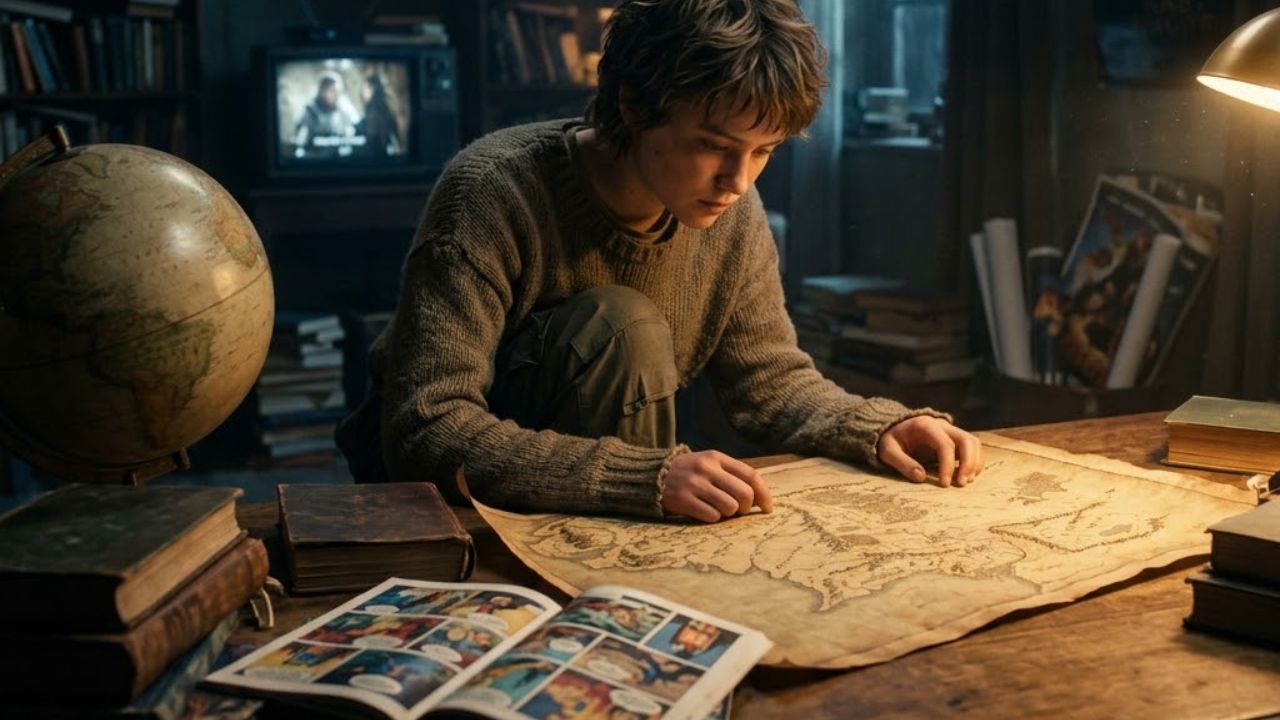
The best fictional worlds aren’t backdrops. They’re characters in their own right — with histories that predate the plot, rules that apply even when the camera isn’t rolling, and textures so specific that you’d recognize them in a single sentence. Middle-earth smells different from Narnia. Westeros operates on different moral logic than the Cosmere. Gotham City feels nothing like Mega-City One.
So what separates the worlds we never forget from the ones we leave behind before the sequel comes out? And how does the medium — a novel, a film, a comic panel, a prestige TV series — shape the kind of world a creator can build?
This is an attempt to answer both questions, working through some of the greatest fantasy worlds ever conceived, medium by medium.
BOOKS: The Worlds That Live in Your Head Rent-Free
Books get the longest leash. A novelist can spend four pages describing how moonlight moves through cathedral windows without losing a studio executive. That freedom has produced some of the most immersive, internally coherent worlds in all of fiction.
Middle-earth — J.R.R. Tolkien
The grandfather of them all. What Tolkien built in The Hobbit, The Lord of the Rings, and The Silmarillion wasn’t just a setting — it was a complete cosmology, spanning the creation of the universe through the fading of the elves. He invented languages, plural and functional. He wrote histories that reference other histories. He gave rivers names and those names etymologies.
What makes Middle-earth so durable isn’t the grand sweep of good versus evil — it’s the smallness embedded in the grandeur. The Shire exists, in loving detail, as a world of pipe-weed and second breakfasts and disputes over fences, and it matters because Tolkien understood that epic stakes only land when you know what’s being protected. The battle for the world is also, always, a battle for the Saturday afternoon nap.
The world’s weakness, if you’re being honest, is its insularity. Tolkien’s moral universe is relatively fixed — evil corrupts, virtue holds, the darkness is unmistakably dark. There’s not much moral grey in the stones of Mordor. That’s a deliberate theological choice, not an oversight, but it does mean the world’s emotional range is narrower than some that followed.
What it does best: Depth. Linguistic texture. The feeling that a thousand untold stories are happening just off the page.
The Cosmere — Brandon Sanderson
Where Tolkien built one world with extraordinary depth, Sanderson built a solar system of them. The Cosmere is his shared universe, connecting the worlds of Mistborn, The Stormlight Archive, Warbreaker, Elantris, and more through a hidden metaphysical framework involving divine Shards, the Spiritual Realm, and a mysterious figure named Hoid who keeps showing up.
What’s remarkable about the Cosmere isn’t the ambition — ambition is cheap — but the execution. Each world operates by its own rigorously designed magic system. Allomancy in Mistborn is essentially a physics problem: metal-based powers with defined rules, costs, and limits. Stormlight’s Surgebinding is biological and spiritual at once. The rules feel discovered rather than invented, which is maybe the highest praise you can give a fantasy magic system.
The Cosmere also grapples with something Tolkien mostly didn’t: institutional decay. The world of The Way of Kings isn’t just in danger from monsters — it’s being corroded by its own politics, its caste system, its corrupted religious bureaucracy. The darkness is social as well as supernatural.
The trade-off is intimacy. With this much system, this much interlocking architecture, the Cosmere can occasionally feel more like a game world than a lived one. The prose is workmanlike where Tolkien’s was lyrical. But as a feat of imaginative engineering? Nothing quite matches it.
What it does best: Systematic magic. Interconnected worldbuilding. Rewarding readers who pay attention.
Earthsea — Ursula K. Le Guin
Le Guin’s archipelago is the great corrective. Where so much high fantasy is loud and large, Earthsea is still and deep. The world is made of islands and ocean and the old, old magic of true names — the idea that every thing has a name in the Old Speech that is the thing, and knowing it gives you power over it.
What Le Guin understood, decades before most writers caught up, is that a world’s philosophy is its worldbuilding. Earthsea isn’t just geographically interesting — it’s structured around a Taoist idea of balance, the equilibrium that magic disturbs and must restore. The world has a logic that goes all the way down, and it rhymes with how life actually works: every action has cost, every power has shadow.
And then, fifteen years after The Wizard of Earthsea, she wrote Tehanu and revised everything. The world she built — which had featured a near-exclusively male hierarchy of wizards — was reexamined through the eyes of a woman who had never been able to belong to it. It’s one of the most honest things a fantasy writer has ever done: returning to your own creation and asking who it left out.
What it does best: Philosophical coherence. Emotional depth. The bravery to revisit and revise.
Discworld — Terry Pratchett
Discworld is a flat planet on the back of four elephants standing on the back of a giant turtle swimming through space, and you probably already know that. What you might underestimate, if you’ve only read one or two of the forty-plus novels, is how complete it is.
Pratchett built Ankh-Morpork over decades into one of the most vivid cities in fiction — a stinking, thriving, corrupt, vital metropolis that simultaneously parodies medieval fantasy tropes and feels more alive than most realistic settings. The city has guilds (including a Thieves’ Guild and an Assassins’ Guild, both licensed and regulated), a dysfunctional Watch, a university of wizards who spend most of their time avoiding doing actual magic, and a Patrician who runs the whole thing through the kind of enlightened despotism that makes you quietly uncomfortable.
The genius of Discworld is that the satire is the worldbuilding. Every comic exaggeration reveals something true about how bureaucracies work, how religions behave, how prejudice operates, how death comes for everyone eventually (and Death himself turns out to be one of literature’s great characters). The jokes are load-bearing. When the humor lands, so does the emotion, and it hits harder for being unexpected.
What it does best: Comic density. Social satire that sharpens into real feeling. The most fully realized city in fantasy literature.

MOVIES: Worlds Built to Be Seen
Film imposes radical constraints. You have two hours — maybe three if you’re Peter Jackson and audiences are willing — and every inch of your world has to earn its place on screen. The best fantasy films solve this through design as much as writing: a world’s architecture, costuming, and color palette do the work that a novelist does with prose.
Middle-earth (Again) — Peter Jackson’s Films
It’s hard to discuss film fantasy worlds without starting here, because The Lord of the Rings trilogy (2001–2003) essentially redrew the map of what big-screen fantasy could do. Jackson and his collaborators — above all, production designer Grant Major and the teams at Weta Workshop — made the crucial decision to treat the world as archaeological rather than theatrical. Rivendell looked ancient. Helm’s Deep looked used. Moria looked like somewhere things actually died.
The Shire is perhaps the most precise piece of fantasy world-design ever committed to film: a landscape of gentle hills and curved doors and washing on the line that communicates contentment-worth-protecting in about twelve seconds of screen time. Then Mordor arrives — all ashen sky and volcanic stone and the absence of anything growing — and the contrast does emotional work no script page could.
Jackson’s films also demonstrated a principle that’s easy to undervalue: restraint creates scale. We never see more of the world than we need to. The distances are suggested. The histories are whispered. A world that implies more than it shows always feels bigger than one that explains itself.
What it does best: Visual coherence. Emotional geography. Making an imagined world feel like it predates the camera.
Pandora — Avatar (2009)
Love it or hate the screenplay, Pandora is a genuine achievement in visual worldbuilding. James Cameron and his team built an entire ecosystem — not just a pretty background, but a biosphere with internal logic. The bioluminescence. The neural-link biology of the Na’vi, the ikran, the direhorses. The floating Hallelujah Mountains, ridiculous and magnificent at once.
What Pandora does that almost no other film world does is make the environment the moral stakes. The world isn’t in danger because a bad person wants something — it’s in danger because a system wants its resources. The indigenous ecology and indigenous people are inseparable. For all its script problems, the film built a world whose loss would feel real, and that’s a rare thing.
The weakness is the cultural thinness. The Na’vi are designed beautifully but written in broad strokes. A world’s visual richness and its cultural depth can come apart, and in Pandora they do. We see the world. We don’t quite understand how it thinks.
What it does best: Ecosystem design. Making environment feel like character. Visual scale.
Spirited Away’s Spirit World — Hayao Miyazaki
Every Miyazaki film contains a world, but the bathhouse in Spirited Away (2001) is the one that most completely feels like somewhere real — real in the way that childhood impressions of vast, incomprehensible adult spaces feel real. You don’t understand all the rules. You’re not supposed to. The spirit world operates on dream logic that is nevertheless perfectly consistent: work or be turned into an animal, don’t eat the food without permission, everyone here has a job and if you don’t have a name you don’t exist.
The genius of this world is that it’s a social world as much as a magical one. The bathhouse is a workplace, with hierarchy and labor and exploitation and small kindnesses. The spirits who come to bathe there are weird and funny and sometimes frightening, but they all have business. There are no extras in Miyazaki’s world — every creature has somewhere to be.
And the world is beautiful in a way that rewards just looking. The long corridors, the cramped kitchens, the bridge over the water at night. You want to live there and you’d be terrified to.
What it does best: Dream logic with internal consistency. Visual invention. Making strangeness feel lived-in.
TELEVISION: The Long Game
Series television — particularly prestige drama in the streaming era — has given fantasy worldbuilders a new tool: time. Enough episodes to build geography, enough seasons to show change. The best fantasy TV series use that time to do what books do, at a pace that film cannot afford.
Westeros — Game of Thrones / George R.R. Martin
Let’s separate the world from the show’s trajectory: Westeros, as Martin conceived it and as the early seasons rendered it, is the most politically sophisticated fantasy setting ever put on screen. The genius of the world isn’t its dragons or its magic — it’s the institutions. The great houses. The Small Council. The Night’s Watch, an institution so old it has forgotten why it exists. The system of allegiances and debts and marriages that structures power in the absence of anything like modern law.
Martin built a world where the fantasy elements arrive late and are almost beside the point. The horror of Westeros is human: that political violence has no arc, that the decent die before the clever, that systems of power grind through individuals without pausing to acknowledge their virtue. The Red Wedding is devastating not because it’s unexpected by the logic of the world — it’s perfectly expected by that logic — but because we kept hoping this world would be different from the one we live in.
The show’s later decline is, in its way, a worldbuilding lesson. When the writers abandoned Martin’s systemic logic — power flowing through institutions, consequences following from causes — the world collapsed. Magic could fix anything. Armies could teleport. The world stopped being real.
What it does best: Political texture. Institutional storytelling. Consequences that feel earned.
The Continent — The Witcher
Based on Andrzej Sapkowski’s novels and the phenomenally successful CD Projekt Red games, The Witcher series presents a world built on the debris of idealism. The Continent isn’t a world where good and evil are at war — it’s a world where that war already happened, several times, and the rubble is what’s left. Racism is institutional. Monsters are often less monstrous than the people who hire someone to kill them. Geralt, the White Wolf, is a man designed by his society to solve problems that the same society creates.
The series has struggled to match the richness of its source material, but at its best, it captures something the books do powerfully: a world where moral choice matters in the absence of moral clarity. Nobody in this world is coming to save you. That’s bleak, but it’s also honest in a way that makes genuine decency — when it appears — feel radical.
What it does best: Moral ambiguity. A world that has already lost its innocence and is trying to live in the aftermath.
The Upside Down — Stranger Things
A different kind of fantasy world: not a secondary world but a secondary dimension, existing in dark parallel to a specific, lovingly rendered version of small-town 1980s Indiana. The Upside Down works because it’s a shadow rather than a replacement — it takes everything familiar about Hawkins and inverts it. Same geography, same architecture, different atmosphere: darker, colder, alive with particles in the air and the distant sound of something breathing.
The world-logic of the Upside Down is deliberately incomplete, revealed piecemeal, and that’s correct. The horror depends on not fully understanding the rules. What the show does brilliantly is use the two worlds as emotional mirrors: the darkness that runs under ordinary life, the way the most suburban-normal exterior can contain something terrifying underneath.
What it does best: The doppelgänger uncanny. Using a parallel world as emotional metaphor. Mystery maintained over multiple seasons.
COMICS: Worlds That Live in Panels
Comics occupy a unique position in world-building. Unlike prose, they’re visual — you can see the world. Unlike film, they’re static, and the reader’s eye controls the pacing. A single splash page can hold an entire world in a way that neither a paragraph nor a shot quite replicates. The best comics world-builders understand that white space and panel borders are part of the world, not just the container.
Gotham City — DC Comics
Gotham is perhaps the greatest fictional city in any medium: not just a setting but a psychological state, an architecture of urban dread and decadent ruin that has been reimagined by hundreds of artists over eight decades and somehow always comes back to something coherent. There’s a Gotham look — gargoyles, art deco bones beneath Gothic decay, the perpetual night sky, steam rising from grates — and there’s a Gotham feeling: the sense that the city is sick in a way no Batman could cure.
What makes Gotham exceptional as a world is that it generates story automatically. Drop almost any character into Gotham and the city will do something to them. The corruption is ambient. The darkness is structural. It’s the only city in comics where you believe, down to your bones, that it needs a Batman — and simultaneously that having a Batman is a symptom, not a cure.
The world’s depth varies enormously by creative team, and that’s partly the point: Gotham is a world that different artists can inhabit differently without breaking. Frank Miller’s Gotham is noir and fascist-adjacent. Neal Adams’ Gotham is kinetic and lurid. Jeph Loeb and Tim Sale’s Gotham is impressionistic and seasonal. It holds all of them.
What it does best: Architectural mood. Generating story through setting. Being simultaneously specific and malleable.
The Sandman’s Dreaming — Neil Gaiman
The Dreaming — Dream’s realm in Neil Gaiman’s Sandman — is not so much a world as a condition. It’s the place where all stories come from, the archive of every nightmare and reverie that any consciousness has ever experienced. Its geography is unstable. Its castle expands and contracts with Dream’s power. There are librarians cataloguing books that were never written. Ravens and gargoyles with opinions. Rooms that lead to anywhere, if you know how to ask.
What Gaiman understood is that a world defined by story has infinite real estate. The Dreaming can contain ancient gods and contemporary nightmares, a serial killer convention and a road trip through American mythology, a version of Shakespeare negotiating the origin of his plays. The world is a principle — story as the fundamental substrate of consciousness — and that principle gives every issue room to breathe differently.
Sandman also introduced a standard for comics worldbuilding that still hasn’t been surpassed: the sense that the world is older than its own narrative. Characters in the Dreaming have histories that predate the comics. The universe has already ended several times. What we’re reading is an episode in something without edges.
What it does best: Conceptual ambition. Making “story” the world’s physical law. Infinite implication.
Image Comics’ Saga — Brian K. Vaughan & Fiona Staples
Saga takes a different approach to fantasy/sci-fi worldbuilding: maximalism without mythology. The galaxy Vaughan and Staples have built is busy — multiple alien species, multiple political factions, a war that’s been running so long nobody remembers the original cause, a planet-sized television set broadcasting the whole thing as entertainment. There are robots with human faces and TV screens for heads. There are seal people. There are spider-centaur beings called Will who hunt people for bounty.
What makes Saga’s world stick is that it refuses to prioritize the spectacular over the specific. Every alien character eats, sleeps, falls in love, gets tired, takes medication. The world is enormous but never abstract. Fiona Staples’ art does something almost no fantasy comic manages: every new species and setting looks completely inevitable, like this is obviously what it would look like.
The emotional core of the world is also its worldbuilding premise: two people from enemy races have a child, and the universe’s response to that child is a test of what civilization is actually for. The stakes are cosmic and domestic at once.
What it does best: Maximalist visual invention. Making the spectacular feel lived-in. Using genre scale for intimate emotional stakes.

What Separates the Immortal Worlds from the Rest
After sitting with all of these — the archipelagos and the ash plains, the spirit bathhouses and the gothic cities — a few principles emerge.
The world must be older than the story. Whenever you feel like the setting was built specifically to support this plot, the illusion breaks. The worlds that last feel archaeological. They feel found rather than constructed.
Rules create beauty. Magic systems, political structures, physical laws — constraint is generative. Le Guin’s true-name magic is beautiful because it has consequences. Sanderson’s allomancy is thrilling because it has limits. The freedom to do anything is actually the freedom to mean nothing.
The small things carry the world. Tolkien’s second breakfast. Pratchett’s Thieves’ Guild membership cards. The Dreaming’s library of unwritten books. The texture of a world is not its epic events but its daily arrangements — the things that were true before the heroes arrived and will be true after they leave.
Good worlds can be argued with. The greatest fantasy worlds aren’t perfect — they’re alive. They generate disagreement about how they work and who they serve and what they mean. If a world can only be admired, it’s a museum piece. If you find yourself in a heated argument about it at 2 a.m., it’s something else entirely.