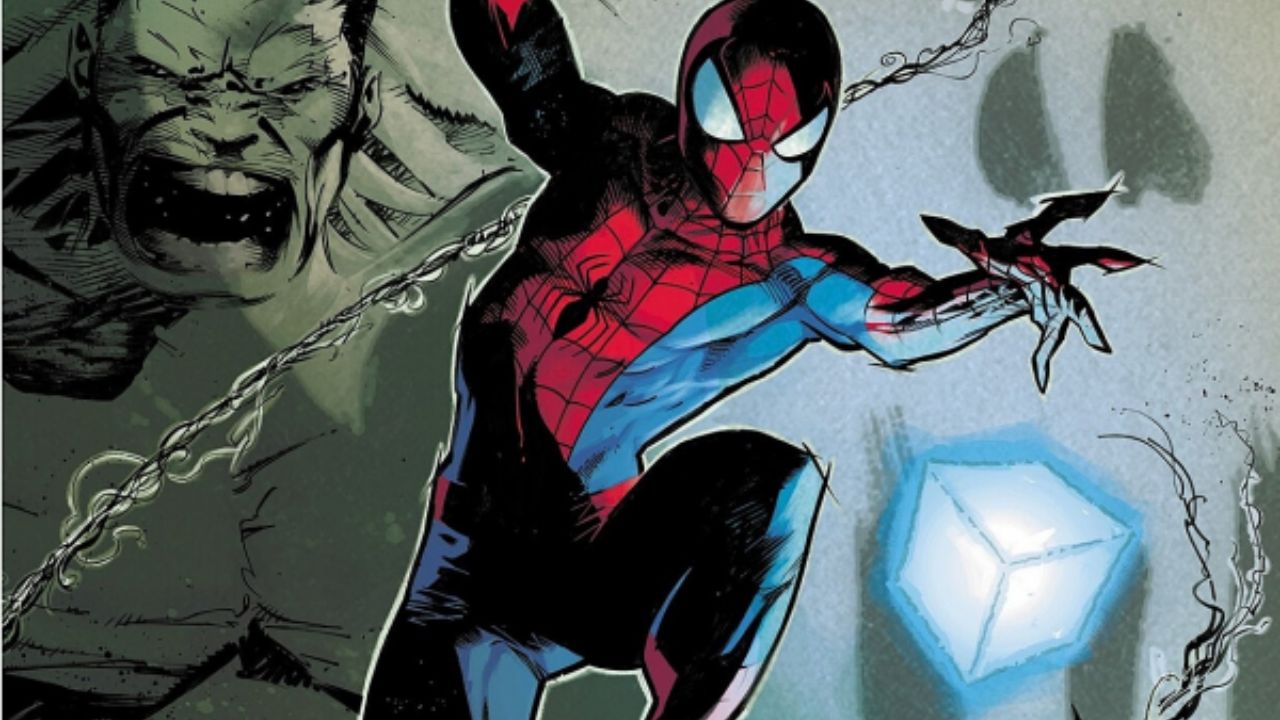
Jonathan Hickman returns to Marvel with a Spider-Man book that feels nothing like your typical neighbourhood adventure. From its very first page, Spider-Man: Long Way Home #1 drops you into a morally dense, non-linear espionage thriller — one involving black-ops soldiers, a missing Cosmic Cube, the Hulk on a mission nobody hired him for, and Peter Parker caught somewhere in the wreckage asking the question every reader is quietly asking alongside him: why am I here?
Which Is the Greater Evil?
The actual story begins not with Spider-Man, not with a jungle explosion, but inside a confessional booth in what appears to be a small Latin American mountain town. Adam Kubert’s panels here are vertical and tight, almost suffocating — the latticed grille of the confessional bisecting faces, the interior dark and intimate. An elderly priest leads a stranger through the traditional Catholic opening prayers in Spanish. “El Señor esté en tu corazón.” “Bendíceme, Padre, porque he pecado.”

The man on the other side of the screen wears a worn brown jacket and a pair of distinctive green-tinted circular goggles. The priest notices something quickly: the man’s accent. He’s American — “of a sort,” as the man coolly answers. The priest has had Americans in his confessional before. Intelligence officers. Military contractors. Men whose sins, he says, are “spread a mile wide and stacked a mile deep.” He dares to hope this one might be different.
The man removes his green goggles slowly. “No, Father. Not different.”
“Dare I hope you are something different?”
“…No, Father. Not different…”
“…much, much worse. …a moral man who ignores his conscience… or a monster who has none?”
— The Priest & The Stranger
The final panel of the scene zooms in on the man’s eye — and it is not a normal human eye. It is green, slit-pupilled, reptilian. Whether this is metaphorical, a visual representation of the “monster within,” or something far more literal remains one of the issue’s deliberate mysteries. What’s certain is the thematic framework it establishes: this question of the greater evil — conscience ignored versus conscience absent — will echo through every scene that follows.
The Team That Never Existed
Hickman cuts directly from the confessional into a flashback. The narration — dry, military, delivered without sentiment — sets the stage. After the Berlin Wall fell but before the next formal war began, a handler named Sheppard recruited a team of soldiers and set them loose on the world. Over a hundred missions, erased, denied, or forgotten. Their team was honed to a razor sharpness. And at some point, they stopped caring about the whys and the reasons. What mattered was the job. What mattered was coming home.

We meet them all inside a cramped military helicopter, lit in that deep red cockpit glow that signals night operations and poor odds. Arthur Hesli’s colors here are superb — all blood-red interiors cutting to that vast, moon-bathed blue-black jungle outside.
Mission Roster — Callsigns and Ranks
Major
Donald Duke “Wallet”
Lieutenant
Frank Castle “Punisher”
Sergeant
Dexter Hollings “Farmhouse”
Corporal
Tomas Dukes “Jowls”
Corporal
Devlin Wayne “Doorknob”
Sergeant
Jack Ward “Sweetgrass”
Frank Castle is here. Before the skull. Before the war on crime. His callsign on the team is already “Punisher” — written right there on his label, which immediately raises the question of what this mission will cost him and how it might shape the man he eventually becomes. He takes the overwatch position, watching the treeline through the scope while the rest of the team drops into the jungle. His internal narration is bone-dry, fatalistic, and utterly Frank Castle.
As they rappel into the jungle on a fat full moon, the team banter flows freely. “Farmhouse” admits he has a bad feeling about this one — he always does, they’d all be worried if he didn’t. “Doorknob” isn’t wrong but concedes there are too many moving pieces for his comfort. “Sweetgrass” just wants to get in, do the job, and get to the border. “Jowls” teases him about his blind girlfriend. It’s that kind of easy, warm team chemistry that great war stories use to make you care about people before putting them in danger.
Into the Hive — A.I.M., Hydra, and the Box
The mission parameters, as Castle narrates from his overwatch position, are deceptively simple: surround and scout an Advanced Ideas Mechanics base hidden in the jungle; infiltrate; neutralize any A.I.M. agents encountered; and retrieve “the device.” That’s all. No description of the device. No further context. Just: retrieve it. As Castle notes grimly, the mission objective was “clear as mud.”

Complicating the approach was the known probability of Hydra interference — a variable that, from the smoke already rising on the horizon at the drop site, had very clearly become a certainty. Castle scans the burning perimeter from the trees and thinks to himself: “God, do I hate bein’ right.”
Hydra has beaten them to the punch. Green-uniformed soldiers are already assaulting the A.I.M. perimeter as the team enters through the southeast, using the chaos as cover. The interior of the base is a hive structure — long conduits, subterranean labs, the A.I.M. yellow suits already taking casualties as Hydra pushes in. Wallet directs the team deeper while Punisher holds overwatch outside.
And then, at the centre of the base’s critical lab, suspended in cables from the ceiling: the wreckage of a Super Adaptoid. Someone — or something — has torn it apart for spare parts. It should be unnerving enough on its own. But the real discovery is the base’s lead scientist, a wild-eyed, round-goggled man who has apparently been waiting for this moment.
He announces what all of this hardware was designed to create. Twenty billion dollars of equipment, sacrificed for one singular purpose. The result — sitting in its containment housing, glowing faintly — is a Cosmic Cube.
The Cosmic Cube is one of Marvel’s most dangerous objects: a reality-warping artifact capable of granting wishes to its wielder. Its effective power has no defined ceiling. Its critical variable is stability — an unstable Cosmic Cube is as dangerous as an active one, perhaps more so, because its effects are unpredictable and uncontrollable.
The scientist is practically vibrating as he offers to unlock the cube and carry it himself if the team will take him along. Before anyone can process that offer, Hydra soldiers crash through the wall — “HAIL HYDRA!” — and the lab explodes into firefight chaos. Bullets fly. The cube is loose in the confusion. And then the entire upper section of the base shakes with a catastrophic impact. Something has come in from above.
Peter Parker Gets the Call
Hickman cuts away from the jungle — a deliberate structural move that threads present-day New York between the flashback sequences. It’s night in the city. An alarm goes off. Peter Parker stirs in bed, phone ringing.

He tries the standard deflection. “Hello? Wrong number.” The voice doesn’t play along. “Cut the crap, Parker. Do you know who this is?” The caller knows his name — knows who he is and how to reach him. Peter recognises the voice and sits up: “Spider-Man?” A brief exchange follows. There’s an agent waiting at the S.H.I.E.L.D. Intrepid substation. Five minutes.
“Cut the crap, Parker. Do you know who this is?”
“…Spider-Man?”
“…yeah.”
— Unknown Caller & Peter Parker
The phone clicks off. Peter sighs, pulls on the suit, and leaps out the window into the New York night with a muttered “Fantastic.” The quiet domesticity of his apartment — the messy bed, the pale light of the phone — makes the transition to what awaits him all the more jarring.
The Green Rage Problem
Back in the jungle. In the lab, before the full chaos erupts, a voice cuts in from somewhere above — a face visible in a small circular screen. The question it poses hangs in the air like a lit fuse: “Tell me, gentlemen, have you ever wanted to play god?” Then the ceiling comes down.
Something massive crashes through the top of the facility — the explosion visible from outside, where Punisher tracks the fire through his scope. Inside, the team is dealing with the simultaneous collapse of the Hydra assault and whatever just breached the upper structure. Through a shattered viewport, between the smoke and the screaming, something enormous fills the frame.

The Hulk.
A full double-width spread shows him as the Hydra soldiers see him: filling the entire back wall, fists up, eyes blazing with blue-white energy, a wall of green muscle that makes the room feel like a toy box. Dozens of Hydra soldiers raise their weapons at him in a neat line. One of the team members says quietly from the back of the room: “Uh, guys… little problem here.”
It’s a brilliant comic beat. The understatement of the decade. The team barely survived a Hydra assault inside an A.I.M. base. And now the Hulk is in the room. With them. Next to the Cosmic Cube.
What follows is the most chaotic sequence of the issue. The team tears through the facility corridors in full retreat, guns blazing in every direction. Hydra soldiers go down. A.I.M. agents are already dead. Ariana Maher’s lettering goes operatic — “DAKKA-DAKKA-DAKKA RAT-A-TAT-TAT” fills pages edge to edge, the visual noise of a full firefight barely covering the deeper, more ominous sounds of the Hulk moving through walls behind them.
Jowls, and the Weight of Every Empty Click
From his scope, Punisher tracks the team emerging from the base, guides them clear, and then pauses. Something in the sight picture changes. “You— Wait. I see it.” His eye pulls to something massive following the team through the brush. “My god… What is that?”
Even Frank Castle — a man defined by his refusal to flinch — is shaken by what he sees in that scope.

In the jungle, Doorknob explains what the cube means in practical terms as they run: if it’s a genuine Cosmic Cube and if it’s stable, it’s essentially a genie’s lamp. Make a wish. See it come true. Wallet asks what “stable” means and — mid-sentence — the question is answered for him. A scream rips through the jungle:
“AAAAAAA”
“Jowls?”
— The Team
No lingering. No mourning on the page. The narration doesn’t have time for it, and neither does the team. Jowls — easy grin, teasing Sweetgrass about his señorita thirty pages ago — is gone. A minigun lying in the dirt. Blood on the ground. They run.
The team opens up with everything they have. Multiple full-width panels of sustained gunfire — “RAT-A-TAT-TAT DAKKA-DAKKA-DAKKA” repeating in an almost hypnotic rhythm, the sound of an entire team emptying every magazine they carry into a single target. Page after page of muzzle flash and sound effects, until the final panel strips away all colour and sound and leaves only four things: “CLICK. CLICK. CLICK. CLICK.”
Smoke. Fire. Silence. And then movement in the flames.
“You didn’t miss… All you did was make me angry.”
— The Hulk
Full page. The Hulk walks out of the inferno. Scorched. Still holding a team member in one massive fist. Not particularly winded. The horror of the image is in its casualness — he has absorbed everything they had and it cost him nothing except his patience.
Someone Has to Stay
Grenades. The team throws everything that’s left. Three pages of BOOMs and close-ups of the Hulk’s burning, bleeding face — a terrifying mask of green rage — and then he delivers a line that reads more like a dare than a threat:
“Well? You gonna stand there? Or you gonna run?”
— The Hulk

They run. Through the jungle at night, over uneven ground, until they hit a rope suspension bridge — one of those thin, swaying things that hangs over a dark gorge with nothing below but darkness. One of the team turns back. Fires a burst of energy from a weapon glowing hot. The others stop. The team member is already in position, holding the bridge side:
“Get across the bridge and collapse it… I’ll hold ’em off!”
Protest. “You don’t have to—”
“I SAID GO!”
They cross. The bridge comes down behind them. The sound that follows — a long, trailing YAAAAAAAAAA — says everything the page doesn’t need to write. Another member of the team, gone. The Hulk doesn’t need the bridge. He leaps the gap. He always does.
“Give It to Me” — The Hulk’s Real Objective
The last confrontation comes in a clearing, lit by the ambient green of the cube and the distant glow of the burning base behind them. The Hulk closes in — not rampaging, but purposeful. And his demand is specific in a way that stops the surviving team members cold:

“Give it to…me. Give me…the cube.”
— The Hulk
Doorknob stares at him. “That’s what this is over? That doesn’t make any sense… How’d you know it was there? Who hired you?” These are exactly the right questions — and the Hulk does not answer them. The cube is not a prize he stumbled upon. The Hulk came here for it. Someone sent him. Someone told him where to look. The implications of that are left entirely unresolved in issue one, and deliberately so.
The Hulk’s final demand — “GIVE IT TO ME!” — fills an entire close-up panel. Teeth. Green. Rage. An open mouth big enough to swallow a car.
Doorknob looks at the glowing cube in his hands. Looks at the Hulk. And makes the only move left.
“You want it… fine. Here you go.”
He fires the Cosmic Cube. Or fires it at the Hulk. The result is the same — a massive FWASSHHHHH of released energy that lights the jungle blue-white and sends something enormous arcing away through the night sky. The genie’s lamp, as it turns out, is not stable. But as the lone survivor standing in the aftermath quietly notes: that doesn’t mean it can’t be useful.
“Over a hundred missions — a team honed to a razor sharpness, experienced… proven… the best there was… but this time, only one of us was comin’ home.”
— Survivor (Narration)
Page 23 is a full-page splash: a lone figure in tactical gear walking away through dense blue-black jungle, an owl watching from a branch above, the broken fragments of the Cosmic Cube glowing faintly in the mud at his feet. He speaks to no one. “What’s the world comin’ to?” It’s one of the best images in the issue — the scale of what’s been lost compressed into a single quiet tableau.
Spider-Man at the Aftermath
Time has passed. S.H.I.E.L.D. helicarriers hang in the air above what remains of the A.I.M. base. Spider-Man swings in to find a war zone — dead A.I.M. agents, dead Hydra soldiers, and some casualties so thoroughly destroyed that the two factions are indistinguishable from each other. Peter surveys all of this through his white lenses with a line that is pure Parker: “Gotta say… I’m glad I skipped breakfast.”

He turns to Agent Quartermain with the eminently reasonable question of why he’s there. Quartermain explains, with the brisk efficiency of someone who does not have time for his reaction:
S.H.I.E.L.D. was operating under international agreements that required a third-party intermediary rather than direct agent involvement. Someone in leadership decided a superhero would serve that role nicely. The situation — which was supposed to be a controlled three-way dance monitoring Hydra’s planned assault on the A.I.M. facility — has instead become a catastrophe of sufficient scale that they now need help of the superhero variety specifically. Quartermain has helicarriers, thousands of agents, and several million rounds of ammunition. But what’s down in that jungle is the kind of problem you don’t get to refuse.
“You are here because that ain’t no where near the kind you don’t get to refuse. So welcome aboard, Spider-Man.”
— Agent Quartermain
Spider-Man’s response — unspoken, internal — is the same sigh that opened his night.
Great.
The issue closes on the page shown in the screenshot. Spider-Man stands at the edge of the cleared battlefield, looking down. On the jungle floor below him is a shattered piece of equipment — a screen, a glass panel from the destroyed A.I.M. base — lying face-up in the dirt. It’s acting as a mirror.

In its reflection: the jungle below, and the Hulk — crouched, dishevelled, snarling — and the unconscious body of another figure slumped beside him. Spider-Man’s own masked face stares back from the glass surface, framing the image. Somewhere above the scene, a single speech bubble:
“Great.”
— Spider-Man
One word. It carries the entire issue’s weight on its back. The Hulk is still here, still connected to whatever happened during that mission — the Cosmic Cube, the dead team, the unanswered question of who sent him and what he wanted to wish for. The cube is shattered somewhere in the jungle. One soldier from a ghost team came out alive. A mystery man with green reptilian eyes is confessing sins he hasn’t named yet. And Peter Parker, who agreed to be a third-party intermediary for a spy operation he didn’t ask to join, is now standing at the intersection of all of it.
Great.