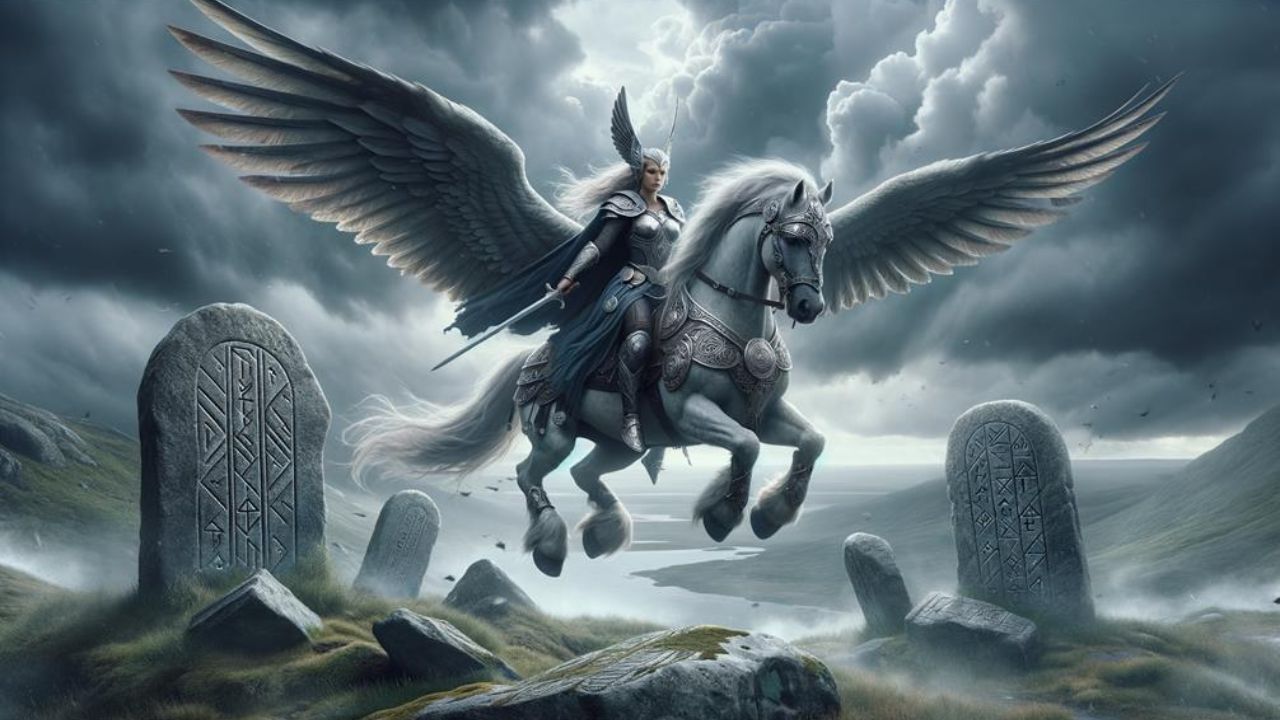
There is a battlefield. The air is thick with iron and ash. Somewhere between the living and the dead, among the clash of shields and the cries of fallen men, she rides — neither mortal nor wholly divine, armed with a spear and a sovereign will over who breathes their last breath. She is a Valkyrie. And she is nothing like what most people imagine.
The name Valkyrie has suffered centuries of romanticization. Wagner dressed them in horned helmets and sent them soaring through operatic thunder. Modern pop culture gave them wings, attitude, and increasingly, a redemption arc. But strip all of that away, and what you find in the original Norse sources is both stranger and more profound — a being that embodied the Norse understanding of fate, war, death, and the relationship between gods and mortals in a world perpetually on the edge of annihilation.
So who were they, really? Let’s start at the beginning.
The Name Itself Is a Warning
The Old Norse word Valkyrja — plural Valkyrjur — translates with brutal clarity. Valr means “the slain,” those fallen in battle. Kjósa means “to choose.” Put them together and you get: Choosers of the Slain. Not rescuers. Not mourners. Choosers. They didn’t arrive on the battlefield out of compassion; they arrived with a job to do.
That job was, at its core, a cosmic administrative task — one with enormous theological weight. In the Norse worldview, the universe was marching toward Ragnarök, the great final battle that would consume gods and men alike. Odin, the Allfather, needed an army. Not just any army. The greatest warriors who had ever lived. And the only way to recruit them was through death.
The Economy of the Slain

In Norse cosmology, Valhalla — Odin's hall — was not a reward for a virtuous life. It was a military installation. The einherjar, warriors chosen to dwell there, spent every day training, fighting, dying, and being resurrected. They were being prepared for one purpose: to fight alongside the gods at Ragnarök. The Valkyries were the recruiters.
The Valkyries flew over battlefields not simply to escort the dead but to actively decide the course of the battle. Ancient sources describe them weaving the outcomes of conflicts, choosing which warriors would die — and selecting the finest among them for Valhalla. The other half of the slain went to Fólkvangr, the field of the people, presided over by the goddess Freya. Yes — even the dead were divided between two divine powers.

Servants of Odin, Daughters of Something Older
In the poetry of the Eddas and the skaldic verse that preserves much of what we know about them, the Valkyries are most often described as Odin’s handmaidens, his warriors, his will made manifest on the battlefield. They carry out his decrees. They pour mead in Valhalla’s vast hall. They serve the einherjar as both cup-bearers and guardians.
But this servile image hides something more complicated. In older, darker texts — particularly the skaldic poem Darraðarljóð (the Song of the Spear) preserved in Njáls saga — the Valkyries appear as something altogether more terrifying. In this poem, twelve Valkyries are discovered at a loom, weaving the fate of a battle using human intestines as thread, severed heads as weights, and swords as shuttles. They are not handmaidens here. They are weavers of doom, closer in spirit to the Norns — those ancient beings who spin the threads of fate itself — than to any kind of angelic attendant.
“They were not angels of mercy. They were the instruments by which the universe kept its appointment with the end of all things.”
This duality — loyal servant and autonomous fate-weaver — runs through nearly every account of the Valkyries and suggests that these figures drew from multiple, older mythological traditions. Some scholars have proposed that the Valkyries evolved from earlier Germanic death spirits, female beings associated with war and the dead, who predate Norse mythology’s more organized pantheon. Others connect them to the dísir, ancestral female spirits who watched over clans and families, sometimes protective, sometimes terrifying.
Whatever their origins, by the time the Eddic poems were composed in medieval Iceland, the Valkyries had become a rich, layered concept existing at the intersection of fate, war, divine will, and female supernatural power.
Their Names Tell Their Nature
One of the most revealing ways to understand the Valkyries is simply to look at their names. They were not given the soft names of flowers or seasons. Their names were drawn directly from the vocabulary of battle and death, and the Old Norse poets clearly chose them with intentional weight.
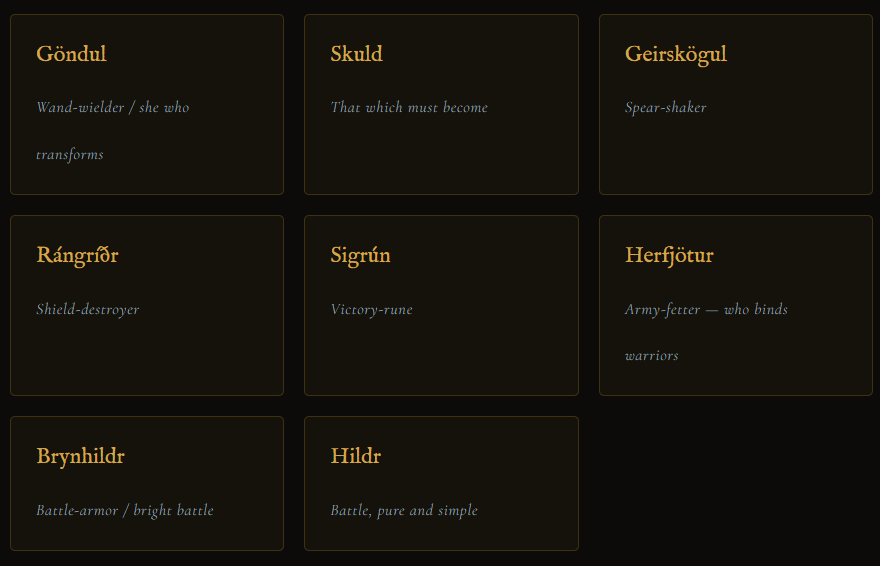
Notice what is absent from these names: beauty, grace, compassion, mercy. Several — like Herfjötur (Army-fetter) — suggest an active, hostile role in battle, the ability to paralyze warriors, to rob men of their fighting ability at the critical moment. This was understood as a real power: a warrior might feel his limbs go numb before death, and the Norse saw the invisible hand of a Valkyrie in that failure.
The Women Between Worlds
One of the more genuinely fascinating aspects of Valkyrie mythology is that several named Valkyries appear in heroic legend as something far more personal than cosmic battlefield operatives. They appear as women — women who fall in love, who defy gods, who are punished for their autonomy, and who exist in the tragic space between divine duty and human feeling.
Brynhildr is perhaps the most famous of these. In the Völsunga Saga, she is a Valkyrie who defies Odin’s decree by choosing the “wrong” warrior for victory in a battle. As punishment, Odin pierces her with a sleep thorn and surrounds her with a ring of fire, condemning her to sleep until a man brave enough to cross the flames wakes her. That man, eventually, is Sigurðr — the great hero. What follows is one of Norse literature’s most devastating love stories: a romance fractured by memory, betrayal, enchantment, and death.
Sigrún’s story is equally poignant. She is described in the Helgakviða Hundingsbana as a Valkyrie who loves the hero Helgi Hundingsbane, mourns his death with a grief that the poem renders with startling tenderness, and is allowed one final night with his shade before he departs the world forever.
The Swan Maiden Tradition

Several Old Norse texts describe Valkyries wearing swan cloaks — enchanted garments that allowed them to fly and shapeshift. If a mortal could steal the cloak while the Valkyrie bathed, he could capture her. This connects the Valkyries to a much older pan-European tradition of supernatural "swan maidens," female beings bound to a mortal life through the loss of their otherworldly garment — a myth that recurs from Ireland to Siberia.
These narratives do something subtle and important: they humanize the Valkyries without diminishing them. They are not made pathetic by love. If anything, Brynhildr’s story is one of extraordinary agency — even betrayed, even imprisoned, even burning, she drives the final tragedy through sheer force of will. The Norse did not sentimentalize their supernatural women; they gave them teeth.
What They Were Not
It would be a mistake — a popular, understandable, but real mistake — to read the Valkyries primarily through the lens of modern fantasy, or even through Wagner’s magnificent but thoroughly 19th-century interpretation. The Valkyries of the original sources were not warrior women in the sense of mortal female soldiers (that honor, if anything, belongs to the legendary skjaldmær, shield-maidens). They were not angels in any Christian theological sense. They were not simply beautiful women on horses dispensing mercy to dying men.
They were agents of a cosmos organized around war, fate, and eventual apocalypse. Their “mercy” — if you could call the selection of a warrior for Valhalla a mercy — served a larger, indifferent design. From the perspective of a Norse warrior, being chosen by a Valkyrie was an honor, yes, but it was also simply the machinery of fate operating on schedule.
The Norse relationship with death was not one of fear and denial. Death on the battlefield was not a tragedy to be avoided but a threshold to be crossed in the right way. The Valkyries were the threshold itself, personified — beautiful because fate can be beautiful, terrifying because death always is.
Their Legacy in the Real World
The Valkyries left traces in history that go beyond poetry. Archaeological finds from the Viking Age include small silver figurines — some found in Scandinavia, one notably discovered in Hårby, Denmark — depicting women with long braided hair, sometimes carrying drinking horns or shields. These are widely interpreted as Valkyrie figures, suggesting that they were venerated in some tangible, material way, not just recited in poetry.
There is also the question of the valknut, that knotted symbol of three interlocking triangles found on memorial stones and Viking artifacts, often in contexts associated with Odin and the slain. Some researchers connect this symbol to the Valkyries’ role as weavers and choosers of fate, a visual shorthand for the mysteries surrounding death in battle and passage to Valhalla.
Place names across Scandinavia and northern Europe preserve echoes of these beliefs. Names containing elements meaning “field of the slain” or “Odin’s warriors” dot the linguistic landscape of the old Norse world, and some scholars have argued that certain sites associated with battle and the dead may have been understood as places where the Valkyries were particularly present.

Why They Still Matter
You might reasonably ask why any of this is worth knowing in the modern world. The simple answer is that the Valkyries represent one of the most sophisticated mythological engagements with a problem every human culture must face: how do you make sense of violent death?
The Norse answer was not to console. It was to find meaning in the machinery. The battlefield was not chaos; it was the operating floor of a cosmic plan. The dead were not lost; they were recruited. And the being who stood at that crossing point — the Valkyrie — was not a monster, not a comforter, but something stranger and more honest: a figure who acknowledged that fate was real, that death had a purpose, and that the universe was indifferent to your suffering but not indifferent to your courage.
That is a hard theology. It is also a deeply human one. And it explains why the Valkyries have never quite gone away — why they keep surfacing in literature, art, music, and games long after anyone stopped believing in Odin. They carry something true about the experience of mortality and the desire to find significance in loss.
The armor and the ravens and the battlefield gallop: those are the costume. What lies beneath is a question that has never stopped being asked. Who decides who lives and who dies? What happens to the brave? Where do the fallen go?
The Valkyries were one civilization’s attempt to answer it. And what an answer it was.
A Final Word on the Choosers
The Valkyries occupy a space in world mythology that very few figures manage: they are simultaneously terrifying and magnetic, servants and sovereigns, agents of doom and guardians of the honored dead. They belong to a mythology that looked at a violent, uncertain world and decided to give it a face — many faces, in fact, each named for the very things that ended life.
That the modern world continues to find them compelling is not surprising. In an age that still struggles to speak plainly about death, there is something clarifying about a tradition that looked death in the eye, named it Göndul and Skuld and Herfjötur, and sent it riding.