Every week, without thinking, we speak the names of ancient gods. We say “Thursday” when we mean the day of Thor, the hammer-swinging Norse god of storms. We say “Friday” without remembering Frigg, Odin’s queen and the Norse goddess of wisdom. And we say “Sunday” in unconscious tribute to the celestial body once worshipped across half the ancient world. The days of the week are, in every real sense, a living mythology — one that has survived thousands of years and continues to roll off every tongue in the English-speaking world.
How did this happen? The story begins in Babylon, travels through Rome, crosses the English Channel, and eventually lands in the longhouses of Viking-age Scandinavia. It’s a tale of cultural collision, linguistic borrowing, and the slow, grinding evolution of language itself. Buckle up — or rather, sharpen your quill — because this is one of history’s most quietly remarkable stories.
A quick note on origins: The seven-day week was likely invented by the Babylonians around 2000 BCE, inspired by the seven celestial bodies visible to the naked eye — the Sun, Moon, Mars, Mercury, Jupiter, Venus, and Saturn. The Romans adopted this system, named each day after a planet (which was also the name of a god), and the rest of the ancient world followed. When Germanic tribes encountered the Roman calendar, they swapped many of the Roman gods for their own equivalent deities — a process linguists call interpretatio germanica. English got its days from that process.
Let’s walk through the week, one day at a time.
Sunday — Day of the Sun
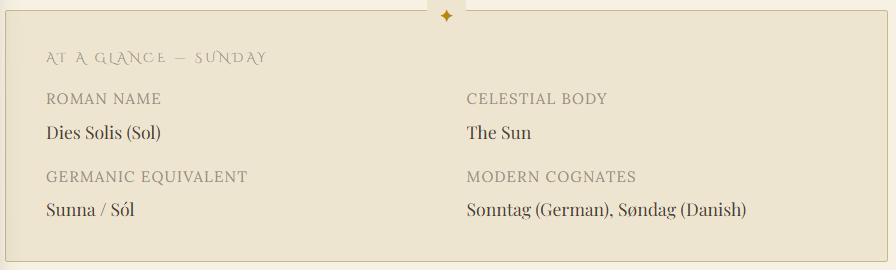
Old English: Sunnandæg · Latin: Dies Solis
Of all seven days, Sunday is perhaps the most straightforward. It simply means “the Sun’s day,” and that has been true in virtually every culture that adopted the Roman week. In Latin it was Dies Solis — literally the Day of the Sun. In Old English it became Sunnandæg, which compressed into the “Sunday” we say today.
But the Sun was far from a passive symbol. In the ancient world, the Sun was one of the most consistently worshipped deities across civilizations that had no contact with each other. The Egyptians worshipped Ra, their solar god, as the supreme ruler of the gods. The Romans had Sol Invictus — the Unconquered Sun — whose feast day on December 25th was later folded into Christmas by early Christianity. The Greeks had Helios, who drove a blazing chariot across the sky each day. The Inca revered Inti. The Japanese divine lineage traces back to Amaterasu, the goddess of the sun.
“The sun is the same in a different eye” — and yet, across every civilization on earth, someone looked up and saw a god.
Even the Germanic tribes, who tended to resist Roman influence more than most, kept the solar name when they translated the Roman week. The sun was simply too important to rename.
Monday — Day of the Moon
Old English: Mōnandæg · Latin: Dies Lunae
If Sunday belongs to the Sun, it was only natural that the following day belonged to the Moon. In Latin: Dies Lunae. In Old English: Mōnandæg. In French: Lundi. In Spanish: Lunes. The Moon’s claim on the second day of the week is one of the most cross-linguistically consistent facts in the entire calendar.
The Moon, like the Sun, was worshipped in almost every ancient culture — but with a very different personality. Where the Sun was bright, commanding, and male in most traditions, the Moon tended to be associated with mystery, femininity, cycles, and the night. The Romans attributed the Moon to Luna, their goddess of the moon, who was often depicted riding a silver chariot through the night sky. The Greeks called her Selene, and she was said to fall in love with the sleeping shepherd Endymion, visiting him each night as he lay on a hilltop.
For Germanic peoples, the moon deity was Mani (Old Norse), a male figure — one of the interesting reversals in world mythology, where Germanic tradition made the Moon masculine and the Sun feminine (the goddess Sól). Norse mythology tells us that Mani drives the moon chariot across the sky while being chased by a wolf named Hati. One day, the myth warns, Hati will catch him — and that will be the end of the world.
Etymology note: The word "moon" itself comes from Proto-Germanic *mēnô, which shares its roots with the Proto-Indo-European word for "measure" — because ancient peoples used the moon to measure time and mark the months. The word "month" comes from the same root. Monday, then, is doubly connected to timekeeping.
Tuesday — The Day of Tyr
Old English: Tīwesdæg · Latin: Dies Martis
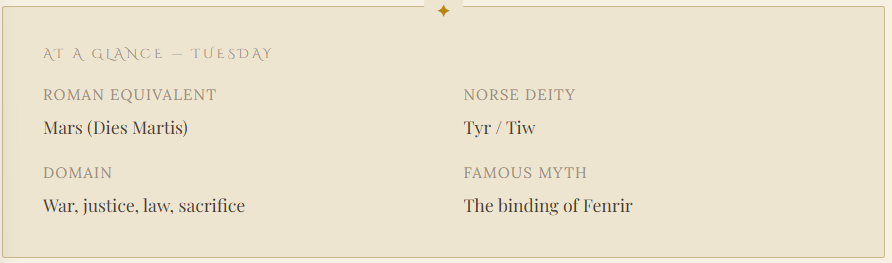
Here is where the calendar leaves the celestial and enters the mythological. Tuesday takes its name not from a planet in the sky, but from a specific Norse god: Tyr (also spelled Tiw or Tiwaz in earlier Germanic). The Roman equivalent was Dies Martis — the Day of Mars, god of war. Germanic peoples looked at Mars and said: yes, we have a war god too. His name is Tyr. And so the day was renamed.
Tyr is one of the most fascinating and underrated figures in the Norse pantheon. He was the god of justice, law, and single combat — a warrior, yes, but one defined by honor rather than violence. He is famous for a single act of extraordinary sacrifice recorded in the Prose Edda: the binding of Fenrir.
Fenrir was the monstrous wolf, son of Loki, who the gods knew would one day grow powerful enough to devour Odin himself at Ragnarök. The gods tried to bind him, but he broke every chain. Finally, the dwarves crafted Gleipnir, a magical ribbon made from impossible things — the sound of a cat’s footfall, the beard of a woman, the roots of a mountain. Fenrir would only allow himself to be bound if one of the gods placed their hand in his mouth as a pledge of good faith.
Tyr placed his hand in the wolf’s jaws. He knew what would happen. And he did it anyway — because it was necessary, and because he was the only one willing.
From the Prose Edda, retold
When Fenrir found he could not break the magical ribbon and realized he had been deceived, he bit off Tyr’s hand at the wrist. Tyr lost his hand so that the world could be safe — for a while. It is one of the oldest stories of self-sacrifice for the greater good that we have. Every Tuesday, you are quietly honoring a one-handed god who gave his arm for justice.

Wednesday — The Day of Odin
Old English: Wōdnesdæg · Latin: Dies Mercurii
Wednesday is linguistically the trickiest day in the English week — nobody says it the way it’s spelled. WED-nes-day. That silent “d” is a ghost of Old English Wōdnesdæg: the Day of Wōden, the Anglo-Saxon name for Odin. The Romans called it Dies Mercurii — the Day of Mercury — and it was this equation between Odin/Wōden and Mercury that the Germanic tribes made when adapting the Roman week.
On the surface, the comparison might seem odd. Mercury is the quick-footed messenger, the god of trade and commerce. Odin is the brooding, one-eyed Allfather, lord of war and wisdom. But look closer and the parallels are real: both are travelers who move between worlds. Both are associated with language, poetry, and communication. Mercury guides souls to the underworld; Odin rides his eight-legged horse Sleipnir through the nine realms. Both are shapeshifters. Both are cunning. The Germanic tribes saw in Mercury a kindred archetype.
Odin is perhaps the most complex figure in all of Norse mythology. He is a god of wisdom who sacrificed his eye by casting it into the well of Mimir to gain cosmic knowledge. He is a god who hung himself from Yggdrasil — the World Tree — for nine days and nine nights, wounded by his own spear, in order to learn the secret of the runes. He collects the souls of warriors fallen in battle, bringing them to Valhalla to prepare for Ragnarök, the final battle. He keeps two ravens, Huginn (Thought) and Muninn (Memory), who fly across the world each day and return to whisper in his ears everything they have seen.
Curious: Wednesday is the only day of the week whose name is almost unrecognizable from its origins — a testament to how dramatically English pronunciation shifted over the centuries while spelling stayed behind, frozen in time like an insect in amber.
Thursday — The Day of Thor
Old English: Þūnresdæg · Latin: Dies Jovis
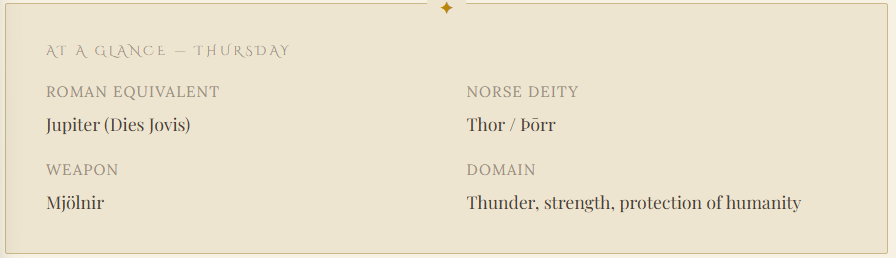
Perhaps no day of the week carries a more recognizable mythological pedigree. Thursday is Thor’s day, and even casual readers of Marvel comics or Norse mythology will know the name. The Romans mapped it to Dies Jovis — the Day of Jupiter, king of the Roman gods. Once again, the Germanic tribes saw the parallel: Jupiter was the thunder god who ruled Olympus; Thor was the thunder god who defended Asgard. Both wielded the sky’s most terrifying weapons. The swap was natural.
Thor — known as Þōrr in Old Norse — is the son of Odin and the earth goddess Jörð. He wields Mjölnir, his legendary hammer, which can flatten mountains and call down lightning. He drives a chariot pulled by two goats, Tanngrisnir and Tanngnjóstr, and the rumble of that chariot is said to be the sound of thunder. He is the protector of humanity, the god invoked by Norse farmers and sailors, the defender against giants and chaos.
Unlike the aristocratic, politically complex gods of Mount Olympus, Thor has always been a fundamentally populist deity. He drinks prodigiously, argues loudly, and fights without hesitation — but his heart is always in the right place. There’s a famous story of Thor disguising himself as a bride to retrieve his stolen hammer from the giant Thrym, calmly eating an ox, eight salmon, and three barrels of mead at the wedding feast before anyone grew suspicious. Not exactly Apollo’s style. The Norse loved him for it.
Thor is not the cleverest god in the Norse pantheon. He is the most dependable. And in a cosmos as dangerous as the Norse one, that counts for more than cleverness.
Friday — The Day of Frigg (and Freya)
Old English: Frīgedæg · Latin: Dies Veneris
Friday is the most contested day in Norse mythology — contested not by scholars arguing, but by the goddesses themselves. The Roman Dies Veneris was the Day of Venus, goddess of love and beauty. When Germanic peoples translated this day, they named it Frīgedæg, the day of Frīg — but scholars have debated for generations whether that name refers to Frigg, Odin’s wife, or Freya, the Vanir goddess of love and magic, or whether the two were originally the same goddess whose myths later diverged.
Frigg is Odin’s queen, the goddess of marriage, motherhood, and foresight. She alone among all beings knows the fate of every living thing — but she never speaks of it. She is wisdom through silence, power through restraint. Her most heartbreaking myth is the death of Baldr, her radiant son. Sensing his doom, Frigg traveled the entire world and extracted an oath from every living thing — every animal, every plant, every rock and stone — that they would never harm Baldr. She missed only one thing: the mistletoe, which she deemed too young and too harmless to bother with. Loki, of course, discovered this, fashioned a dart of mistletoe, and guided the blind god Höðr’s hand. Baldr fell. The first death among the gods.
Freya, on the other hand, is the goddess of love, fertility, magic, and war. She drives a chariot pulled by two giant cats. She owns a cloak of falcon feathers that allows the wearer to transform and fly. She is the leader of the Valkyries. She weeps tears of red gold. She is one of the most widely worshipped deities in the Norse world, and arguably its most powerful sorceress. The magic she practices, called seiðr, gives its user the ability to alter fate itself.
The Frigg–Freya mystery is one of mythology's most fascinating puzzles. Both are associated with love, foresight, and gold. Both are connected to the falcon-feather cloak. Some modern scholars believe they were originally a single great goddess whose mythology split as her stories were told and retold across centuries. Either way — Friday honors a goddess of remarkable depth.
Saturday — The Day of Saturn
Old English: Sæternesdæg · Latin: Dies Saturni
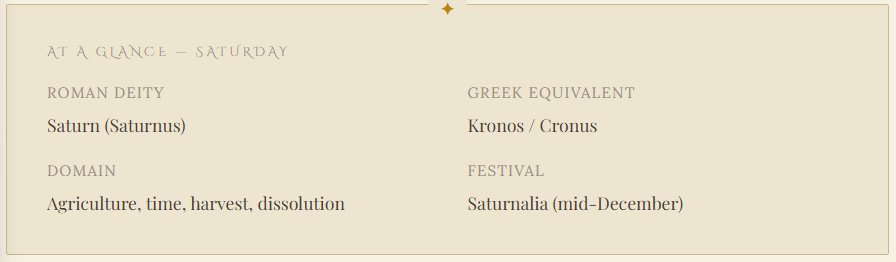
Saturday is the outlier — the only day in the English week that was never translated from Latin into a Germanic god’s name. Every other day swapped its Roman deity for a Norse equivalent. Saturday alone kept its Roman heritage intact: Dies Saturni, the Day of Saturn. In Old English it became Sæternesdæg, and we’ve called it Saturday ever since.
Why wasn’t Saturn replaced? The most likely answer is that the Germanic peoples had no good equivalent. Saturn was a complex deity who didn’t map neatly onto anyone in the Norse pantheon. He was the god of agriculture, time, renewal, and dissolution — a primordial figure who had ruled the cosmos before Jupiter overthrew him, consigning him to rule the underworld and, according to some traditions, the island of Britain. He was also associated with Kronos, the Greek titan who devoured his own children in fear of a prophecy that one would unseat him.
Saturn’s most famous celebration was the Saturnalia — a Roman winter festival in mid-December when social hierarchies were temporarily inverted, masters served their slaves, gifts were exchanged, and the world was briefly turned upside down in memory of the mythical golden age Saturn supposedly presided over. Scholars have traced many Christmas and New Year’s traditions back through Saturnalia. In that sense, Saturday’s god still shapes our December.

What We Carry Without Knowing
Seven days. Seven celestial bodies. A Babylonian calendar, a Roman empire, a Germanic migration, a Norse mythology, and somewhere in between — the slow, patient drift of language that carries old things forward long after anyone remembers what they meant.
We don’t invoke Odin when we check our Wednesday calendars. We don’t think of a one-handed god when we send a Tuesday email. And yet, in some small linguistic sense, we are always trailing behind us a vast invisible inheritance — thousands of years of human beings who looked up at the sky, felt afraid of the dark and the storm, and gave names to what they feared and loved.
The days of the week are, in that sense, a kind of secular prayer — or at least, a secular remembrance. A fossil record of belief, embedded in the language we use to schedule dentist appointments and complain about Mondays. The gods are still there, in the syllables, waiting for someone to notice.
Every week is a small mythology. You’ve been living inside one your whole life.
So the next time someone asks you what day it is, you’ll know: it depends on which god you want to name.