Some comic-book villains kill because they’re angry. Others kill because they’re broken, power-hungry, or simply monstrous. But in Amazing Spider-Man/Venom: Death Spiral — Body Count #1, Torment kills for something far stranger: love. Or at least, his horrifying version of it.
The Fall
New York City · Now
We open mid-action. Torment is airborne — and not by choice. Venom (Mary Jane Watson, bonded to her symbiote) has just thrown him off a rooftop, and as he tumbles through the purple Manhattan sky, we drop into his inner monologue. It’s wry, bitter, and unnervingly calm for a man who’s about to become street art.
People disappoint you. You try to help them, to give them a truly unique and special gift… and they throw you off a roof. Thanks very much, Venom.
— Torment, narrating his own death

He admits he “might have had it coming” — after all, he’s killed 189 people. Venom was supposed to be 190. “Oh well,” he says, with the resignation of a man cancelling a dentist appointment. In a few seconds he’ll hit the pavement. No more Torment. No more torment. He finds a dark poetry in that. His final question to himself — “what am I thinking about?” — cuts to a single black page with two phrases floating in the void: “What I always think about. Family.” And with that, we fall backwards into the past.
Vermont, Then
Vermont · Then
The first stop in Torment’s memory is a rain-soaked cemetery in Vermont. A young man named Rory Conway stands at a fresh grave, attended by a priest named Father Cunningham. But this isn’t a single loss — Rory tells the priest that he’s already buried his mother, father, brother, uncle, and cousin. His entire family tree has been stripped bare, one by one, in what seems like an impossible streak of tragedy. “How could this happen?” he asks. The priest can offer no comfort beyond presence. “You’re not alone,” Father Cunningham says. Rory’s hollow response: “Yeah? Sure as hell feels like it.”

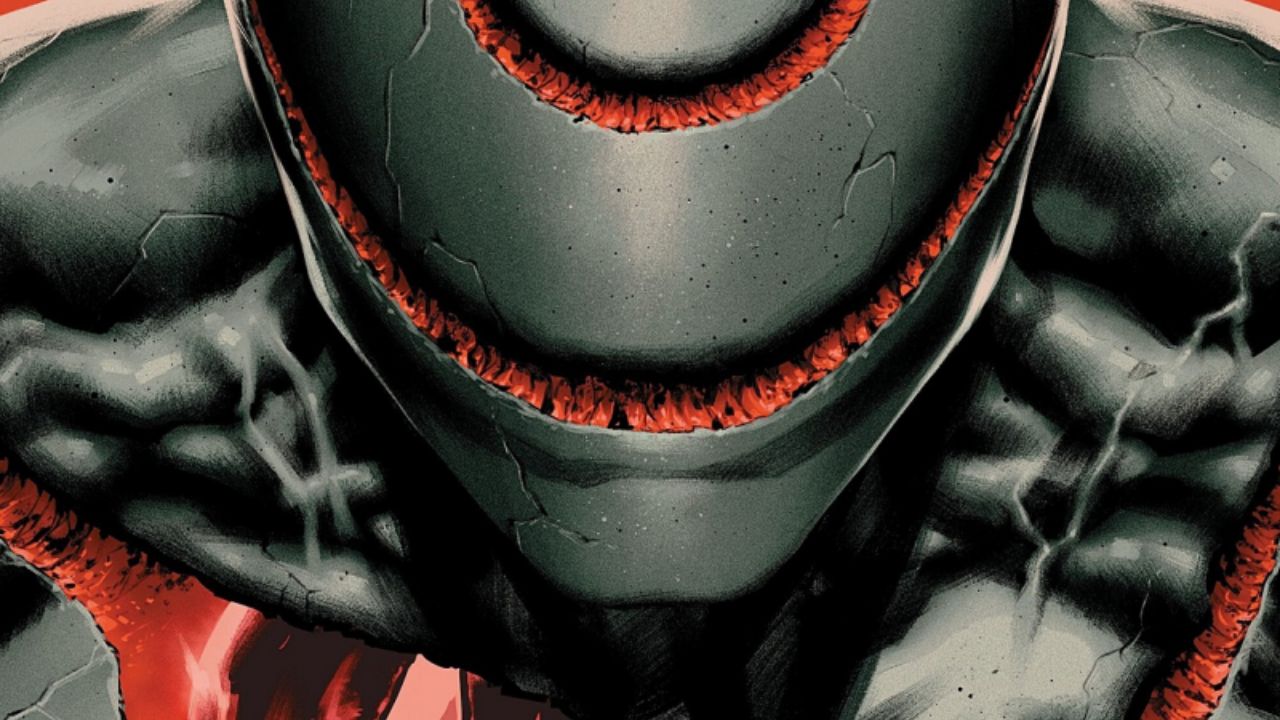
Later that night, Rory returns to his apartment. Someone is already inside, sitting in the dark. A large, bizarre figure in a black-and-white costume with a hypnotic spiral motif on his head — Torment. He crushes Rory’s phone before he can call for help, casually, clinically. Then he sits down and says: “Tell me how you feel.” The stage is set for what is essentially one of the most unsettling therapy sessions in Marvel history — except the therapist is a serial killer, and the patient has no choice.
Torment’s Power Revealed
Here the issue reveals Torment’s supernatural ability in full, chilling detail. He can see the connections between members of a family — invisible lines of bond and obligation that appear to him as spirals of light. “Some people only have a few,” he explains. “You used to have MANY, Rory Conway. That’s why I chose you.” Now, those spirals are nearly gone. Only very distant relatives remain. Rory, horrified, slowly realizes the truth: Torment didn’t arrive to inform him of tragedy. He is the tragedy. He killed Rory’s family. All of them. One by one. Because of spirals only he could see.
“Family,” Torment tells the trembling Rory, is what his story is about. And so he begins to tell it — not as an act of mercy, but because Torment has always desperately needed someone to understand him.
The Making of a Monster
The Past · Torment's Origin
Through flashback, we enter a sunlit summer afternoon at a family reunion — the kind of sprawling, loud, multigenerational gathering that fills backyard tables and tests everyone’s patience. The young man we’ll come to understand as the future Torment — here called Graham — is everything his family could want: charming, accomplished, artistic, a class treasurer going to Bard College on a soccer scholarship. He introduces his family to a girl he clearly loves: Laura Weddle. Laura is quieter, more guarded. Her home life, we’re told, is complicated. Her family is under a lot of pressure. Their great-aunt Gladys — a formidable, imperious elderly woman with an iron moral certainty — immediately sizes everyone up. Graham is her favourite. Laura is a project. Derek, Graham’s younger rebellious brother, is a disappointment-in-training. Mac, the middle brother, is somewhere in between.

But within the warmth of all this family noise, there’s something Graham can see that no one else can: the spirals. The glowing ribbons of familial connection that wrap around everyone at the reunion like invisible chains. He sees how thick they are, how tight. Pressure, he calls it. The bigger the family, the more opinions and obligations binding a person. He sees it on Laura most of all — her spiral tied so tight around her neck it’s practically choking her.
◆ ◆ ◆
That night, Laura goes home to her difficult household. Her mother is harsh and demanding — commanding her to clean the entire house alone before bed, dismissive and cold. Graham calls from outside: “College awaits.” It feels like a promise. Like rescue. But while Laura sleeps, something happens. There’s smoke. Fire. Graham appears at her window.
Don’t worry. I’ll get you out. No time — we have to MOVE.
— Graham (the future Torment), pulling Laura from the burning house
But when Laura screams for her family — her parents, her brother — Graham’s response is chillingly gentle. “It’s all right, Laura. You don’t have to worry about them. They’re already gone.” He saved her. He did not save them. He removed them. Because he could see the spiral around her neck, and he decided — with the calm certainty of someone who believes completely in what he’s doing — to cut it.
The Confrontation That Created Torment
Laura is hysterical. Graham explains his worldview with heartbreaking earnestness: families are chains. Holding people back from their free selves. He thought she, of all people, would understand. He imagined it could be “you and me against the world, Laura.” He killed her family as a gift. As an act of love.
Laura’s response is the most important line in the entire issue. She asks: “If you hate families so much, why didn’t you kill yours instead of mine?” And Graham’s answer — “Well, I wasn’t going to do THAT, Laura” — is the crack in the ideology. He loves his own family. His belief system has a gaping double standard at its core: he frees other people from their spirals while protecting his own. Laura sees it. She slaps him. Screams “Get off me!” and runs toward the burning building, toward the family he’s already murdered, crying out for her mother. Graham watches her run. The final caption from this sequence: “People disappoint you.”
163 Tries and One Big Secret
Back to the Present — Rory's Apartment
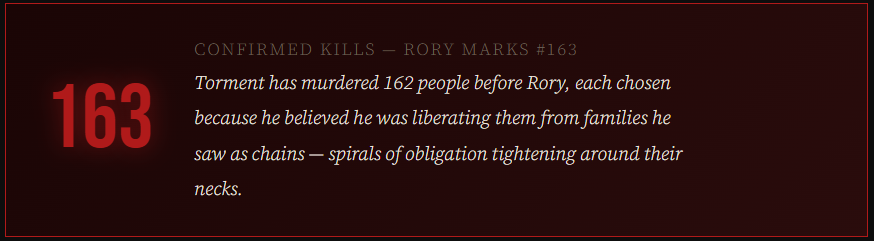
Torment finishes his story. Back in the present, Rory — battered and terrified — has been listening the whole time. And now he delivers a verdict that lands like a punch: Torment went out into the world, built his creepy costume, and has been killing family after family across 162 victims — all trying to find one person who would receive the gift of a dead family and say thank you. No such person has ever existed. Rory points out the obvious: “No one thinks that. No one will ever agree with you. Because what you’re doing is INSANE.” He tells Torment he could have used his power to find kidnapped children, lost relatives, adoptees searching for their birth parents. Instead, he chose to be a monster. Torment’s reply is almost bored: “Well, that’s one perspective.”

Rory lunges. Threatens. It doesn’t matter. Torment kills him with terrible efficiency. As he sits in the aftermath — Rory’s body crumpled on the floor — he muses aloud. “163 people… that’s a lot.” He wonders if he’s even doing it to help anymore, or whether he simply likes it. The question hangs in the air unanswered.
Enter: VoidChat and Redman
Then his phone pings. VoidChat — an encrypted, dark-web adjacent messaging service for people with, as Torment puts it, “similar interests.” His contact is a user called Redman, who is, as Torment describes him, “intense, even for this crowd. Like… bloodthirsty.” Torment doesn’t know if they’d be friends in real life. But Redman understands. And now Redman has a scoop.
Spider-Man’s real name is Peter Parker.
— Redman, via VoidChat — the secret that changes everything
Torment reads this and utters: “Holy hell.” Because Peter Parker isn’t just Spider-Man. He’s a man at the centre of one of the most extraordinary, tangled family spirals Torment has ever seen — connected to Mary Jane Watson and Eddie Brock, all three bound to each other and to alien symbiotes, forming what Torment will later describe as a “triple spiral.” Three humans. Two symbiotes. One spectacular, poisoned family constellation. Redman — who Torment will later realize is Carnage, the most monstrous killer of all, a thousand times worse than Torment himself — has just handed him the greatest job of his career.
The Magnum Opus
The issue pulls back to reveal the full scope of what Torment then attempted. In a stunning double-page spread — Torment at the centre, his spiral-vision painting Peter Parker, Mary Jane Watson, and Eddie Brock in enormous glowing rings — he narrates the grandeur of his plan. He had never seen spirals like these. Three people who loved and hated each other, bonded in complicated, layered, beautiful, terrible ways. Each one also tethered to an alien symbiote. Depending on how you counted, three spirals or five, all woven together into one vast tangle.

He called it his Magnum Opus. He followed the spirals to the Parkers, to Mary Jane Watson and the Brock family lines — all the tributaries, all the family members holding each one back — and he cut them all away. Systematically. This is the Death Spiral event as seen from Torment’s own perspective. He believed he was saving them. Liberating them. Doing the greatest work of his entire career. And in return, he received only fury. Spider-Man, Venom, and Carnage’s combined response was to ultimately throw him off a roof.
The Pavement Answers
Back to the Opening — NYC Rooftop
We return to where we started — Torment in freefall. His final thoughts cycle back to his own family, the one he always protected, the one he never cut. Would they judge him? Would they call him a failure? “I hope not,” he thinks. “They made me who I am.” And then comes the irony that the entire issue has been building toward:
Nothing’s more important than—
— Torment’s last thought, cut short by the pavement. SPLTCH.

His final unfinished thought is about family. The man who spent his life destroying other people’s families dies with his own name on his lips. His weapons — the thorned wheel and barbed tail — scatter around his broken body like a halo of violence. It’s grotesque. It’s earned. It’s almost poetic. Kev Walker and Matt Hollingsworth render the impact with a surreal, almost dreamlike colour palette — pink and lavender — that makes the death feel less like consequence and more like a final release. The kind Torment was always trying to give others and could never give himself.
Epilogue — “Don’t You See It?”
A Rainy Funeral · After
The final pages shift to a grey, rain-soaked funeral. Someone is being buried. The family gathered around the grave wears grief differently. Among them is the formidable Aunt Gladys — recognizable immediately as the same imperious old woman from the flashback reunion — who wastes no time making her feelings known. She points at a young woman named Susan and says: “You have to redeem the family name. You have no choice.” Mac and another family member tell Susan to ignore the old bag, that they can live however they want. But Susan pauses. She says quietly, with an odd certainty: “No, I think she’s right. We have a RESPONSIBILITY.”
She looks haunted. She sees something. “Don’t you see it?” she asks. Nobody responds. Nobody else can see what she sees.
Then the final page — Susan, a young girl with a dark bowl cut and a black hoodie, stands at the graveside in the pouring rain, her back to us. Around the people nearest to her — two adults standing close — spiral lines blaze in vivid pink and blue. Enormous, glowing, spiralling connections. The same kind that Graham could see. The same kind that made Torment what he became.

Nothing’s more important than family.
— Susan, the final page. END.
Susan can see the spirals. The ability — the curse — didn’t die on that New York pavement. It has passed, somehow, to a new generation. A girl who already speaks of family responsibility in the same breath as the woman who spent decades wielding that word like a weapon. The cycle has not ended. It has only reset.