You’ve been there. The lights dim, the first frames flicker onto the screen, and for a moment, hope takes over. This is the story you loved — the one that kept you awake at night turning pages, imagining every scene in your head. But then, somewhere within the first twenty minutes, something quietly collapses. The characters don’t feel quite right. The dialogue sounds flatter. Entire moments that mattered in the book are missing. The film isn’t terrible, exactly. It might even be entertaining on its own. But it isn’t the book either, and that difference can feel strangely personal — almost like a betrayal. That lingering disappointment is why the question keeps coming back every time Hollywood adapts another beloved novel: why are book-to-film adaptations usually disappointing?
We Go to the Cinema With a Ghost in Our Head
Before a single frame of a film adaptation appears on screen, the die is already partially cast — because the book’s readers have already made their own film. They’ve cast it. They’ve scored it. They’ve built the architecture of every room, the exact cadence of every beloved voice. The imagination is a profoundly private and stubborn director, and it doesn’t give up its cut easily.
This is the fundamental, rarely acknowledged paradox of adapting beloved books: the more passionately people love a novel, the more intensely they’ve already visualised it — and the more catastrophically the real film will clash with that internal version. A book with a small, devoted readership may actually fare better on screen precisely because fewer people have strong preconceptions baked in.
When Peter Jackson cast Elijah Wood as Frodo Baggins, millions of readers didn’t see a young actor on screen. They saw an intruder in a role they’d already given to someone else entirely — someone who existed only in their minds, and who was, by definition, perfect.
“A novel is a machine for generating meaning in the reader’s head. A film is a machine for generating images in the director’s.”
The fundamental incompatibility
Two Arts With Different Languages
Literature and cinema are not the same art form wearing different clothes. They are fundamentally, almost philosophically different mediums — and this is where most adaptations stumble, not because filmmakers lack talent, but because they’re being asked to translate poetry into mathematics.
A novel can spend forty pages inside a character’s head. It can pause time to unfold the specific texture of grief, the exact quality of a winter afternoon, the interior monologue that reveals more than any action ever could. This is the novel’s supreme gift: interiority. The reader has direct, unmediated access to a character’s consciousness.
Film, by its very nature, is exterior. It shows. It cannot easily tell. The camera can linger on a face, but it cannot live inside it. Voiceover narration is often used as a workaround, and it almost always feels like a concession — an admission that the filmmakers haven’t found a cinematic solution to a literary problem.
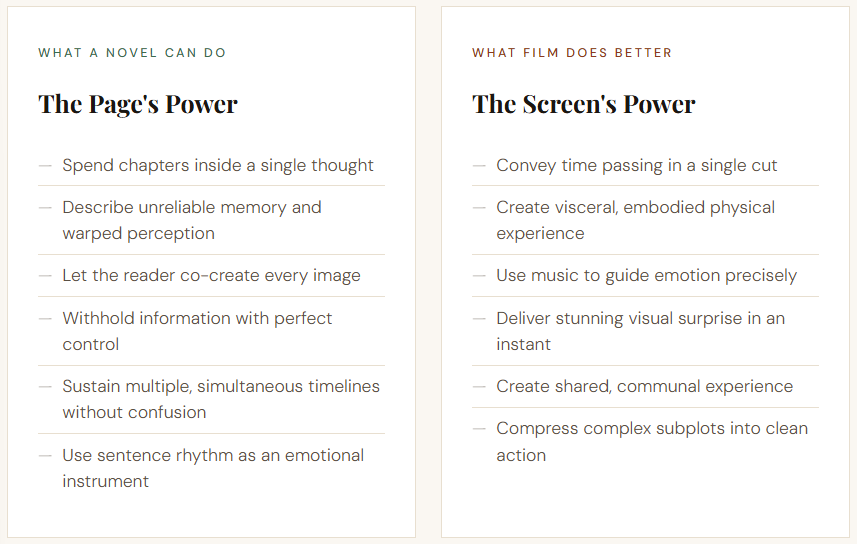
The problem isn’t that filmmakers try to adapt books — it’s that they so often try to film books, importing literary logic into a visual medium that doesn’t run on the same fuel. The best adaptations understand that fidelity to the spirit of a book sometimes requires radical infidelity to its surface details.

You Can’t Fit a River Into a Glass
A reader typically spends ten to twenty hours with a novel. A film gets two. That compression isn’t just an inconvenience — it’s a structural violence. Characters who take three chapters to grow into themselves get a single scene. Subplots that give the story its texture and thematic depth are cut entirely. Relationships that develop across hundreds of pages are established with a single meaningful glance and a swelling score.
The casualty list is always painful. Secondary characters — often the most beloved, the most eccentric, the ones readers have quietly adopted — disappear. Tom Bombadil. Nearly all of The Goldfinch’s Amsterdam section. Every quiet, unplotted moment in Normal People that made the relationship feel lived-in rather than performed.
What gets cut is rarely the wrong thing by Hollywood logic. It’s almost always the right thing by that logic: the scenes that don’t advance plot, that don’t deliver information, that simply exist — breathing, accumulating feeling. But those are exactly the scenes that make a book unforgettable. When they’re gone, what remains is the skeleton without the warmth that made you love it.
The Compression Paradox

The scenes that feel most expendable to a film editor are often the ones most essential to a book's emotional architecture. You can cut them and still follow the plot. You can't cut them and still feel the same way at the end.
Hollywood Doesn’t Trust Your Taste
Let’s be honest about something that film criticism often politely ignores: studio films are not artistic projects with commercial implications. They are commercial projects with artistic ambitions — and the order of those words matters enormously.
When a studio acquires a beloved novel’s rights, they’re not buying the book. They’re buying the brand recognition, the built-in audience, the safety of a known property. What they often do next — smoothing the rough edges, adding a love subplot, manufacturing a cleaner ending, ensuring the protagonist is more conventionally likeable — is not stupidity. It’s a business decision based on the perfectly rational assumption that most ticket buyers are not the novel’s most devoted readers.
The dark irony is that the core audience who drives the pre-release buzz — the passionate readers — are precisely the people most likely to feel betrayed by these commercial adjustments. The studio markets to them and then makes the film for someone else.
Cormac McCarthy’s The Road is a good example of this tension handled relatively well. The Weinstein Company kept the bleak structure intact. But countless other adaptations have softened exactly what made the source material worth adapting. The edges that gave it its power are filed smooth for mass palatability, and what remains is a film that pleases no one deeply.
When It Goes Wrong — and When It Doesn’t
It’s worth being specific. Not all adaptations are equal failures, and understanding what separates them tells us something about what the good ones actually understand.
No Country for Old Men (2007)
Adapted from Cormac McCarthy · Dir. Coen Brothers
A near-perfect translation because the Coens understood the novel’s grammar. McCarthy’s prose is spare, visual, dialogue-driven. The film didn’t try to film what it couldn’t — it found cinematic equivalents for McCarthy’s silences. Anton Chigurh works on screen for the same reason he works on the page: he’s given almost no interiority. The mystery is the point.
Adaptation Triumph
Gone Girl (2014)
Adapted from Gillian Flynn · Dir. David Fincher
A masterclass in what you can and can’t do. Fincher nails the atmosphere and Rosamund Pike is extraordinary. But the novel’s greatest weapon — Amy’s diary, which readers experience as truth before the reveal — loses its gut-punch because we’re watching rather than reading, and the medium makes us more suspicious of performance. The trick half works.
Partial Success
Dune (1984)
Adapted from Frank Herbert · Dir. David Lynch
Lynch himself later disowned the film. The problem was existential: Herbert’s novel works because of its dense, interior world-building. The film resorted to voiceover to convey what the page conveys through structure. Denis Villeneuve’s two-part 2021–24 version solves this by understanding the book’s political allegory is cinematic; its metaphysics mostly isn’t.
Cautionary Tale
Arrival (2016)
From “Story of Your Life” by Ted Chiang · Dir. Denis Villeneuve
Perhaps the greatest modern example. Villeneuve and screenwriter Eric Heisserer found something the short story’s unique temporal structure couldn’t offer on the page: the emotional devastation of watching events in order while understanding them out of sequence. The film is not faithful. It is deeply true. It makes you cry for reasons the original couldn’t.
Transcended the Source

Perhaps We’re Asking the Wrong Question
Here is the uncomfortable thought that most conversations about adaptations quietly avoid: maybe the disappointment is the point. Maybe it tells us something valuable about what reading actually is.
When a film fails to live up to the book you love, what you’re mourning is your own imagination. You’re grieving a version of the story that existed only inside you — that was, in fact, collaborative creation between you and the author. The film arrives and makes that private thing public, finite, someone else’s. It displaces your version with a version that belongs to the world, and the intimacy is gone.
This is why rereading a beloved book often satisfies in a way no adaptation can: you’re returning to your own creation as much as the author’s. The story on the page is a set of instructions, and you are its most faithful director.
A disappointing adaptation doesn’t prove the filmmakers failed. It proves that reading is a more creative act than we usually admit. The reader is always a collaborator — and collaborators don’t like being fired.
The best adaptations have always known this. They don’t try to recreate your private film. They make a new argument about the same material. They say: here is what we found in this story that moved us. And if they’ve done their job — if they’ve had the courage to look for something true rather than something faithful — you sometimes find yourself moved by a film about a book you love, in a way you couldn’t have predicted, by something the book couldn’t quite do.
That’s the rarest thing. But when it happens, it doesn’t feel like disappointment at all. It feels like the story grew.
So the next time you sit in that cinema and feel the faint ache of a story not quite translated — try to sit with it rather than against it. You're not just experiencing a failed adaptation. You're experiencing evidence of how deeply you read, how completely you inhabit stories, how much of your own self you pour into the act of turning pages in the dark.

That's not a small thing. That's the whole point of literature. The film was never going to be your book. Your book is yours. No one can put that on a screen.