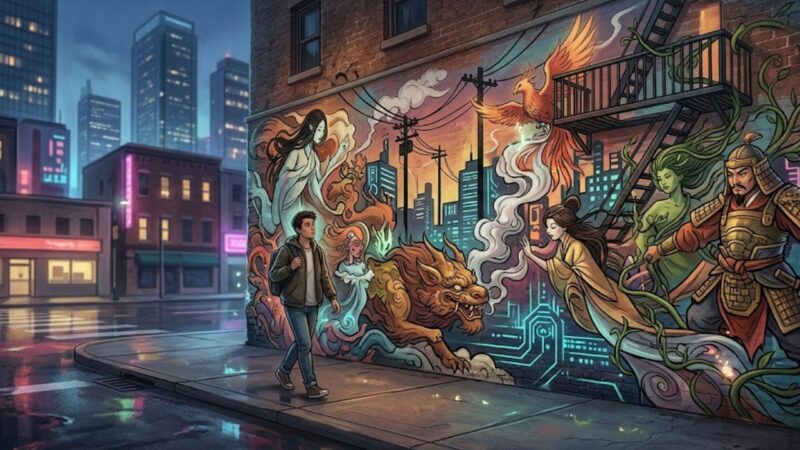

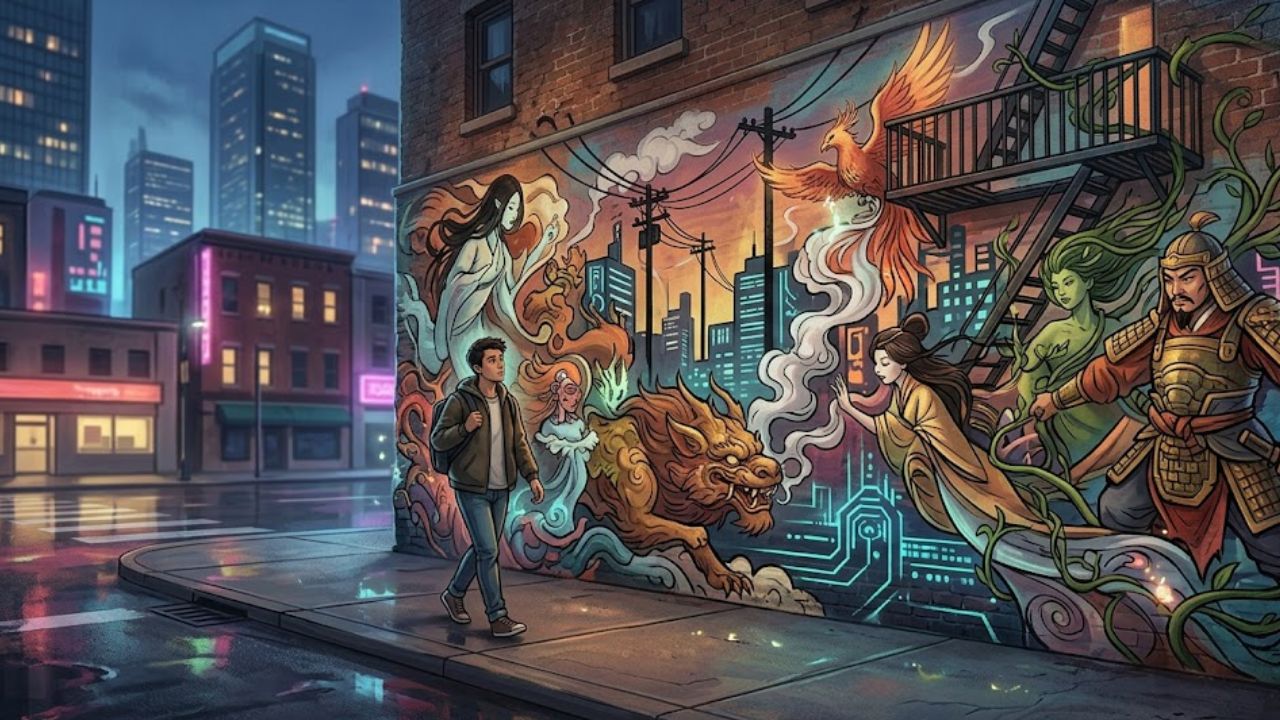
Modern urban fantasy — that strange, seductive genre in which faeries ride the London Underground and gods argue over parking spaces — is perhaps the most remarkable literary phenomenon of the past half-century. It does not invent the supernatural from scratch. It inherits it. With extraordinary creativity and cultural intelligence, urban fantasy writers take the ancient imaginative architecture of world folklore and rebuild it inside the recognizable, often gritty landscape of the contemporary city. In doing so, they accomplish something quietly profound: they reveal that our oldest fears and longings have not changed, only the scenery surrounding them.
This article is an attempt to trace how that inheritance works — to follow the threads that connect a West African spider god telling stories around a fire to a fast-talking trickster in a Chicago nightclub, or a Celtic banshee wailing in the mist to a hollow-eyed woman weeping on a highway overpass. The transformation is never merely cosmetic. It is a re-reading: every time a writer plants an ancient being in a modern world, they are asking a new set of questions about power, identity, belonging, and what it means to be human in a world that still feels, in spite of everything, deeply haunted.
The Grammar of the Supernatural: What Folklore Actually Is
Before examining how folklore is transformed in urban fantasy, we must understand what it was in its original context — and the answer is both simpler and stranger than most literary critics acknowledge. Folklore is not merely a collection of quaint superstitions. It is a living cognitive technology: a community’s way of encoding hard-won wisdom, social rules, taboo, and cosmology into narrative forms so memorable that they survive the absence of literacy, the collapse of empires, and the migration of peoples across entire continents.
Key Concept
Folklore is not decorative — it is functional. Each creature, each prohibition, each ritual carries a community’s negotiation with the unknown, compressed into story.
The banshee of Irish tradition, for instance, is not simply a screaming ghost. She is the personification of grief’s inevitability, a reminder that death comes for great families as readily as for humble ones, and that women’s mourning — historically marginalized and silenced — has a power that can pierce the boundary between worlds. The Japanese kappa is not merely a river monster; it encodes generations of warnings about the dangers of waterways to unsupervised children, while its elaborate system of politeness rules (a kappa can be defeated by bowing, as it must bow back and spill the water in its head-dish) teaches something about social reciprocity. Every creature has layers. Every legend carries weight.
Urban fantasy writers who work with folklore well understand this. They do not simply grab a creature’s aesthetic — its wings, its fangs, its uncanny eyes — and drop it into a thriller plot. They engage with the underlying logic: the fears, the values, the cosmology. And by transplanting that logic into a new context, they create something that feels simultaneously alien and inevitable.
The Trickster Reborn: Gods in the Gutter
Perhaps the most enduring folkloric figure in modern urban fantasy is the trickster. Across virtually every mythological tradition in the world — Anansi of the Akan people, Coyote of the Plains nations, Loki of Norse myth, Hermes of Greece, Eshu of Yoruba cosmology, Raven of the Pacific Northwest — the trickster occupies a singular position: he stands at boundaries, disrupts order, enables creation through chaos, and embodies the terrifying creative power of the outcast, the marginal, the ignored.
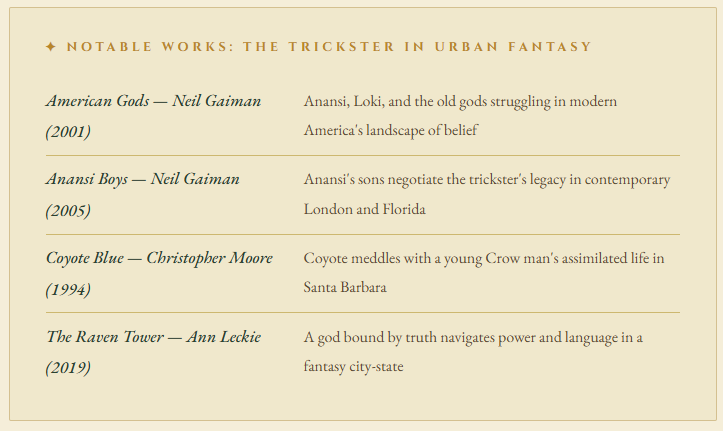
Neil Gaiman’s American Gods (2001) represents perhaps the most sustained and sophisticated engagement with this archetype in contemporary fiction. Gaiman’s premise — that the gods of old-world immigrants have come to America with their believers, fading now in an age that worships television and credit cards — is essentially a meditation on cultural displacement and the sociology of belief. Anansi, the Ghanaian spider god of stories, appears not in a village clearing but in a roadhouse in rural Wisconsin, wearing a sharp suit and telling jokes. The adaptation is not incidental. The sharp suit is a new kind of web. The jokes are still traps.
The trickster does not need a sacred grove. He needs an audience. In the modern city, audiences are everywhere — and so is the trickster, sharper than ever, wearing whatever disguise the age provides.
— On the persistence of the trickster archetype
What Gaiman understands — and what makes his treatment so much more resonant than a surface-level mythological name-drop — is that the trickster’s power is fundamentally social. He exposes the gaps between what a society claims to value and what it actually does. In traditional Akan culture, Anansi’s stories were subversive precisely because they showed how a small, clever creature could outwit larger powers. In contemporary America, the same dynamic plays out in a different register: the immigrants, the marginalized, the overlooked are the new Anansi-figures, navigating systems designed by and for those who already hold power.
Courts of Iron and Concrete: The Fae in the Modern World
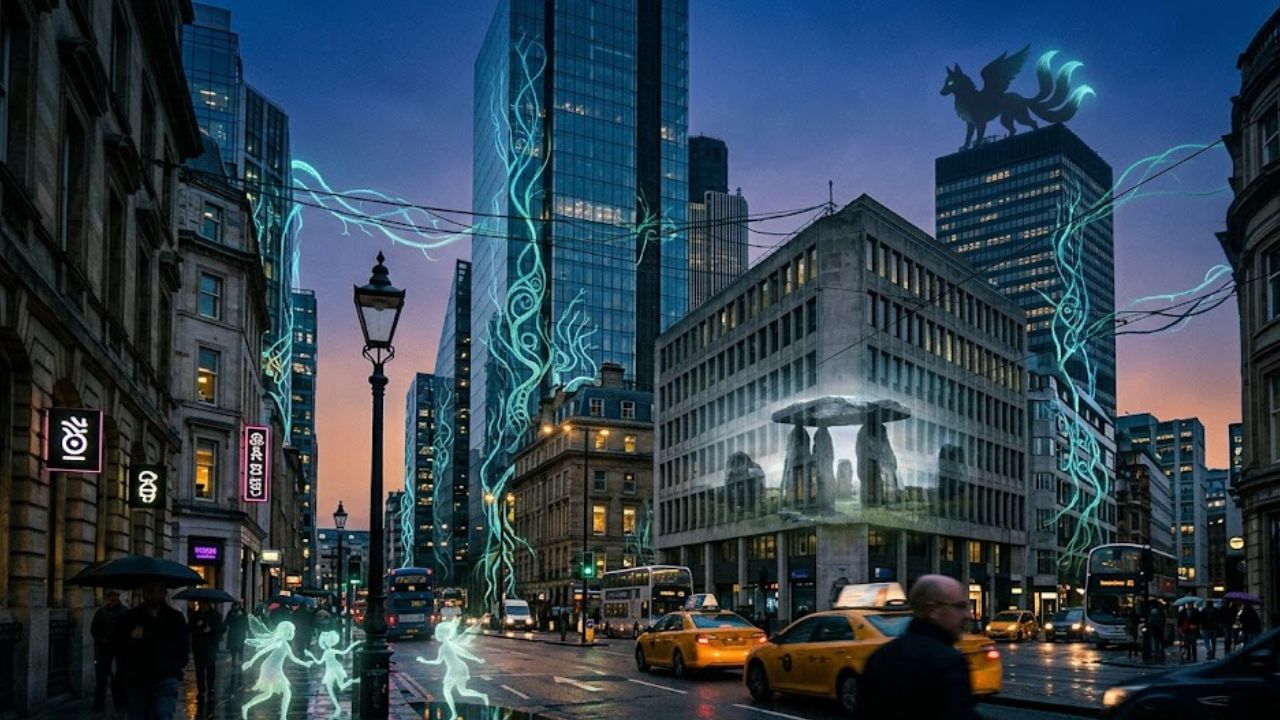
Few folkloric traditions have proven as enduringly generative for urban fantasy as Celtic faerie lore. The Seelie and Unseelie Courts of Scottish tradition, the Irish Tuatha Dé Danann, the solitary fae of countless regional legends — these beings have been transplanted into modern cities with remarkable frequency and with a consistency of underlying logic that reveals how deeply their original rules resonate with contemporary anxieties.
In traditional folklore, the fae are defined above all by their relationship to language and contract. They cannot lie — but they twist the truth like a blade in silk. Every deal with them is a trap; every gift comes with a cost that was buried in the fine print of a verbal agreement you barely remember making. This is not a casual character trait. It encodes a community’s hard-won wisdom about power: that those who hold power tend to operate through the technically legal rather than the genuinely fair, and that the vulnerable must be extraordinarily careful with their words.
Holly Black’s modern faerie novels — particularly The Cruel Prince trilogy — transplant the Seelie Court’s political intricacies almost wholesale into the present day, and the parallel to real-world aristocracy and political maneuvering is not accidental. The faerie court becomes a mirror for the way human power structures actually work: through beautiful lies dressed as truth, through obligations that bind without ever openly declaring their terms, through a glittering surface that conceals ruthless hierarchies of cruelty. The Faerie Queen and the corporate CEO occupy the same psychological territory.
Folkloric Root
In Irish tradition, the phrase “fairy gold” describes wealth that seems real but dissolves into leaves at dawn — a warning about prosperity built on illegitimate foundations.
Seanan McGuire’s October Daye series takes a different, harder-edged approach: here the Faerie courts have integrated into San Francisco’s urban landscape, with changelings — half-human, half-fae creatures belonging fully to neither world — serving as the primary viewpoint. The changeling’s position in traditional folklore was one of pure tragedy: stolen from a human family, yet never belonging to the fae who took them. McGuire preserves this tragedy while giving it new political dimensions. Her changelings become a lens for examining the experience of mixed-race identity, of belonging to two cultures and being fully claimed by neither, of navigating institutions that were built without your kind in mind.
The Monster as Mirror: Rewriting the Monstrous
Every folklore tradition has its monsters — beings that embody, in exaggerated form, the things a community fears most. The vampire drains vitality, the werewolf loses civilized selfhood to animal violence, the succubus weaponizes desire. Urban fantasy’s most radical recontextualization of folklore is not cosmetic renewal but moral inversion: it asks what happens when we tell the story from the monster’s point of view.
The modern vampire, as developed in the tradition that flows from Anne Rice through Charlaine Harris to Erin Morgenstern and beyond, is no longer simply a predator. The vampire in contemporary urban fantasy is an immigrant — a being from another time, another set of social codes, forced to negotiate with a modernity that did not ask for its presence. The traditional vampire’s terror was specifically the terror of contamination: it corrupted the pure (usually figured as virginal and female), it spread its condition like a disease, it was fundamentally foreign, Other, a threat to the community’s integrity. This coded Victorian anxieties about immigration, disease, and sexuality with extraordinary density.
Urban fantasy writers have deconstructed this coding methodically, sometimes with knowing irony. Charlaine Harris’s Southern Vampire Mysteries (which became the TV series True Blood) use the vampire’s “coming out of the coffin” — their public acknowledgment of their existence following the invention of synthetic blood — as a direct analogy for LGBTQ+ experience: the way a minority group reveals itself to a society that has always feared it, the negotiation between assimilation and authenticity, the question of whether acceptance is actually possible or merely a new form of control.
The monster’s reinvention in urban fantasy is almost always political. When a despised creature is given interiority and community, the author is not merely being kind to fictional beings — they are challenging our inherited definitions of the monstrous.
— On the political dimensions of monster rehabilitation
The werewolf undergoes an equally revealing transformation. In European folklore, the wolf-man was a figure of judicial horror — in many traditions, condemned criminals could be said to have become werewolves, their socially unacceptable violence literalized as animal transformation. Urban fantasy frequently reclaims this figure by linking it to indigenous relationships with animal transformation — the shapeshifter traditions of many Native American and First Nations peoples, where transformation is sacred and communal rather than damning and solitary. Patricia Briggs’s Mercy Thompson series is particularly conscious of this, weaving together European werewolf mythology with Walker tradition and asking hard questions about which version of the supernatural narrative gets to be called “natural.”
Ancestral Spirits in the Diaspora: Folklore Carries the Homeland
One of the most profound and underexamined dynamics in contemporary urban fantasy is the way folklore functions as a carrier of cultural identity for displaced communities. When people are forced to move — through colonialism, through the violence of the Middle Passage, through the desperation of economic migration — they carry their supernatural landscape with them. The orishas cross the Atlantic. The aswang follows Filipino migrants to Los Angeles. The nagual trails Mexican families across the border. The beings of folklore are not simply stories; they are the encoded memory of a place, a people, a cosmology.
Rivers Solomon’s The Deep meditates on this with extraordinary power, tracing the wajinru — beings born from the drowned bodies of enslaved African women thrown overboard during the Middle Passage — as they build an underwater civilization out of the specific trauma of that history. The folkloric logic here is entirely coherent with the African diasporic spiritual traditions that arose from slavery: the idea that the dead do not simply vanish, that they transform, that the violence done to their bodies does not end their agency but changes its form. The ancestors are always present, and in Solomon’s work, their presence is specifically the presence of the ocean dead, demanding that their history be known and held.

Silvia Moreno-Garcia’s work is particularly notable for its refusal to treat Aztec and Mayan mythology as merely aesthetic material. In Gods of Jade and Shadow, the Mayan death god Hun-Kamé walks through 1920s Mexico not as a curio but as a being whose mythology has been actively suppressed and distorted by colonial culture — and whose partnership with a young indigenous woman becomes a journey of reclamation as much as adventure. The folklore is not background flavor; it is the political argument.
The Witch’s New Cauldron: Magic, Feminism, and Reclamation
If one folkloric figure has undergone the most transformative recontextualization in modern urban fantasy, it is the witch. Across European folklore, the witch occupied one of the most complex positions in the supernatural imagination: she was the woman whose power fell outside the sanctioned structures of church, family, and state; whose knowledge of herbs and bodies and the turnings of seasons made her a resource and a threat simultaneously; whose persecution in the early modern period represented one of history’s most systematic campaigns against female autonomy and communal female knowledge.
Modern urban fantasy has overwhelmingly chosen to reclaim the witch rather than rehabilitate the old fear of her. The contemporary fictional witch is frequently depicted not as a corrupted or dangerous figure but as a practitioner of an ecological, embodied, ancestral knowledge that has been suppressed precisely because it empowers women and challenges institutional authority. The covens in Erin Sterling’s novels are communities of mutual support. The witches in Deborah Harkness’s All Souls Trilogy guard ancient knowledge that powerful institutions — academic, governmental, supernatural — have long sought to control.
There is a direct line from this literary reclamation to the broader cultural movement around contemporary witchcraft — the resurgence of interest in herbalism, folk magic, lunar practice, and ancestral spirituality that has grown dramatically in the past two decades, particularly among young women. Urban fantasy both reflects and shapes this movement, giving narrative form to the intuition that there is a form of knowledge and power that has been systematically delegitimized, and that recovering it is an act of both personal and political resistance.
The witch, reborn in contemporary fiction, is not merely a supernatural figure — she is a historical argument. Her power is precisely the power that was once burned away, and her persistence is an act of defiance against every bonfire that tried.
— On the feminist reclamation of the witch in urban fantasy
The City as Sacred Geography: Urban Space and the Numinous
One of the subtler but most structurally important transformations that urban fantasy performs on its folkloric material is spatial. Traditional folklore is almost always rooted in specific landscape: the banshee haunts particular families in particular Irish counties; the kelpie inhabits specific Scottish lochs; the genius loci is, by definition, tied to a specific place. This geographic specificity is not incidental — it is ontological. These beings belong to their terrain the way a root belongs to its particular soil.
Urban fantasy displaces this belonging without destroying it. The city becomes its own kind of sacred geography — a landscape with its own power sites, its own thresholds, its own places where the boundary between worlds grows thin. Charles de Lint, whose Ottawa-based Newford series essentially invented the aesthetic template for North American urban fantasy, populated his fictional city with beings that belonged to its specific geography: the Native spirits of the Ottawa Valley watershed coexisting, uneasily, with the immigrant folklore brought by the city’s European and Asian communities. The city is not a neutral backdrop; it is an active participant in the supernatural ecology.
Ben Aaronovitch’s Rivers of London series takes this principle to its logical extreme: London itself becomes the organizing mythology. The genius loci of London’s rivers — Father Thames, the various goddesses who personify the tributaries — are living beings with political relationships and territorial disputes that exactly mirror the politics of urban waterway management. Aaronovitch’s great achievement is making you feel that these beings were always there, embedded in the geography of the city, and that London is simply more honest now about what it has always been: a place haunted by the weight of every story ever told within it.
Why It Works: The Anthropology of Narrative Persistence
The question worth sitting with — the one that makes this entire phenomenon genuinely interesting rather than merely entertaining — is why it works. Why does the transplantation of ancient folklore into modern urban settings produce narratives that feel so resonant, so emotionally true? The answer, I think, lies in the nature of what folklore actually preserves.
The psychologist Carl Jung argued that myths and folklore persist because they express something structural in human psychology — what he called archetypes, inherited patterns of response that shape how we process fundamental experiences: birth, death, transformation, the encounter with power, the experience of love, the fear of the dark. Whether or not one accepts Jung’s specific formulation, there is something compelling about the observation that certain narrative patterns — the trickster who enables creation through chaos, the threshold guardian who tests the worthy, the descent into darkness and return, the figure of wild nature that must be negotiated rather than conquered — appear across cultures with no plausible historical connection, as if they were solutions that human imagination had independently arrived at to the same deep problems.
Urban fantasy works because modernity has not changed the deep problems. We still live with the terror of death, the anxiety of social exclusion, the experience of encountering power that operates by rules we were never told, the feeling that underneath the rational surface of daily life, something stranger and more consequential is happening. The supernatural beings of folklore — the fae who exploit contractual ambiguity, the gods who demand belief, the ancestral dead who refuse to be forgotten — map onto these experiences with eerie precision. The urban setting does not diminish them; it contextualizes them in a language contemporary readers can read with their whole bodies.
The Ancient Flame in the Electric Dark
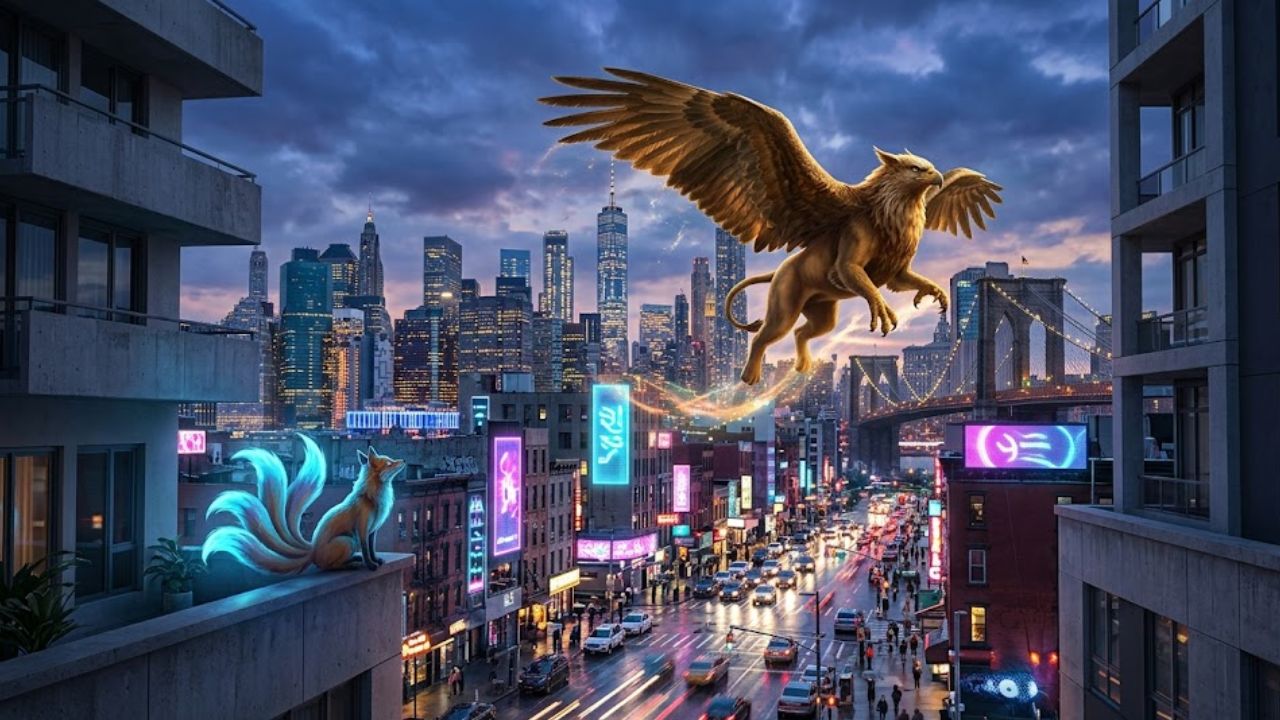
What modern urban fantasy ultimately tells us is something that anthropologists have long argued and that storytellers have always known: the supernatural is not a product of ignorance that civilization has outgrown. It is a cognitive and emotional technology — a way of processing the aspects of human experience that resist rational reduction — and it is as necessary now as it has ever been.
When a writer places Anansi in a Chicago nightclub, or lets the banshee weep under a highway overpass, they are not being whimsical. They are making a claim about continuity: that the fears and the hungers and the negotiations with power that shaped the original folklore have not disappeared, have only changed their costumes. The ancient flame burns in the electric dark. The stories that kept our ancestors company in the forest are with us still — riding the subway, drinking overpriced coffee, navigating bureaucracies, telling their impossible truths to anyone willing, for a moment, to believe.
And perhaps that is the final, most honest lesson of the genre: that we were never as secular, never as rational, never as disenchanted as we told ourselves. The world was always full of wonders. We simply, for a time, forgot to write them down.