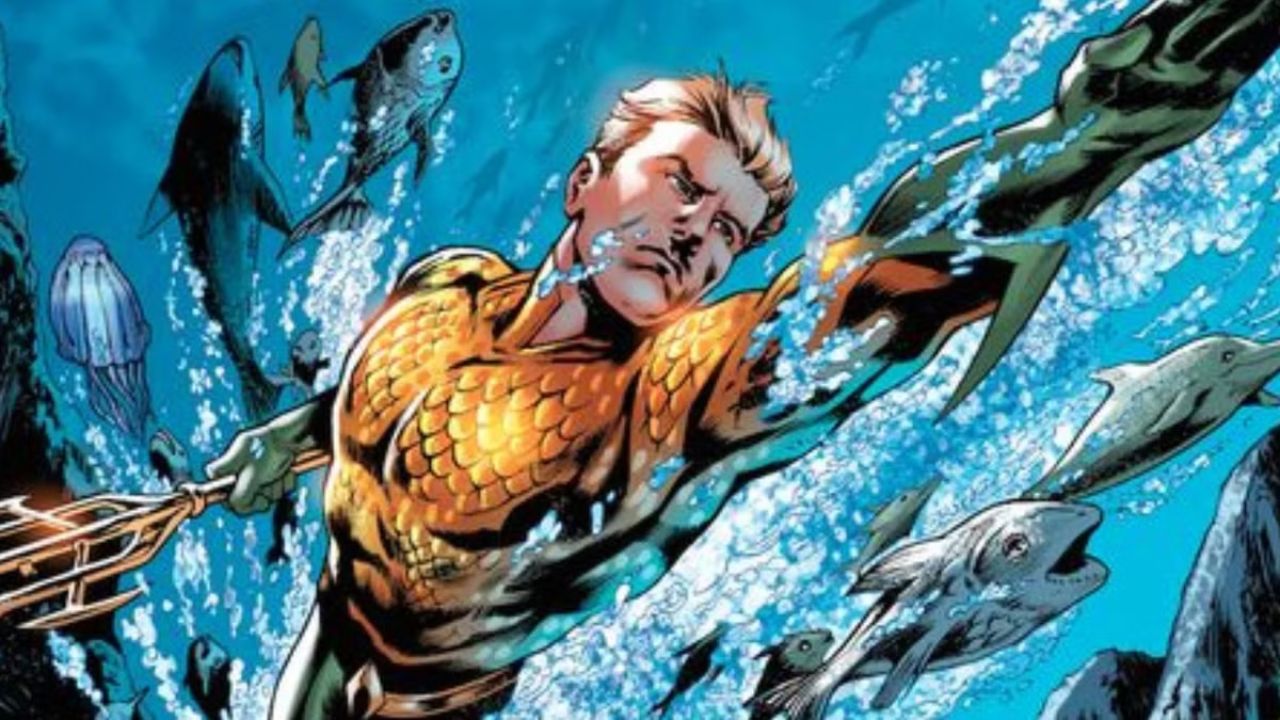
Let’s be honest. For decades, Aquaman was the punchline of superhero culture. Saturday morning cartoons gave him a wholesome but dopey image — a blonde guy in an orange-and-green suit who rode seahorses and talked to fish. Late-night talk show hosts loved him. Family Guy roasted him. Even people who had never read a single comic book knew the joke: Aquaman is useless on land, and most fights happen on land, so what’s the point?
But here’s the thing about jokes — sometimes the person being laughed at ends up having the last word.
Today, Aquaman is one of the most formidable, narratively rich, and cosmically powerful characters in DC’s entire roster. He commands the largest kingdom on the planet. His physiology makes him a physical match for Superman in many scenarios. He has wielded weapons capable of shattering the laws of reality. And his solo film crossed a billion dollars at the box office — something that even Batman v Superman couldn’t manage.
So how did we get here? How did the butt of every superhero joke transform into one of the genre’s most compelling figures? The answer is a story about bad writing, brilliant reinvention, cultural timing, and one very particular king who refused to stay a punchline.
The Early Days: Born to Be Underestimated
Arthur Curry — Aquaman — first appeared in More Fun Comics #73 in November 1941, created by Paul Norris and Mort Weisinger. His origin was simple even by Golden Age standards: the son of a lighthouse keeper who had discovered ancient Atlantean secrets, Arthur trained from childhood to breathe underwater and communicate with sea life.
He was a perfectly serviceable character for his era. The oceans were mysterious, largely unexplored, and genuinely terrifying to most Americans. An underwater hero made a certain kind of sense. But as the comics industry evolved, Aquaman didn’t quite keep pace. His rogues’ gallery was thin. His stories lacked the emotional weight that made characters like Batman or Superman feel mythic. And that telepathic fish communication ability — while genuinely useful when you think about it — became cultural shorthand for “weak superpower.”
The Super Friends animated series in the 1970s arguably did the most lasting damage. In that show, Aquaman was consistently sidelined. He’d show up, say something about the ocean, and then watch the rest of the team handle the real crisis. It wasn’t that the writers hated him — they just didn’t know what to do with him. That image of a perpetually underutilized hero lodged itself into a generation’s collective memory and never fully let go.
For years, DC seemed to quietly accept his second-tier status. He appeared in crossovers. He joined the Justice League. He showed up when the plot required someone to talk to a whale. But he rarely drove the story. He rarely mattered.
That was about to change — violently.

Peter David Breaks Everything (In the Best Way)
If there’s a single moment when Aquaman’s rehabilitation began in earnest, it’s 1994. Writer Peter David took over the solo title and did something almost unthinkable at the time: he took the joke seriously.
David’s approach was blunt. He acknowledged that Aquaman had become a laughingstock and then systematically dismantled every reason for it. His run introduced a darker, angrier Arthur — a man wrestling with the weight of ruling a kingdom that the surface world ignored, exploited, and polluted. This wasn’t the cheerful, slightly dim hero of Saturday morning cartoons. This was a king with a genuine chip on his shoulder and legitimate grievances.
One of David’s most iconic moves was having Aquaman lose his hand.
After being trapped and left to drown (or rather, starve — an irony not lost on anyone), Arthur gnawed off his own left hand to escape. He later replaced it with a hook made from the mystical Lady of the Lake’s own enchanted water-hand and then a harpoon attachment. Gruesome? Yes. Dramatic? Absolutely. But more than anything, it was a statement of intent. This creative team was not interested in playing it safe. They wanted an Aquaman who felt danger, who bore scars, who had earned his standing through genuine sacrifice.
David also leaned hard into the political complexity of Aquaman’s world. Atlantis wasn’t just a cool underwater backdrop — it was a civilization with factions, power struggles, ancient grudges, and a deep contempt for the surface world. Arthur existed at the intersection of two worlds and was fully trusted by neither. That tension gave the book a richness it had never had before.
Suddenly, Aquaman had edge. He had tragedy. He had stakes.
Grant Morrison and the Justice League Elevation
Around the same time David was reinventing the solo series, Grant Morrison was doing something equally important in JLA, which launched in 1997. Morrison’s Justice League was a deliberate return to the “Big Seven” — Superman, Batman, Wonder Woman, The Flash, Green Lantern, Martian Manhunter, and Aquaman — assembled as a team of gods rather than a neighborhood watch.
In Morrison’s hands, every member of the League was treated as genuinely formidable. Aquaman didn’t just stand around looking confused. He was depicted as someone you’d want in your corner during a planetary crisis, a warrior king whose command of the seas represented a literal geopolitical force. The oceans cover over 70% of Earth’s surface. A man who controls them isn’t a liability — he’s a strategic asset of almost incomprehensible scale.
Morrison’s JLA run didn’t fundamentally reinvent Aquaman the way David’s solo work did, but it did something crucial: it placed him in a context where his power was treated with respect rather than as a running gag. When readers saw Aquaman standing shoulder-to-shoulder with Superman and Batman as an equal — not a hanger-on — it shifted the internal math of how people understood the character.
Geoff Johns and the Definitive Reimagining
If Peter David lit the match, Geoff Johns poured gasoline on it.
Johns took over Aquaman in 2011 as part of DC’s New 52 relaunch, and his approach was almost postmodern in its self-awareness. He opened his first issue with Arthur sitting at a fish-and-chips restaurant in Boston, ordering chowder. A group of locals recognize him and start asking, earnestly, whether it bothers him that everyone thinks he’s useless. A blogger literally calls him “the lamest superhero ever” to his face. A cop asks if he talks to fish with barely concealed disdain.
And Aquaman just… absorbs it. With dignity. With a quiet, weary confidence that suggests he has heard it all before and has decided it doesn’t define him.
It was a masterclass in addressing the elephant in the room. Johns essentially said: yes, we know the jokes exist. We know why people think this. Now watch us prove them wrong.
What followed was one of the most methodical power showcases in DC’s modern history. Johns spent issue after issue demonstrating, concretely and viscerally, exactly how powerful Arthur Curry actually is. He benched a car with one hand. He moved through a firefight like a guided missile, taking bullets and shrugging them off. He punched through walls, held his own against some of DC’s heaviest hitters, and demonstrated that his telepathic connection to marine life — long the subject of ridicule — was genuinely terrifying in practice. Ever seen a school of piranhas strip something to the bone in seconds? Now imagine commanding them.
Johns also deepened the mythology around Atlantis enormously, transforming it from a vague underwater kingdom into a fully realized civilization with history, religion, warfare, and political intrigue. He explored Arthur’s half-human heritage and the way it alienated him from both worlds. He gave him villains who were genuinely threatening — the Trench, horrifying deep-sea creatures; Black Manta, a nemesis with a profoundly personal history with Arthur; and Orm, the Ocean Master, his own half-brother.
Most importantly, Johns gave Arthur a sense of self that the character had historically lacked. This was a man who knew exactly who he was, even when no one else did.
The Powers People Kept Ignoring
Part of why Aquaman was underestimated for so long comes down to a fundamental misreading of what his powers actually are. People heard “talks to fish” and stopped listening. They should have kept listening.
Let’s go through the actual resume.
Physical Power. Aquaman’s body is built to survive the crushing depths of the deep ocean — pressures that would kill an unprotected human being instantly. That same physiology means his body is dramatically denser and more durable than a normal human’s. He can take a hit from Superman and stay standing. In water, he moves at speeds that rival some of DC’s fastest characters.
Marine Telepathy. Yes, he communicates with sea life. And the ocean is full of things that want to kill you. Great white sharks. Giant squid. Whale pods. Creatures from depths humanity hasn’t even fully explored yet. In practical terms, this ability is an enormous force multiplier.
Superhuman Strength. Aquaman regularly places among DC’s strongest physical fighters. He’s moved small islands. He’s held tectonic plates together. During crossover events, he’s traded blows with characters who can crack the planet.
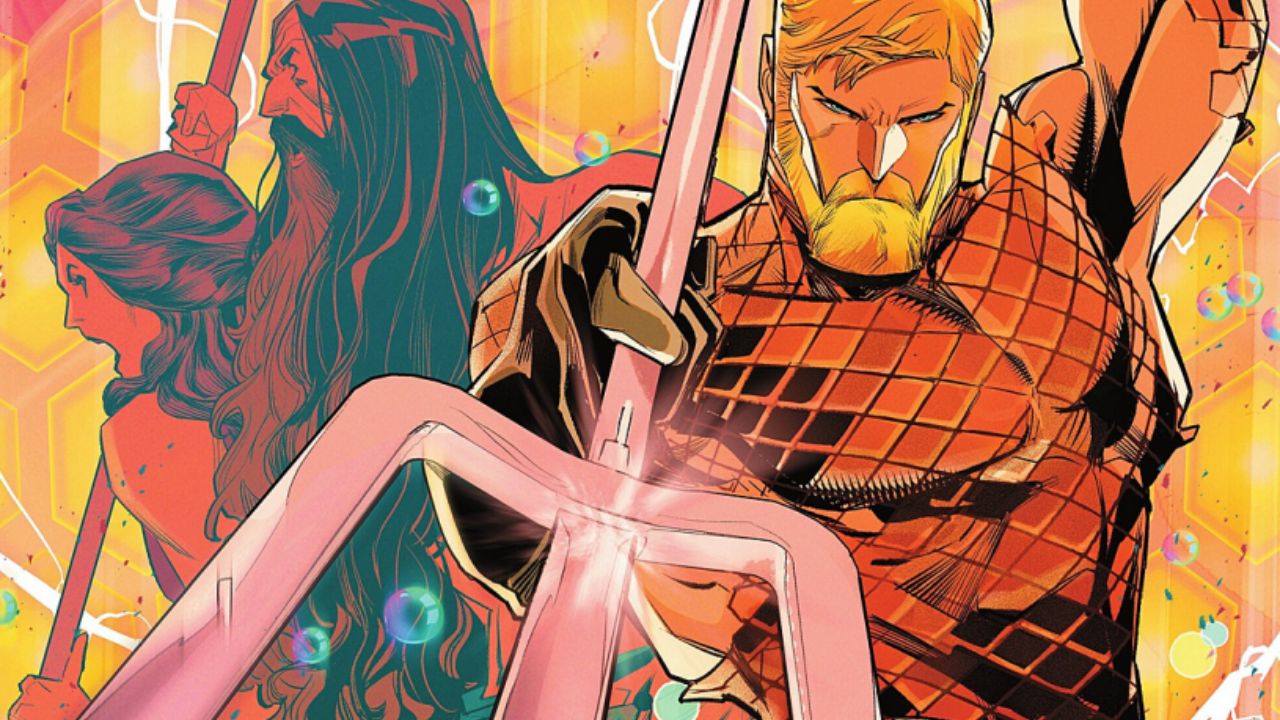
The Trident of Neptune (and later, the Trident of Poseidon). This weapon deserves its own section. The trident isn’t just a cool prop — it’s a divine artifact capable of generating force blasts, controlling water on a massive scale, disrupting magic, and in some continuities, affecting reality itself. When Arthur goes to war with this weapon in hand, he isn’t bringing a spear to a gunfight. He’s bringing a natural disaster.
Control Over Water. In more recent comic iterations, Arthur’s command over water has been expanded to truly extraordinary levels. He can generate tsunamis. He can dehydrate enemies. He can sense and influence weather systems tied to ocean currents. On a planet that is mostly water, this isn’t a niche power. It’s the power.
The Film That Changed Everything
For all the progress made in comics, mainstream audiences didn’t fully reckon with the new Aquaman until 2018, when James Wan’s Aquaman arrived in theaters.
The film was loud, colorful, and completely uninterested in being subtle. Jason Momoa played Arthur as a tattooed, hard-drinking, hard-laughing brawler who was as comfortable in a bar fight as in a throne room. It was a bold choice — deliberately at odds with the polished, aristocratic image that the character had sometimes carried in the comics — and it worked spectacularly.
What Wan understood was that Aquaman’s world, properly visualized, was genuinely spectacular. The oceans aren’t boring. They’re alien. They’re vast and dark and filled with creatures that look like science fiction. Atlantis, rendered with a genuine budget and creative ambition, looked like nothing audiences had seen before — a civilization that evolved underwater, with architecture and technology and culture shaped by an entirely different physical reality.
The film also gave Arthur the emotional core that great superhero stories require. His relationship with his mother Atlanna, played by Nicole Kidman, grounded the spectacle in something real. His reluctance to claim the throne of Atlantis wasn’t mere reluctance — it was the story of a man who had spent his whole life belonging to two worlds and being rejected by both.
Aquaman grossed over $1.1 billion worldwide. It became the highest-grossing DC film ever at that point. The joke wasn’t funny anymore.

King of Atlantis: The Title That Changes Everything
One aspect of Aquaman’s power that often gets overlooked in superhero discourse is the political dimension.
Aquaman isn’t just a superhero. He is the king of Atlantis — a nation of millions that occupies most of the planet’s surface. On a geopolitical level, that’s an extraordinary position. The surface nations of Earth have no jurisdiction over his kingdom. He commands armies. He controls the world’s oceans, which means he controls shipping lanes, fishing rights, undersea cables, and the climate systems that regulate weather on every continent.
This is why the most interesting Aquaman stories aren’t really about punching. They’re about what happens when the surface world and the underwater world collide — politically, culturally, ecologically. When oil spills pollute Atlantis’s shores. When nuclear submarines cross into sacred territory. When the Justice League needs to ask Aquaman for permission rather than assistance.
That dynamic makes for genuinely compelling drama, and it’s one that writers like Johns, Kelly Sue DeConnick, and others have mined beautifully in recent years.
Where He Stands Now
The rehabilitation of Aquaman is one of comics’ great success stories — not because a character was polished up with a fresh coat of paint, but because writers eventually took the time to excavate what was genuinely interesting about him and build on it honestly.
The ocean is the most mysterious place on Earth. It covers more of our planet than land does. It contains ecosystems we’ve barely catalogued, depths we’ve barely reached, and species that look like they belong in nightmares. A man who commands that world — who was born of it — is not a figure of fun. He is something old and strange and quietly terrifying.
When you understand that, you understand Aquaman.
He was never the weakest member of the Justice League. We were just asking the wrong questions about him.
The joke, it turns out, was always on us.