To understand Issue #2, you need to know what Barbara Gordon chose to do. Gotham has been seized. Vandal Savage — the immortal warlord — installed himself as GCPD Commissioner, put Poison Ivy in the mayor’s chair, and framed the entire Bat-Family for the murder of a cop. His private army, the TUCOs, replaced legitimate law enforcement. The Bat-Family became public enemies overnight.
Into this chaos, Vandal built Supermax: a brutalist island prison seeded with his own agents. Inside, former prosecutors, police officers, and city officials — people who served Gotham faithfully — were thrown together with the very criminals they once prosecuted. And they were dying. One by one, loudly labeled suicides, quietly murdered. Jennifer Peck, a prosecutor Jim Gordon admired. Daniel Rascott, a former police captain. The pattern was clear to anyone who cared to look.
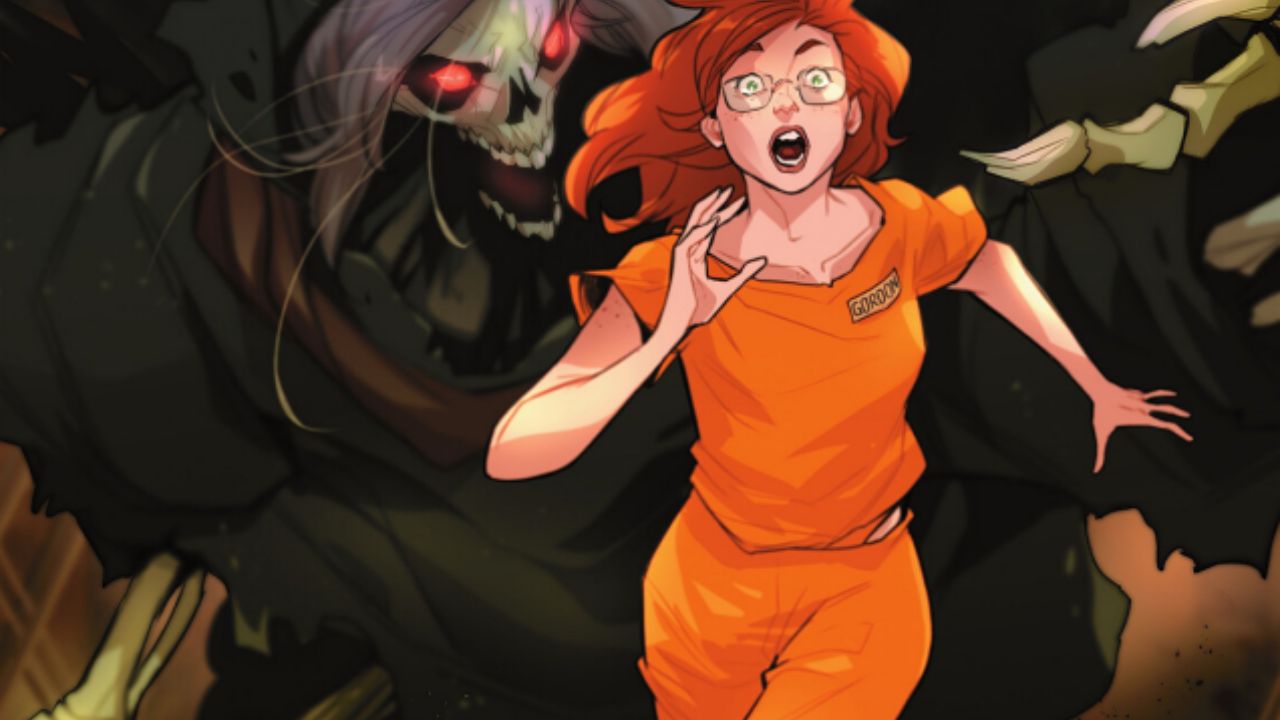
Barbara Gordon cared. So she arranged to be caught “sabotaging” Bat-servers she had already remotely destroyed days earlier, stood trial in Vandal’s rigged courtroom, and walked into Supermax as Inmate 682281 — alias K. Kilter — by choice. Batman told her it was a bad idea. She smiled and told him it was the only idea that mattered: they help people who have no one else. That’s what they do. Even now. Even here.
Day One in Supermax was brutal. Barbara survived yard brawls and a cafeteria riot, traded menacing small talk with Die — a prisoner who claims to be Two-Face’s daughter — and was warned by a hostile TUCO guard who remembered being put behind bars by her father, Jim Gordon. By night, alone in her cell, she heard a strange mechanical ticking and a soft, ominous shushing from the darkness. Issue #1 ended on a full-page close-up of her wide-open eyes. Then the lights went out.
Alive. Barely. One Day In.
Issue #2 opens not with action but with a face. Three stacked horizontal panels fill the page — each one a close-up of the same face, beaten and bandaged, framed by a wash of bruised yellow-green. A voice offscreen says, “Barbara?” Her eyes stay shut. The internal caption box — that yellow rectangle that has been Tamaki’s visual signature for Barbara’s internal voice since Issue #1 — offers four words: I am upside down. The voice asks again, more urgent now: “Can you hear me?” Her lips press together in pain. A hand enters the frame and cups her cheek, checking her. “Barbara? How did this happen?”

She wakes with a scream — a loud, involuntary “AH!” — and a nurse or medic calls out: “Doctor, #682281 is awake.” The next caption box is equally terse: Alive. Nahuelpan holds on her face for three panels — the shock, the blinking adjustment, then the slow sag of someone who has just remembered exactly where they are and what that means. A guard and another figure stand over her hospital bed. One of them says drily, “Guess you’re made of steel, huh?” Her wrist is fractured, two ribs broken, a serious crack to the head. Eleven stitches. A concussion. Bruised vocal cords. And she’s been inside for less than a day.
"Less than 24 hours in Max, someone tries to kill me."
The title card arrives at the bottom of the infirmary page, rendered in Nahuelpan’s jagged, hand-etched lettering: BLACK OUT. It’s the title of this chapter and, grimly, a literal description of what happened to Barbara between Issue #1’s final page and now — something or someone put her lights out completely.
The Diagnosis, and a Name: Sparrow
A doctor reads off Barbara’s injuries in a clinical monotone while X-rays of her skull, ribs, and fractured wrist glow in diagnostic circles around the panel. A guard asks the obvious question: “Did you see who attacked you?” Barbara answers flatly: “No.” She doesn’t say she has no idea — she says no, which is something different. She saw nothing. But she heard something: a mechanical noise, subtle, before everything went black. And here is Barbara Gordon’s analytical mind already working through the logic of her own near-murder.

"There are too many obvious reasons as to why someone would kill me in here."
She ticks them off internally: she’s Jim Gordon’s daughter, she was arrested for helping Batman, she’s not affiliated with Die’s crew, and she punched one of Die’s people in the face the day before. Any one of those is grounds for retaliation in Supermax. But the mechanical sound narrows the field. Barbara knows Die. If Die wanted her dead, she wouldn’t have been subtle about it — she’d have come with a crowbar and something to say. The mechanical noise points elsewhere. Vandal Savage’s men have motive. But the attack was also restrained — she’s alive. Someone wanted her damaged, not destroyed. Not yet.
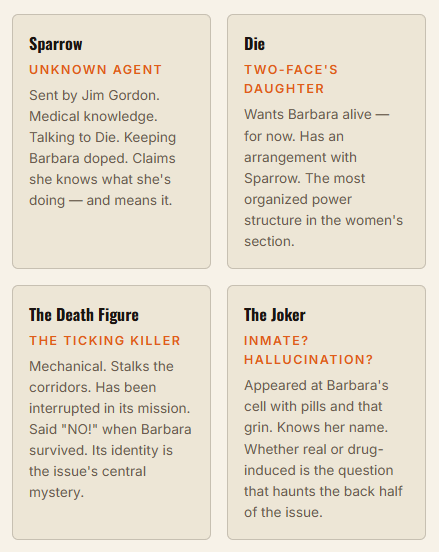
The guard tells her to contact them if she thinks of useful details. Then they leave. In the corner of the room stands the figure in the orange jumpsuit with the distinctive red neckerchief who had appeared briefly at the end of Issue #1. This person crouches down, looks Barbara level in the eyes, and introduces herself.
Sparrow
“I’m Sparrow. You call me if you need anything. You’re not safe here, Gordon. Try to drink as much as you can. I’m getting you out.”
Barbara’s internal caption floats in the final panel like a question mark pressed onto the page: Sparrow. Can I trust you? She doesn’t know. She has no reason to. But she’s lying in an infirmary bed with a cracked skull, and Sparrow is holding out a cup of water, so the answer her body makes is the only realistic one.
No Choice. No Rescues.
A yellow caption box fills the left corner of page eight like sunlight: No choice. Beside it, a close-up of a plastic hospital cup with a straw. It’s almost comically mundane — a cup of water as the pivot point between staying put and doing something dangerous. In the adjacent panel, Sparrow shushes Barbara quietly while pressing something small into her hand — a small, folded object, a key or a pick, passed palm-to-palm with a steadiness that says this isn’t the first time Sparrow has done something like this. “We have to be quick. And quiet,” Sparrow says.

The next panel pulls back to a corridor shot: Barbara, still bandaged, leaning against Sparrow as they push through a door into a hallway. The perspective is low — floor-level — and the colors shift dramatically from the sickly infirmary green to something stranger. On the right side of the panel, the corridor bleeds into swirling psychedelic colors: pinks, purples, greens in an abstract, unnatural flow. It’s not supernatural. It’s the drug Sparrow gave Barbara to manage the pain. It’s starting to kick in. The caption at the bottom of the panel completes the echo from Batman’s warning in Issue #1, delivered now from inside the prison: No rescues.
Barbara wanted no rescue. She said so. And yet here she is, being half-carried by someone she barely knows, doped on prison painkillers, lurching through a corridor while her perception of reality starts to fragment. The irony is not lost on her — or on Tamaki, who lets the visual design carry the joke.
The Drug Takes Hold: Batman, Jim Gordon, and Nightwing
The psychedelic corridor bleeds into full hallucination. As Sparrow guides Barbara through the prison, the walls dissolve into a swirling dreamscape. Barbara begins slurring her words. She asks Sparrow what she gave her. And then — in the fractured logic of a drugged, concussed mind — she sees Batman.

Nahuelpan’s page composition here is extraordinary: Barbara is small in the lower foreground, horizontal, half-prone, while Batman looms enormous in the background above Sparrow. The colors are acid-bright, unnatural. Batman’s cowl is dark green in the haze. His voice is the calm, controlled cadence she has heard a thousand times: “What was that sound before?” Sparrow says “What?” The caption box explains what Barbara’s brain is doing: Slurring my words. Like an escalator. Or… something metal. She’s still processing. Still working the problem. Even drugged out of her mind, the analytical part of her refuses to go quiet.
She asks Batman what Sparrow gave her. Batman makes the universal gesture for silence — one finger to the lips — and says “Shhhhh.” A click of metal. And then: a cut to the outside world.
We’re outside Supermax’s perimeter — a different Gotham, the one that still technically exists beyond the walls. A guard walks a beat at a chain-link fence. The radio crackles: “Officer Gordon? You can wrap up. Your shift is over.” He responds: “Ten-four.” And then: a red car screams by in a lower panel. Warning lights. Something’s wrong. The guard watches it go, jaw tightening. His internal read is clear from the single caption: Maybe the shift’s not over after all.
This is Jim Gordon. Barbara’s father. Still out here. Still a cop, even in a city where being a cop means serving Vandal Savage’s perverted version of law. And he’s still watching. The panel of him running in pursuit — breathless, aging, refusing to quit — is one of the issue’s most quietly moving images. He shouts “Stop! GCPD!” He knows he can barely keep up. He goes anyway.
The chase ends in a confrontation: Jim Gordon gets jumped by two of Vandal’s muscle. He takes hits, gives some back, goes to the ground. Then — a splash page that earns every inch of real estate it takes up — Nightwing drops in. Blue and black, escrima sticks raised, landing on the lead attacker with the kind of kinetic grace that reminds everyone exactly how dangerous Dick Grayson is. “Plus those knees are going to give out sooner or later,” he says to the downed man, grinning. It’s a classic Nightwing line: confident, warm, and slightly too cheerful for someone who just beat a man unconscious.
The fight disperses. Nightwing and Jim Gordon talk. This scene carries the emotional heartbeat of the outside world’s storyline. Jim knows Barbara doesn’t want to be rescued. Nightwing confirms it: “She’s made it abundantly clear she doesn’t want to be rescued.” Jim explains what’s actually going on inside her head — she feels responsible for the people dying in that prison. Nightwing says what anyone who knows the Bat-Family would think: “We were all trying to figure that one out. It wasn’t her job.” But Jim Gordon knows his daughter. “She won’t leave until she finds out who’s doing this.” Then comes the exchange that changes the shape of the conversation:
Nightwing
“She’s going to need help in there. Even if they don’t know who she is, they’ll know —”Jim Gordon
“I sent help. That’s what I wanted to tell you.”Nightwing
“You what —”
The issue cuts back inside before we find out exactly who Jim Gordon sent. But the implication is clear: Sparrow isn’t just a random inmate with a good heart. Jim Gordon put someone in that prison specifically to look after his daughter. Which means Sparrow is operating on instructions from outside — and the question of whether those instructions are still good, whether the person Jim trusted can be trusted at all, is now an open wound in the middle of the story.
“She feels responsible for the people who are dying in that prison, Nightwing. She won’t leave until she finds out who’s doing this.”
Jim Gordon — Outside Supermax
Back in Her Cell: Concentrate, Gordon
Back inside, Sparrow brings Barbara to her cell and begins rebandaging her wrist. Three tight panels run across the middle tier of the page: a bandaged hand being rewrapped, a prescription bottle tipping pills into a palm, and Barbara’s battered face receiving a glass of water. The economy of the page layout mirrors Barbara’s own mental state — reduced, stripped down, functioning on the minimum required. Sparrow says she needs sleep. Barbara, still working through the logic haze in her head, answers with a thought that cuts to the center of everything: If this is the guards, then this is all Vandal’s trap.

And then the line she immediately tries to correct: Right. Which I knew. Thought. Right. She knew this going in. She knew Vandal seeded the prison with his own people. She knew the guards were enforcers. So why does being attacked by them feel like new information? Because knowing a thing in theory and surviving it in your body are two completely different experiences. Barbara knew she was walking into a trap. She chose to walk into it anyway. Now she’s living in it.
Sparrow says something that makes Barbara’s eyes open: “I know why you’re here, Barbara.” She uses her first name. Not her number. Not her alias. Her name. Then she adds: “But then why…” — the sentence left deliberately unfinished. Why what? Why am I helping you? Why did Jim Gordon send me? Why is someone trying to kill you but also keeping you alive? The unfinished question hangs in the air. Barbara, medicated, concussed, and exhausted, gives up the fight against sleep. The final caption of the sequence: I can help you. / Why… The last word drifts off as her eyes close.
Death Walks the Corridors of Supermax
The Figure in the Hallway
One of the most visually distinctive elements of Barbara Gordon: Breakout #2 is the recurring appearance of a skeletal, Grim Reaper-like figure — rendered in Nahuelpan’s most expressionistic style — stalking the green-lit corridors of Supermax. This is not a supernatural being in the traditional sense. It is a visual metaphor made flesh: the inevitability of death in this place, personified, given panels of its own to roam the prison. Whether it represents a specific threat, Vandal’s kill order, or something stranger entirely has not yet been revealed. What the comic makes clear is that it is active. It is hunting. And it is the source of that mysterious ticking sound that has haunted Barbara since the end of Issue #1.
Page sixteen opens on a full-width panel: a hooded skeletal figure with a scythe moving through a corridor lined with cell bars, trailing a haze of sickly green. The caption box, in yellow, reads: …am I still alive? A second panel shows the characteristic TICK TICK TICK TICK that Barbara first heard in her cell — here accompanied by a long, jagged skeletal claw dragging slowly along the bars. The question Barbara’s mind keeps cycling back to: Why try to kill me and let me live?
In the lower third of the page, the figure turns directly toward the reader in two tightly framed panels. It speaks — which it has not done before. The speech bubble contains a single word: NO! It sounds like a correction. Like it was interrupted. Like something — the explosion, the fact that Barbara is still breathing — defied its agenda. The skull face is rendered with a dramatic red accent light on its left side, making it look like the cover of a horror movie. This figure is not just a visual flourish. It has a voice now. And it’s angry that Barbara is still alive.
Page seventeen returns us to morning count. “PRISONERS RISE FOR MORNING MEAL!” echoes down the cell block. Barbara gets up. The single-word caption: Pain. Sparrow hands her something for it. Barbara accepts it with a look that suggests she’d refuse the luxury if she could afford to. Her internal dialogue is a compressed thesis statement: I have pain. I don’t have time for pain. She files into line with the other prisoners, bandaged and battered, and keeps moving. Because this is Supermax, and stopping is the same as dying.
“They’re Picking Us Off One by One”
In the cell block corridor, a TUCO guard — massive, armored, baton in hand — calls out prisoner number 554A23. The guard states the official language: “Officer 45 going in.” No explanation. No charges. The implication is everything: this is a maintenance call. Vandal’s enforcers are cycling through their target list. The last panel of the page is a blood-smeared hand in the lower corner. The caption says simply: …isn’t finished.

Barbara and Sparrow are in the yard when another inmate tells them: “There was another one.” Barbara’s expression is a controlled thunderstorm — the green-eyed fury of someone who came here to stop exactly this and is watching it happen anyway. Another inmate responds with a bleakness that has become Supermax’s native language: “They’re picking us off one by one. We’re all dead.”
Barbara asks Sparrow the key investigative question: who do people think is doing this? Are they blaming the guards? Sparrow cuts her off immediately, voice dropped low: “Keep your voice down.” Then the answer that closes every door: “No one knows.” No one inside the prison knows who is behind the killings. The guards are obvious suspects, but the methods are strange — not blunt TUCO violence, but something subtler. Something with a mechanical component. Something that ticks.
Knock Knock: The Joker at the Door
Night again. Barbara is back in her cell, lying down, eyes open. The ticking starts: TICK TICK TICK. She goes alert. “Who’s there?” In the upper-right panel, a figure appears at her cell bars — sharply dressed in a purple suit and hat, face split into that unmistakable grin. The Joker says: “Knock, knock.” Then, leaning close: “Time for your pills, Barbara.”
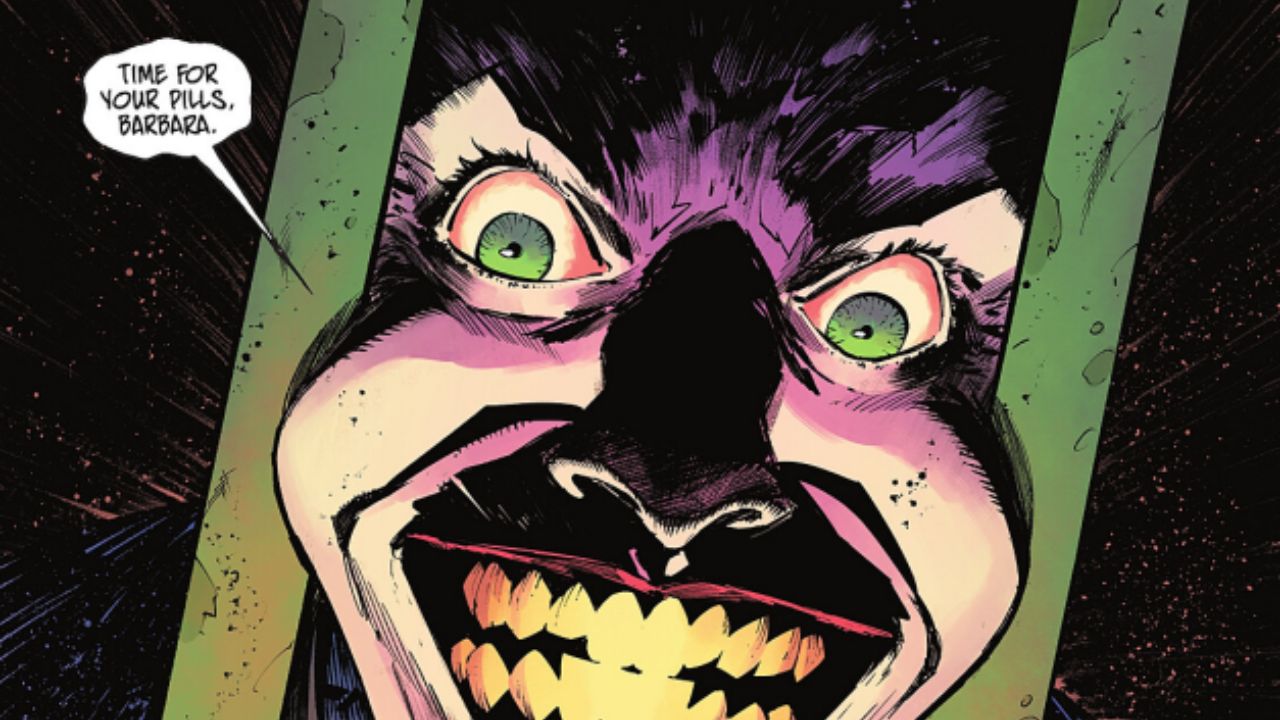
The lower half of the page is dominated by a single massive panel — a close-up of a face crammed between the bars, goggle-wide green eyes, yellow teeth bared in a grin that takes up the bottom third of the page. It is deeply, viscerally unsettling. The face is not drawn like a hero or a monster. It is drawn like a Jack-in-the-box that has just sprung open in a room you thought was locked. Barbara stares. The question implied by everything in the panel: is this real, or is she still in the drug haze? Either possibility is terrifying.
Tamaki and Nahuelpan have been precise about when Barbara hallucinates and when she doesn’t. The Batman vision earlier was clearly tagged as drug-induced. This scene carries no such tag. The Joker appears at her bars, knows her name, and has pills. Which means one of several things: the Joker is genuinely here, in Supermax, as a prisoner — and has been observing her. Or Vandal Savage, who has a vicious sense of twisted humor, arranged for the Joker to be placed where he would be maximally destabilizing. Or something else is happening entirely, something that the issue doesn’t explain yet.
Page twenty-one pulls back to what feels like a quieter moment — or as quiet as Supermax gets. Barbara is in her cell again, resting. A figure in yellow and brown stands at the door, watching. The caption returns to Barbara’s analytical mode: The construction of Max started two years ago. Just because I couldn’t find a financial link to Vandal doesn’t mean there isn’t one. He’ll try again. The guards. Someone. She drifts toward sleep: Need to… And then: out again. In the bottom two panels, the watching figure at the door says softly: “Stay asleep, dear Barbara.” It is someone who knows exactly who she is and has chosen, for reasons entirely their own, to let her rest.
Sparrow’s Network: Die and the Doped Prisoner
The ticking sound returns — rendered again in Nahuelpan’s signature yellow lettering against the green-black of the corridor: TICK TICK TICK TICK. Sparrow is walking the cell block at night, moving with the deliberate quietness of someone who has learned to belong in every part of this place. A disembodied voice from the darkness: “Hey there, nurse.” She stops. A hand reaches out from between bars. She doesn’t flinch.

It’s Die. Blonde hair, aggressive posture, those cold blue eyes that calculated Barbara’s weakness the moment she walked into the yard on Day One. Die is not asking for help. She is checking in on an investment. “So?” she says, meaning: is Gordon still alive? Sparrow’s answer is flat and precise: “So it’s going fine, Die. Relax.” Die presses harder: “She didn’t die.” Not a question. Sparrow confirms it: “No.” Then adds something that reveals the full shape of her operation: “And I’m keeping her breathing but doped.” Die absorbs this. Sparrow’s final line is the one that closes the exchange and opens a new set of questions: “I know what I’m doing.”
This is the revelation that recontextualizes every prior scene involving Sparrow. She is not simply Jim Gordon’s ally placed inside to protect Barbara. She is playing a multi-party game. She is talking to Die — the most dangerous social predator in the women’s section — about Barbara’s condition. She is managing Barbara’s consciousness through medication. She says she knows what she’s doing. But what, exactly, is she doing? Is she protecting Barbara from Die while also keeping Die informed enough to stay satisfied? Is she actually working for Die, and Jim Gordon’s trust is being exploited? Or is Sparrow running some third operation entirely, one in which both Barbara’s survival and Die’s compliance are useful tools?
Death Comes for Us All
The final page is a two-panel composition followed by a devastating full-bleed splash. In the top tier: a small cell, an inmate lying on a cot, the skeletal death figure looming huge in the second panel with a single caption rendered in what appears to be speech: “Just let me do my job.” The figure is talking. It talks to prisoners. It has a will and a voice of its own, distinct from the TUCO guards, distinct from Die’s crew, distinct from Vandal’s visible operations.

The splash itself is the most terrifying image the series has produced so far. The death figure — scythe raised, skeletal hand extended, robes swirling in an impossible dark wind — looms over a prone figure in orange whose hair spreads across the cot like a copper flame. That hair. That orange uniform. That bandaged wrist. The figure on the cot is Barbara Gordon. The death figure says: “You know what they say…” And reaches for her.