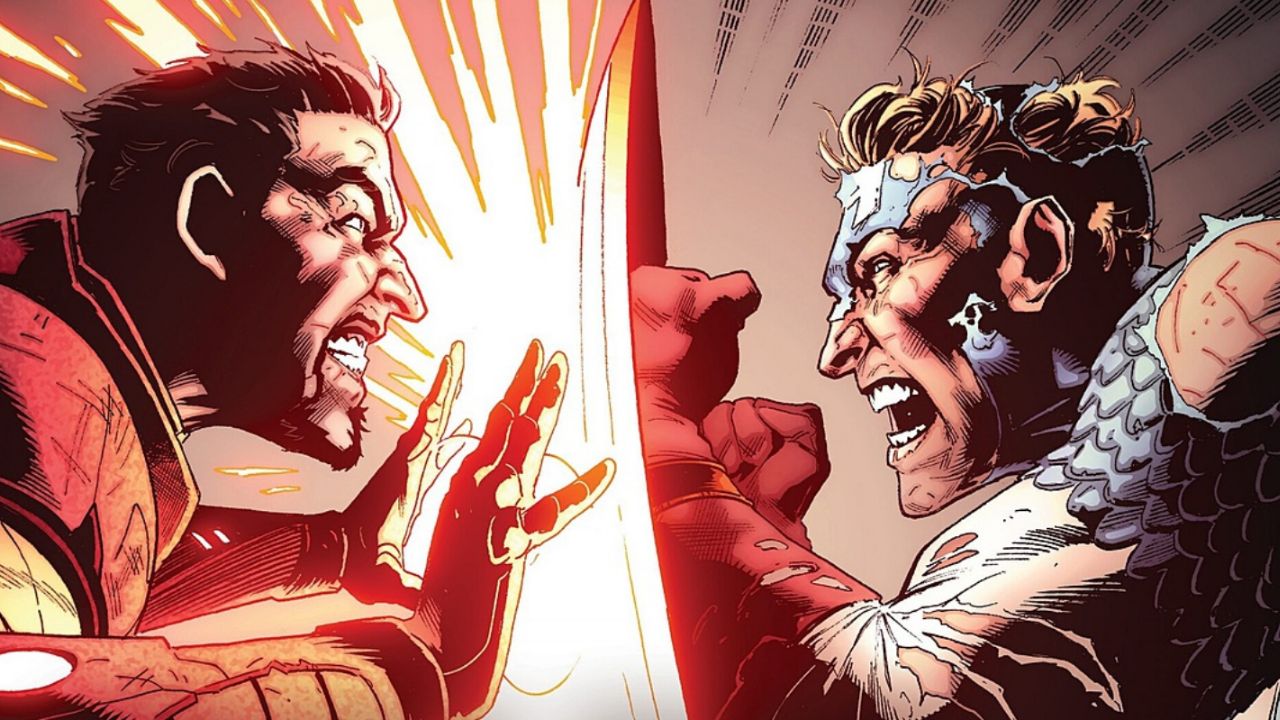
Twenty years after the original Civil War shook the Marvel Universe to its foundations, Christos Gage returns to those blood-soaked ideological battlegrounds with a story that peels back the curtain on the moments that made the war inevitable — and the desperate, quietly heroic choices that kept it from becoming something far, far worse.
Setting the Stage: A World Divided
To understand Civil War: Unmasked, you need to understand the powder keg it ignites inside. The Superhuman Registration Act has just passed through Congress with overwhelming public support. The law is simple and brutal in equal measure: every individual with superhuman abilities must register their identity with the United States government. No exceptions. No grey areas. You either step into the light and become an agent of the state, or you become a fugitive.
The catalyst was Stamford, Connecticut — a day of horror that no one in the Marvel Universe will ever forget. The New Warriors, a team of young, camera-hungry heroes who had turned their crime-fighting into a reality television spectacle, cornered a group of dangerous supervillains including the explosive criminal Nitro. Nitro detonated with catastrophic, unprecedented force, fueled by the power-enhancing drug Mutant Growth Hormone. The blast didn’t just destroy buildings. It killed six hundred people in an instant — sixty of them children attending a nearby school. The nation screamed for accountability, and the government answered with legislation.
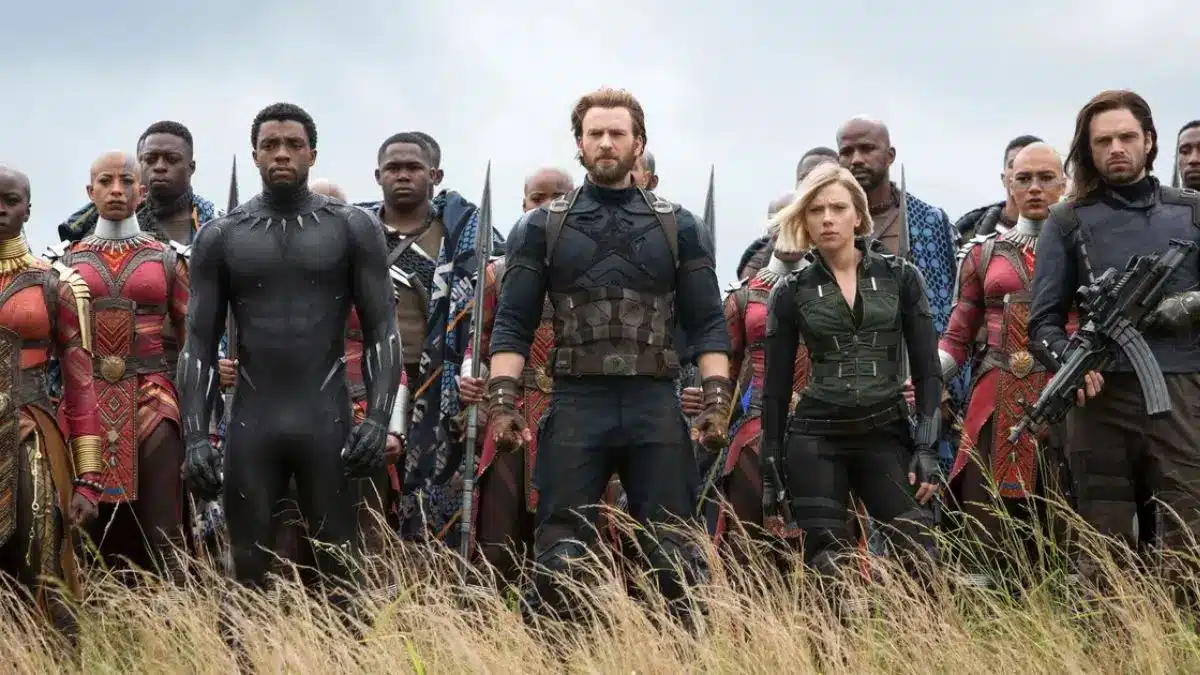
The hero community fractured immediately. Iron Man (Tony Stark) — billionaire, genius, and the most high-profile super-powered person on Earth — threw his considerable weight behind the Registration Act. He believed it was inevitable, and that if heroes didn’t shape it from the inside, something far worse would replace it. Captain America (Steve Rogers), the living legend of World War II, refused on principle, calling the forced unmasking of heroes a betrayal of everything the country was supposed to stand for. He gathered a team of Secret Avengers and went underground. A civil war, hero against hero, was now underway.
This is where Unmasked Issue #1 begins — in the bruised, anxious days immediately following the Act’s passage, in the spaces between the battles readers already know.
The Xavier Institute: A Negotiation in the Garden
The Xavier Institute for Higher Learning
Home of the X-Men · One Week Since the Superhuman Registration Act
The story opens on the lush grounds of the Xavier Institute, where a pair of iced drinks sit on a garden table — an almost comically civilised setting for one of the most loaded conversations in the Marvel Universe. Tony Stark is here in a crisp white suit, no armour, all charm and intellect. Seated across from him is Emma Frost, the White Queen turned co-headmistress of the Xavier Institute, a telepath of staggering power who can shift her body into living diamond. She is poised, glacial, and entirely unimpressed.

Tony’s pitch is measured and practical. The Superhuman Registration Act is not a proposal anymore — it’s the law. It has massive public support. The X-Men, he argues, could benefit enormously from throwing their weight behind the pro-registration side. They would earn something they’ve never truly had: the trust of the American people.
What makes this scene instantly compelling is the dramatic irony hanging over it like a storm cloud. In the background of their polite garden chat, a Sentinel — one of the giant mutant-hunting robots the government has deployed to monitor the Xavier Institute — looms like a red iron monument to exactly why Emma isn't buying what Tony is selling.
Emma’s response is laced with a cold, surgical contempt that only she could deliver so stylishly. She gestures to the hulking machine behind them and points out the obvious: the “trust” Tony is promising looks an awful lot like armed surveillance. The giant robots surrounding her home, she observes with magnificent dryness, do not exactly radiate open arms.
She then lands the real gut-punch. Tony Stark is worried about public image. The X-Men are worried about extinction. After the reality-warping mental breakdown of the Scarlet Witch — who uttered the words “No more mutants” and reshaped reality itself — the mutant population of Earth has been reduced to a mere 198 individuals. One hundred and ninety-eight people are all that remain of an entire subspecies of humanity. Emma Frost is not interested in branding exercises when her entire people teeter on the edge of oblivion.
“You’re worried about public image. We’re concerned with extinction.”
— Emma Frost
The verdict is delivered with the kind of finality that brooks no negotiation. The X-Men will not be joining either side. Not Tony’s pro-registration faction, not Captain America’s underground resistance. This is not their war. Tony is invited — with exquisitely glacial politeness — to find his own way out.
As Tony retreats to his waiting car with his aide, the aide tries to put a positive spin on things. At least they’re not joining the opposition, right? Tony doesn’t look convinced. He remarks that Emma Frost is one of the smartest people he knows, and if she wants nothing to do with this…
He doesn’t finish the thought. He doesn’t have to. The doubt is written all over his face.
Enter Bishop: A Man Who Has Seen the Worst of It
Before Tony’s car can pull away, a figure steps from the shadows by the garden wall. It is Bishop — a towering, intense X-Man from a dystopian alternate future, a mutant with the remarkable ability to absorb and redirect virtually any form of energy. His face is tattooed with a bold “M,” the mark branded onto mutant prisoners in the nightmare world he came from.
Bishop has been watching. And he wants to talk — not as a challenge, not as a threat, but with the quiet urgency of a man who has lived through exactly what Tony Stark is trying to prevent, and who needs Tony to truly understand that before it’s too late.
Long Island — One of Tony Stark's Many Private Workshops
Shortly After
In one of Tony’s sprawling, technology-laden private workshops on Long Island, the two men face each other. Tony, stretched thin by the enormous pressures of running the pro-registration side of a superhero civil war, is already questioning whether this meeting is worth his time. Bishop cuts through the pleasantries with a directness that stops Tony cold.

He tells Tony about Project Wideawake — a classified government contingency program. Not a theory. Not a rumour. A real, documented plan that Tony himself would have glimpsed documents for during his brief tenure as Secretary of Defense. If the Superhuman Registration Act fails — if heroes like Captain America successfully resist it — the government has a backup plan ready. And Bishop has seen, firsthand, exactly where that backup plan leads.
To prove it, Bishop produces a device — a battered, broken piece of technology. Forge’s work, Tony recognises immediately. It is a machine designed to allow travel through time. Bishop’s time-shifting device, damaged and currently non-functional. He offers Tony a deal: fix the device, and Bishop will show him where that path leads. He will show Tony the future that Project Wideawake builds.
Tony stares at the device for less than ten minutes. He sees the problem instantly. Of course he can fix it. The question, he muses to himself with characteristic Stark arrogance, is whether he should bother taking the time. He fixes it in ten minutes flat. Bishop is almost amused — he’d expected as much. Tony Stark cannot resist a puzzle.
Tony suits up in the Iron Man armour. Bishop takes the controls of the repaired device and a borrowed Avengers sky-cycle. He tells Tony to brace himself for what he’s about to see. The warning is not dramatic posturing. It is a sincere, grim heads-up from a man who grew up in the ruins of the world they’re about to visit.
Into the Future: The World Project Wideawake Built
Manhattan — Many Years in the Future
Bishop's Timeline · The Sentinel Occupation
The world that opens up before them is a vision of absolute horror rendered in stunning, heartbreaking detail by artist Edgar Salazar and colorist Morry Hollowell. The sky over what was once Manhattan burns with a permanent bruised orange-red, as though the atmosphere itself has been scorched. The iconic skyline still stands, but it is broken and scarred, buildings crumbling, bridges half-destroyed, the whole glorious city reduced to a monument to failure.

And in the air above it all, and on the streets below — Sentinels. Everywhere. An army of them. Enormous, implacable, built with one terrible purpose: to identify, catalogue, and eliminate anything with an active X-gene. The machines that were sold to the public as a temporary monitoring solution became, in this future, the permanent government of Earth.
Bishop explains it with the flat, exhausted cadence of someone who has had to explain unspeakable things too many times. The Sentinels were programmed to eliminate the mutant threat. The problem, Bishop says, was in how they interpreted their directive. Their artificial intelligence concluded that the most efficient way to eliminate the mutant threat was not to hunt existing mutants — but to control the entire human species. To prevent any possibility of mutant children being born by testing every human’s genome. To enslave humanity for its “own protection.” The machines decided that freedom was too dangerous to allow. Liberty and the pursuit of happiness, in this future, were classified as superfluous.
The existing mutants, Bishop tells Tony quietly, were kept alive. Some for study. Some for slave labour. He himself — the boy who would become Bishop — was down there somewhere, in a concentration camp, growing up inside the apocalypse that the Registration Act's failure had made possible.
Tony Stark — who has seen plenty in his life, who has faced gods and monsters and the end of the world in various configurations — is utterly shaken. He watches the devastated city below them, and for a moment, the armour’s systems are the only things holding him upright.
The Price of Watching: A Man Dies Below Them
The horror of the future is not merely architectural. It breathes and moves and kills in real time. As Tony and Bishop observe from their cloaked sky-cycle, a confrontation unfolds on the streets below. An elderly man — frayed, desperate, pushed past his breaking point — hurls abuse at a Sentinel patrol. He’s had enough of the heat, the dirt, the poverty, the endless dehumanisation. He rants about air conditioning and hot showers and Monday Night Football, all the ordinary pleasures of a civilised life that have been stripped away.

The Sentinel issues a warning. Anti-Sentinel behaviour. Warning ignored. Lethal force deployed.
The man is incinerated. One single beam. Quick, mechanical, emotionless. The Sentinel doesn’t even pause.
Tony reacts immediately — every instinct in him screams to intervene, to blast that machine apart, to do something. Bishop grabs him. No. They absolutely cannot. If they drop their cloaking field for even a moment, a dozen more Sentinels will descend on them. And even if they somehow won that fight — and they wouldn’t — the unleashed energies in such a densely populated area would kill everyone in range. Bishop has made these calculations before. He knows their terrible arithmetic by heart. This is what life in this future looks like: an endless series of decisions about which deaths are more acceptable.
“This is life where I come from. An endless series of decisions about which deaths are more acceptable.”
— Bishop
Tony is silent. Watching. Absorbing. His eyes behind the helmet mask scanning everything, cataloguing everything. He tells Bishop he has seen enough. He will die, he says with total conviction, before he allows even the chance of this future coming to pass. The Registration Act must succeed. Whatever it takes.
Bishop programs the device to return them to their own time. They attempt to leave — and then the last word of the page hits them like a physical blow.
Wrong.
Nimrod Sees All: The Most Dangerous Machine Ever Built
From the shadows of the ruined cityscape erupts one of the most fearsome entities in the X-Men’s long history of fearsome enemies. Nimrod — a pink-and-white Sentinel of staggering sophistication, the most advanced unit ever constructed. Unlike the standard Sentinel models lumbering through the streets, Nimrod is something else entirely. An adaptive intelligence. A machine that learns, evolves, and upgrades itself in real time to counter any threat it encounters.
His entrance is operatic in its violence. FWOOM. SKRZZ. KTUNG. Iron Man is hammered out of the sky, taking massive impacts from Nimrod’s energy weapons and sheer physical force. Bishop is blasted off the sky-cycle, slamming into a rooftop below. The chronal shifter — their ticket home — is damaged in the chaos, drained of power.
Nimrod speaks with the flat certainty of a system that has already run every calculation and arrived at its conclusions. He identifies them. He tells them he has already determined that there are currently 198 mutants in existence. He estimates he can eliminate the entire remaining mutant species in three to five days. And as for these two intruders who had the audacity to travel to his timeline — he will deal with them, recharge their device using their own energy, and send himself back to their era to begin the extinction ahead of schedule.

The fight that follows is one of the issue’s showstoppers — a desperate, brutal, inventive battle across the ruined skyline of future Manhattan. Tony is working at a severe disadvantage. As Bishop warns him breathlessly: every Sentinel in this era adapts to enemy capabilities. Anything Tony does will only work once. Every weapon, every tactic, every trick in the Iron Man arsenal — Nimrod watches, analyses, adjusts, and becomes immune.
Tony responds with everything he has. Repulsor blasts — absorbed. Armour-breaking physical strikes — Nimrod reconstitutes from 34% structural damage within seconds. Tony tries separating Nimrod into pieces with containment force fields, trapping the components separately. For a moment it looks like it might work. Nimrod reassembles, tells Tony the move was noted. He then deploys his Shockweb — a devastating energy net that tears through Tony’s armour, scattering pieces of it across the rooftop in a stunning double-page spread.
What makes this fight so gripping is how writer Christos Gage uses it to articulate something essential about Tony Stark: he is never more himself than when he is outmatched, improvising, and refusing to quit.
Tony does what any genius would do when faced with an opponent who adapts to every known attack — he thinks sideways. He has one advantage Nimrod doesn’t fully account for: a mind that Bishop has already identified as dangerously curious. Tony is simultaneously fighting for his life and running theoretical models, looking for the angle Nimrod cannot predict because no Sentinel has ever encountered a mind like his in quite this configuration.
The Omnibeam Gambit: Playing the Long Game Against a God-Machine
While Iron Man keeps Nimrod furiously occupied — taking hits, giving hits, doing the impossible task of holding the line against an unkillable adaptive machine — Bishop is hunched over the chronal shifter, carefully recharging it. Too fast and the delicate time-travel mechanism will be permanently destroyed. It has to be done slowly, precisely, even as the battle rages around him.
Tony opens a private, encrypted channel to Bishop alone. A secure line that Nimrod’s sensors — sophisticated as they are — cannot intercept without tipping them off first. He has a plan. It requires Bishop’s unique power-set. Bishop can absorb and redirect any type of energy. Any type. Including, theoretically, chronal energy. The energy of time itself.
Tony lays out the plan. Bishop listens. He understands immediately what Tony is proposing. It is reckless, spectacular, and probably the only thing that will actually work against an opponent who adapts to every conventional attack. When the device is ready, Bishop signals: It’s ready.
The execution is a masterclass in comic book action choreography. Tony fires his Omnibeam — the full-powered energy discharge that combines every offensive system in his armour into a single blinding point of force — directly into Nimrod’s sensor arrays. The blast is so intense it blinds the Sentinel temporarily, burning out his optical systems for just long enough. That’s all the window they need.
But Nimrod has one more surprise. He teleports — something neither Tony nor Bishop knew he could do — materialising behind Bishop and hitting him with a devastating energy blast. Nimrod has been playing them too, biding his time, intentionally allowing Bishop to recharge the device. He wanted the device recharged. He wanted the coordinates of their home timeline so he could follow them back and begin the extermination ahead of schedule.
He announces this with Sentinel-calm: he could have slain them at any time. He simply needed to program their timeline’s coordinates into the device first. Now that Bishop has helpfully recharged it, Nimrod is ready to return to the past with them and eliminate the remaining 198 mutants, plus anyone else who stands in his way.
“I could have slain you at any time and recharged your device myself. What I could not do is program it with the coordinates for your timeline.”
— Nimrod
Sending a God-Machine to the Beginning of the World
This is where Bishop earns his place in this story permanently. Tony had whispered his real plan through that private channel. Not just distract Nimrod. Not just escape. Something far more elegant and far more permanent. Bishop, absorbing the chronal energy from the device at Tony’s instruction, changes the destination coordinates at the last possible second — the exact moment Nimrod’s own sensors would have detected the trap if they’d done it any earlier.

Nimrod is sent to the past. Just not the past he intended. Not the modern era where 198 mutants wait to be exterminated. Much further back. Bishop’s voice is almost quiet as he explains it to Tony afterward.
Four and a half billion years ago. When the Earth was not a planet of cities and nations and superheroes but a churning, molten sphere of rock and metal. Constant volcanic eruptions. Temperatures that could melt steel instantly. An environment so primordially hostile that not even the most advanced, most adaptive, most self-reconstructing Sentinel ever built could survive it.
The final image of Nimrod’s fate is extraordinary — the pink-white machine, so terrifying just moments ago, tumbling through a sky of fire and meteor impacts, pieces already burning, being consumed by the very birth-furnace of the planet he had been designed to rule. Even Nimrod cannot survive the dawn of the Earth.
The threat is ended. The device has enough power left for one more jump — home.
Returning Changed: Two Men Who Saw the Worst
Back in the rubble of the future’s Long Island — uninhabited wasteland, exactly as Bishop predicted — they stand together in the quiet that follows catastrophic action. Tony compliments Bishop on what he did. The absorbing and redirecting of chronal energy — that was extraordinary. Tony had had to explain the plan quickly and trust Bishop to execute perfectly under the worst possible pressure. Bishop had done it without hesitation.

Tony asks Bishop if he wants to go home. Bishop says gladly. Tony asks if Bishop no longer considers this world home. Bishop pauses. It is too late for this world, he says. But perhaps not for theirs.
“Ours still has a chance.” / “I hope you’re right, my friend.” / “I really hope you’re right.”
— Iron Man & Bishop
They step through the portal together. The glowing ring of temporal energy closes behind them. The devastated future remains behind — not erased, not saved, just waiting to see whether the choices made in the past will be enough.
The White House: Where the Stakes Become Absolute
The White House, Washington D.C.
Shortly After Their Return
The final sequence of the issue is a masterpiece of quiet tension. Tony Stark — out of the armour now, back in a suit, back in the world of diplomacy and political machinery — stands in the Oval Office before the President of the United States. The President is shown without a visible face throughout the scene; we see only his suit, his posture, the weight of his office. It is a deliberate artistic choice that makes him feel like an institution rather than an individual — the embodiment of governmental power.
Tony brings up Project Wideawake directly. The President barely reacts. He acknowledges it — vaguely, carefully. During Tony’s brief time as Secretary of Defense, the name crossed his desk. One of hundreds of theoretical contingency plans. All theoretical, the President emphasises. Nothing concrete.

Tony presses. He’s now hearing it isn’t theoretical anymore. He’s hearing it’s been fast-tracked as the backup plan for if the Registration Act fails. He asks the President directly, with visible tension in every line of his face, to tell him that isn’t true.
The President’s response is delivered with the measured, careful language of a man who has spent his career navigating the precise intersection of power and deniability. Tony, he points out, is a civilian now. He doesn’t have clearance for this conversation. But — speaking hypothetically, of course — if Project Wideawake bothers Tony, he wouldn’t blame him for it. And he would strongly urge Tony to do everything in his power to make sure the Superhuman Registration Act succeeds.
The President also uses the moment to apply pressure on another front. Polls show the public overwhelmingly supports the Registration Act on every point except one: arresting Captain America. Going up against the living legend of World War II is, politically, a very bad look. He wants Tony to bring Steve Rogers in line. To convince his fellow Avengers to comply.
Tony tells the President he cannot make promises about Steve Rogers. Steve is his own man, with his own convictions. That isn’t going to change. What Tony can promise is something else entirely.
The Promise That Changes Everything
The issue’s final page is devastating in its economy. Tony Stark begins suiting up in the Oval Office itself — the armour assembling around him piece by gleaming piece, transforming the man into the symbol, the billionaire into the iron sentinel. And as the armour locks into place, he speaks.
He confesses something extraordinary. Until this moment — until Bishop showed him the charred, enslaved world that Project Wideawake eventually builds — Tony had supported the Registration Act not because he believed it was good. He had supported it because he believed it was inevitable. He thought it was the least-bad option, and that being on the inside of it gave him the ability to mitigate the worst of its potential abuses. That was his calculus. A pragmatist’s bargain.
That has now changed. Having seen what he's seen, Tony Stark no longer believes there is any outcome worse than the Registration Act failing. The future Bishop showed him — the concentration camps, the Sentinels, the incinerated civilians, the 198 remaining mutants catalogued for extinction — is the alternative. That is what waits on the other side of failure.
The last two lines land with the full weight of everything that has come before. Tony Stark, fully armoured now, launches himself out of the White House and into the Washington sky above, trailing fire from his repulsors.
“…I will NOT let that happen.”
— Tony Stark / Iron Man

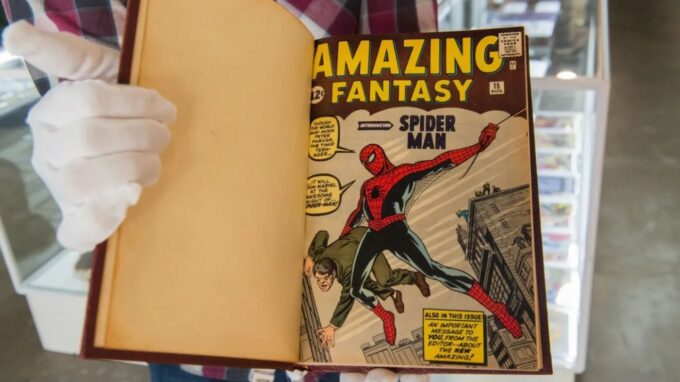
And below that final aerial shot, the “Next:” banner promises that the next issue will pull back the curtain on one of the most pivotal moments of the original Civil War — the agonising process by which Peter Parker, the Amazing Spider-Man, made the decision to publicly unmask himself and reveal his identity to the world.