Everyone knows the story. A Trojan prince steals a Spartan queen. A thousand ships launch. Heroes clash on a wine-dark shore for ten years. A wooden horse decides everything. Homer tells it beautifully, devastatingly, with the kind of moral weight that still makes grown scholars weep. But here’s the problem: Homer only tells part of it — and the parts he leaves out are stranger, darker, and far more illuminating about why wars actually happen.
The Iliad covers roughly 51 days of the war’s final year. Fifty-one days out of ten years. The Odyssey concerns a single man’s journey home. Together, these two monumental poems give us what feels like the whole war — but it’s really a careful, curated selection. The ancient Greeks themselves knew there was far more to the story. They had it. Then, mostly, they lost it.
The Epic Cycle: What We’re Missing
Homer’s poems were not alone. Surrounding them like a constellation were at least six other epic poems — the so-called Epic Cycle — that told the full arc of the war: its origins, its middle years, its catastrophic end, and the disastrous homecomings that followed. Titles like the Cypria, the Aethiopis, the Little Iliad, the Iliupersis, and the Nostoi once existed in full. Now they survive only in fragments and ancient summaries — a few hundred lines total where there were once tens of thousands.
The Lost Epics of the Trojan Cycle
- Cypria — The war’s origins: the wedding of Peleus and Thetis, the golden apple, the Judgement of Paris, and the first nine years of fighting Homer skips entirely.
- Aethiopis — The arrival of the Ethiopian warrior-queen Penthesilea and the Trojan ally Memnon, both killed by Achilles. And then: Achilles’s own death.
- Little Iliad — The contest for Achilles’s armor, the madness of Ajax, and the forging of the wooden horse plan.
- Iliupersis — The fall and sacking of Troy in full, including atrocities Homer’s heroes never commit on-page.
- Nostoi — The homecomings of all the Greek heroes, not just Odysseus — many of them catastrophic.
- Telegony — Odysseus’s final years and a grim end Homer never anticipated.
What this tells us immediately is that the Greeks who lived closest to these stories felt they were profoundly incomplete without the parts Homer omits. The Iliad begins famously in the middle of the story — in medias res — and it ends without the fall of Troy. No Trojan horse. No burning city. No Achilles dying. The poem is a masterwork of selection: Homer chose to tell the story of wrath, of what anger costs, not the story of war’s causes or its ugly finale.
Homer shaped the Trojan War into a meditation on mortality and honor. The Epic Cycle told what Homer, perhaps wisely, chose not to.
Helen, Paris, and the Politics Behind the Passion
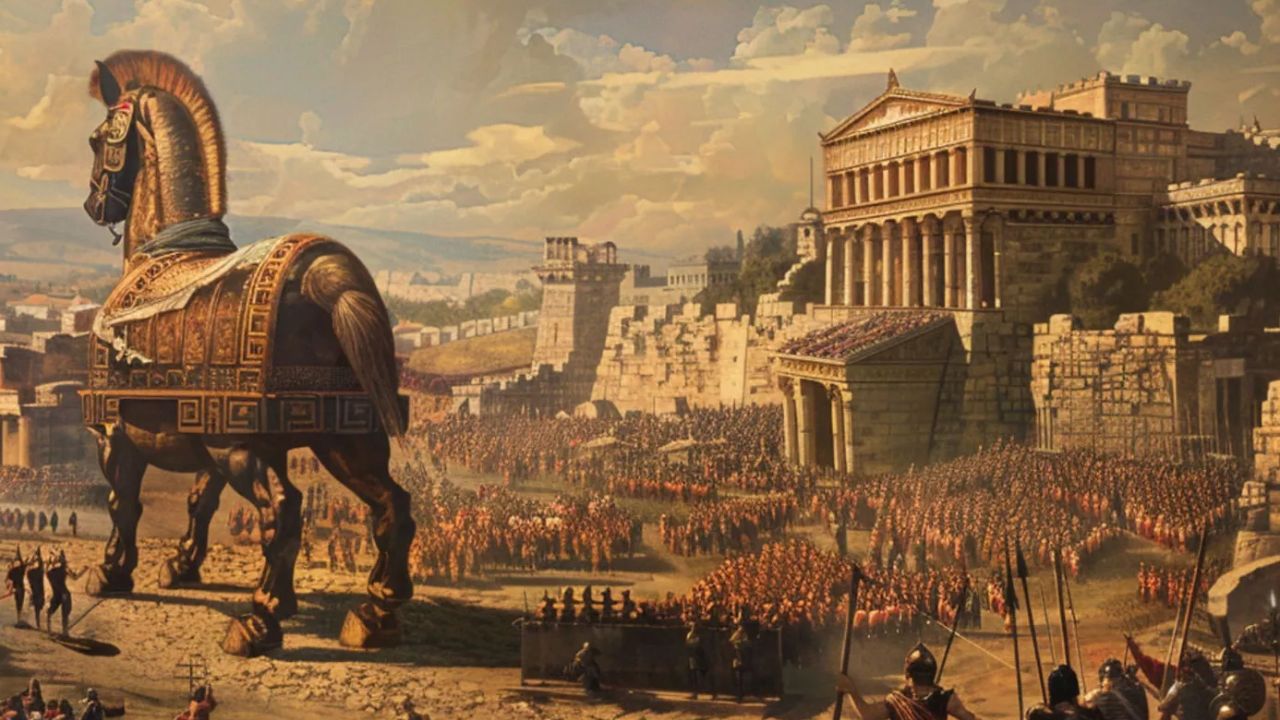
In Homer, the war’s immediate cause is personal: Paris abducted (or seduced — ancient sources disagree) Helen, wife of Menelaus, king of Sparta. Her husband rallied the Greeks under his brother Agamemnon. Simple enough. But even Homer drops clues that the war is about something far more structural.
Agamemnon is not Menelaus. The man who leads this vast expedition is not the wronged husband but a king whose power base in Mycenae sits at the heart of the Late Bronze Age Aegean world. The coalition he assembles reads like a roll call of every significant Greek power — Odysseus’s Ithaca, Achilles’s Phthia, Diomedes’s Argos, Nestor’s Pylos, Ajax’s Salamis. This is not a rescue mission. This is a geopolitical mobilization of extraordinary scale.
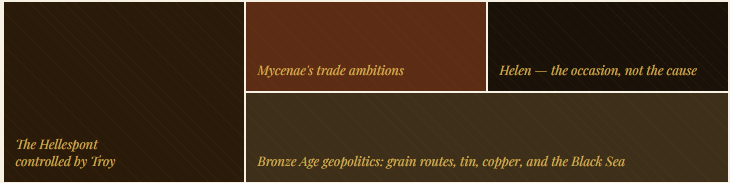
Troy — or Wilusa, as the Hittites called it — controlled the entrance to the Hellespont, the narrow strait now known as the Dardanelles. Every ship sailing from the Aegean into the Black Sea, where Greek colonies traded grain and metal, had to pass through waters Troy dominated. To the Bronze Age world, this was the equivalent of controlling a major oil chokepoint today. A city that rich, that strategically placed, was always going to provoke war eventually. Helen may have been the occasion. She almost certainly wasn’t the cause.
The Real Troy: Archaeology Versus Myth
In 1870, a businessman-turned-archaeologist named Heinrich Schliemann started digging at a mound called Hisarlik in northwestern Turkey. He was convinced — with an obsessive certainty that alarmed professional archaeologists — that Homer’s Troy was a real place and that this was it. He was right. And also spectacularly wrong in the details.
Hisarlik contains not one Troy but at least nine, stacked like the layers of a geological core sample. Schliemann found “Priam’s Treasure” and announced triumph — but the treasure he found belonged to Troy II, a city that flourished around 2400 BCE, a full thousand years before any plausible Trojan War. He had, in his excitement, dug straight through the relevant level.
The archaeological layer that actually matches Homer’s era is Troy VIIa — a city that shows evidence of violent destruction around 1180 BCE, just when Bronze Age civilization across the Eastern Mediterranean was catastrophically collapsing. It was a large, densely populated citadel by late Bronze Age standards, with thick defensive walls, grain storage suggesting a population bracing for siege, and human remains showing signs of violence. Is this the Troy? Maybe. Probably. But the city that actually burned was significantly smaller and less magnificent than Homer’s gleaming towers suggest — which raises the uncomfortable question of how much the legend grew in the telling across the five hundred years between the destruction and Homer writing it down.
The Heroes Homer Sanitizes
Homer’s heroes are brutal, yes — men of the Bronze Age who kill without hesitation and weep without shame. But they operate within a code of honor that Homer largely upholds. Strip away that code, and the figures who emerge from other ancient sources are considerably darker.
Take Achilles. In the Iliad, his refusal to fight costs thousands of Greek lives, he mutilates Hector’s corpse, and he is consumed by a wrath so outsized it borders on pathological. But in later traditions, he also kills Troilus — a young Trojan prince, barely adolescent — in a sanctuary of Apollo, a sacrilegious act that effectively seals his fate. His relationship with Patroclus, rendered with aching tenderness in Homer, was understood by later Greeks and Romans as a fully erotic love — a dimension the Iliad gestures toward without stating.
Or consider Odysseus — Homer’s great hero of the Odyssey, praised for his cunning. It is Odysseus who invents the wooden horse. It is also Odysseus, in post-Homeric tradition, who has the prophet Palamedes framed and stoned to death out of personal rivalry. Who forces the sacrifice of Polyxena, Priam’s daughter, at Achilles’s tomb after the war ends. Whose cleverness, by the time we reach Sophocles and Euripides, has curdled into something we might simply call cruelty.
Greek tragedy did to Homer’s heroes what Homer’s heroes did to their enemies: it stripped away the armor and showed what was underneath.
The Trojan side is equally complicated. Hector, Homer’s noblest figure, is a man fighting to defend his city knowing it cannot be saved — a tragic dignity Homer handles with extraordinary care. But the Cypria gave us a Paris who had already abandoned a first wife before Helen; an entire Trojan royal family honeycombed with bad decisions, divine debts, and curses stretching back generations. Priam’s city was doomed long before the Greeks arrived.
The Gods Are Not a Metaphor
Modern readers often treat Homer’s divine machinery as literary decoration — a way of externalizing psychological states, of giving form to fate. When Athena grabs Achilles by the hair to stop him attacking Agamemnon, we read it as Achilles restraining his own rage. This is a reasonable interpretation. It is also probably not what Homer’s original audience thought was happening.
The Trojan War mythology is saturated with divine causation at a level that defies easy rationalization. The war begins because Eris, goddess of strife, threw a golden apple inscribed “for the fairest” into a wedding feast — specifically, the wedding of the sea-nymph Thetis to the mortal Peleus, a union arranged by Zeus partly to prevent Thetis from having a son more powerful than himself. The three goddesses who competed for the apple — Hera, Athena, Aphrodite — each offered Paris a bribe. Aphrodite offered Helen. He chose Aphrodite. The war follows directly from this divine vanity and this divine deal.
There is no version of the Trojan War in which the gods are absent. Their presence isn’t decorative — it’s structural. The Greeks understood that the war happened at the intersection of human desire and divine will, and that neither alone was sufficient to explain ten years of catastrophic violence. What the modern mind might call “geopolitics,” the Bronze Age mind mapped onto a cosmos populated by beings who could be offended, bribed, and played off against each other — because that, too, is an accurate description of how power works.
The Ten Years Homer Doesn’t Tell
Homer’s Iliad covers, again, roughly 51 days. The Greeks had been at Troy for nearly ten years before the poem opens. What happened for nine of those years? The Cypria told us: raiding expeditions along the Anatolian coast, sacking of nearby cities including Chryse and Lyrnessus (where Achilles captures Briseis, the woman whose ownership dispute launches Homer’s plot), alliances made and broken, supply lines maintained, men dying of disease as readily as of combat.
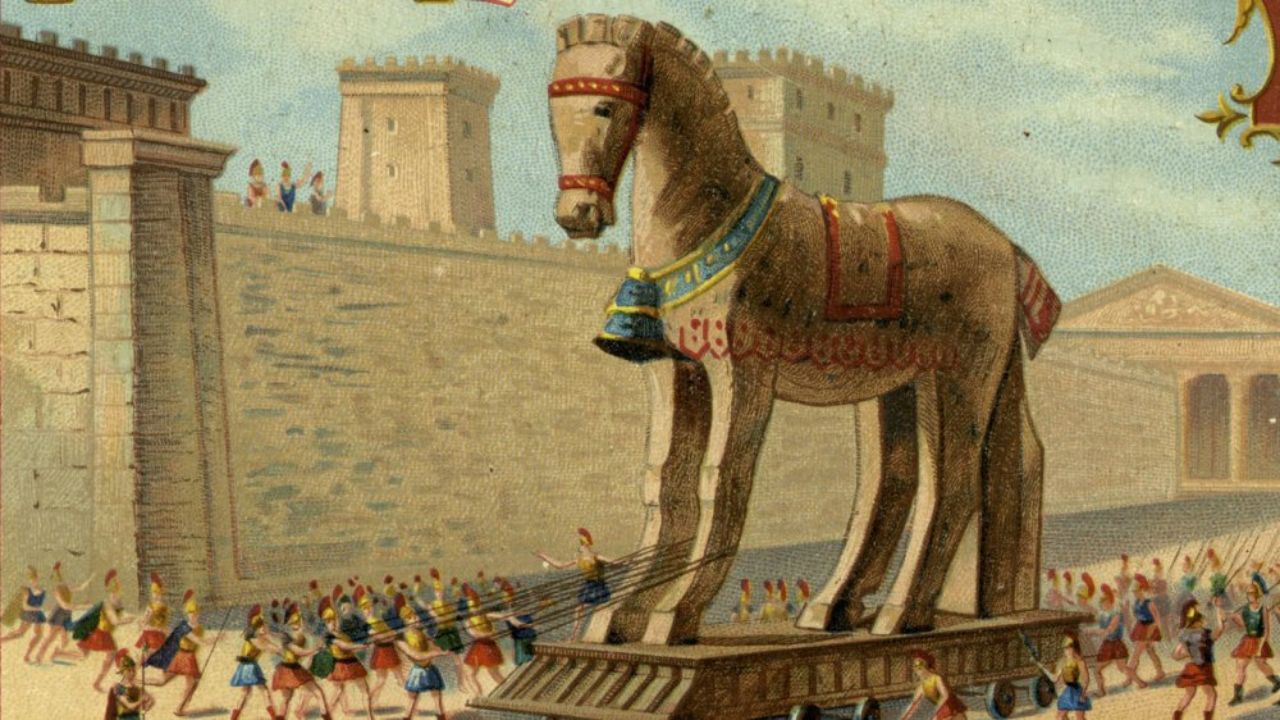
This tells us something essential about ancient warfare that Homer’s compressed, intensified drama tends to obscure: wars of this kind were not primarily pitched battles. They were sieges, and sieges were sustained primarily by logistics, raiding, negotiation, and attrition. Troy’s walls were strong enough that a direct assault was essentially impossible — which is precisely why the wooden horse, a stratagem of deception rather than force, is what finally ends the war. Homer’s poem, with its great set-piece duels and divine interventions, aestheticizes violence in a way that makes war feel almost glorious. The reality of nine years of siege warfare in the Bronze Age Mediterranean would have been considerably grimmer and more mundane.
After Troy: The Nastier Story
The fall of Troy in the Iliupersis — the Sack of Ilion — is a story of atrocity. Priam is murdered at the altar of Zeus. The infant Astyanax, Hector’s son and Troy’s last heir, is thrown from the city walls to prevent him growing up to avenge his father. Cassandra is assaulted in Athena’s own temple by the Greek warrior Ajax the Lesser — a sacrilege so severe it triggers divine retribution against the entire Greek fleet on the homeward voyage.
The Greeks, victorious, go home. And here the Nostoi — the Homecomings — take over. Most of them don’t make it cleanly. Agamemnon, who launched the whole enterprise, returns to Mycenae and is murdered by his wife Clytemnestra and her lover Aegisthus. Menelaus is blown off course and wanders for years. Ajax the Lesser is shipwrecked and drowned by Poseidon’s storm. Diomedes comes home to find his wife unfaithful and his kingdom seized. Idomeneus returns to Crete to find betrayal. Only Nestor, old and wise, gets home without catastrophe.
And Odysseus, of course, takes ten more years — the length of the war itself — to reach Ithaca. His homecoming fills the Odyssey. When he arrives, he kills more than a hundred men in his own hall. The story of the Trojan War doesn’t end with Troy burning. It ends with blood on a palace floor in Ithaca, two decades after a goddess threw a golden apple at a wedding and everything went wrong.
✦
Homer gave us the Trojan War’s soul. The rest of antiquity gave us its body: messier, more human, more recognizably like the way wars actually start, unspool, and refuse to end cleanly. To read Homer is to understand what the Greeks valued. To read around Homer is to understand what they feared.