There is something deeply comforting about a book club. The shared ritual of it — the wine, the sticky notes, the earnest arguments about whether a character deserved her fate — has an almost liturgical warmth. And yet, for all its pleasures, the book club has quietly become one of the least reliable paths to genuinely great literature. Not because the people in them read badly, but because the very mechanism of choosing what to read bends relentlessly toward the agreeable, the accessible, and the discussable. And those three qualities, while virtues in conversation, are often the enemies of extraordinary fiction.
This is not a polemic against the institution. Book clubs serve a beautiful social function. They coax people back to the page in a culture that competes furiously for attention. They create communities. They make finishing a book feel like a social obligation rather than a personal luxury. All of this is genuinely good. But when we look at what book clubs actually choose to read — week after week, city after city, generation after generation — a pattern emerges that is worth examining honestly.
The Problem of the Discussable Book
The primary criterion for a successful book club pick, whether acknowledged or not, is discussability. A good book club book must generate enough surface-level disagreement to fuel two hours of conversation without generating the kind of profound discomfort that makes someone feel attacked, confused, or genuinely destabilized. It should have a clear moral landscape, even if that landscape contains shadows. Characters should be psychologically legible. The ending should resolve enough to allow for a verdict.
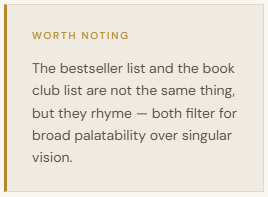
Now consider how many of the most important novels ever written fail this test spectacularly. The Sound and the Fury is almost defiantly undiscussable until you’ve read it twice and a critical biography. Blood Meridian offers no stable moral ground to stand on while you debate it. Correction by Thomas Bernhard is a single airless monologue that might end friendships before it ends chapters. These books are transformative precisely because they refuse to be comfortable. They demand something of the reader that a book club, by its social contract, almost cannot demand.
The best books often feel like a private act of violence against your previous understanding of the world. That is very hard to share over chardonnay.
Consensus as a Filter Against Excellence
Think about the process by which a book gets chosen for a book club. Someone suggests it. Others Google it. They check the reviews, glance at the star ratings, notice whether anyone they respect has praised it. Someone asks: “Is it a hard read?” The group negotiates. A book that sounds too experimental, too dense, too relentlessly bleak, or too formally strange gets quietly set aside in favor of something that promises to be a conversation rather than a homework assignment.
This process is rational. It makes complete sense for a group of people with busy lives and various tolerances for literary difficulty. But rationality in this case is precisely what prunes the most extraordinary choices. The books that change you most are frequently the books that only one person in the group would have chosen alone. The books that survive the committee process are the ones that already have broad appeal baked into them — and broad appeal in literary fiction usually means some combination of the following:
- A sympathetic, clearly motivated protagonist. The reader must be able to enter the character’s head without too much friction. Difficult or deliberately alienating narrators — the great Humbert Humberts and Stevens of literary fiction — tend to get vetoed early.
- A narrative arc with emotional resolution. Book clubs need an ending to discuss. Open-ended, structurally fractured, or deliberately inconclusive novels create anxiety rather than conversation. Yet it is often in that unresolved space where a book’s real power lives.
- A contemporary, culturally relevant setting or theme. A book about climate grief, racial identity, or generational trauma in the twenty-first century will always outpoll a masterpiece of Hungarian absurdism, even if the Hungarian novel is, by any literary measure, the superior work.
- Manageable length. The unspoken thirty-year ceiling of most book clubs means that anything over four hundred pages begins to meet resistance, quietly eliminating Tolstoy, Proust, and vast swaths of the nineteenth century from practical consideration.
- Approachability without condescension. A book must feel literary enough to justify the gathering but not so demanding as to make anyone feel out of their depth. This is perhaps the most insidious filter of all.

The Tyranny of the Relatable
One word has done more damage to the reading of serious literature than perhaps any other in the past two decades: relatable. The demand for relatability — the expectation that characters should feel like neighbors, that emotional experiences should mirror our own, that the novel’s world should be a slightly elevated version of the world we already inhabit — has become so entrenched in book club culture that books which violate it are almost automatically disqualified.
But the greatest literature is not relatable. It is expansive. It does not confirm your existing emotional vocabulary; it introduces you to feelings and ways of being that you could not have articulated before you encountered them. Kafka’s Gregor Samsa is not relatable — he is revelatory. The characters of Flannery O’Connor are not people you would have a drink with; they are vessels for a grace so violent it looks like damnation. Dostoevsky’s underground man is a challenge to every comfortable assumption you hold about consciousness and resentment. None of these books would last five minutes in the selection round of a suburban book club, and all of them will outlast every bestselling novel of the past decade by at least a century.
To demand that literature be relatable is to demand that it stay within the borders of your existing self. It is, in effect, to ask the book not to do its job.
The Oprah Effect and the Machinery of Selection
It would be dishonest to discuss book club picks without acknowledging the vast machinery that produces them. Publishers know what book clubs want. They have known it for decades, with increasing precision since Oprah’s Book Club demonstrated in the 1990s that the right selection mechanism could move a million copies in a week. This is not a conspiracy; it is capitalism reading a market signal clearly. Publishers now develop, edit, and market certain novels with the book club reader specifically in mind — complete with reading group guides, author Q&As, and discussion questions printed right there in the back pages like a confession.
The novels that emerge from this pipeline are not necessarily bad. Many are genuinely good. They are crafted with care, written with real skill, and they often contain genuine emotional intelligence. But they are optimized. And optimization, in literature as in almost every other domain of human endeavor, tends to smooth away the rough edges — and the rough edges are frequently where the genius lives.
What You Miss When You Only Read What the Group Chooses
There is a kind of reading that can only happen alone, in private, accountable to no one. It is the reading you do at two in the morning when a book has colonized your sleep, when you are a hundred pages in and the world has been slightly rearranged. No book club can replicate this. But certain books almost require it — books that are too strange, too demanding, too formally peculiar to survive the group’s need for consensus about what they mean.
What you miss when you only read book club picks is not just a list of difficult novels. You miss a different relationship with literature altogether — one in which you are not seeking a shared experience to discuss but a private encounter to survive. You miss the books that leave you uncertain, disoriented, permanently changed in ways you can’t quite articulate over discussion questions. You miss the books that fail interestingly, that take enormous risks and only half-succeed, teaching you more in their partial failure than a perfectly executed commercial novel ever could.
A Defense of the Difficult, the Strange, and the Demanding
None of this is to suggest that every reader should immediately abandon their book club and disappear into a private reading life of relentless challenge. Literature should give pleasure. Accessibility is a genuine virtue. And there are extraordinary books that are both widely loved and genuinely great — To Kill a Mockingbird, Giovanni’s Room, Beloved, and Never Let Me Go exist, after all, as proof that the Venn diagram of popular and profound is not entirely empty.
But the book club, as currently practiced, fills only one corner of what reading can be. If it is your only relationship with literature, you are receiving a curated, committee-approved, heavily mediated version of what fiction can do. You are, in a very real sense, reading the wine list rather than the cellar.
The books that matter most to your life as a reader — the ones that you will still think about at seventy, that will have genuinely altered the way you perceive consciousness, time, language, and the moral life — are almost certainly not going to be found on a reading list assembled by consensus. They are going to be found in the margins: recommended by one obsessive friend at midnight, discovered on a dusty shelf in a secondhand shop, stumbled upon because you followed a footnote too far. They will be the books you almost didn’t finish. The books that confused you before they illuminated you. The books that nobody you know has read, and that you therefore had to sit with alone, until sitting alone with them became the most intimate reading experience of your life.
The best reading is not a group activity. It is a solitary act of encounter — between one consciousness and another, across the centuries, with no one watching.

A Modest Proposal for the Book Club Reader
Keep your book club. Treasure it, even. The connection it gives you with other readers is real and rare in a distracted world. But let it be only one stream of your reading life, not the whole river. Allocate some portion of your reading year to books chosen by no one but you — books too strange to propose to the group, too demanding to inflict on a Thursday evening, too privately significant to survive the vote. Read at least one book a year that confuses you more than it comforts you. Read something translated from a language and culture distant enough from yours that you feel the friction of genuine otherness on every page. Read something old enough that the world it assumes has vanished.
And the next time your book club finishes its chosen novel and someone says, “Well, that was enjoyable,” notice the faint flatness of that compliment. Enjoyable is fine. Enjoyable is even good. But the books that matter most are the ones that leave something more than enjoyment behind — a residue of strangeness, a slight permanent displacement of the self, a new room in the house of your understanding that was not there before you read them. Those books rarely make the list. That is precisely why you need to find them yourself.