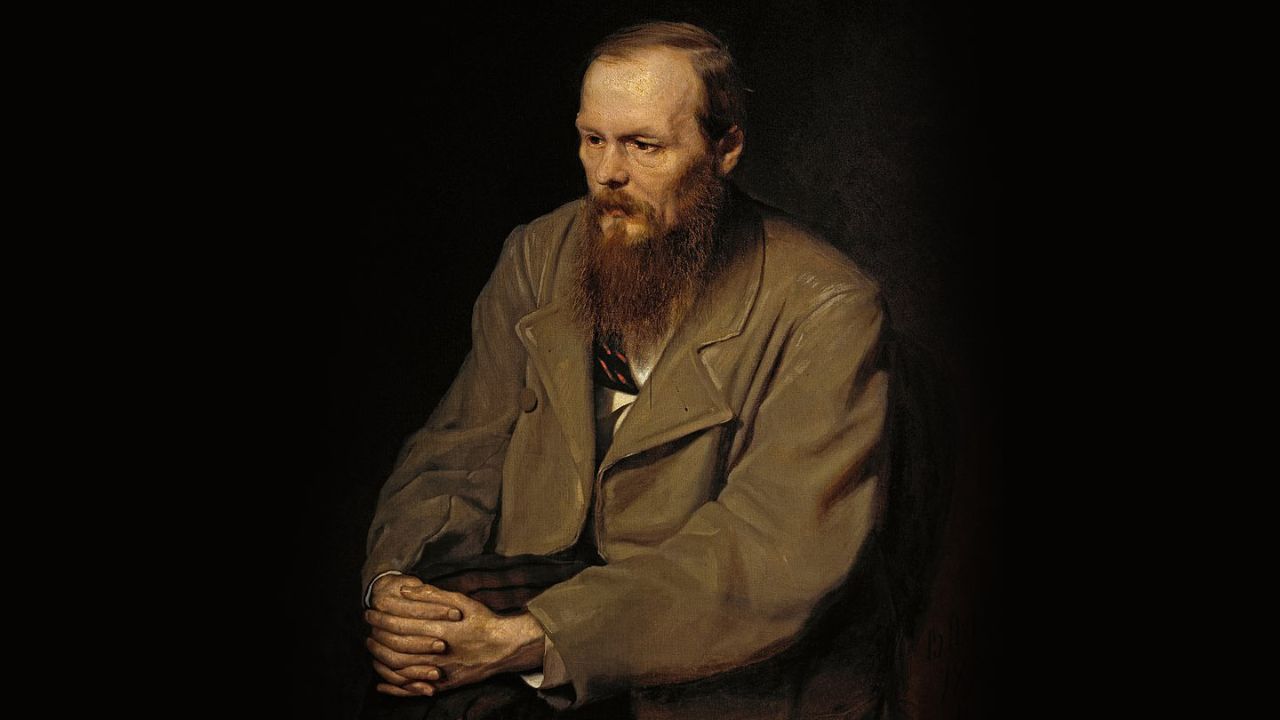
Sigmund Freud published The Interpretation of Dreams in 1899. He laid out the unconscious, the repression of desire, the architecture of anxiety — and the world called him a revolutionary. What most people don’t fully reckon with is that a Russian novelist had already mapped all of that territory, in devastating fictional detail, nearly half a century earlier. Fyodor Dostoevsky didn’t have clinical language. He had something rarer: an almost preternatural ability to inhabit the minds of people who were falling apart, and to describe what that disintegration felt like from the inside.
Born in Moscow in 1821, Dostoevsky led a life that reads like its own psychological case study — near-execution, imprisonment in Siberia, epilepsy, compulsive gambling, profound grief, and towering faith. He didn’t observe human anguish from a comfortable distance. He lived it. And perhaps that is why his fiction has a quality that even the most well-researched academic works on psychology can struggle to achieve: it doesn’t just describe suffering, it transmits it.
Today, in an era of attachment theory, trauma-informed therapy, cognitive distortions, and the neuroscience of compulsion, Dostoevsky’s novels read less like Victorian-era literature and more like field notes from a therapist who worked without a couch, without a degree, and without a clock on the wall. His patients were fictional. His findings were not.
Inventor of the Neurotic Self
Before there was neurosis as a clinical category, before Karen Horney wrote about the tyranny of the “should,” Dostoevsky gave us the narrator of Notes from Underground — a bitter, hyper-conscious civil servant who is at war with himself in every possible direction simultaneously.
What makes this character so astonishing, from a psychological standpoint, is not his misery. Miserable characters are as old as literature. What’s astonishing is the precision with which Dostoevsky maps his self-defeating logic. The Underground Man knows he is irrational. He knows that his resentment is poisoning him. He understands, in excruciating detail, the chain of thoughts that leads him to humiliate himself. And he does it anyway — because he has discovered something that 20th-century psychoanalysts would spend careers formalizing: that the drive to undermine ourselves is not a failure of reasoning, it is a form of assertion. It is a way of insisting that we are more than our circumstances, even if that insistence takes the form of self-destruction.
“Dostoevsky understood repetition compulsion not as a clinical term, but as a lived reality — the mystery of why we return to exactly the things that hurt us.”
Modern psychotherapy has a name for this: repetition compulsion. Freud described it as the tendency to recreate painful situations, as if the mind were trying to master what it could not originally resolve. Dostoevsky didn’t name it. He simply wrote a character who embodies it with such specificity that readers — across languages, centuries, and cultures — have recognized themselves on the page and felt, for the first time, slightly less alone in their own self-sabotage.
Guilt as Psychological Architecture
If there is a single Dostoevsky novel that a cognitive behavioral therapist, a trauma specialist, and a philosopher of consciousness could all assign in the same semester, it is probably Crime and Punishment. On the surface, it is a murder story. Underneath, it is one of the most detailed studies ever written of how the human mind constructs, carries, and ultimately cannot contain guilt.
Raskolnikov, the student-turned-murderer at the novel’s center, does not simply feel bad after killing the pawnbroker Alyona Ivanovna. He experiences what we would now recognize as a full dissociative break — fever, paranoia, a detachment from his own identity, and the peculiar condition of simultaneously fearing detection and unconsciously engineering it. He keeps returning to the scene. He picks unnecessary fights with the detective who is investigating him. He confesses in fragments to people who are barely listening. The crime is not what breaks him. The psychological cost of carrying the crime is what breaks him. And Dostoevsky writes this not as a morality tale, but as a phenomenological account — an exact record of what guilt does to perception, to memory, to the body.
Worth Noting
Contemporary trauma research has identified something called "traumatic guilt" — a state in which the perpetrator of harm, not just its victim, develops PTSD-like symptoms. Raskolnikov's physiological collapse after the murder, his inability to eat, his fevers, his distorted sensory experiences, read almost identically to the symptom clusters described in modern literature on perpetration-induced traumatic stress. Dostoevsky described it in 1866. The clinical category emerged in the 1990s.
What is perhaps most extraordinary is Dostoevsky’s understanding that Raskolnikov’s intellectual framework — his Napoleon theory, his idea that certain “extraordinary” men stand above ordinary moral law — is not the cause of his fall. It is the symptom. The theory is a rationalization, a structure the mind builds to protect itself from the knowledge of what it actually wants and what it actually fears. That gap between what we tell ourselves we believe and what we actually feel, between our stated reasoning and our unconscious motivations, is the central discovery of psychoanalysis. Dostoevsky dramatized it before Freud was ten years old.
The Id, the Superego, and a Russian Student
Freud himself was not blind to his debt. In his 1928 essay on The Brothers Karamazov, he called Dostoevsky “a great writer, a great sinner, and a great saint” — and he was uncharacteristically humble about the novelist’s psychological reach. He noted that Dostoevsky seemed to have intuited things about the inner life that psychoanalysis was only beginning to systematize. This is a significant admission from a man who was not generally given to acknowledging his predecessors.
The parallels are everywhere once you start looking. The three Karamazov brothers — sensual, impulsive Dmitri; coldly intellectual Ivan; gentle, spiritual Alyosha — are not just three different men. They function in the novel as three facets of a single psyche. Dmitri is pure id: appetite, rage, desire, lived entirely in the body. Ivan is the relentless superego: reason, doubt, a capacity for empathy that coexists with a withering contempt for faith. Alyosha is something closer to the integrated self that Jungian therapy works toward — not naive, but grounded, capable of holding contradictions without being destroyed by them.
“The Karamazov brothers aren’t three separate men. They’re three different chambers of the same mind — and Dostoevsky gives each of them exactly as much air as they can bear.”
Dostoevsky did not conceive of them as an allegory for ego-structure. He conceived of them as people. But the fact that they map so precisely onto psychological frameworks developed decades later suggests something important: the structures that psychologists formalize are real features of human mental life, and sufficiently attentive novelists can discover them through observation alone, the way naturalists once discovered species before taxonomy existed to name them.

Dostoevsky and the Fragmented Identity
In 1960, the Scottish psychiatrist R.D. Laing published The Divided Self, a landmark study of schizoid experience and the way the self can fragment under conditions of extreme psychological pressure. He described patients who felt that they were watching themselves from outside, who constructed false social selves to protect an inner self they could not bear to expose. It was groundbreaking clinical writing. It was also, in most of its essential insights, an elaboration of what Dostoevsky had already written in The Double in 1846.
The Double is Dostoevsky’s most overtly psychological novel and, until recently, one of his most underread. Its protagonist, Golyadkin, begins to be followed by a man who is his exact double — same name, same face, same position — but socially confident where Golyadkin is anxious, aggressive where Golyadkin is passive, successful where Golyadkin fails. The double takes everything Golyadkin cannot claim for himself. And the horror of the novel is not supernatural. It is psychological: the double is not a ghost. He is everything Golyadkin has repressed, externalized and given a life of its own.
This is a precise literary enactment of what object relations theory would later call projective identification — the process by which unwanted aspects of the self are attributed to external figures, who then seem to embody those qualities as if by magic. It is also a portrait of derealization and depersonalization that reads, symptom by symptom, like a clinical case history. Dostoevsky was twenty-five when he wrote it. He had not yet been to Siberia. He had not yet had his first epileptic seizure. Somehow, he already knew.
Dopamine Before Neuroscience
There is a short novel called The Gambler that Dostoevsky dictated in twenty-six days under conditions of extreme financial desperation — partly to satisfy a contract, partly, it seems, because he could not stop thinking about it. He was himself a compulsive gambler. He would win significant sums and then remain at the tables until he had lost every coin, then write anguished letters to his wife begging for more. He knew the loop from the inside.
The novel’s narrator, Alexei, describes the gambling experience with an accuracy that anticipates everything modern neuroscience has since confirmed about addiction: the way near-misses feel almost more compelling than wins, the way the experience of playing feels qualitatively different from any other state of mind, the way the compulsion operates on a logic that has nothing to do with rational self-interest, the way shame and the gambling itself become mutually reinforcing rather than mutually corrective.
The Science, Caught Up Later
Contemporary neuroscience has established that near-miss outcomes in gambling activate the dopaminergic reward system almost as powerfully as actual wins — a quirk of the brain's prediction-error circuitry that drives compulsive play. Dostoevsky described this phenomenologically in 1866. The neurological mechanism was identified in the early 2000s. He beat the lab by a hundred and forty years.
What Dostoevsky understood, and what it took behavioral psychology decades to formalize, is that addiction is not primarily about the substance or the behavior. It is about the state of consciousness it produces. Alexei gambles not because he wants money and not because he has poor impulse control in any general sense. He gambles because at the roulette wheel, everything else — anxiety, shame, social failure, romantic rejection — ceases to matter. The game provides a singular, absolute focus that the rest of his life does not. Understanding that, you understand why willpower alone cannot resolve addiction. The gambler is not failing to resist temptation. He is seeking relief that nothing else in his life provides. That insight — which made Dostoevsky’s novel feel psychologically alive for a century and a half of readers — became the foundation of motivational interviewing and third-wave addiction therapy only in the late 20th century.
What Therapy Rooms Are Still Catching Up To
There is a question worth sitting with: why does it matter that a novelist got there first? Psychology has the terminology now. We have CBT and DBT and EMDR and a literature of peer-reviewed research. Why should we care that Dostoevsky described it in novels?
The answer is that psychological knowledge and psychological understanding are not the same thing. You can know that repetition compulsion is real — you can have the textbook definition memorized — and still have no felt sense of what it is like to be trapped in it. Dostoevsky gives you the felt sense. He puts you inside the skin of people who are experiencing these phenomena, not from a clinical distance but from the interior. And that kind of understanding — the kind that changes how you see yourself and the people around you — is something that prose can do in a way that a diagnostic manual simply cannot.
“Reading Dostoevsky is not escapism. It is the opposite — a confrontation with the parts of yourself you have been most careful not to examine too directly.”
Moreover, Dostoevsky’s novels contain observations that contemporary psychology is still only beginning to approach. His sense of the relationship between physical suffering and spiritual crisis, his understanding of how humiliation shapes personality over a lifetime, his grasp of the way that love and cruelty can coexist within a single relationship without either canceling the other out — these are areas where the clinical literature is thin and the fictional literature remains the richest source we have.
Ivan Karamazov’s “rebellion” against God, his refusal to accept any theodicy that requires the suffering of children, is simultaneously a theological argument, a political position, and one of the most acute descriptions ever written of what we now call moral injury — the particular form of psychological damage that results not from fear or loss but from a fundamental violation of one’s sense of how the world should be ordered. The clinical concept of moral injury was developed in the context of military trauma in the 1990s. Dostoevsky wrote Ivan’s argument in 1880, and it remains, to this day, one of the most devastating formulations of what the concept means.
The Writer as the First Psychologist
There is a version of intellectual history that presents psychology as a discipline that rescued human self-understanding from the vague impressionism of art and literature, replacing guesswork with methodology. There is truth in that story. But there is another version, equally true, in which writers like Dostoevsky saw things with such clarity and reported them with such fidelity that the entire subsequent project of scientific psychology can be understood partly as the long task of proving what they already knew.
Dostoevsky wrote from suffering, from faith, from an almost painful attentiveness to what it means to be human under pressure. He wrote without the benefit of placebo-controlled trials or brain imaging or decades of accumulated clinical data. He wrote with only the instruments he had: his extraordinary mind, his damaged and resilient life, and the conviction that fiction was a place where the most difficult truths could live — truths that the daylight language of science was not yet equipped to speak.
The world built the science. He wrote the case notes first.