Jean Grey died, came back, died again, came back again. Spider-Man perished in one universe. Tony Stark sacrificed himself to save half of all life in existence. And yet — somehow — none of it feels quite permanent.
If you’ve spent any amount of time in the Marvel universe — whether in the comics or the MCU — you’ve probably noticed something peculiar: death has a revolving door. Characters fall dramatically, the world mourns, and then, somewhere down the line, they return. Sometimes with a good explanation, sometimes with barely a shrug. It’s one of the most talked-about, criticized, and sometimes beloved traditions in superhero storytelling.
So why does Marvel keep doing it? Is it laziness? Greed? Or is there something deeper going on — a storytelling logic that actually makes a strange kind of sense?
The answer, it turns out, is all of the above. And more.
Death Is a Story, Not a Destination
Here’s the thing most casual viewers don’t fully appreciate: in superhero comics, death was never really meant to be permanent. The genre evolved in a world where new writers take over characters every few years, where decades of continuity have to be respected, and where beloved figures have fans who’ve grown up with them across generations.
When a character dies in Marvel, it’s rarely about closure. It’s about drama. The death of a hero sends shockwaves through the story — it reshapes relationships, forces other characters to grow, and creates the kind of grief that powers genuinely moving narratives. The emotional weight is real, even if the permanence isn’t.
Think about it this way: when Gwen Stacy died in 1973, that moment changed Spider-Man’s character forever. When Iron Man sacrificed himself in Endgame, it crystallized everything his character arc had built toward. Those deaths mattered — not because the characters stayed dead, but because of what they meant in the moment.
Death in superhero stories was never a wall. It was always a door — and Marvel built the universe knowing someone would eventually open it back up.
Jean Grey
5+ deaths & revivals
The gold standard of Marvel revolving-door deaths. The Phoenix Force makes almost every revival feel cosmically justified.
Bucky Barnes
Believed dead for decades
His return as the Winter Soldier is considered one of the best revival storylines in comics history.
Thor
Multiple deaths & rebirths
As a god, death is almost a technicality. Each return usually marks a major character shift.
Captain America
"Death" in 2007 comics
His death sparked one of Marvel’s biggest crossover events — and his return was equally massive.

The Business Behind the Grief
Let’s be honest about one thing: Marvel is a business. And very few things sell comics like a major character death. Sales spike. Headlines get written. The internet catches fire. When Captain America “died” in 2007 after the Civil War storyline, comic shops reported massive jumps in orders. Television news covered it. It was a cultural moment.
Revivals are just as commercially valuable. When a beloved character returns, fans who drifted away come back. New storylines get launched. Variant covers are printed. Merchandise gets refreshed. The cycle of death and resurrection isn’t just dramatically convenient — it’s economically brilliant.
This doesn’t make it cynical, exactly. Plenty of these deaths and returns produce genuinely great stories. But it does explain why Marvel has never been in a hurry to let its most popular characters stay gone for long. The more you love a character, the more powerful their death — and the more satisfying their return.
3×
Average sales increase when a major character dies
73
Years of Marvel characters cycling through death & rebirth
<5
Major Marvel characters with truly permanent deaths
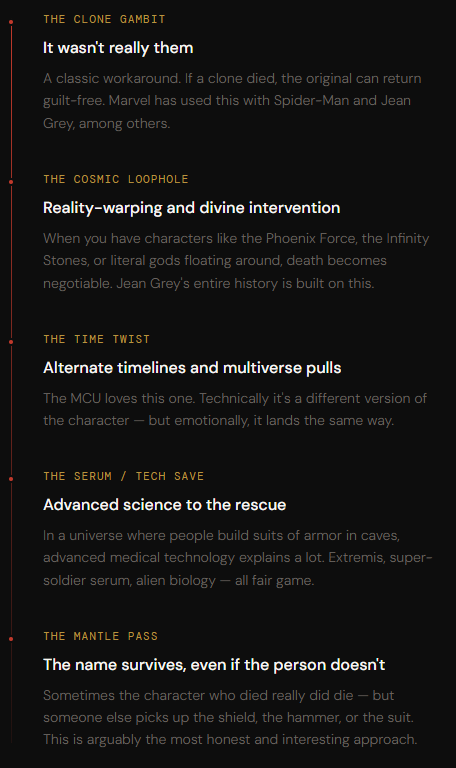
The Mechanics of Coming Back
Marvel has gotten genuinely creative with its resurrection toolkit over the decades. Some revivals are cheap. Others are elegant. The best ones actually expand what we understand about a character or the universe they inhabit.
When It Actually Works
Not all resurrections are created equal. Some are cheap, and fans know it immediately. But when a revival is handled well, it can be genuinely extraordinary storytelling.
Bucky Barnes returning as the Winter Soldier is the textbook example of a great comeback. Ed Brubaker didn’t just bring him back — he used the revival to explore what happens to a soldier out of time, what it means to be weaponized against everything you once stood for, and what redemption actually costs. It worked because the return served the character’s soul, not just the plot.
Contrast that with the cheap revival: a character comes back because a writer needed them back, the explanation is handwaved, and nothing about their return changes the story in a meaningful way. Those moments feel hollow because they treat death as a plot device rather than an emotional event.
Key Insight
The best Marvel revivals don't just bring characters back — they transform them. A return that doesn't change a character in some fundamental way is a missed opportunity. Death should cost something, even when it isn't permanent.
The MCU has navigated this with varying degrees of success. Tony Stark’s death in Endgame — which has, so far, held — felt weighty precisely because Avengers was built over 11 years. Whether Marvel can maintain that weight as the multiverse opens up new possibilities will define a lot about the next phase of storytelling.
What It Says About Us
Here’s the part nobody talks about enough: the cycle of Marvel deaths and revivals works because we let it. Fans have participated in this contract for decades. We know, on some level, that Iron Man might return. We know that death is rarely the last word in a universe built on hope, heroism, and legacy. And we buy into it anyway.
That’s not stupidity — it’s a different relationship with narrative. In the real world, death is permanent and terrifying. Superhero stories offer us a space where the people we love and admire can come back, where loss can be undone, where the worst-case scenario isn’t necessarily the final one.
There’s something quietly moving about that. These stories, for all their cosmic bombast and Hollywood spectacle, are really about refusing to accept that good people are gone forever. The Phoenix doesn’t just resurrect Jean Grey — it resurrects the hope that things can be set right.
Of course, that same hope gets abused. When every death is reversible, the stakes evaporate. When audiences start betting on the return date rather than grieving the loss, the emotional contract has been broken. Marvel walks this line constantly — sometimes gracefully, often clumsily.
We want these characters to die because we need to feel something. We want them to come back because we’re not ready to let go. Marvel knows both things at once, and it builds its entire universe on that contradiction.
The best Marvel stories find a way to have it both ways: a death that genuinely hurts, and a return that feels earned rather than inevitable. When they pull that off — when Bucky remembers, when Tony says “I am Iron Man,” when Steve Rogers finally gets his dance — it’s a reminder of why this universe has held our attention for so long.

So, Does Death Mean Anything?
In the Marvel universe — yes, it does. Just not in the way we usually mean.
Death means transformation. It means a shift in the story’s emotional weight, a chance for supporting characters to step up, a dramatic pressure valve that forces characters and narratives to change. The fact that it isn’t permanent doesn’t make it meaningless — it makes it a different kind of meaning.
Marvel keeps killing and reviving characters because death is one of the most powerful tools in a storyteller’s kit. And because a universe built on hope, resilience, and heroism isn’t one where the good guys stay down forever. It wouldn’t be Marvel if they did.
The real question isn’t whether they’ll bring a character back. It’s whether the comeback will be worth the wait. And every so often — when the story is right and the writing is honest — it absolutely is.