There was a time when stories made morality feel simple. Heroes wore white, villains wore black, and readers always knew who deserved to win. But somewhere along the way, fiction stopped pretending people were that easy to understand. Enter the morally grey character — the thief with a conscience, the hero willing to cross dangerous lines, the villain whose pain feels painfully human. These are the characters readers obsess over, argue about online, and remember long after the story ends.
What makes them so compelling is not just that they blur the line between good and evil. It’s that they feel real. In life, people are rarely entirely noble or entirely corrupt. We make selfish choices for understandable reasons. We hurt people while trying to protect the ones we love. Morally grey characters capture that uncomfortable complexity in a way flawless heroes often cannot. They force readers to question their own beliefs, loyalties, and sense of justice.
And perhaps most importantly, they keep stories unpredictable. A morally grey character can save a life in one chapter and destroy another in the next. Readers never fully trust them — and that uncertainty creates tension, fascination, and emotional investment. Whether it’s anti-heroes, conflicted rulers, ruthless survivors, or charming manipulators, morally grey characters reflect the messy contradictions that make humanity endlessly interesting.
They Feel Like Real People — Because They Are
Let’s start with the most obvious reason, and resist the temptation to dismiss it as too simple: morally grey characters feel true. Not just realistic in the way a well-researched detail is realistic, but true in the way a conversation with an old friend is true — familiar, complicated, occasionally uncomfortable.
Most people are not pure villains. Most people are not pure heroes either. We contain both. We’ve made choices we’re ashamed of. We’ve justified things we knew were wrong. We’ve hurt people we loved and done good things for selfish reasons. A character who sits in that same complicated space doesn’t feel like a literary device. They feel like someone we know. Or someone we’ve been.
The perfectly virtuous hero and the cartoonishly evil villain are both comfortable fictions. They let us off the hook. Morally grey characters don’t. They sit across the page from us and say: you would understand this. Sometimes that’s unsettling. But unsettled is not the same as unengaged — it’s actually the opposite.
A character who only ever does the right thing is easy to admire. A character who does the wrong thing for the right reasons — or the right thing for the wrong reasons — is impossible to put down.
On the paradox of flawed protagonists

They Give Us Permission to Explore What We Can’t Do
Fiction has always been a kind of controlled fire — a safe place to feel things that would be dangerous or destructive in real life. Fear, grief, rage, forbidden desire. When we read about a character who acts on impulses we suppress, something releases. We get to experience the action without the consequences. We get to understand the logic of something we’d never actually do.
Think about Walter White from Breaking Bad. A lot of the early audience sympathy he generated wasn’t just because his situation was unfair — it was because somewhere, in a quiet and embarrassing corner of the brain, viewers understood the intoxication of finally doing something. Of refusing to be a victim of circumstance. Of choosing power. We’d never cook meth. We’d never let a kid die to protect our operation. But inhabiting someone who does, through the screen or the page, lets us understand something about human nature that no lecture ever could.
That’s not glorification. That’s one of the oldest functions of storytelling. We process through narrative. And morally grey characters give us the richest, most complex things to process.
The Characters Who Defined the Archetype
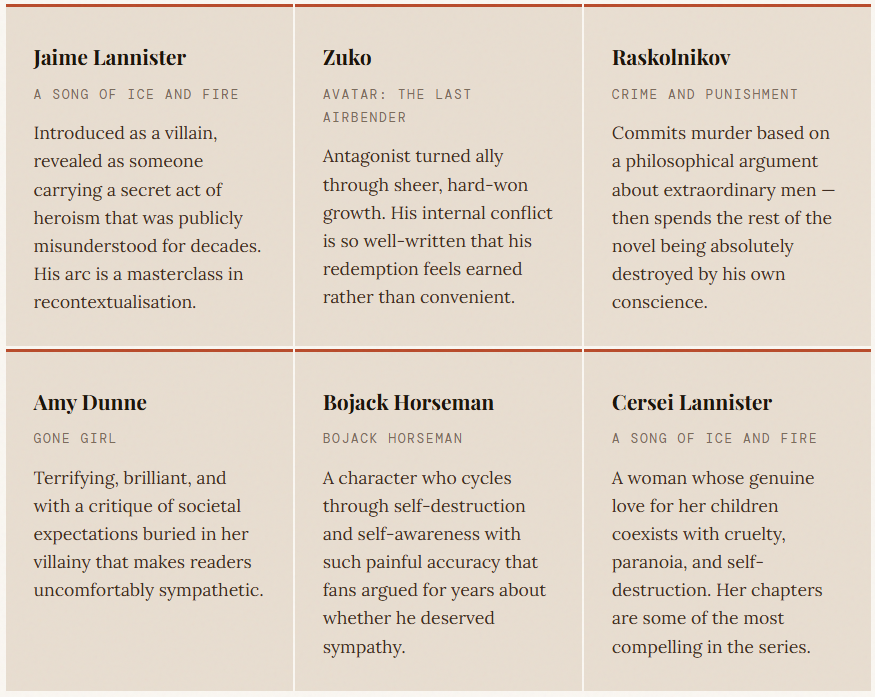
To talk abstractly about moral ambiguity is one thing. But it’s more honest — and more fun — to look at the actual characters who made readers lose their minds. Here are a few who earned their complexity:
They Make Us Work — And We Like Working
There’s a cognitive pleasure in puzzle-solving that literature can activate in ways other mediums can’t quite replicate. When a character is morally ambiguous, we become detectives of motivation. We read more carefully. We go back and re-examine scenes. We ask ourselves: why did they do that? What does this tell us about who they really are? Are they getting better or worse?
This engagement isn’t just intellectual — it’s deeply emotional. When we invest in figuring out a character, we invest in caring about them. By the time we’ve pieced together their history, their fears, the wound underneath the cruelty, we are attached. We didn’t passively receive a character. We built them, in a sense, through our reading. And we protect what we’ve built.
This is why fandom discourse around morally grey characters can feel so intense. People aren’t just defending a fictional person — they’re defending their interpretation of that person, the work of understanding they’ve put in, the emotional truth they’ve arrived at. Telling them their favourite character is simply a monster is like telling them their reading was wrong.
Six Reasons the Grey Zone Holds Us Captive
- Moral complexity mirrors lived experience
Real ethical decisions rarely come with clean answers. Characters who inhabit that same murky territory resonate because they validate what we already know: that doing the right thing is hard, and sometimes we fail, and that failure doesn’t always define us. - They generate genuine suspense
With a true villain, you know they’ll do villainous things. With a hero, you trust they’ll ultimately prevail. With a morally grey character, you genuinely don’t know. That unpredictability — rooted in internal conflict rather than external plot — is a specific kind of tension nothing else produces. - They invite empathy without requiring endorsement
One of fiction’s great gifts is teaching us to empathise with people whose choices we find wrong. Morally grey characters are the best possible training ground for this. You can understand someone’s logic completely and still know they’re making a terrible mistake. - They create space for moral debate
Ask twenty people whether Jaime Lannister is a good person or a bad one and you’ll get twenty different arguments. That generative quality — characters who don’t resolve into simple verdicts — makes for the richest literary conversations. - Their arcs feel genuinely earned
When a flawed character grows, it means something. Growth requires having been less than ideal to begin with. A character who was always perfect can’t have a redemption arc because they have nothing to be redeemed from. Moral greyness is the prerequisite for meaningful change. - They challenge our desire for easy justice
We want stories to punish the bad and reward the good. Morally grey characters make that impossible, and that impossibility teaches us something important: that justice in the real world is equally complicated, equally unsatisfying, equally human.

The Writer’s Side of the Bargain
It’s worth acknowledging that this kind of character is also the hardest to write well. Moral ambiguity is not an excuse for incoherence. A character can’t just commit atrocities and be given a sad backstory and called complex — that’s not grey, it’s just poorly thought-through. The best morally grey characters have a clear internal logic. Their contradictions make sense. The writer understands them completely, even if the reader is never entirely sure how to feel about them.
The failure mode is on both ends. Go too far in one direction and you get a villain who is accidentally glamourised with no accountability. Go too far in the other and you get a good character who has bad things happen to them, which is not the same as moral complexity at all. The narrow path between those extremes is where the genuinely extraordinary characters live.
Authors who walk that path well — Dostoevsky, George R.R. Martin, Gillian Flynn, Ursula K. Le Guin — tend to share one quality: they never judge their characters from outside the text. They inhabit them. They understand why someone would do a terrible thing without endorsing it. And that inside-out understanding is what gets transmitted to the reader.
The writer’s job isn’t to condemn or to excuse. It’s to understand so completely that the reader has no choice but to feel something true.
On the craft of moral ambiguity
What We’re Really Looking For
At the deepest level, I think our love for morally grey characters is a love for being seen. Not the sanitised version of ourselves — the version that always says the right thing, makes the virtuous choice, has motives that could survive public scrutiny. The complicated version. The one who has done something we’re not proud of. The one who has thought something dark and private. The one who is still, somehow, trying.
When we find a character who holds both beauty and ugliness, courage and cowardice, love and cruelty — and when that character is written with enough care that we understand all of it — we feel less alone in our own complexity. That’s not a small thing. That might be one of the largest things fiction can do.
The morally grey character is, at the end of it all, an act of honesty. An acknowledgment that being human means being inconsistent. That damage and love coexist. That we are capable of more harm than we’d like to admit, and more tenderness than we sometimes show. The reader who defends their favourite flawed character so fiercely isn’t being naive or morally confused. They’re recognising something real.
And in fiction, recognition is everything.