Hinduism is not simply a collection of gods and monsters, heroes and villains. It is a philosophical system so layered, so self-aware of its own metaphors, that scholars have spent entire lifetimes excavating just one of its texts and still felt they had only scratched the surface.
When people talk about Greek mythology, they speak of twelve Olympians on a mountain. When they speak of Norse mythology, they picture nine worlds and a tree. But when you enter Hindu mythology, you step into something that defies easy containment — a tradition spanning at least five thousand years, written across hundreds of texts in multiple languages, carrying within it astronomy, psychology, ethics, governance, aesthetics, music, and medicine, all woven into a single unbroken mythological fabric.
To call it merely a “pantheon” almost undersells it. It is more accurate to call it a civilizational imagination — the complete inner life of one of the oldest continuous cultures on earth, compressed into story, symbol, and sacred sound.
So what exactly makes Hindu Mythology the richest and most complex? The answer is not one thing. It is many — and each layer only deepens when you look closer.
A Mythology Larger Than Any Single Book Could Hold
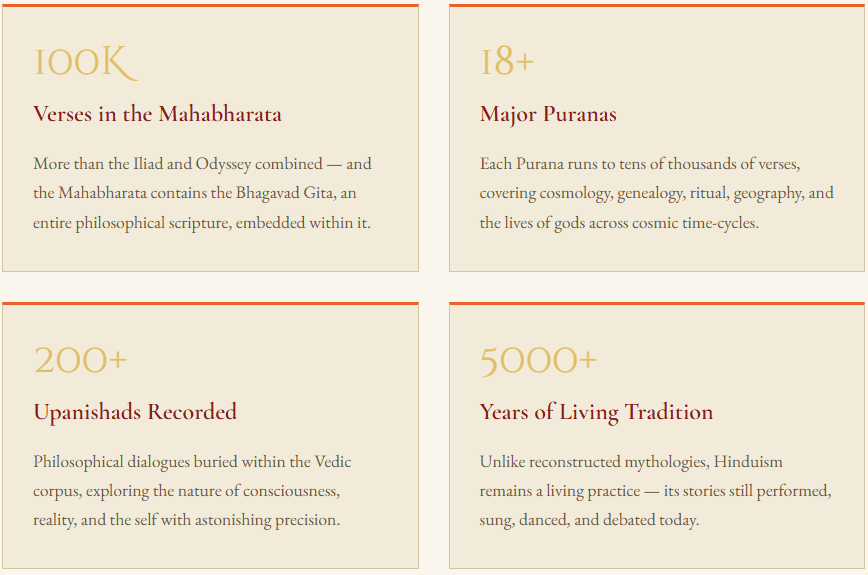
Most mythological traditions we study today come down to us in a single primary source, or a handful. The Iliad and the Odyssey for the Greeks. The Poetic Edda for the Norse. The Epic of Gilgamesh for the Mesopotamians. These are extraordinary works, but they are bounded — you can read the entirety of surviving Greek mythology in a few months.
Hindu mythology exists in a corpus that, if translated entirely into English, would fill a modest library. We are talking about four Vedas and their associated Brahmanas and Aranyakas; over two hundred Upanishads; the Mahabharata (the longest poem ever composed, containing over 100,000 verses — ten times the combined length of the Iliad and Odyssey); the Ramayana; eighteen major Puranas and eighteen minor ones; the Agamas; the tantric literature; regional oral traditions in Tamil, Telugu, Kannada, Bengali, Odia, Marathi, and dozens of other languages — and this does not include the vast commentary literature written on top of all of it.
Each text does not merely add more stories. It often revises, deepens, or reframes what came before. The god who appears as a minor character in one text becomes the supreme deity in another. The demon defeated in one telling reappears as a devotee in the next. This is not inconsistency — it is intentional plurality.
Not a Pantheon. A Philosophy in Costume.
Here is something most outsiders miss: Hindu mythology is not a list of gods. It is a structured philosophical argument about the nature of ultimate reality, expressed through divine personalities.
At the centre is the concept of Brahman — the formless, nameless, infinite ground of all existence. Brahman is not a god. It is the totality of what is. Every deity, every story, every symbol in Hindu mythology is ultimately pointing back toward this formless absolute, offering a different angle of approach, a different face that the human mind can engage with and contemplate.
“Ekam sat viprā bahudhā vadanti — Truth is one; the wise call it by many names.”
Rigveda 1.164.46 — among the oldest philosophical statements in recorded literature
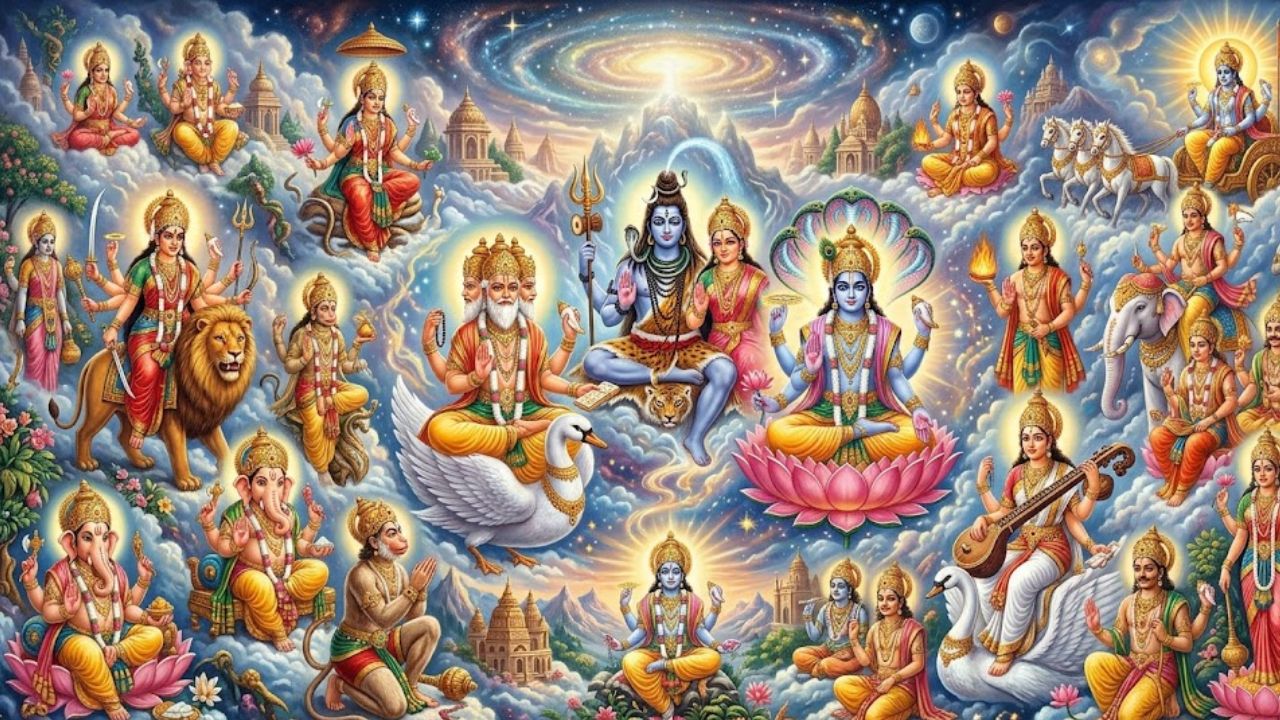
From this flows the Trimurti: Brahma the creator, Vishnu the preserver, Shiva the destroyer. But these are not separate beings in eternal competition. They are aspects of a single cosmic function — the rhythm of creation, maintenance, and dissolution that governs all existence from galaxies down to cells. Western interpreters sometimes compare this to a Hindu “Trinity,” but the comparison misses the depth: the Trimurti is a model of cosmic process, not a family of persons.
What makes it even richer is that the tradition is not even unified in this structure. Shaivism places Shiva at the apex of divinity, Vaishnavism elevates Vishnu, Shaktism sees the Goddess — in all her forms — as the primordial reality. These are not schisms or heresies. They are accepted schools of thought within a single tradition, each with its own scriptures, philosophy, and devotional practice, coexisting for thousands of years.
🔱
Shiva
Destroyer & Transformer
The most paradoxical deity — simultaneously the ascetic and the erotic, destroyer and the source of regeneration, terrifying and supremely benevolent.
🪷
Vishnu
Preserver & Sustainer
The cosmic keeper of dharma who descends as avatars whenever the world tilts toward chaos — ten major incarnations across vast stretches of cosmic time.
🌸
Devi / Shakti
Primordial Power
The divine feminine as ultimate reality — gentle as Lakshmi, fierce as Kali, wise as Saraswati. Not consort to the gods but the very energy that makes them possible.
🐘
Ganesha
Remover of Obstacles
The elephant-headed son of Shiva and Parvati — a deity beloved across all Hindu sects, invoked at every beginning, symbol of auspicious wisdom and worldly intelligence.

Gods Who Descend Into Time
Among the most sophisticated contributions of Hindu mythology to world religious thought is the concept of the avatar — from the Sanskrit avatāra, meaning “descent.” This is the idea that the divine can willingly take on limited, embodied form to intervene in the world at moments of extreme moral crisis.
Vishnu has ten primary avatars in the canonical Dashavatar tradition. But what is astonishing is not the number — it is the evolutionary arc. His avatars begin with a fish, progress through a tortoise, a boar, a half-lion-half-man, a dwarf, and eventually arrive at fully human forms: the warrior-sage Parashurama, the dharmic king Rama, the divine cowherd Krishna, and the enlightened sage Siddhartha Gautama Buddha (yes, the Buddha was absorbed into Hindu cosmology as an avatar of Vishnu). The final avatar, Kalki, is prophesied to arrive at the end of the current age, riding a white horse.
Modern scholars have pointed out — with some wonder — that this sequence mirrors biological evolution from aquatic life to land to mammal to human and beyond. Whether this is ancient intuition, allegory, or coincidence, it stands as one of the most remarkable narrative sequences in world mythology.
The Ramayana and the Mahabharata — Two Kinds of Epic

If you want to understand why Hindu mythology operates differently from any other tradition, look at how its two great epics work. The Ramayana is linear — a hero, a villain, a quest, a rescue, a homecoming. It is also a precise moral instruction: Rama as the ideal son, husband, king, and warrior; Sita as the ideal wife; Hanuman as the ideal devotee. Every character is a thesis about how to live.

The Mahabharata refuses to be so clean. It is the story of a war between cousins, but it turns into an exploration of what happens when every option is morally compromised. Should you fight your own family for justice? What does loyalty mean when your leader is wrong? Can a warrior fulfill his duty while loving those he must kill? These are not simple questions, and the Mahabharata refuses to give simple answers.

Embedded within it — in eighteen chapters of conversation between the hero Arjuna and his charioteer Krishna on the eve of battle — is the Bhagavad Gita, perhaps the most influential philosophical text ever produced in India. It is a meditation on duty, the self, action without attachment, and the nature of the divine, placed inside a story of impending catastrophe. It is still read, memorized, and argued over daily across the world.
A Cosmology That Spans Billions of Years
Most ancient mythologies operated with a relatively modest sense of cosmic time — a few thousand years, perhaps, between creation and the present. Hindu cosmology is almost shocking in its temporal ambition.
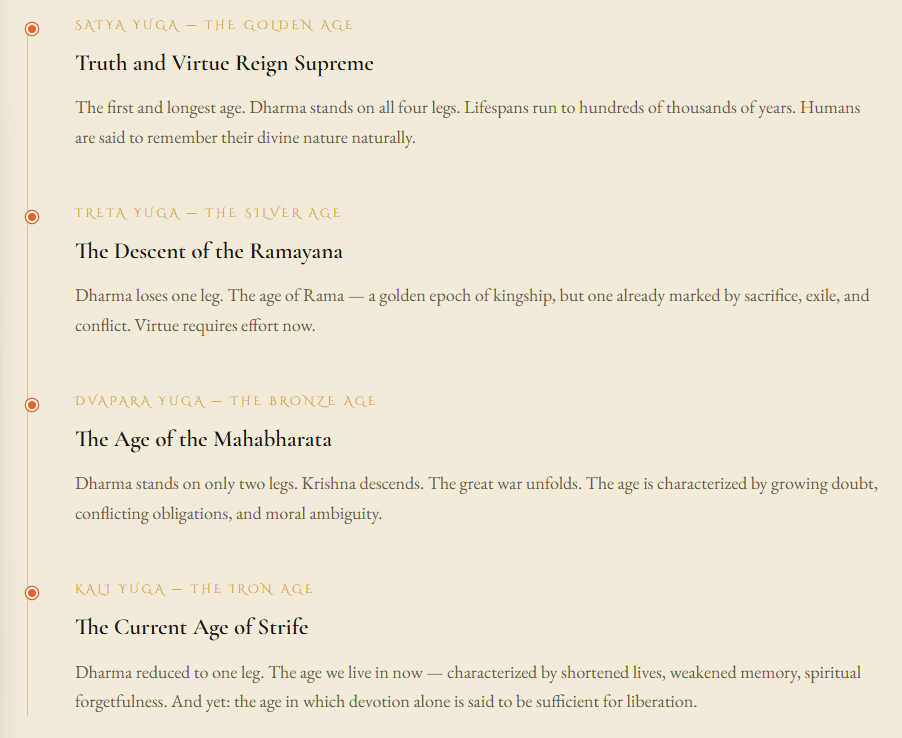
The basic unit is the yuga — a cosmic age. There are four yugas (Satya, Treta, Dvapara, Kali), and one complete cycle of all four — called a Mahayuga — lasts roughly 4.32 million years. A thousand Mahayugas make a single day of Brahma, the creator. His full day and night lasts 8.64 billion years. His entire lifespan runs to 311 trillion years. At the end of Brahma’s life, the entire universe dissolves, and after an equal period of non-existence, a new Brahma arises and the whole process begins again.
These numbers are not random. The current scientific estimate for the age of the universe is approximately 13.8 billion years. The Hindu concept of a “day of Brahma” — 4.32 billion years — corresponds, with striking closeness, to current estimates of the age of the Earth. Whether this is a coincidence or an ancient astronomical intuition, it places Hindu cosmology in a different category from mythologies that locate creation at 4004 BCE.
Shakti: The Energy Without Which Gods Cannot Act
One of the most remarkable aspects of Hindu mythology — and one that distinguishes it markedly from the Abrahamic traditions and even from much of Greco-Roman mythology — is the absolute centrality of the divine feminine.
Shakti is not merely a female deity. She is the primordial energy (shakti means “power” or “energy”) that animates the entire cosmos. The classic formulation is this: Shiva without Shakti is a corpse. The masculine principle, without the energy of the feminine, cannot move, cannot create, cannot destroy. Shakti is the animating force of existence itself.
She manifests in ten major forms known as the Dasha Mahavidyas — ten faces of the divine feminine, ranging from the terrifying Kali (who dances on Shiva’s chest, drunk on demon blood, a garland of skulls around her neck) to the radiant Tripura Sundari (the most beautiful in the three worlds), to the benign Bhuvaneshvari (whose body is the universe itself). Each form addresses a different spiritual need, a different face of reality.
The Devi Mahatmya, a text within the Markandeya Purana, contains what may be the single most powerful narrative of female divinity in world religious literature: the story of the Goddess who alone defeats the demon Mahishasura after all the gods together have failed. It is not a story of female assistance — it is a story of female primacy. The gods surrender their individual powers to her, and she, containing all of them, does what none of them could.
Feminine as Nurturing
Lakshmi brings abundance, fortune, and grace. Saraswati presides over art, learning, and sacred speech. Parvati is the mother of the cosmos, whose love draws Shiva out of his ascetic withdrawal and back into the world of creation.
Feminine as Fierce
Kali embodies time’s destructive power and the liberation that comes from surrendering all ego. Durga is the warrior goddess who battles cosmic evil across nine nights of divine combat. Neither needs rescue — both are absolute and supreme.
Every Myth Is Also an Argument About Reality
What truly separates Hindu mythology from most others is this: every story is simultaneously three things. It is a narrative (an event that happened). It is a psychological map (an inner process described in outer form). And it is a philosophical argument (a claim about the nature of reality).
Take the story of Ganesha’s creation. Parvati, alone and desiring companionship while Shiva is away, creates a boy from the turmeric paste she is scrubbing from her body. She asks him to guard the door while she bathes. Shiva returns, the boy refuses him entry, and Shiva — not recognizing his own son — beheads him. Parvati’s grief is cosmic. Shiva, realizing what he has done, sends his soldiers to bring back the first head they find, which turns out to be that of an elephant. The boy is resurrected with this new head.
At the surface: a charming origin story for an elephant-headed god. One level deeper: a meditation on the tension between domestic intimacy (Parvati’s world) and spiritual transcendence (Shiva’s world), and the violence that can erupt when they collide without recognition. Deeper still: Ganesha’s elephant head — associated with intelligence, memory, and the ability to clear obstacles — placed on a human body suggests that the integration of animal wisdom (instinct, power, patience) with human consciousness is the foundation of true intellect. His broken tusk, with which he is said to have written the Mahabharata, represents sacrifice in the service of knowledge.
This interpretive depth is not imposed later by scholars. It is built in. The tradition invites — requires — this multi-layered reading. Mythology here is not a primitive predecessor to philosophy. It is philosophy’s most sophisticated vehicle.
“Hinduism is a cathedral. Every deity, every myth, every ritual is a different window — but the light coming through them all is the same.”
— A modern scholar’s attempt to capture what the tradition has always said about itself
The Mythology That Never Became History
Here is the fact that perhaps most distinguishes Hindu mythology from every other ancient tradition we discuss: it never became archaeology. It never required excavation or reconstruction. It did not survive in fragments dug up from ruins or pieced together from inscriptions. It survived because it never stopped being lived.
The stories of Krishna are still enacted in the Rasa Lila dances of Vrindavan. The Ramayana is still performed across Southeast Asia — in Indonesia, Thailand, Cambodia, Bali — in forms both ancient and reinterpreted. The Kumbh Mela, the world’s largest human gathering, draws tens of millions to riverbanks sacred since the dawn of the tradition. Classical temples still follow construction guidelines laid down in the Agamas and Vastu Shastra, their architecture a three-dimensional cosmic map. The Carnatic and Hindustani classical music traditions are inseparable from mythological devotional literature. The classical dance form Bharatanatyam is itself a form of scripture in motion.
This aliveness means Hindu mythology is not fixed. It breathes. It adapts. Bhakti (devotional) poets of the medieval period rewrote classical narratives from the perspective of love, subverting caste hierarchies and institutional religion. The epics have been retold from the perspectives of their villains — Ravana, Duryodhana, Karna — in modern literature and film, exploring moral complexity the originals only sketched. Every generation adds to the corpus without erasing what came before.
Why This Matters Now
We live in an age that increasingly hungers for complexity — for stories that do not resolve into simple moral binaries, for cosmologies that match the scale of what science has revealed, for spiritual traditions that hold space for paradox and mystery. By these measures, Hindu mythology is not a relic from the past. It reads, in many ways, as if it were written for this moment.
It offers a cosmos without beginning that was never created by a personal will. It offers deities who can be simultaneously terrible and loving, distant and intimate, transcendent and present. It offers ethical frameworks that account for complexity and context — the dharma of a warrior is not the dharma of a renunciant; what is right in one circumstance may be wrong in another. It offers a conception of time so vast that human history barely registers as a line in the margin.
And it offers something perhaps most rare: a tradition in which the question “what is the ultimate nature of reality?” is not answered with a commandment but with a story, and then another story, and then a story that revises both — trusting, always, that the human mind and heart, given enough time and enough wonder, will find their own way to truth.

The Ocean Has No Shore
There is a famous image from the Bhagavata Purana: Vishnu asleep on the cosmic ocean, resting on the serpent Ananta (whose name means “infinite”), while from his navel grows a lotus, and on the lotus sits Brahma, beginning to create the world. The ocean is consciousness. The serpent is time. The lotus is the cosmos, rooted in the divine but blooming into the world of form and multiplicity.
This image captures something essential about Hindu mythology as a whole. The surface — the lotus, the stories, the gods with their weapons and consorts and rivalries and adventures — is endlessly beautiful and fascinating. But everything is rooted in depth. Every story is resting on an ocean that has no visible bottom.
That is why you can spend a lifetime reading its texts and never feel you have exhausted them. That is why scholars from Schopenhauer to Carl Jung to Aldous Huxley found in it a mirror for their own deepest questions. That is why it continues to produce new commentaries, new art, new devotion, new philosophy — not because the old answers were insufficient, but because the questions themselves are inexhaustible.
Of all the world’s mythological traditions, Hindu mythology is the one that seems to know this about itself — and to have made that inexhaustibility not a weakness but the whole point. To enter it is not to arrive at a destination. It is to begin a journey that has no end.
And in a world that so desperately wants simple answers, there is profound relief in a tradition that says, without apology: the mystery is real, it is beautiful, and it will hold you forever.
ॐ