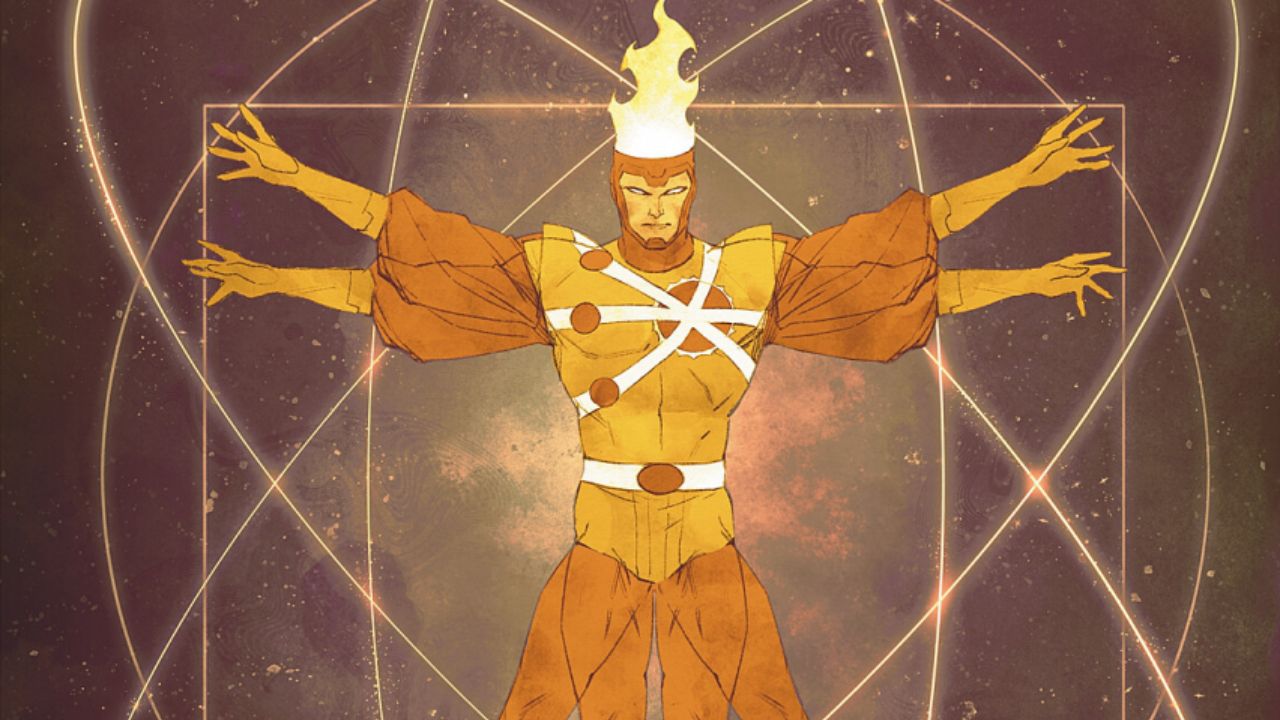
Jeff Lemire and Diego Olortegui’s The Fury of Firestorm #2 is not a superhero comic in the traditional sense — it is a horror story disguised as one. Where most Firestorm tales celebrate transformation, fusion, and limitless power, this issue interrogates the terrifying cost of becoming something more than human. Beneath the nuclear fire and cosmic destruction lies a deeply intimate tragedy about loneliness, self-worth, and the dangerous desire to escape pain entirely.
Division. Reaction. Fusion.
The issue opens not with an action sequence, but with something far more intimate and far more terrifying: a psychological autopsy. Two faces fill the page — Ronnie Raymond and Professor Martin Stein — each screaming the same words in their own separate panels: “I am one. I am scared. I am in pain.” The caption boxes label each stage of what we are watching: Division. Reaction. Fusion.

When those two terrified, fractured men finally merge in the third panel, the tone shifts entirely. Together, the caption reads, “We are beyond fear. We are beyond pain.” And there, in the final panel, a new face stares out at us — composed, cold, burning — asking simply: “Who are we?”
It is a brilliant piece of sequential storytelling. Lemire establishes the central horror of this entire series in four panels: that the fusion that created Firestorm didn’t just grant power. It erased pain. And a being without pain is a being without humanity.
The Fury, Part 2 — Going Back Further
The title page splash shows a classic, bright-costumed Firestorm bursting through fire and rubble — the heroic Nuclear Man of old, a stark contrast to the dark, faceless entity stalking Bedford. In a fragmented inset sequence, that same familiar Firestorm hesitates mid-flight, uttering the words that form the spine of this entire issue: “Wait — this isn’t right—” and then, devastatingly, “I need to go back further… I am not Firestorm. Not yet.”

It is Ronnie’s consciousness — somewhere deep inside the broken matrix — reaching backward through memory, trying to find the person he was before the explosion, before the fusion, before the power swallowed him whole. What follows is one of the most quietly heartbreaking origin stories Lemire has ever written.
Ronnie Raymond: The C Student Who Lied His Way In
We are taken to the University of Pittsburgh, and we meet Ronnie Raymond at nineteen years old — and he is nobody. His inner monologue is disarmingly honest: “I am a C student at the University of Pittsburgh. Today is my first day assisting Professor Martin Stein in the Physics Department. It’s a position I lied my way into. I am a fraud. I don’t belong here.”

He stands outside the door with Stein’s nameplate, backpack on, full of dread. His internal voice continues — he belongs on a football field, not a physics lab. The only reason he is here, he admits with brutal self-awareness, is to impress a girl. “How pathetic is that?”
When Professor Stein greets him — warm, welcoming, “Ronald! Right on time!” — Ronnie is already convinced the man will see through him entirely. Standing before a chalkboard covered in equations that might as well be written in a foreign language, Ronnie tells Stein it might be “a little beyond me.” The red caption box in the corner reads simply: “I need to go back, even further…”
The Boy Who Always Waited Alone
The memories plunge deeper. We find Ronnie at eight years old, sitting cross-legged on the floor of his grandmother’s kitchen, holding action figures. His mother has been dead for almost a year. His father works late — always late — and Ronnie waits. And waits.
“It’s okay though, because I have my toys to keep me company. Sometimes I imagine they talk to me.”
De Latorre renders this sequence in a softer, muted palette — yellows and greens drained of warmth — and the result is quietly devastating. The small boy with the superhero toys isn’t whimsical. He is lonely in a way that has already become permanent.
Then we see Ronnie at thirteen, number 17 on the jersey, racing for a game-winning touchdown in a junior high championship. Every thought is not about the score — it is about scanning the crowd. “I hope my dad is in the crowd watching. I hope he decided to come to the game after all.” He wins. His teammates erupt. And in the panel immediately beside it, Ronnie’s eyes are already searching the bleachers, already knowing. “But even before I look, I know he’s not there. I know that I am alone.”

It is a masterclass in economy. Lemire never dwells, never over-explains. The loneliness of Ronnie Raymond is established not through tragedy but through repetition — the boy who always waits for someone who never comes.
“There’s This Girl—”
Back at nineteen, back in Stein’s lab. The Professor has seen straight through the lie immediately, and he is far from angry. He is, in fact, almost amused — curious in the way a scientist is curious about an unexpected result.
“Did you really think you could fool me? Did you really think I wouldn’t know?”
Ronnie has no answer. He tries to leave, apologizing for wasting the Professor’s time, and Stein stops him with a single, devastating question: “You still want the job?”

When Ronnie, stunned, asks why on earth Stein would still offer it, the Professor says he likes to think he can see things in people. “And what do you see in me, Professor?” Stein pauses — a full, silent beat — and then says one word: “Potential.”
The girl, it turns out, is Doreen Day, a student in Stein’s advanced physics class. Stein’s reaction — “Ha! God. Of course there is” — is the most genuinely human moment in the issue, a flash of warmth that makes what comes later all the more painful. His assessment of the situation, however, is characteristically blunt: “She’s brilliant.” / “Yeah, I know.” / “No, I mean she’s way out of your league.”
Stein erases the board, starts fresh, and tells Ronnie they’re going back to the beginning. The caption boxes confirm what we already suspect: “The beginning. At the beginning, we were two.”
The Making of Something Great
What follows is a montage that functions as the emotional heart of the issue. Ronnie’s inner voice describes, with stunning clarity, what it meant to be taken seriously by Martin Stein for the first time in his life.
“He was so damn smart — like smart in a way I’d never seen before. And me? I was just trying to hang on.”

But Stein did not dismiss him. In the lab, side by side over beakers and microscopes, under the glow of a lecture hall projector, through campus conversations in winter coats, Stein saw Ronnie — “all my faults, all my weaknesses. And he didn’t care.”
“He didn’t just help me become something better. For a while, I even felt I really could be something great.”
And then the doubt creeps back in, as it always does with Ronnie: “Was I kidding myself to think I could be like him? Was I just delusional? Maybe I did lose sight of who I really was.”
It is exactly this self-doubt — this lifelong, bone-deep suspicion that he is nothing and will always be nothing — that makes what the Firestorm Matrix did to Ronnie so monstrous. The fusion didn’t just change his body. It answered a question he had been asking his whole life. And the answer, as it turns out, was catastrophic.
The Night at the Plant — Division
“Who am I? I was Ronnie Raymond. He was Professor Martin Stein.”
The memory shifts to night. A nuclear facility, protesters massing outside the fence with signs. Stein has asked Ronnie to meet him late, dismissing the demonstrators with frightening confidence: “They have no idea what I’m really doing here. My work will revolutionize their lives and they whine and complain.”
There have been threats, Stein explains. He needed someone he trusted to keep an eye on things. As if on cue, Stein freezes: “Yes, I — wait. Do you hear that?”

Inside a ventilation shaft, red and ticking — a bomb. The caption box drops one word: DIVISION.
What happens next is rendered in a single catastrophic page. Stein shouts “Ronald! Get ba—” and then the bomb’s beeping becomes a scream and the world becomes fire. REACTION. Two men thrown apart by the explosion, their bodies dissolving into light — and then, in a full-page splash of breathtaking painted darkness, a silhouette rises from the smoke with a flame burning where a head should be. FUSION.
“We are one. No longer scared. No longer in pain.”
We Are Firestorm — and Then We Are Not
For one luminous page, we see it as it should have been. Classic Firestorm — bright yellows and reds, Stein’s disembodied head floating beside Ronnie’s shoulder — in the middle of a battle against a water-manipulating villain. Stein guides; Ronnie acts. “It’s only water after all! Simply change hydrogen to oxygen!” / “Got it! What next, Professor?”

It is joyful. It is the heroic partnership that defined the character for decades. And it lasts exactly one page.
Because then Ronnie calls out and gets no answer. Stein is gone. The floating head has vanished. The panels begin to shatter — literally, physically fragmenting on the page, pieces of Firestorm’s classic-era adventures tearing apart like panels ripped from an old comic book and scattered to the white void of the page. A female Firestorm figure appears within the shards — perhaps another memory, perhaps another bearer of the matrix — screaming “Professor Stein?!” as a civilian is flung into empty space asking the same desperate question: “Where — where are you?!”
It is one of the most visually inventive pages in recent mainstream comics. De Latorre doesn’t just draw the breakdown of the Firestorm Matrix. He breaks the comic itself.
You Are Nothing
Inside the matrix now — a dark, psychic void. Ronnie Raymond faces something wearing his face. A Firestorm with red, burning eyes and no humanity behind them, dark and armored where the classic costume was bright and open.
“I am the Firestorm,” the dark entity says.

Ronnie, terrified, shouts back: “No! I am Firestorm! I AM!”
The entity’s response is a blast of nuclear fire and three words that land like a verdict: “You? You are nothing.”
It echoes every thought Ronnie has had since childhood. Every C grade, every empty bleacher, every chalkboard covered in equations he couldn’t read. The entity in the matrix isn’t just a corrupted power — it is Ronnie Raymond’s deepest fear about himself, given a face and a fist and a nuclear reactor’s worth of power to back it up.
I Am the Fury
Back in Bedford. The bench. The devastated town. The ghostly translucent remains of townspeople drifting past like smoke.
“Who am I? Not who. What.”
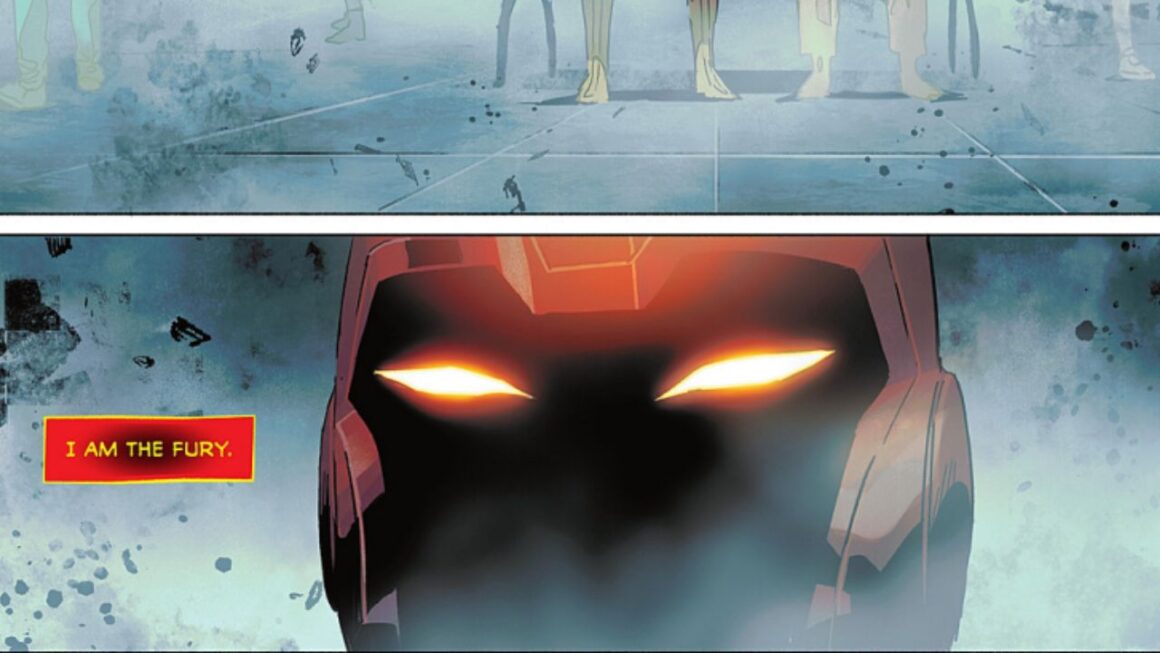
“I am the Firestorm.”
And then, in the final close-up — that featureless red mask, those burning white eyes, the flame overhead — comes the name that redefines everything:
“I am the Fury.”
The Military Loses Its Nerve
Back in the command center, the general’s staff confirm what was already unthinkable: the entity’s face is simply gone now — not obscured, not masked. Gone. Lorraine Reilly has been radio silent since she left to find Professor Stein, and the patience of the Department of Defense has reached its limit.

“We can’t wait on her any longer, sir.”
The general stares at the satellite feed of the Fury sitting motionless on its bench in the ruins of Bedford. “That thing is out of control. It’s out of our hands.”
Let’s Pray They’re Enough
The final splash page answers the question of what happens when something is out of the military’s hands. They call in the only people equipped to handle a Level 10 Meta who has declared himself a cosmic force of nature.
“Let’s pray they’re enough.”

Descending from the storm-lit sky above the ruins of Bedford: Hawkgirl, mace in hand. Green Lantern, rings blazing. Supergirl, cape snapping in the nuclear wind. The Flash, crackling with speed force energy. And Martian Manhunter, grim and emerald-eyed. Five of the most powerful beings on Earth, converging on a figure sitting calmly on a park bench — a figure that, moments ago, effortlessly killed a soldier through a suit specifically designed to make him invulnerable.
In the foreground, from the Fury’s perspective, we see its own fist begin to glow.
TO BE CONTINUED…
Read: The Fury of Firestorm #1 (2026) – The Nuclear Nightmare