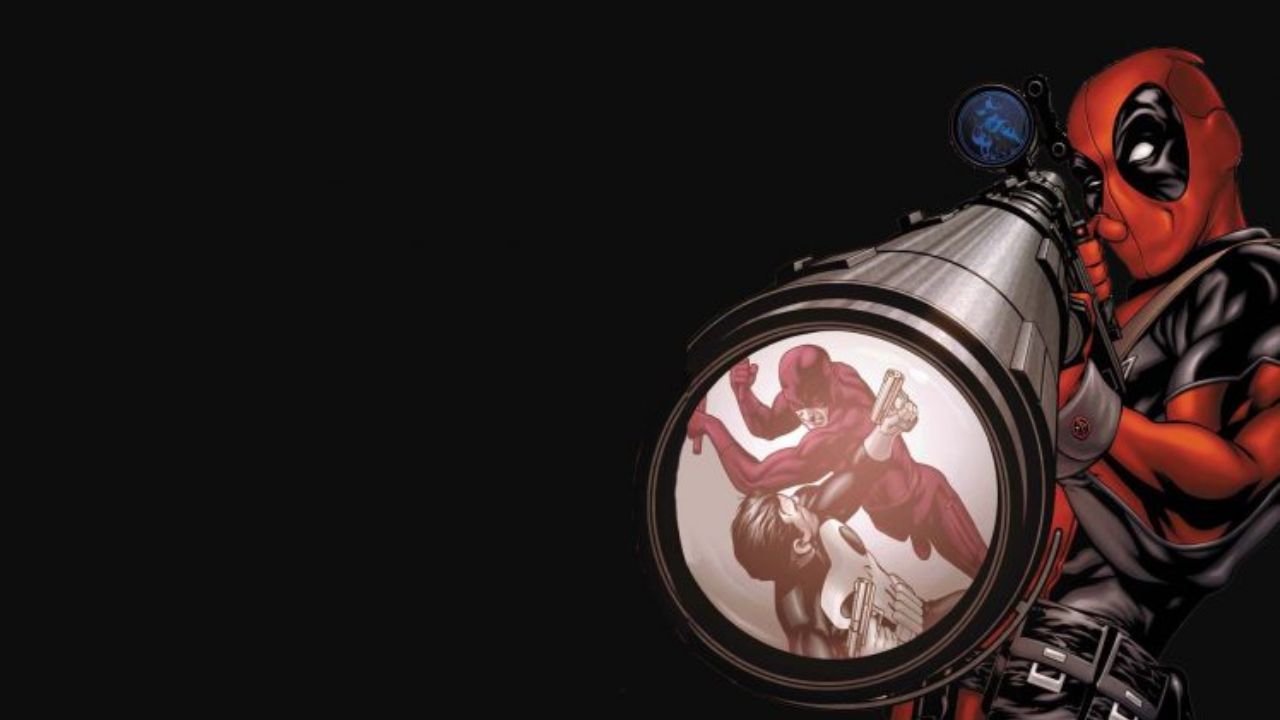
There’s a moment — you’re flipping through a Deadpool comic, maybe it’s a late night and the lamp is throwing warm yellow light across the pages — and suddenly the guy in the red suit turns and winks directly at you. Not at another character. Not at thin air. At you. And something genuinely strange happens in your brain. You feel caught. Like you were just minding your own business watching a movie and the actor on screen just pointed at your living room couch.
That’s the fourth wall break, and nobody in comics does it quite like Wade Wilson. But here’s the thing most casual fans miss: Deadpool’s fourth wall breaks aren’t just a gimmick for laughs. They’re woven into his entire identity — psychologically, narratively, and philosophically. To understand why he does it, and how it actually works on the page, you have to dig a little deeper than “haha, funny crazy guy.”
It Wasn’t Always Part of the Character
Deadpool first showed up in New Mutants #98 back in February 1991, courtesy of writer Fabian Nicieza and artist Rob Liefeld. At the time, he was a pretty straightforward villain — a wisecracking mercenary hired to take out Cable. The quippy dialogue was there from the start, but the fourth wall stuff? That came later.
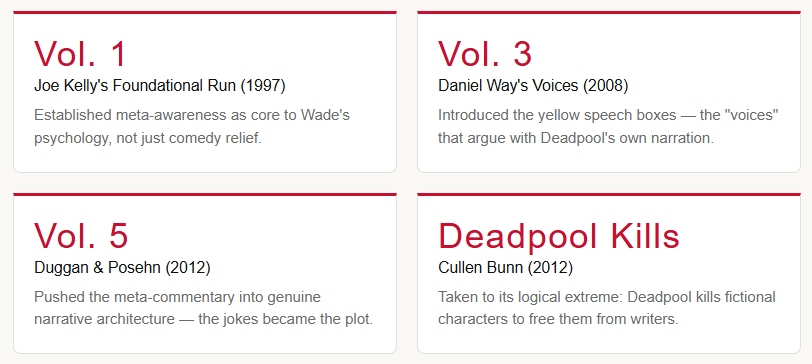
It was writer Joe Kelly, during his legendary 1997 run on the Deadpool solo series, who really leaned into the meta-awareness. Kelly and his collaborators started having Wade comment on his own comic book existence, make references to Marvel editorial, and generally behave like someone who had read the script before everyone else. The character’s popularity exploded, and the fourth wall break became his signature move — as identifiable as Spider-Man’s web-slinging or Batman’s brooding.
People think the craziness is the point. It isn’t. The fourth wall stuff works because Deadpool is the only character in Marvel who knows he’s powerless in a way that has nothing to do with his enemies.
— Joe Kelly, on his Deadpool run

How It Actually Works on the Page
Comics have a unique spatial grammar. Every page is a grid of panels, and each panel is a frozen moment in time. Characters exist within that space — they speak in dialogue balloons, react to things within their panel borders, and are entirely unaware of the white gutters between frames or the hands holding the book. The fourth wall is that invisible boundary between the fictional world of the story and the real world of the reader.
Deadpool violates that boundary in several distinct ways, and they’re worth breaking apart because each has a different effect on the reader.
Direct Address
The most obvious technique. Wade literally talks to the reader — “You still reading this?” or “Don’t worry, I’ll explain later” — often while other characters in the scene are completely oblivious. The visual staging is usually clever: Deadpool faces out toward the reader’s perspective while everyone else faces in toward the fictional action. It creates this funny, slightly uncomfortable feeling of being pulled into a conspiracy. The reader is now complicit. You’re not just watching; you’ve been recruited.
Acknowledging the Medium Itself
This is where it gets more sophisticated. Deadpool will sometimes reference panel borders, comment that he only has two more pages before the issue ends, or point out that a particularly dramatic scene is “clearly a splash page moment.” He knows he lives in a comic book. He’s aware of the constraints of the format — page count, panel layout, even the difference between a trade paperback collection and a monthly single issue.
The Speech Box Trick
One of the most visually distinctive fourth wall techniques in Deadpool comics is the speech box system. Most Marvel characters get white dialogue balloons. Deadpool gets yellow caption boxes — and crucially, he gets multiple overlapping caption boxes that argue with each other. This is Daniel Way’s contribution from his 2008 run, and it’s genuinely brilliant.
The yellow boxes represent one internal voice. The white boxes represent another. And sometimes Deadpool’s actual spoken dialogue disagrees with both of them. So you have a character literally fragmented across the page, three versions of his inner monologue fighting for real estate in the gutters, while he’s simultaneously turning to wink at you. The chaos isn’t decorative — it’s a visual representation of a fractured mind that happens to be self-aware.
Why It Makes Sense For This Character Specifically
This is the question that separates the people who think Deadpool is just a gimmick from the people who think he’s one of the most interesting characters in superhero comics. The fourth wall thing isn’t arbitrary. It makes psychological sense.
Wade Wilson has a healing factor that regenerates his cells faster than his cancer can kill them — but it doesn’t make him whole. His body is a constant war between regeneration and disease. His mind, the comics suggest, fractured under the pressure of that biological chaos and the trauma of Weapon X’s experimentation. He remembers things that contradict each other. He’s not sure what’s real. He has what reads, in modern writing, as symptoms consistent with dissociation, trauma-related memory disturbances, and identity fragmentation.
Against that backdrop, the fourth wall breaks read differently. He doesn’t speak to the reader because he’s showing off. He speaks to the reader because the reader is one of the few stable, consistent things he can identify. We’re always here. We’re always reading. The comic starts at issue one and the reader is there. The story proceeds and we’re still there. In a life defined by chaos and bodily horror and a memory that can’t be trusted, we are, paradoxically, a reliable presence.
The deeper reading

Deadpool talking to readers might not just be comedy. It might be the only form of genuine connection available to a character whose trauma has made him unreachable by normal means — he can't let people in from inside the story, so he reaches outside it entirely.

What Makes a Good Fourth Wall Break vs. a Lazy One
Not every Deadpool writer has handled this equally well, and the difference matters. When the fourth wall breaks feel earned, they land like small revelations — funny but also a little haunting, the way good comedy often is. When they don’t, they feel like a character just stopping to tell you he’s in a comic book, which gets old fast.
The best fourth wall breaks do at least one of three things: they reveal something true about Wade’s emotional state, they comment meaningfully on the conventions they’re violating, or they pull the reader into genuine complicity — making you feel like you’ve been let in on a secret the rest of the Marvel universe doesn’t know.
The worst ones are just noise. A “Hey, reader!” that doesn’t connect to anything, a pop culture reference dropped without integration, a wink without anything behind it. Deadpool works at his best when the meta-awareness feels like a symptom of something real — when it’s not just a joke, but a coping mechanism we happen to be watching in real time.
The funniest Deadpool moments are always the ones that make you feel slightly guilty for laughing — because just underneath the punchline, something genuinely sad is happening.
— Common observation among longtime Deadpool readers
When Writers Pushed It to Its Logical End
Cullen Bunn’s Deadpool Kills the Marvel Universe (2012) is probably the most extreme version of fourth wall logic ever committed to the page. In it, Deadpool becomes convinced that all fictional characters — every hero, every villain, every background citizen in every comic — are trapped in an endless cycle of death and resurrection for the entertainment of readers. He decides to liberate them the only way he can: by killing them all, destroying every story, and ultimately threatening to break through the fourth wall into the real world to kill the writers themselves.
It’s transgressive, genuinely unsettling, and philosophically interesting in a way that mainstream superhero comics rarely dare to be. It takes the fourth wall conceit to its endpoint — if the character knows he’s fictional, what does he owe the story? What does the story owe him? Do readers bear any responsibility for the violence they consume for entertainment?
Heavy questions for a comic about a guy in a red bodysuit, and yet there they are.

What Deadpool Changed for Comics Storytelling
Before Deadpool made it his signature, fourth wall breaks were occasional novelty items in superhero comics — a special issue quirk, a one-off gag. He transformed it into a sustained narrative technique, something a character could use across hundreds of issues as a genuine lens through which to understand a fictional life.
He also opened the door for other comics to take meta-awareness seriously. Grant Morrison’s Animal Man had famously played with similar territory in the late ’80s, but Deadpool democratized it — proved that you didn’t need a prestige literary framework to ask real questions about authorship and character agency. You could do it in a mainstream superhero book, with jokes and fight scenes and everything, and it could still mean something.
The movies cemented it for mainstream audiences, but the comics foundation is richer and stranger and worth going back to. Start with Joe Kelly’s run if you haven’t. Read it slowly. And when Wade turns and looks at you through the page, look back. He’s been waiting.