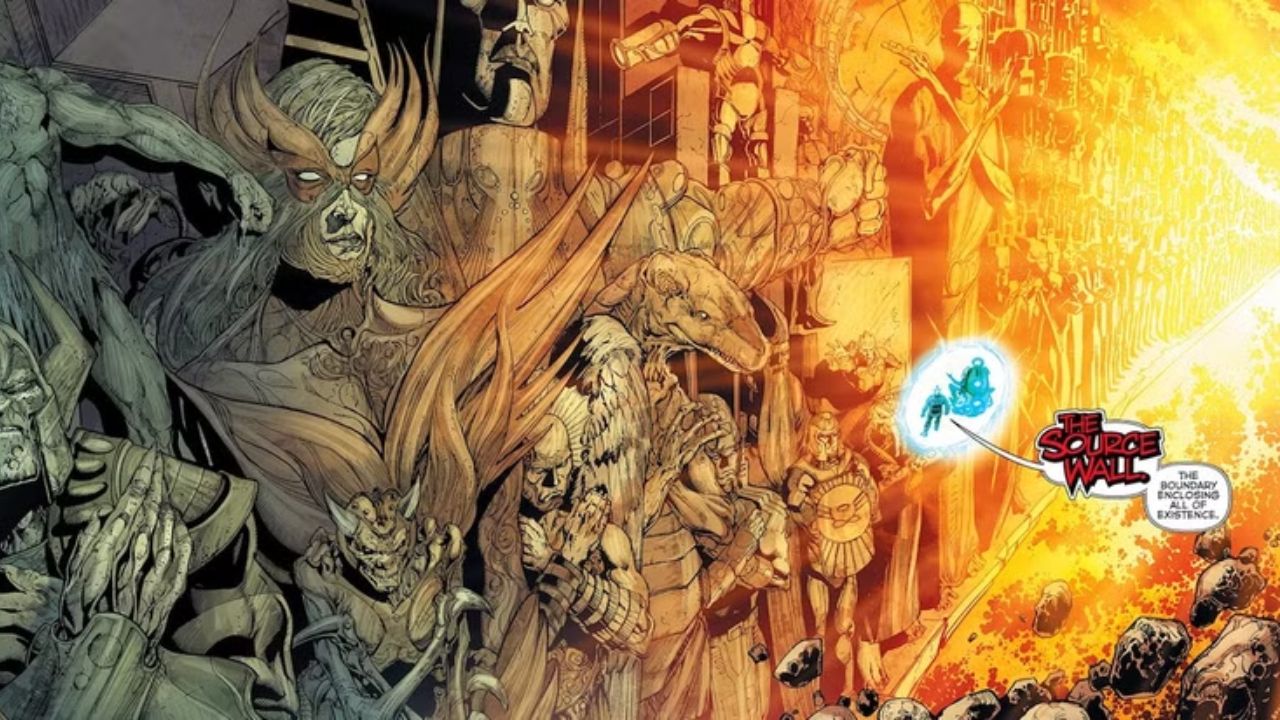
To understand the Source Wall, you first have to reckon with what it’s guarding. In DC’s cosmic cosmology — largely built by the legendary Jack Kirby during his run on the New Gods in the early 1970s — there exists something called the Source. Not a person. Not a place exactly. The Source is better described as the fundamental energy underlying all of existence: a primordial, unknowable force that birthed the universe and continues to animate it. Think of it less like a god and more like the operating system that gods themselves run on.
Kirby was working in grand, almost theological strokes. The Source was never meant to be fully explained, because that would defeat the point. It’s the mystery at the center of everything — the reason the cosmos exists at all, the origin of the power wielded by New Gods like Highfather and Darkseid. Characters who tap into it are drawing on something older and stranger than creation itself. And at the edge of the universe, standing between everything that exists and the Source itself, there is a Wall.
The Structure of the Wall
The Source Wall is exactly what it sounds like: an impossibly immense barrier that marks the outer boundary of the known universe. Beyond it lies the Source — or at least, the domain associated with it. The Wall has no doors. It has no gates. There is no legitimate way through it, and anyone who has tried to breach it has paid a price that makes death look like a minor inconvenience.
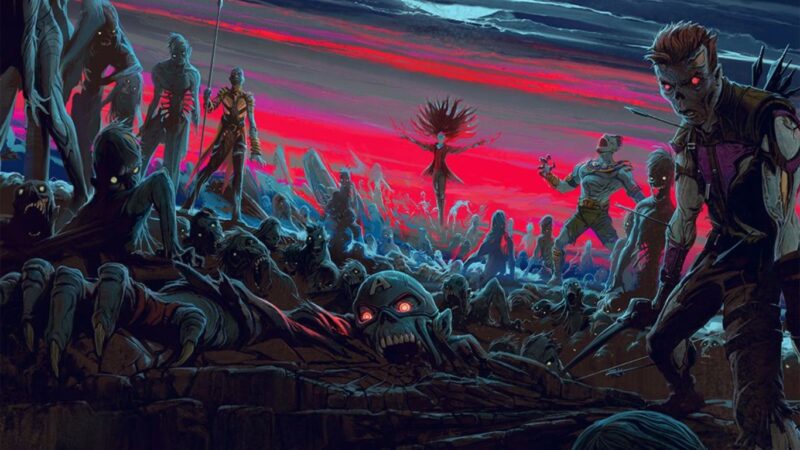
The Wall is covered in bodies.
Not metaphorically. Literally. The surface of the Source Wall is embedded with the forms of gods, cosmic entities, and supremely powerful beings who attempted to pass through and were claimed by the Wall itself. They didn’t die. They became part of the structure — frozen, conscious to some unknowable degree, sealed into the stone-like surface of the barrier forever. The Wall is both a warning and a monument to hubris: here is what happens when you think you’re worthy of the Source.
This is one of the most haunting visual concepts in all of DC Comics. Imagine the most powerful beings in the universe — creatures that could reshape reality, that stars shrank from — reduced to ornaments on a wall. It’s humbling in the most literal sense.
Jack Kirby’s Vision: The Fourth World and the Wall
The Source Wall originated in Kirby’s “Fourth World” saga, a sprawling, interconnected mythology that ran across several titles including New Gods, Mister Miracle, Forever People, and Superman’s Pal Jimmy Olsen in the early 1970s. It was Kirby’s attempt at something genuinely new in superhero comics — an epic with genuine cosmic stakes and a theological spine.
In Kirby’s framework, the universe had gone through multiple cycles of creation and destruction. The current universe was the “Fourth World,” and the New Gods — beings of immense power residing on twin worlds, the utopian New Genesis and the nightmarish Apokolips — were its dominant cosmic players. The Source was the animating principle behind New Genesis, channeled through the “Source Wall” communications interface at the heart of Highfather’s realm.
But the Wall’s most important function wasn’t communication. It was limitation. Kirby understood that the most powerful stories need genuine boundaries. The Source Wall told every reader — and every character — that no matter how strong you are, there are things beyond your reach. That boundary was built into the architecture of the universe.
What Kirby began, later writers would expand into one of DC’s most enduring cosmological features.

Promethean Giants: The First Prisoners
One of the earliest and most striking inhabitants of the Source Wall are the Promethean Giants — immense stone-like figures fused into the Wall’s surface. Their origin has been interpreted in various ways over the decades, but the core idea is consistent: they were beings of extraordinary power who sought to penetrate the Wall and were claimed by it. They are ancient beyond reckoning, the very first cosmic overreachers, serving as a grim precedent for every attempt that followed.
The name itself carries weight. In Greek mythology, Prometheus stole fire from the gods and was condemned to eternal torment for it. Kirby’s Promethean Giants occupy a similar narrative space — they reached for something divine and were punished not with chains and an eagle, but with something arguably worse: permanent, silent immobility while the universe goes on without them.
They’re among the most visually memorable images associated with the Wall. Bodies the size of planets, expressions of effort or anguish frozen into cosmic rock, pressed shoulder to shoulder across an infinite surface. They serve as DC’s reminder that even in a universe full of Supermen and Darkseids, there are powers that dwarf everything.
Who Has Tried to Cross?
The mythology of the Source Wall is partly defined by the roll call of those who have tried — and failed — to breach it.
Anti-Monitor — one of the most powerful villains in DC history, the being responsible for the deaths of entire universes during Crisis on Infinite Earths — ended up embedded in the Wall after his defeat. Think about what that says. A creature that annihilated the Multiverse couldn’t break through.
Darkseid himself has been drawn to the Source Wall. The lord of Apokolips, obsessed with the Anti-Life Equation — a mathematical formula that would strip free will from all living things — has long believed that the true secret of Anti-Life lies beyond the Wall. His obsession with it is almost religious.
Various cosmic entities and would-be conquerors across DC’s history have made the attempt. The Wall’s prisoner list reads like a greatest-hits of cosmic failure. And none of them got through.
What the Wall communicates, over and over, is that ambition has a ceiling. Even gods bleed against it.
The Wall in Post-Crisis Continuity
After DC’s Crisis on Infinite Earths restructured its entire continuity in the mid-1980s, the Source Wall was retained and if anything given more prominence. Writers recognized that it was too good an idea to let go — a self-sustaining mythological concept that could anchor stories without requiring much explanation.
During this period, the Wall became a more explicit boundary between the DC universe proper and whatever lay beyond the realm of the New Gods’ cosmic drama. It appeared in New Gods revivals, in cosmic crossovers, and in the background of stories that dealt with the highest tiers of power in the universe. The Promethean Giants remained its permanent haunting feature.
The Wall also started to function as a narrative shorthand for “beyond the scope of even our biggest stories.” Writers could gesture at it to suggest that the stakes of any given conflict, however enormous, were still operating within limits — that there was always something larger looming.
Grant Morrison and the Deepening Mythology
No writer did more to expand the Source Wall’s symbolic and narrative dimensions than Grant Morrison, whose work on JLA and later Final Crisis wove the Wall more deeply into DC’s cosmological tapestry.
In Final Crisis, the story that in many ways is the culmination of Kirby’s Fourth World mythology, Darkseid’s full corruption of reality brings the universe to the brink of something genuinely final. Morrison understood that Kirby’s cosmic architecture — the Source, the Wall, the New Gods — was serious mythology, and treated it accordingly. The Wall wasn’t just a plot device; it was a philosophical statement about the nature of limits, ambition, and the cost of seeking transcendence.
Morrison’s vision of DC’s cosmology placed the Source Wall at the outermost layer of a nested universe: below it were the stories, the characters, the worlds — and beyond it was something even fiction couldn’t quite contain. This meta-textual dimension gave the Wall an almost sacred quality. It wasn’t just the edge of the universe. It was the edge of the story.
Dark Nights: Metal — The Wall Cracks
For decades, the Source Wall was essentially inviolable. It was a fact of the DC Universe — the thing that can’t be crossed, the barrier that can’t be broken. Then Scott Snyder changed that.
Dark Nights: Metal (2017-2018), Snyder and Greg Capullo’s bombastic, mythology-reshaping crossover event, introduced the concept of a Dark Multiverse — a realm of failed, nightmarish alternate universes existing beneath the “true” Multiverse. Batman’s greatest fears given form. Worlds that should never have existed and were always collapsing toward oblivion.
The events of Metal set the stage for what would become one of the most consequential moments in DC’s recent history: the shattering of the Source Wall.
Snyder’s Justice League — The Wall Is Broken
The follow-up to Metal was Snyder’s epic Justice League run (2018-2020), illustrated by a rotating team that included Jim Cheung, Jorge Jimenez, and others. It took the cosmological stakes of Metal and drove them to their absolute limit.
Early in the run, the Source Wall is broken. Not cracked. Not weakened. Shattered. A catastrophic breach opens in the Wall, and through it falls the Totality — a shard of the Source itself, crashing into the DC Universe like a comet of impossible, universe-altering energy.
The implications are immense. If the Wall was the boundary between the universe and what lay beyond, breaking it doesn’t just create a door — it destabilizes everything. The wall that kept powers and forces outside the universe contained is gone. What pours through isn’t hope or enlightenment. It’s chaos, and danger, and something far worse: the revelation that there are forces even larger than the Multiverse itself that have been waiting on the other side.
This leads to the introduction of Perpetua — the being who built the Multiverse in the first place — and a conflict that operates on a scale that makes the Crisis events look almost modest by comparison.
Snyder’s choice to break the Source Wall was a creative masterstroke precisely because it honored what the Wall meant. It wasn’t dismissed or ignored. The breaking of it mattered because generations of stories had established it as the ultimate boundary. And when ultimate boundaries fall, there are consequences.
What the Source Wall Means Thematically
Strip away the cosmic spectacle and the Source Wall is doing something genuinely interesting on a thematic level.
It’s an acknowledgment built into the architecture of a fictional universe that some things are beyond the reach of even the most powerful beings. In a genre where power escalation is almost a law of nature — where today’s world-ender is tomorrow’s supporting character — the Source Wall insists on a ceiling. It says: no. There are things you cannot have. There are places you cannot go. And the attempt will cost you everything.
In this sense, the Wall is deeply anti-ego. Darkseid, the Anti-Monitor, gods and giants and cosmic titans — the Wall doesn’t care who you are. Hubris is hubris, and the price is fixed.
There’s also something moving about the visual of the Wall’s prisoners. These are the beings who looked at the edge of everything and still said “I want what’s on the other side.” And they were wrong. But they tried. The Wall is a graveyard for ambition, yes — but also a testament to it. Every frozen figure in that stone is proof that something in the universe keeps reaching beyond its own limits, even knowing the cost.
That’s a profoundly human impulse, dressed up in the grandest cosmic drag imaginable.

The Source Wall Today
The breaking of the Source Wall during Snyder’s Justice League run opened up narrative territory that DC’s writers have been exploring ever since. The cosmology of the DC Universe has continued to expand, with stories increasingly operating at scales that would have seemed impossible even a decade ago. New threats, new dimensions of the Multiverse, new questions about what lies beyond the known — all of it flows, in part, from the moment that Wall finally cracked.
In a way, the broken Wall reflects where superhero comics have gone more broadly. The genre keeps pushing its own boundaries, keeps asking “what’s beyond the biggest thing we’ve imagined?” The Source Wall was the answer to that question for a long time. Now that it’s broken, the question is wide open again.
And that, if nothing else, proves the Wall was doing exactly what Kirby intended. It wasn’t just a story element. It was a limit that gave everything inside it meaning — and a mystery that kept every story on the right side of it from feeling final.
Final Thoughts
The Source Wall is one of those rare comics concepts that earns its place in the mythology not through flashy powers or memorable villains, but through what it means. It’s a boundary that gives the DC Universe shape and weight. It’s the reason the cosmos feels like it has stakes. And the giants frozen into its surface — reaching, always reaching, never arriving — are among the most haunting images the medium has produced.
Jack Kirby gave us the Wall as part of his attempt to write genuine myth. Decades of writers have honored, expanded, and finally shattered it. But the idea at its core has never stopped being true:
Some things are beyond even the gods. And the only honest response to that fact is awe.