

In 2019, Marvel Comics did something no one expected — it handed the X-Men a happy ending. A nation. A resurrection protocol. A home. And then, for five extraordinary years, it systematically complicated every inch of it. That story is the Krakoa Era.
The Island That Breathes
Before it was a nation, Krakoa was a monster. Introduced in the landmark 1975 issue Giant-Size X-Men #1, the island was a living, predatory entity — a sentient landmass in the Pacific that had captured and fed on the original X-Men. It was a villain. A threat. A footnote in mutant history.
Then Jonathan Hickman arrived, and everything changed.
In 2019, Hickman relaunched the X-Men line with two interlocking miniseries — House of X and Powers of X — that rewrote everything readers thought they knew. In Hickman’s vision, Charles Xavier had been secretly cultivating a relationship with Krakoa for years. The island was not a monster. It was a partner. A provider. And it was willing to offer its shores to every mutant on Earth, living or dead, as the foundation of something unprecedented: the world’s first mutant nation-state.
Mutantkind had always been told their story ended in extinction. The Krakoa Era said: What if it ended in sovereignty?
What followed was a publishing event unlike anything Marvel had attempted with the X-Men in decades — a sprawling, interconnected universe of titles built around the idea that mutants, after a century of persecution, had finally won.
House of X & Powers of X
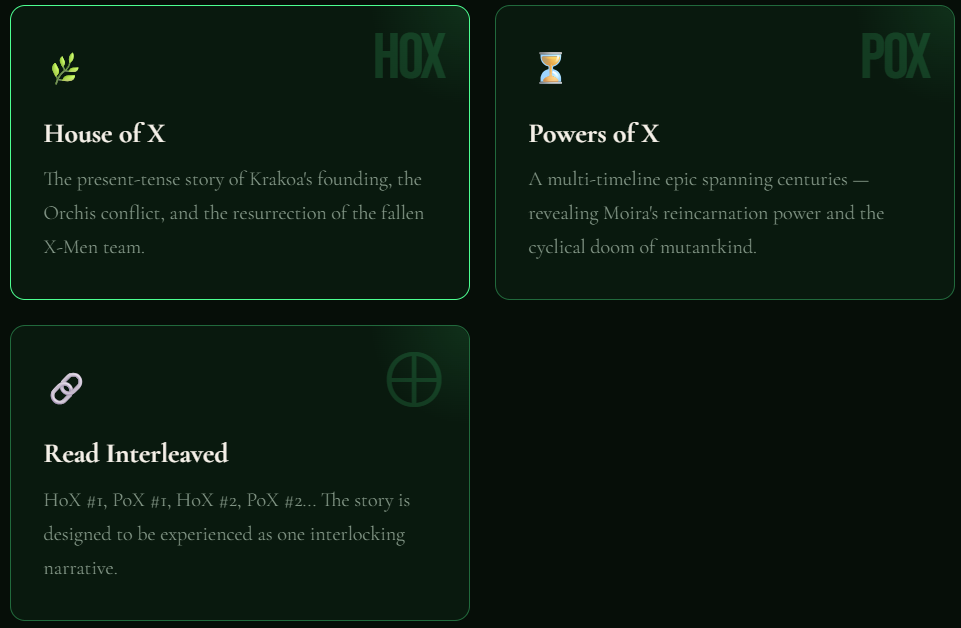
These two miniseries are the architectural blueprints of the entire era. Published simultaneously in the summer of 2019, they are meant to be read interleaved — alternating issues between the two titles — creating a mosaic narrative that spans thousands of years of mutant history across multiple timelines.
House of X focused on the present: the founding of Krakoa, Xavier’s grand diplomatic gambit to win the island recognition as a sovereign nation, and a shocking mission against Orchis — a human supremacist organization building a Mother Mold satellite capable of creating Nimrod-class Sentinels. The X-Men’s raid on the space station ends in catastrophic loss. Every member of the team dies. And then, impossibly, they come back.
Powers of X expanded outward into three timelines — Years One, Ten, One Hundred, and One Thousand — charting the long, losing arc of mutantkind’s war with machines, and implying that the Krakoa initiative is Xavier and Magneto’s last, best attempt to break the cycle. The series introduced the concept of Moira MacTaggert as a mutant with the power to reincarnate — experiencing every life with full memory of her previous ones — and revealed that the founding of Krakoa was her Tenth Life’s desperate gamble.
The critical response was thunderous. House of X / Powers of X is widely considered one of the greatest X-Men stories ever told — a reinvention as bold as Chris Claremont’s original run, and as structurally ambitious as anything in contemporary comics.
The Nation of Krakoa
Krakoa is not merely a geographic location. It is a living, breathing, feeling member of the mutant community. The island communicates through flower-speech — bioluminescent blossoms that bloom in response to emotion and intent. It extends gate-portals across the globe, connecting Krakoa’s shores to secret enclaves hidden within human cities. It produces pharmaceutical flowers with medicinal properties so advanced that they can cure diseases, extend human life, and reverse addiction — drugs that Krakoa offers exclusively to the world’s nations in exchange for diplomatic recognition.
The founding of Krakoa rests on three sacred laws, carved into the island’s very identity. Every mutant is expected to know them. Every mutant is expected to keep them.

Make More Mutants
Mutantkind has always teetered on the edge of extinction. The first law is a mandate for survival — biological, cultural, and communal. Every birth is a victory against genocide.
Murder No Man
A political necessity as much as a moral one. For Krakoa to be recognized by the human world, mutants must foreswear violence against humans — even the humans who have tormented them for generations. This law is the era’s central moral tension.
Respect This Sacred Land
Krakoa is not just territory. It is a sentient being that has offered itself as sanctuary. The island must be honored, not exploited.
Breaking these laws carries the ultimate Krakoan punishment: exile. Being cut off from the island, from the gates, from the resurrection protocols. In a nation built on the promise of immortality, exile is worse than death.
The Gift of Resurrection
If there is one concept that defines the Krakoa Era more than any other, it is resurrection. The era’s central promise — its most radical departure from decades of X-Men continuity — is that mutants no longer have to stay dead.
This is achieved through a process requiring five mutants working in concert, collectively known as The Five. Each possesses a unique biological power that, when combined, can reconstruct a deceased mutant’s body and restore their psyche from stored cerebro backups:
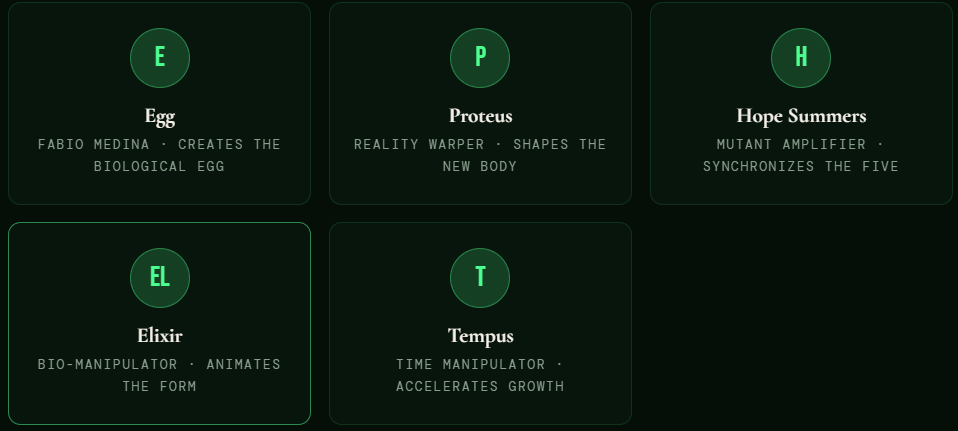
But resurrection is not simply biological rebirth. Charles Xavier wears a Cerebro helmet that constantly backs up every mutant psyche across the globe — their memories, personalities, the full texture of who they are. When a mutant dies and The Five reconstruct a new body, Xavier downloads the most recent backup into it. The result is seamless enough to be the same person… but the gap between the backup and the moment of death always exists.
What dies in that gap? Is the resurrected mutant the same person who died, or an extraordinary replica carrying their memories like a palimpsest?
— The era’s defining philosophical question
This question haunts every resurrection, every relationship, every cup of coffee shared between mutants who have all died and come back multiple times. It is handled with varying degrees of gravity across the era’s dozens of titles, but never fully resolved — and that tension is intentional. Resurrection changes what it means to be a mutant. It changes what it means to love one. And it changes what it means to kill one.
The Quiet Council
Krakoa is not a democracy. It is a strange, deliberately designed oligarchy — governed by a Quiet Council of twelve mutants divided into symbolic seats named after seasons. The council meets in the Autumn House, one of the island’s great living structures, and makes every significant decision affecting Krakoan society.
The composition of the council is the era’s masterstroke of political drama. Xavier and Magneto sit alongside Emma Frost, whose moral compass has always pointed toward self-interest. The murderous Apocalypse holds a seat beside the reformed terrorist Mystique. The White Queen and the Black King. Old enemies compelled by the urgency of the moment to share a table and, occasionally, to govern together.
And lurking beneath all of it, unseen for much of the era’s early chapters, is the influence of Destiny — the precognitive mutant and Mystique’s great love, resurrected by Hickman’s narrative in defiance of the very rule Xavier tried to establish against resurrecting omega-class precogs. She arrives in the story like a slow-burning fuse, knowing far more than she reveals.
Krakoans Are Eternal
Every mutant, no matter how broken, how monstrous, how lost — has a seat on the island. Every mutant gets to come home.
The Three Phases
The Krakoa Era unfolded across five years and dozens of titles, organized loosely into three publishing phases — each with its own tone, central conflicts, and creative roster.
Dawn of X
2020 — A Nation Finds Its Feet
The inaugural wave of Krakoan titles, launching immediately after House of X / Powers of X. X-Men by Hickman featured a rotating cast of mutants elected by Krakoan citizens. Marauders (Gerry Duggan) followed Emma Frost and Kitty Pryde smuggling mutants out of nations that refused to recognize Krakoa. Excalibur sent Betsy Braddock to the mystic realm of Otherworld. X-Force built Krakoa’s secret intelligence arm. New Mutants sent the young squad into space with the Starjammers. Hellions followed Krakoa’s most unstable mutants on black-ops missions under Mr. Sinister’s dubious guidance. A feast of ideas, each title carving its own tonal corner of the Krakoan world.
Reign of X
2021 – 2022 — Cracks Beneath the Utopia
The second wave deepened the mythology and began introducing the fault lines that would eventually destroy everything. The landmark Inferno miniseries by Hickman (his final X-Men work) revealed the full scope of the Moira MacTaggert conspiracy — and the existence of a parallel Council that had been operating in secret. X-Factor investigated mutant deaths that weren’t being properly resurrected. Way of X asked spiritual questions about mutant identity in the age of endless death and rebirth. Immortal X-Men zoomed inside the Quiet Council. X-Men Red took the saga to the terraformed surface of Mars, where Storm and Magneto attempted to build a second mutant haven — and Destiny began moving her pieces.
Destiny of X
2022 – 2023 — The Beginning of the End
The final sustained phase before the cataclysm. Orchis — the human anti-mutant organization — grew from a fringe threat into a globe-spanning conspiracy with moles inside Krakoa itself. The Quiet Council fractured along ideological lines. Apocalypse’s departure opened a power vacuum. The X-Men’s public image in the human world deteriorated. And Mystique, still waiting for a resurrection that Xavier and Magneto had been quietly denying her, began making contingency plans. The Hellfire Gala — Krakoa’s annual diplomatic party — loomed on the horizon like a countdown clock.
The Fall of X
The 2023 Hellfire Gala was meant to be another night of glamour and diplomacy — mutants in extraordinary fashion, surrounded by the world’s press, a living advertisement for Krakoan prosperity. It became the single most devastating event in the history of mutantkind.
Orchis had spent years infiltrating Krakoan society. On the night of the Gala, they executed a plan of catastrophic precision. Using a combination of technology, inside agents, and the corrupted power of Moira MacTaggert — who had long since abandoned her Krakoan alliance — Orchis triggered a global event that turned human public opinion against mutants in minutes. Krakoa’s pharmaceutical network was weaponized. The Gala descended into massacre. Most of the X-Men were scattered across time and space. Krakoa’s gates fell silent.
- The Massacre
The Gala Falls
Orchis agents trigger their plan during the Hellfire Gala. Thousands of Krakoan flowers across the world are turned into poison. Mutants are framed for an atrocity. The X-Men are scattered to the winds — some flung through time, others imprisoned, many dead.
- The Occupation
Krakoa Under Shadow
With most of its population in hiding or worse, Krakoa becomes a ghost island. The few mutants who remain on Earth must operate underground, hunted by a world that has been systematically convinced of their danger. The era’s tone shifts from utopian grandeur to desperate survival.
- The Resistance
X-Men Fight Back
Titles across the Fall of X phase followed different groups of mutants — some hiding, some fighting, some trying to dismantle Orchis from within. The creative range of the era’s writers meant each book told a different kind of survival story, from spy thriller to cosmic horror to intimate character drama.
- 2024
The Island’s End
The Krakoa Era concluded in mid-2024 with a series of finale issues that closed the chapter on the mutant nation — with Krakoa itself making a final, extraordinary sacrifice. The island chose to leave this plane of existence, taking the bulk of its mutant population with it to a realm beyond human reach.
Essential Reading
With over fifty titles published across five years, the Krakoa Era can be overwhelming. These are the titles that define it most completely:
House of X / Powers of X
Jonathan Hickman & Pepe Larraz / R.B. Silva. The foundation. Non-negotiable. Start here.
Marauders
Gerry Duggan. Emma Frost at her absolute best. Kitty Pryde’s arc. High-seas political drama with genuine heart.
Immortal X-Men
Kieron Gillen. The Quiet Council from the inside. Includes the single greatest Destiny characterization in comics history.
X-Men Red
Al Ewing. Storm, Magneto, and a Martian mutant civilization. The most structurally ambitious single title of the era.
Inferno
Hickman’s grand exit. Reveals the full conspiracy beneath Krakoa’s founding. Essential for understanding everything that follows.
Fall of X Titles
Hellions, Uncanny Avengers, X-Men Unlimited, and the finale specials round out the cataclysm beautifully.

Why It Matters
The Krakoa Era ended in 2024, replaced by the “From the Ashes” relaunch — a new status quo in which mutants, without their island nation and without universal resurrection, must rebuild their identity and their place in the world. It is the hangover after the feast.
But what the era achieved in five years will not be forgotten easily. It elevated X-Men comics to a level of sustained ambition they had not reached since the height of the Claremont era. It made the X-line the creative heart of Marvel Comics. It asked genuinely hard questions about sovereignty, identity, trauma, and the price of peace — and it never offered easy answers.
Political Complexity
The era treated mutant nationhood seriously — exploring diplomacy, internal governance, law, and the impossible compromises required to build something new from broken people.
Character Depth
Villains became complicated. Heroes made catastrophic choices. Emma Frost, Magneto, Mystique, and Destiny received characterization rich enough to anchor entire novels.
Thematic Ambition
Resurrection as philosophy. Exile as punishment. The ethics of optimism under siege. The era engaged its metaphors with genuine intellectual seriousness.
Creative Range
From Ewing’s cosmic structuralism to Duggan’s swashbuckling to Gillen’s ironic tragedy — the era housed an extraordinary range of voices under one shared sky.
The Krakoa Era was not a story about mutants winning. It was a story about what happens to people who dare to imagine winning — and what the world does to them for it.
For longtime X-Men readers, it offered the vindication of fifty years of longing — a world in which the outcasts finally had a home, and the cost of that home was paid in full. For new readers, it offered a way into the X-Men’s mythology that bypassed none of the weight and honored all of the history. And for comics as a medium, it offered proof that superhero narratives could still reach for something genuinely new.
The island is gone now. The gates are silent. The flowers have stopped blooming. But for five years, the mutants of Marvel Comics had exactly what they always deserved: a place to breathe. A people to call their own. A future that felt, however briefly, like theirs to shape.




















Leave a comment