Before there were satellites mapping the ocean floor or telescopes photographing distant galaxies, human beings looked into the wild dark — into the untamed forests, the storm-churned seas, the smoking mountains — and imagined the same creature: vast, scaled, breathing something terrible, alive beyond all reason. They called it by a thousand names. But the dragon, in essence, was already there.
The Benevolent Serpent: China, Japan & Korea
Where dragons do not breathe fire — they carry rain.
In perhaps the most radical departure from Western imagination, the dragons of East Asia are not monsters to be slain. They are holy. They are noble. They are the very breath of the civilized world. The Chinese lóng (龍) is a composite creature — antlers of a deer, scales of a carp, claws of an eagle, eyes of a demon, and the sinuous body of a serpent — assembled from the greatest powers in nature into something greater still.
The imperial dragon, a five-clawed creature reserved exclusively for the Emperor himself, was the symbol of heaven’s mandate on earth. To be born under the dragon year was propitious; to dream of a dragon, a blessing. Chinese dragons dwelt in rivers, lakes, and seas, commanding rainfall and controlling floods. They were cosmic bureaucrats, assigned provinces of sky and water, accountable to the Jade Emperor above. They could be petitioned, offended, or appeased — a relationship remarkably different from the adversarial dynamic of their Western counterparts.
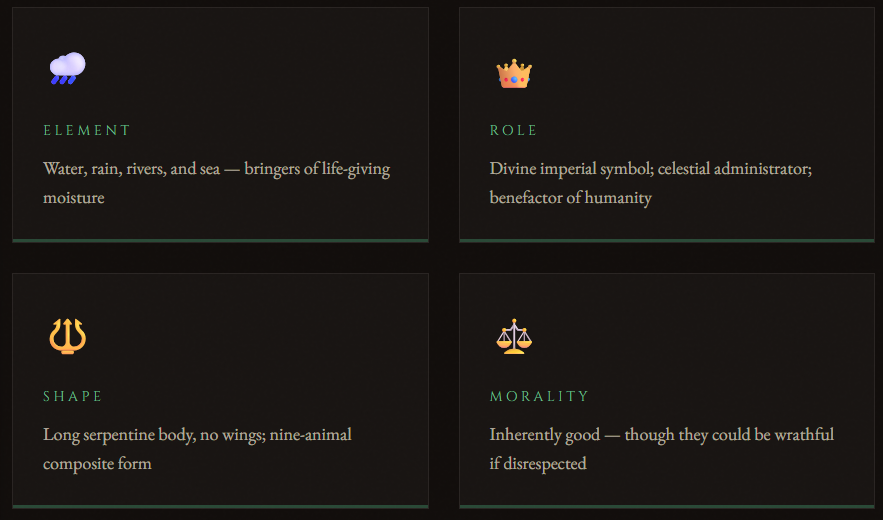
Japan inherited and adapted the Chinese model. The ryū (竜) occupies Shinto and Buddhist temples alike, depicted on ceilings in breath-stopping ink paintings, guardian of sacred spaces. In one of the most beautiful Japanese myths, the sea-king’s palace beneath the ocean, Ryūgū-jō, is presided over by Ryūjin — a dragon king who holds the tides in jewelled orbs. Korea’s yong holds a yeouiju, a luminous wish-granting pearl, a motif that also appears in Chinese and Vietnamese traditions: a pearl the dragon endlessly pursues, representing wisdom and enlightenment chased but never fully possessed.
“In China, you did not slay the dragon. You became worthy of it.”
This Eastern dragon tradition is not merely aesthetic divergence. It reflects a philosophical stance toward nature itself: in the Confucian and Taoist traditions, nature is not something to be conquered but harmonized with. The dragon, as an embodiment of natural force, is thus an ally — not an enemy — to the sage who understands the Way. That a civilization should place a dragon on its emperor’s throne rather than its enemy’s skull reveals everything about the values embedded in the myth.
The Beast of Sin: European Dragons
Serpent, devil, destroyer — and the hero who killed it.
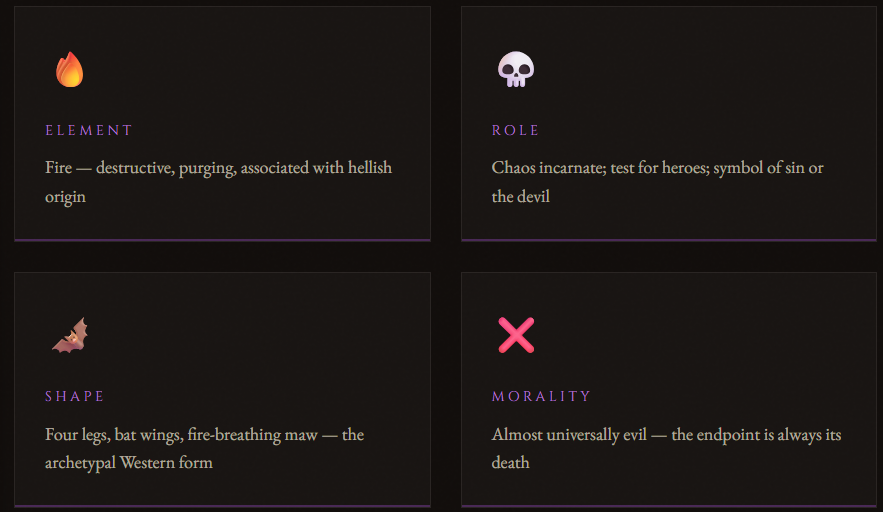
The European dragon is, above all, something that must die. From the serpent in Eden to the Leviathan of the Book of Job, the Judeo-Christian tradition had already coded the great serpent as the embodiment of chaos, pride, and corruption long before the Middle Ages began festooning castle walls with dragon-slaying saints. When Christianity swept across Europe, the ancient pagan dragons — Germanic, Celtic, Greek — were filtered through this moral lens and emerged as unmistakably sinister.
The dragon of European medieval imagination had wings of a bat, the body of a lizard scaled with iron, breath of liquid fire, and an appetite for virgins and treasure in roughly equal measure. It coiled atop hoards of gold in mountain caves, terrorized villages, and demanded tribute. It was the perfect antagonist: powerful enough to require a hero, evil enough to deserve destruction, and symbolic enough to carry the weight of an entire culture’s anxieties about chaos and sin.
Saint George, the most famous dragonslayer in Christendom, is almost certainly a symbolic figure — his legend migrated from Cappadocia to England, transforming across centuries. But the formula he embodies — Christian knight, helpless maiden, monstrous serpent, lance of faith — was endlessly repeated because it encoded a worldview: righteousness overcomes corruption, order conquers chaos, heaven defeats the serpent. The dragon is not nature; it is what happens when nature is left ungoverned by God or king.
Yet the Germanic tradition adds complexity. In Beowulf, the oldest surviving Old English epic, the dragon is ancient and wounded by injustice — it sleeps atop treasure stolen from a dead civilization, and it awakes to rage only because a single cup has been stolen. There is something almost tragic in this creature, a grief encoded in hoarding and fire. J.R.R. Tolkien, a scholar of Beowulf, felt it deeply — and his Smaug carries that same quality of terrible, wounded dignity, his gold-sickness almost a form of madness born from loss.

The Serpent at the Root of the World
Jörmungandr, Níðhöggr, and the cosmic scale of Norse dragons.
If the Chinese dragon is a cosmic civil servant and the European dragon is a moral test, the Norse serpent is something stranger and more terrifying still: a creature whose very existence threatens the structure of reality. Norse mythology does not merely place dragons in mountains or rivers. It places them at the foundations of the universe itself.
Níðhöggr — the corpse-gnawer — eternally chews at the roots of Yggdrasil, the great World Tree whose branches hold the Nine Realms. He is not a villain in any conventional sense; he is entropy. He is the inevitable unraveling at the heart of all things, the force that will one day, at Ragnarök, win. Norse cosmology is unique in its unflinching acknowledgement that chaos will eventually triumph — that the gods themselves will die, that Yggdrasil will fall — and the dragon is the agent of that truth.
Jörmungandr, the Midgard Serpent, is even more cosmologically significant. A child of Loki and the giantess Angrboða, he was cast into the ocean by Odin and grew so vast he encircled the entire world, biting his own tail — the oldest symbol of eternity and cyclical time, the ouroboros. At Ragnarök, Thor and Jörmungandr will kill each other: the thunder-god takes nine steps after the fatal blow before falling to the serpent’s venom. Even victory is mortal. Even heroism ends.
This is a mythology unafraid of the dark. The Norse dragon does not simply die so a village can breathe free — it holds the world itself within its coils, and its death means the world’s death too. There is a profound and melancholy grandeur to this that distinguishes the Norse tradition from all others.
The Feathered Serpent: Quetzalcóatl
A god who is also a dragon — or a dragon who became a god.
In the civilizations of Mesoamerica — the Aztec, the Maya, the Toltec — the dragon takes perhaps its most dazzling and philosophically ambitious form: the Feathered Serpent, Quetzalcóatl, a being that fuses earth and sky in a single impossible body. The quetzal bird is among the most beautiful in the world, its tail feathers cascading in iridescent green; the coatl is the serpent, lord of the earthbound. Together they are a symbol of transcendence — the body that holds both dimensions at once, the creature that does not have to choose between heaven and earth.
Quetzalcóatl was not merely mythological decoration. He was one of the principal creator gods of the Aztec cosmology, credited with creating human beings from the bones of the dead, watering them with his own blood, giving them maize, and establishing civilization itself. In the Toltec tradition he was also a historical priest-king, a real (or semi-real) ruler named Ce Ácatl Topiltzin who became so enmeshed in the legend of the god that the two became indistinguishable.
“The Feathered Serpent does not choose between sky and earth. It is both — and the space between them.”
The Maya equivalent, Kukulkan, was equally central — and his architecture is literal. At Chichén Itzá, the pyramid of El Castillo is engineered so precisely that at the spring and autumn equinoxes, the shadow of the staircase creates the illusion of a serpent descending from heaven to earth. The dragon, for the Maya, was not a story told in a book. It was written in stone, into the movement of the sun itself, across centuries.
Tiamat, Vritra, and the Dragons of Creation
When the universe itself was a dragon to be slain — or worshipped.
Some of the oldest recorded dragon myths in human history come from ancient Mesopotamia, and they are creation myths. The Babylonian Enûma Eliš, among the earliest written narratives ever discovered, describes the primordial sea-dragon Tiamat — mother of all gods — who is eventually slain by the young god Marduk. From her body he fashions the sky and earth. She is not merely a monster: she is the raw, undifferentiated stuff of the universe, the chaos from which all order is torn. The dragon is not evil; the dragon is what exists before good and evil are even conceivable.
In the ancient Vedic tradition of India, the dragon takes the form of Vritra, a vast serpentine being who holds the cosmic waters hostage, creating drought and death. The storm-god Indra slays him with his thunderbolt, releasing the rivers and restoring life. This myth is echoed strikingly across Indo-European cultures — the Norse Thor and Jörmungandr, the Greek Apollo slaying the Python at Delphi, the Hittite storm god and the serpent Illuyanka. Scholars see in these parallel stories the ghost of a single Proto-Indo-European myth: the dragon as the force that blocks the flow of water (and thus life), and the sky-god as its slayer.
Later Hindu and Buddhist traditions developed the nāga — serpentine beings of enormous complexity, neither wholly good nor wholly evil, but powerful and ancient. The great meditating image of the Buddha sheltered from rain by the seven-headed nāga Mucalinda is one of the most iconic images in Buddhist art. The serpent that tempts in Genesis becomes, in this tradition, the serpent that protects — a reversal that speaks volumes.
Rainbow Serpents & African Great Snakes
The dragon as world-spine, as rainbow, as ancestral river.
Across sub-Saharan Africa, the Americas, and Australia, traditions of great serpents that are not merely animals but cosmic forces pulse through oral literature with remarkable consistency. In West and Central African traditions, figures like Aido-Hwedo (from the Fon people of Dahomey) hold the earth itself: this rainbow serpent carries the world in its coils, living beneath the ocean’s floor, and the world’s mountains are the piles of his excrement, accumulated as he carried the creator god through the heavens.
In Australian Aboriginal traditions — some of the oldest living cultures on earth, with oral histories stretching back tens of thousands of years — the Rainbow Serpent is a being of staggering importance. It carved the riverbeds with its body as it moved across the landscape. It is simultaneously creator and danger, fertility and flood, the dream-time ancestor whose movements made the physical world. Different Aboriginal peoples describe it differently, but the broad pattern persists across the continent: a great serpent whose body is the shape of the land itself.
These traditions remind us that the dragon-impulse is not merely a product of ancient Mediterranean or Asian civilization — it appears wherever human beings encounter the unfathomable scale of natural power and reach for a living metaphor. A river in flood, a bolt of lightning, a rainbow arcing over a dark storm — all of these demanded explanation, demanded personification, demanded, in the end, a creature vast enough to hold them.
A World Compared
Seven traditions. One creature. Infinite meanings.
When you lay the world’s dragon traditions side by side, patterns emerge that no single culture could have seen from within itself. The differences are as illuminating as the similarities — because where cultures diverge in their dragons, they reveal what they most deeply valued, feared, and believed about the nature of the cosmos and the human place in it.
| Tradition | Nature | Element | Moral Valence | Fate |
|---|---|---|---|---|
| Chinese (Lóng) | Divine civil servant, rain-bringer | Water | Benevolent | Eternal; revered |
| Japanese (Ryū) | Sea-king, guardian of sacred space | Water / Storm | Protective | Eternal; worshipped |
| European (Medieval) | Devil’s beast, chaos embodied | Fire | Malevolent | Slain by hero |
| Norse | Entropy, cosmic doom-bringer | Void / Venom | Amoral / Apocalyptic | Kills and is killed at Ragnarök |
| Aztec / Maya | Creator god, sky-earth mediator | Wind / Sky | Sacred | Returns; cyclical |
| Babylonian (Tiamat) | Primordial chaos, mother of all | Water / Salt Sea | Neutral / Pre-moral | Slain; becomes the world |
| Hindu (Nāga/Vritra) | Cosmic blocker, serpentine ancestor | Water / Earth | Ambivalent | Slain or worshipped — both |
| Aboriginal (Rainbow Serpent) | World-shaper, Dream-time ancestor | Water / Rainbow | Awe-inspiring; sacred | Ever-present in the land |
The most striking observation is elemental: where Western European traditions associate the dragon with fire — destruction, sin, the infernal — nearly every other culture in the world associates it primarily with water. Chinese dragons bring rain. Norse serpents hold the sea. Tiamat is the salt water. The Rainbow Serpent carves the rivers. This is not coincidence. It is a reminder that fire-breathing was a relatively late and culturally specific addition to the dragon’s repertoire, likely accelerated by Christian moral coding and the practical needs of an antagonist who could physically threaten an armoured knight.
The deeper truth — that dragons are our metaphor for the largest natural forces we encounter — points toward water almost everywhere that agriculture and survival depended on rain. To control the dragon was to control the flood. To offend the dragon was to cause drought. The moral stakes were not abstract: they were harvest, survival, life.

Why We Still Need Dragons
Every age inherits the dragons of the last and redraws them for its own fears and its own needs. Our modern dragons — in film, in literature, in games — still carry echoes of every tradition traced above. Tolkien’s Smaug is Beowulf’s dragon grown literary. The dragons of Game of Thrones wrestle with the question of whether raw power serves good or evil. Miyazaki’s Haku in Spirited Away is a Japanese river-god barely remembered by a world that paved over its rivers.
We return to dragons because we have never stopped needing what they represent: the forces too large for us to control, too ancient for us to fully comprehend, and too magnificent for us to stop imagining. The dragon is what we become when we look at the world and still dare to dream something larger than ourselves.
— To every civilization that looked at the sky and thought: something is up there.