The ancient Greek myth of Sisyphus has echoed through more than two thousand years of human civilization, its haunting image of endless labor resonating with each generation as powerfully as it did with the ancients. Yet what began as a cautionary tale about defying the gods has transformed into something far more profound: a philosophical mirror reflecting the essence of the human condition itself. To understand Sisyphus is to confront fundamental questions about meaning, resilience, and the very possibility of happiness in an indifferent world.
The Ancient Myth: A King’s Cunning and Divine Punishment
In Greek mythology, Sisyphus was no ordinary figure. He was the founder and king of Ephyra, known in antiquity as Corinth, and he possessed something that made him unique among mortals: extraordinary cunning and the audacity to repeatedly outwit the gods themselves. His story begins not with a single transgression but with a pattern of deception that would ultimately seal his eternal fate.
Sisyphus first incurred the wrath of Zeus by revealing the god’s abduction of Aegina, a princess whom Zeus had taken for himself. This betrayal exposed the king of the Olympian gods for the sexual scoundrel he was, and Zeus did not forget such impudence. But Sisyphus’s defiance of divine authority extended far beyond mere gossip. His true legacy of rebellion involved something even more audacious: he twice cheated death itself.
In the first episode of his extraordinary cunning, Sisyphus managed to capture Thanatos, the personification of Death, and chain him up. Without Death to perform his duties, no humans died, creating a cosmic crisis that threatened the entire natural order. Only the intervention of Ares, the god of war, resolved the catastrophe by freeing Death to resume his work. Undeterred by this failure, Sisyphus attempted an even bolder scheme. After dying a second time and descending into Hades, he persuaded the god’s wife Persephone with a clever argument: if she would release him to the living world, he claimed, he could instruct his wife to perform the proper death rituals she had neglected to perform on his behalf. Persephone agreed, and true to his cunning nature, Sisyphus never returned to Hades. Instead, he lived to an advanced age, relatively unmolested by Death, who apparently wanted nothing more to do with the man who had previously imprisoned him.
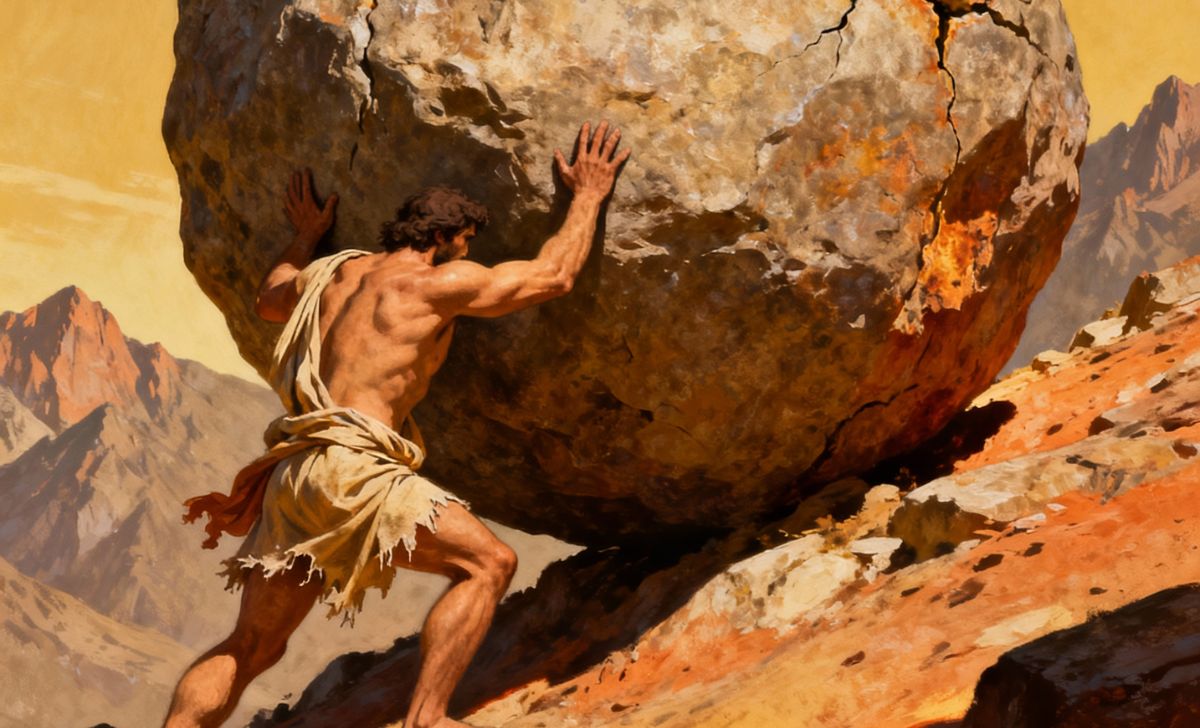
However, defying the gods could not go unpunished forever. When Sisyphus finally died of old age, he faced his ultimate reckoning. His punishment was both elegantly simple and devastatingly complete: he was condemned to eternally push an immense boulder up a steep hill, only to watch it roll back down to the bottom each time he neared the summit. Then he would have to begin again. Forever. The gods had conceived a punishment of exquisite cruelty—not merely physical torment, but psychological anguish derived from absolute futility. As Camus would later observe, the ancient mythmakers understood that “there is no more dreadful punishment than futile and hopeless labor.”

The Philosophical Awakening: Camus and the Absurd
For centuries, the myth of Sisyphus remained a cautionary tale, a simple story about the consequences of hubris and the immutable power of divine authority. But in 1942, a Algerian-French philosopher named Albert Camus transformed this ancient legend into something revolutionary. In his seminal essay The Myth of Sisyphus, Camus elevated the myth from mere mythology into a profound philosophical statement about the human condition itself.
Camus begins his analysis with a shocking proposition: there is only one truly serious philosophical problem, and that is suicide. Is life worth living? This question, he argues, is the fundamental inquiry from which all other philosophical questions follow. Why start here? Because Camus believed that modern humans face a crisis remarkably similar to Sisyphus’s eternal punishment—what he termed “the absurd.”
The absurd, in Camus’s philosophy, arises from a fundamental and irreconcilable conflict: humans desperately seek meaning, order, and rationality in a universe that remains fundamentally silent and indifferent to our pleas. We have an inescapable human need to attribute meaning to life, yet the universe responds with unreasonable silence. This confrontation between our yearning for meaning and the world’s refusal to provide it creates the essence of absurdity.
Unlike other existentialist philosophers before him—Kierkegaard, Jaspers, and Heidegger—who attempted to escape this absurdity through appeals to God, transcendence, or spiritual meaning, Camus refused such “escapism.” He rejected what he called “deifying what crushes them and find reason to hope in what impoverishes them.” For Camus, the absurd was inescapable. Acknowledging this inescapability became the first step toward freedom.
Here lies Camus’s most radical insight: rather than seeking an external solution to life’s meaninglessness, or collapsing into despair and suicide, he advocated for a form of conscious rebellion. Sisyphus becomes the archetypal “absurd hero” precisely because he continues to push his boulder with full awareness of its futility. He does not cling to false hopes of eventual success. He does not blame the gods or resign himself to misery. Instead, he accepts his fate completely while maintaining the freedom to choose his attitude toward it.
In one of the most famous passages in modern philosophy, Camus concludes his essay with an image of defiant acceptance: “The struggle itself towards the heights is enough to fill a man’s heart. One must imagine Sisyphus happy.” This is not a happiness born from ignorance or self-deception. It is a happiness rooted in lucid awareness—the clarity and courage of mind that refuses all comforting illusions while still choosing to live fully and passionately.
The Modern Sisyphus: Lessons for Our Lives
The philosopher Albert Camus may have written his essay during the darkness of World War II, but the relevance of Sisyphus’s boulder has only intensified in our contemporary world. Today, the myth speaks to us in multiple registers, offering profound wisdom about work, meaning, resilience, and the construction of a meaningful life in an often meaningless world.
Finding Meaning in Repetitive Work
In the modern workplace, countless professionals find themselves trapped in what has become known as “Sisyphean tasks”—repetitive, seemingly endless work that produces little visible progress. Email responds that never cease, reports that nobody reads, spreadsheets that never seem complete, meetings that recycle the same problems without resolution. These are not merely frustrating; behavioral economist Dan Ariely has demonstrated through rigorous experiments that such meaningless work actively drains motivation and undermines well-being.
In Ariely’s experiments, participants were paid to build objects from Legos. One group saw their completed work preserved and valued. The other group, the “Sisyphean” group, watched their finished creations immediately disassembled before their eyes. The results were striking: those whose work was undone stopped producing much sooner, building three fewer objects and earning three fewer dollars, despite having the same financial incentive to continue. This demonstrates something profound: money and external rewards are insufficient to sustain motivation when work feels meaningless. Yet here is where Sisyphus instructs us. The key is not to escape meaningless work—often that is impossible—but to create meaning within it.
Camus teaches that meaning is not discovered in the universe; it is created through conscious engagement and personal choice. We can choose to view our daily labor not as futile repetition but as an opportunity for excellence, for demonstrating our commitment, for practicing discipline, for contributing to a collective enterprise even if that contribution goes unrecognized. This shift in perspective does not change the tasks themselves; it changes our relationship to them.

Cultivating Resilience Through Acceptance
Sisyphus also speaks directly to our capacity for resilience in the face of genuine hardship. For individuals struggling with mental health challenges—depression, anxiety, or other conditions that create daily battles—the myth offers a powerful lesson. Like Sisyphus pushing his boulder, those dealing with mental health issues often confront struggles that seem never-ending, that appear to offer little progress despite tremendous effort.
Yet the very image of Sisyphus continuing to push embodies a profound message about resilience. He does not ask for permission to stop, does not wait for external validation, does not succumb to despair despite the apparent futility of his task. By embracing his fate rather than rebelling against it, Sisyphus demonstrates a form of freedom that transcends his circumstances. His labor continues not because he has defeated his punishment, but because he has chosen to engage fully with it despite its limitations.
This reframing is not mere positive thinking or denial. It represents what Camus calls “lucidity”—a clear-eyed acknowledgment of reality combined with a deliberate choice to live passionately and fully anyway. For those struggling with mental health or life’s inherent difficulties, this perspective can be transformative. The goal is not to eliminate struggle—that may be impossible—but to cease viewing struggle as something that invalidates life’s worth.
The Freedom to Create Meaning
Perhaps Sisyphus’s most important lesson for modern life concerns personal agency and meaning-making. In a world where traditional sources of meaning—religion, stable careers, clear social roles—have eroded for many people, the burden of creating meaning falls on individuals themselves. This is simultaneously the most daunting and most liberating aspect of contemporary existence.
Camus understood this paradox. In refusing to prescribe a specific meaning for Sisyphus’s boulder, he created space for each reader to find their own. For one person, the meaning might lie in excellence and craftsmanship—doing even repetitive work with extraordinary care. For another, it might lie in relationships and connections forged with others facing similar struggles. For still another, it might involve creative expression: transforming the experience of absurdity into art, writing, music, or other forms of creative work that help others make sense of their own struggles.
The point is not that specific tasks are inherently meaningful. Rather, we possess the freedom—indeed, the responsibility—to bestow meaning upon our actions through our conscious engagement and choices. This is radically empowering. It means that even in circumstances we cannot change, we retain the power to define how those circumstances contribute to our lives and identities.

Finding Joy in the Present Moment
One final lesson from Sisyphus involves a shift in temporal perspective. Our contemporary culture obsesses over outcomes, goals, and future achievements. We push boulders hoping to reach the summit, assuming that reaching it will bring happiness. But Camus points out that this future-focused mindset may be precisely what causes our anguish. What if the summit will never come? What if the boulder always rolls back down? What then?
Sisyphus teaches us to find joy in the moment itself—in the act of pushing, in the effort expended, in the full engagement with our task regardless of its ultimate outcome. This is not resignation but rather a profound reorientation of value. Rather than postponing happiness until we achieve some future milestone, we learn to recognize and appreciate what Camus calls “the implacable grandeur of existence”—the simple fact of being alive and conscious, moment by moment.
This perspective transforms ordinary activities. A conversation with a friend becomes precious not because it leads somewhere but because it is happening now. Work becomes meaningful not because it produces permanent results but because we are engaging our full selves in its execution. Daily routines become opportunities for presence and awareness rather than obstacles to be overcome on the way to “real life.”