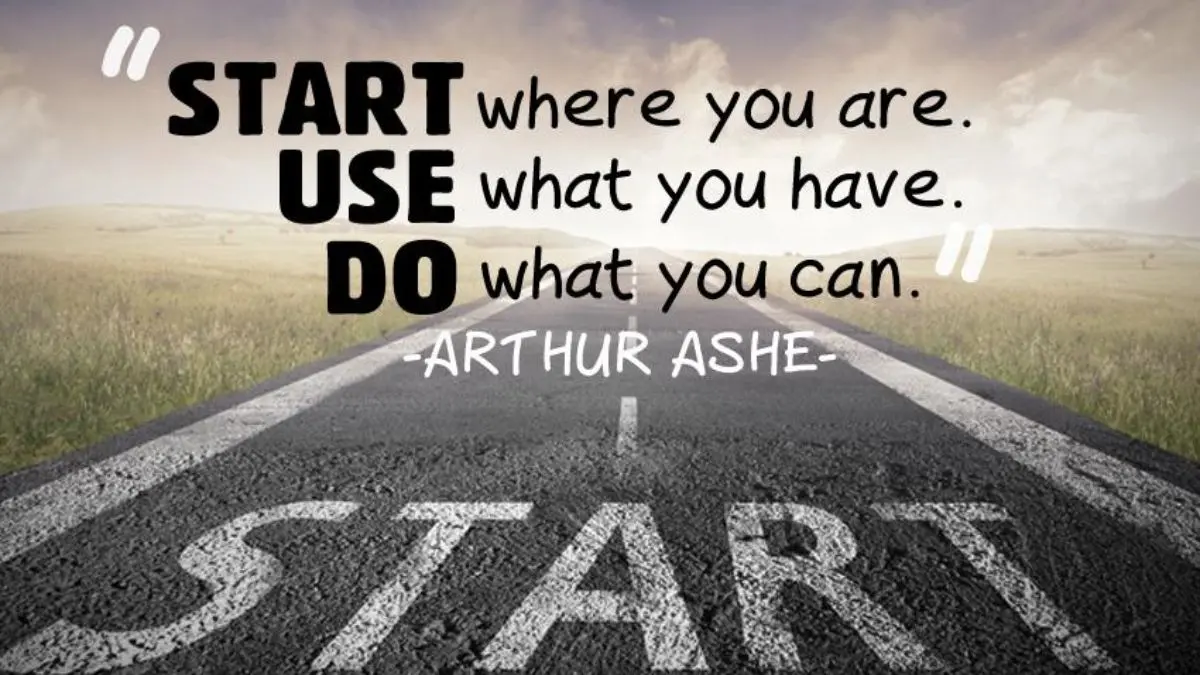
In a world constantly chasing the ideal of perfection, it’s easy to feel overwhelmed by the expectations and dreams we set for ourselves. The journey towards personal and professional growth can often seem daunting, filled with obstacles and seemingly insurmountable challenges. It is in these moments that the timeless wisdom of Arthur Ashe, an exemplary figure in both sports and human rights activism, echoes profoundly: “Start where you are. Use what you have. Do what you can.” This simple yet powerful statement is a beacon of hope and a guide for those feeling lost in the pursuit of their goals.
Start where you are. Use what you have. Do what you can.
Start Where You Are
The journey of a thousand miles, as the old adage goes, begins with a single step. This rings true in the pursuit of any goal, be it personal, professional, or spiritual. “Start where you are” is not just a call to action; it’s an invitation to embrace your current circumstances, no matter how imperfect they may seem. In this section, we delve into the significance of this phrase and how it can be a transformative principle in our lives.
Understanding Your Current Position
Self-awareness is the cornerstone of growth. It involves an honest assessment of where you are in your life’s journey. This process can be challenging, as it requires acknowledging both your strengths and limitations. However, it’s crucial to understand that every journey is unique, and every starting point has its value. Whether you’re at the peak of your career, navigating a personal setback, or standing at a crossroads, acknowledging your current position is the first step toward meaningful change.
Overcoming the Paralysis of Perfectionism
Many of us fall into the trap of waiting for the perfect moment to start. We wait for the ideal conditions, the right mood, or the perfect opportunity. However, perfection is an illusion, and waiting for it can lead to paralysis. Arthur Ashe’s life teaches us that perfection isn’t a prerequisite for progress. Starting with what you have, where you are, is far more important than waiting for an ideal scenario that may never come.
Small Steps Lead to Big Changes
The magnitude of our goals can sometimes be overwhelming. When we look at the distance between where we are and where we want to be, it can feel insurmountable. The key is to break down the journey into smaller, more manageable steps. It’s about progress, not perfection. Every small step you take is a move in the right direction. Remember, Rome wasn’t built in a day, and your goals won’t be achieved overnight. It’s the consistent, small steps that pave the path to significant change.
Embracing Your Current Reality
Starting where you are also means embracing your current reality with all its imperfections and challenges. It’s about making the best of your situation and not letting the “what ifs” and “if onlys” hold you back. It’s a mindset shift from focusing on what you lack to maximizing what you have. This shift in perspective is empowering – it puts you in the driver’s seat of your life, ready to navigate through the terrain of your unique journey.
Use What You Have
“Use what you have” is a principle that champions resourcefulness and creativity. It’s about making the most of the resources, skills, and opportunities you currently possess, rather than fixating on what you lack. This segment delves into the art of resource utilization, a critical step in turning aspirations into achievements.
Recognizing Your Resources
The first step in using what you have is recognizing the resources at your disposal. These resources can be tangible, like financial assets or physical tools, or intangible, such as skills, knowledge, experiences, or even your network of relationships. Often, we overlook what we already have, focusing instead on our deficiencies. Conduct a personal inventory to identify and appreciate the resources you possess. This exercise not only boosts your confidence but also gives you a clearer picture of your starting point.
Creativity and Resourcefulness
History is replete with Stories of individuals who achieved remarkable feats with limited resources. They succeeded not because they had everything they needed but because they could make the most out of what they had. Creativity plays a pivotal role here. It’s about thinking outside the box and finding unconventional ways to utilize your resources. Whether it’s repurposing materials, learning new ways to leverage your skills, or finding innovative solutions to problems, creativity is the key to maximizing your existing resources.

The Power of Networks and Relationships
One often underappreciated resource is your network of relationships. The people you know – family, friends, colleagues, mentors – can be invaluable in your journey. They can provide support, advice, information, and sometimes even the resources you lack. Don’t underestimate the power of a strong network. Building and maintaining relationships, networking within and outside your industry, and being open to collaborations can open doors that you might not have been able to open alone.
Leveraging Skills and Knowledge
Your skills and knowledge are your most personal and powerful resources. Continuously improving and adapting these skills to suit your goals is essential. This might mean improving existing skills, learning new ones, or finding ways to apply your knowledge in different contexts. Remember, in our rapidly changing world, the ability to adapt and evolve is crucial.
Embracing Minimalism and Efficiency
Sometimes, having limited resources can be a blessing in disguise. It forces you to be efficient and to prioritize what’s truly important. This minimalist approach can lead to more focused and effective strategies. It’s not about the quantity of resources but the quality of their utilization.
Do What You Can
The final part of Arthur Ashe’s profound guidance, “Do what you can,” is a compelling call to action. It’s about making the most of your current situation and resources, and then taking proactive steps, no matter how small, towards your goals. This section explores the significance of action in the journey of personal and professional growth and how it can be the most decisive factor in achieving success.
Action-Oriented Mindset
The transition from planning to doing is often where the challenge lies. Many great ideas and intentions never materialize because they don’t cross the threshold into action. Adopting an action-oriented mindset is about shifting from a passive state of thinking and planning to an active state of doing. This doesn’t mean taking hasty, ill-considered actions but rather committing to purposeful and consistent steps towards your goals, no matter how small.
Dealing with Obstacles and Failures
Action inevitably brings challenges and setbacks. It’s important to understand that obstacles and failures are not the end of the road but rather an integral part of the journey. They are opportunities for learning and growth. Embracing a resilient mindset helps you to view these challenges as stepping stones rather than stumbling blocks. Remember, what matters is not how many times you fall but how many times you get back up and continue moving forward.
Sustainable Efforts and Consistency
Sustainability and consistency in your actions are key. It’s better to take small, consistent steps than to start with a burst of energy only to burn out quickly. Developing a routine or a habit around your goals can be incredibly effective. This could mean setting aside a certain amount of time each day to work on your project, or it might involve small daily practices that move you closer to your goal. Consistency builds momentum, and over time, these small actions accumulate into significant progress.
Leveraging Your Strengths
While it’s important to acknowledge and work on your weaknesses, focusing on your strengths can be more beneficial. Leveraging your existing skills and talents to take action can lead to more efficient and effective results. Identify what you’re good at and find ways to apply these strengths to your current goals. This not only boosts your chances of success but also increases your confidence and motivation.
The Importance of Flexibility and Adaptability
Being flexible and adaptable in your actions is crucial. Sometimes, despite the best plans and efforts, things don’t go as expected. Being able to pivot and adapt to changing circumstances can make the difference between stagnation and progress. Stay open to new ideas, be willing to adjust your plans, and don’t be afraid to take a different path if it leads you closer to your goals.
Conclusion
As we reach the conclusion of our exploration of Arthur Ashe’s inspiring quote, “Start where you are. Use what you have. Do what you can,” it’s clear that these words offer more than just motivation; they provide a blueprint for personal and professional growth. This journey through Ashe’s wisdom has not only highlighted the importance of acknowledging our current situation, leveraging our resources, and taking proactive steps, but it has also offered practical insights into how these principles can be applied in our daily lives.
Also Read: A little progress each day adds up to big results