David Allan Coe is gone. The man who gave the world “Take This Job and Shove It,” who wrote songs that ended up on every jukebox worth its salt, and who lived a life so wild it often blurred the line between truth and mythology — died Wednesday night at the age of 86. His wife, Kimberly Hastings Coe, confirmed the news to Rolling Stone, writing: “One of the best singers, songwriters, and performers of our time — never to be forgotten. My husband, my friend, my confidant and my life for many years. I’ll never forget him and I don’t want anyone else to ever forget him either.” No cause of death was given. To understand David Allan Coe, you have to understand that he was never just a musician. He was a character — one that he largely wrote himself.
A Life That Began in Reform Schools
Born on September 6, 1939, in Akron, Ohio, Coe didn’t exactly have a gentle start in life. By the time he was nine years old, he was already in a reform school in Michigan. The following two decades were spent cycling in and out of correctional facilities for offenses ranging from burglary to auto theft. He claimed, in a story that was widely disputed and for which prison officials said there was no supporting evidence, that he killed a fellow inmate with a mop bucket during a confrontation in the prison showers in 1963.
Whether true or not, stories like that were Coe’s currency. Waylon Jennings’ drummer Richie Albright perhaps said it best: Coe was “a great, great songwriter” but “he could not tell the truth if it was better than a lie he’d made up.” Even Shelby Singleton, the Nashville producer who first signed him, put it bluntly in a 1976 Rolling Stone interview: “Ninety percent of what he tells you is probably bullshit. We thought it was a gimmick, and we promoted it in that manner.”
Still, Coe himself, in a more candid moment in 1975, admitted that prison had once felt like home to him. “There were a lot of times when I would actually be in the county jail after being busted, and I’d wake up the next morning and say to myself, ‘Oh, I’m glad it’s over — I’m glad I’m going back to prison now, where I know I’ll be safe, where I’ll be out of society.'”
He claimed to have been inspired behind bars by blues legend Screamin’ Jay Hawkins, whom he said was a fellow inmate at some point during those years.
Nashville and the Long Road to Recognition
Upon his release from Ohio State Penitentiary in 1967, Coe made a beeline for Nashville. The stories about those early days are as colorful as the man himself — he was said to have lived out of his car and even camped outside the Ryman Auditorium, home of the Grand Ole Opry, hoping someone would notice him. One account has him working himself into a sweat outside the hallowed venue just to look like he’d performed inside, then signing autographs for passing tourists.
Two years after arriving in Nashville, he signed a deal with Shelby Singleton’s SSS International and Plantation Records and released his debut album, Penitentiary Blues, in 1969 — a collection of tracks written during his time behind bars. Critics and fans took to it warmly, but it didn’t sell. His second record, Requiem for a Harlequin, met a similar fate.
Coe kept grinding. He hit the road, opening for acts like Grand Funk Railroad and performing in clubs from coast to coast. Slowly, things started moving. He got some radio play with the 1973 single “Keep Those Big Wheels Hummin’,” but the real turning point that year came not from his own recordings but from someone else’s.
Tanya Tucker took Coe’s song “Would You Lay with Me (In a Field of Stone)” to Number One on the country charts. It also spent ten weeks on the Billboard Hot 100. Suddenly, Nashville knew what Coe was capable of — as a writer, at least.
The Mysterious Rhinestone Cowboy Era
Coe leaned into reinvention in the mid-70s. He began showing up onstage in rhinestone-studded suits and a cloth mask, billing himself as “The Mysterious Rhinestone Cowboy.” He signed with Columbia Records and released his major-label debut, The Mysterious Rhinestone Cowboy, in 1974 — a full year before Glen Campbell would score a massive hit with his own song of that name.
The follow-up, Once Upon a Rhyme in 1975, was where Coe’s recording career really clicked. The album featured his own version of “Would You Lay with Me” and, more importantly, the song that would stick to his name forever: “You Never Even Called Me by My Name.”
Written by Steve Goodman and an uncredited John Prine, the song was tailor-made for Coe. It poked fun at country music while simultaneously honoring it, let him do spot-on impressions of Waylon Jennings and Merle Haggard, and, crucially, gave him room to insert himself into country’s mythology. In his own added verse, he sang: “The only time I know, I’ll hear ‘David Allan Coe,’ is when Jesus has his final judgment day.” The song became a jukebox staple that, decades later, still hasn’t quit.
That same year, 1975, saw the release of a documentary that is equal parts concert film and performance art, in which Coe visits Ohio’s Marion Correctional Institution and is interviewed inside a prison cell. Another documentary, Heartworn Highways, released in 1976 and directed by James Szalapski, placed Coe alongside Townes Van Zandt, Guy Clark, Steve Earle, and the Charlie Daniels Band as part of a portrait of the outlaw country movement at its peak. Szalapski, in a 1996 interview, described Coe as “an outlaw amongst the outlaws.”
Coe’s performance at Tennessee State Prison, captured in that film, remains one of the more striking things he ever committed to record. Standing before inmates in a rhinestone suit, he told the crowd: “Show y’all how someone like you gets to where I’m at today, being someone like me — because I used to be someone like you.”
The Songwriter Who Defined an Era
If there’s one song that defines Coe’s legacy as a writer, it’s probably not one he ever sang himself. In 1977, Johnny Paycheck recorded “Take This Job and Shove It” — entirely Coe’s creation — and sent it to Number One on the country charts. The phrase became a cultural shorthand for telling your boss exactly what you think of him. Coe recorded his own version the following year on Family Album.
His self-referential streak ran deep throughout this period. On 1976’s “Longhaired Redneck,” he sang: “They tell me I look like Merle Haggard, and I sound a lot like David Allan Coe.” In 1977’s “Willie, Waylon and Me,” he introduced himself mid-song with the declaration, “My name is David Allan Coe and I’m from Dallas, Texas!” — a line made funnier by the fact that he was from Ohio. And his Longhaired Redneck compilation album became, according to Rolling Stone, the first-ever platinum certified country record — a milestone that tends to get lost in the more salacious parts of his biography.
The Controversy That Never Went Away
Not everything Coe did during those years was something his fans could defend. In 1978 and 1982, he independently released and sold via mail order two albums — Nothing Sacred and the Underground Album — that were, by any measure, offensive. The records were loaded with racial slurs, misogynistic language, and deeply harmful content. Coe maintained they were written as parody, citing Dr. Hook’s 1972 Shel Silverstein album as inspiration, and denied being a racist. Not many were convinced.
The albums made sure that Coe’s legacy would always carry an asterisk — no matter how many hit songs he wrote, no matter how many jukeboxes still play his music, those records exist and have never gone away.
The Comeback, the Collaborations, and the Final Decades
The early ’80s were rough for outlaw country. The urban cowboy craze, riding the wave of the John Travolta film of the same name, effectively shoved the genre aside. Coe, typically, refused to adjust.
His 1983 album Castles in the Sand staged a genuine comeback, with the single “The Ride” — a song about a hitchhiker who encounters the ghost of Hank Williams — hitting Number One on the Cashbox Country Singles chart. In his own hands, Coe couldn’t resist adding an outro verse in which Hank personally praises the new generation of country singers, including one David Allan Coe.
He appeared alongside Johnny Cash and Kris Kristofferson in a pair of TV movies in 1986, The Last Days of Frank & Jesse James and Stagecoach. He continued releasing albums well into the 2000s, recorded a series of tracks with members of heavy metal band Pantera that eventually became the 2005 album Rebel Meets Rebel, and built a late-career friendship and working relationship with Kid Rock, who brought Coe out as an opening act and recorded his song “Single Father.”
Around 1990, when his Columbia contract ended and personal troubles mounted, he lost his Key West home. He claimed at one point to have lived in a cave — another story that raised eyebrows. In 2015, he pleaded guilty to impeding the administration of tax laws and was sentenced to three years’ probation and ordered to pay the IRS nearly one million dollars in back taxes.
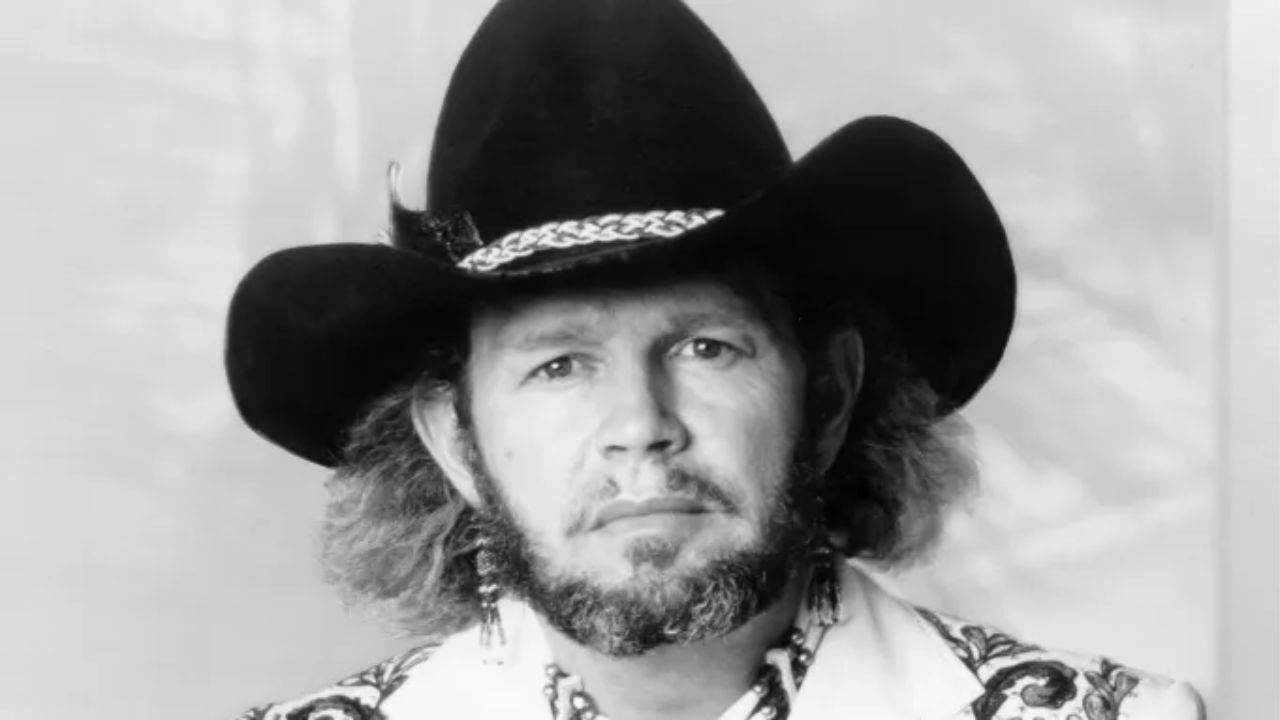
In his final years, Coe was a commanding presence onstage — long hair, braided beard, hunched over his guitar, singing into a headset mic. He was a fixture on the motorcycle rally circuit and drew loyal crowds who had been following him for decades.
In that 1975 prison visit documentary, Coe reflected on what had always driven him — not money, not chart positions, but simply the need to be known.
“I’ve found my place in society. And it’s not in a prison,” he said. “I no longer have to come back here and have everybody knowing who David Allan Coe is — now everybody on the street knows who I am. So I still get that satisfaction of being somebody.”
Say what you will about David Allan Coe. He was somebody. That much was never really in dispute.