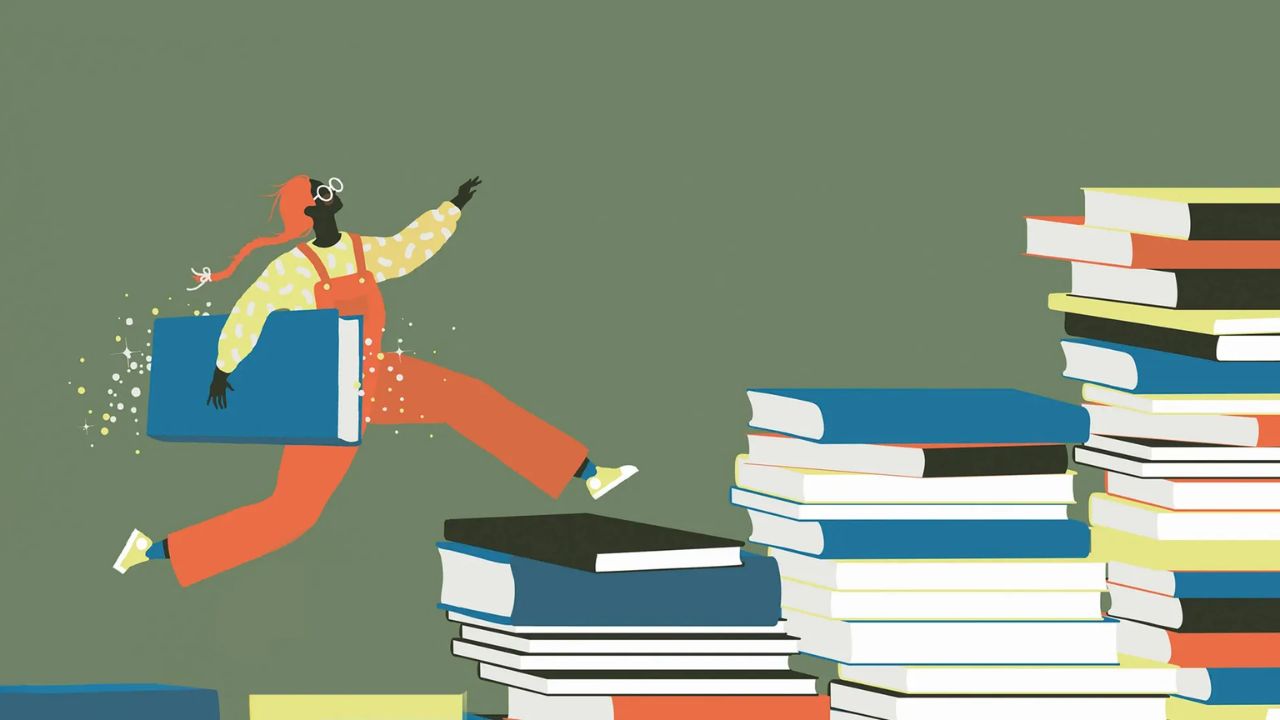
There is a particular kind of guilt that haunts the modern reader. You know the one: the doorstop novel on your nightstand with its bookmark frozen at page 47, the non-fiction opus you swore you’d finish before the new year, the collected works of some Important Author gathering their dignified dust. We live in an age that has handed us every book ever written in our pocket — and yet we’ve never felt more unread.
Here is the thing they don’t tell you in the canon: length is not depth. The short book — that once-derided “little volume,” sniffed at by academics and booksellers alike — has quietly staged the most elegant comeback in literary history. And in doing so, it has revealed something profound about what reading is actually for.
This guide is not a concession to shrinking attention spans. It is an argument — urgent, unashamed, and backed by a very long reading list — that the short book is a different creature entirely from the abridged book, the summarised book, the book designed to be consumed without friction. The great short books demand everything of you. They simply do it faster.

What Is a “Short Book,” Exactly?
Let us draw the borders carefully. For our purposes, a short book is any work of enduring literary, philosophical, or narrative significance that runs between 100 and 250 pages. This excludes novellas designed merely to be brief (though we’ll discuss those separately), pamphlets, essays collections, and anything published primarily in digital format. We are talking about books that sat with their authors for years — perhaps decades — and emerged spare not because they were rushed, but because they were exact.
The distinction matters. George Orwell’s Animal Farm — 112 pages — was not compressed. It was conceived that way. Camus spent years refining the 123 pages of The Stranger until every sentence was load-bearing. John Steinbeck’s Of Mice and Men hits 107 pages and contains more tragedy per sentence than most 600-page sagas. These are not summaries of bigger ideas. They are the idea, crystallised.
What unites these works — what makes them categorically different from the airport thriller or the celebrity memoir — is the quality of compression. Every paragraph earns its place. Every word is paid for. The short book is the literary equivalent of a well-cut suit: nothing hangs loose; nothing is missing; every line does double duty.
There is also a practical taxonomy worth establishing. Short books cluster naturally into three reading modes, each serving a different hunger:
The Long Lunch read — books you can begin and finish in a single afternoon of real commitment: think The Great Gatsby, Siddhartha, The Old Man and the Sea. These are for weekends, flights, or the rare day off when your mind is wide and your phone is face-down.
The Three-Evening read — books you can legitimately complete in a working week if you give them an hour each night: Stoner, Their Eyes Were Watching God, Giovanni’s Room. These reward patience without punishing a busy life.
The Bedside Accumulator — philosophical and essay-adjacent short books that are read in fragments over weeks, each visit as complete as the last: Marcus Aurelius’s Meditations, Montaigne’s Essays (a selection), Rilke’s Letters to a Young Poet. These become companions, not conquests.
The Myth of the Long Book
We have been taught, somewhere between school and seriousness, that difficulty is proportional to length. That a thousand-page novel is inherently more ambitious than a hundred-page one. That to have read Tolstoy’s War and Peace is to have climbed a literary Everest that reading The Death of Ivan Ilyich — Tolstoy’s own masterpiece, at 86 pages — somehow does not.
This is almost entirely backwards. The constraints of the short form force an intensity of decision-making that sprawling works often escape. Every character must justify their existence. Every scene must turn the screw. There is no wandering subplot, no chapter of weather, no digressive meditation that costs the reader nothing. The short book writer is playing with a budget; the long book writer can always defer the bill.
- Length ≠ depth or ambition in literature
- Compression forces purposeful, precise writing
- Many of history’s most celebrated works are short
- Reading a short book completely beats abandoning a long one

Why Digital Life Changed the Equation
The digital environment has not destroyed our capacity for deep reading — but it has made it more expensive. Every time we pick up a book after an hour of scrolling, we are not arriving fresh. We arrive fragmented. The cognitive cost of re-immersing in a 700-page novel has risen dramatically for most of us.
The short book does not demand that you first detox from the internet before entering. It begins quickly, it moves, and it rewards immediately. The satisfaction of finishing — of saying “I read this, all of it, with nothing left over” — is a kind of recalibration that longer books can rarely provide to the time-pressed reader.
- Digital habits raise re-entry cost for long works
- Short books provide the reward of completion
- The reading muscle is rebuilt through frequent wins
- Attention is trained, not simply rationed
“The most important things are the hardest to say, because words diminish them.”
— Stephen King, Different Seasons
12 Essential Short Books
by Mood, Moment & Mind
Organised not by genre but by what you need from them. Because the best book is always the right one for right now.
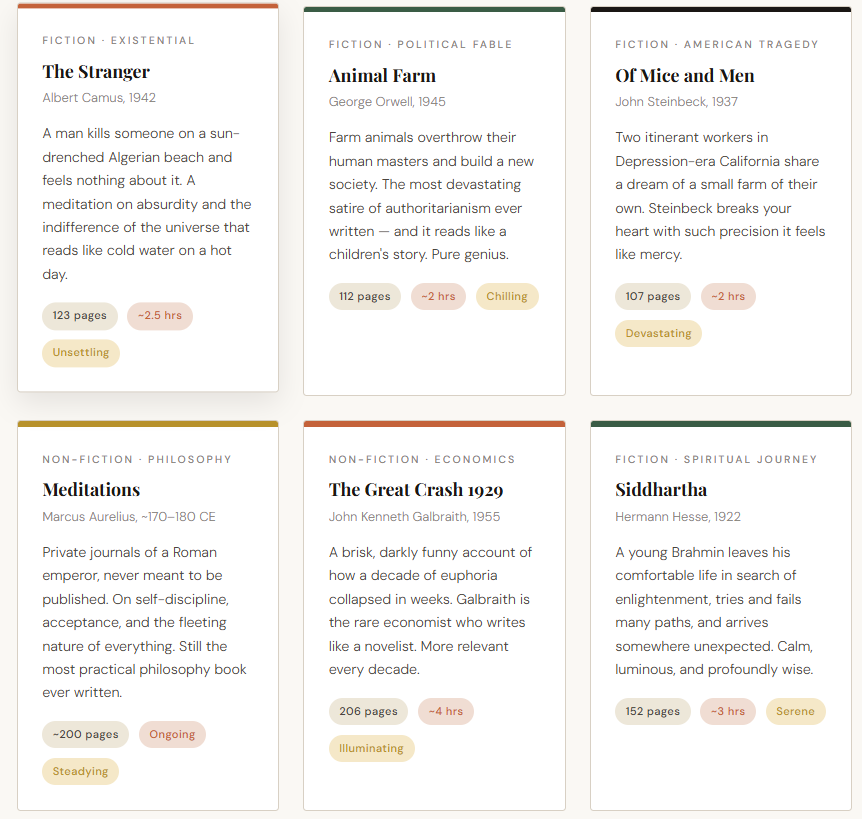
by Mood, Moment & Mind
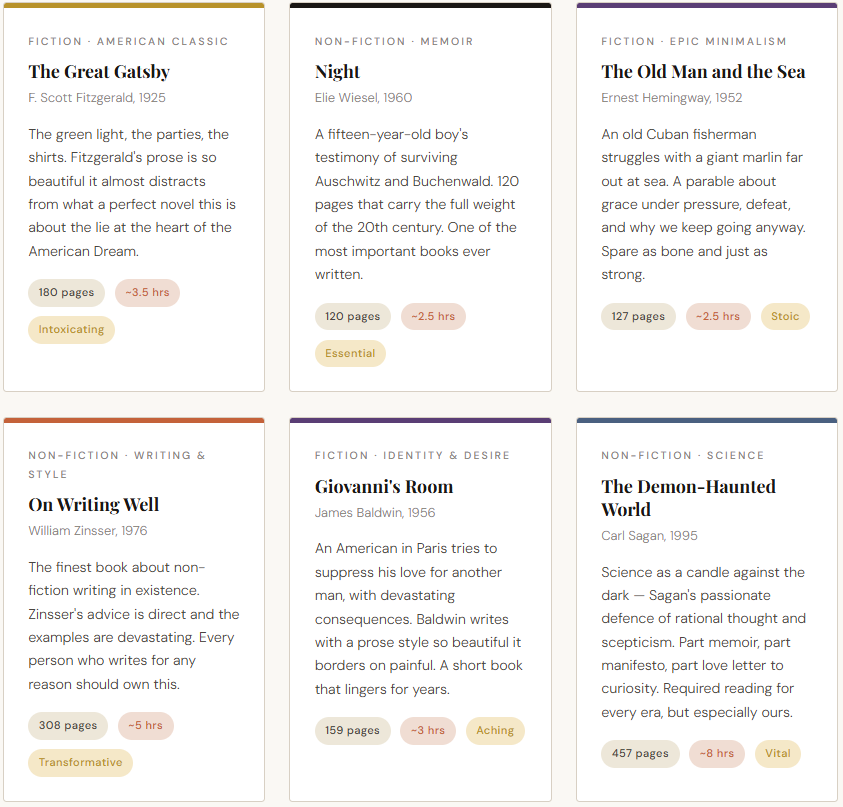
by Mood, Moment & Mind – The Guide to “Short Books” for Digital-Era Attention Spans
How to Actually Read
in the Digital Age
Knowing which books to read is the easy part. Here is the harder conversation: how to carve out the conditions in which reading becomes possible again.
The Phone-Free Hour
Set a recurring alarm — not a vague intention, an actual alarm — for the same time each day. When it fires, your phone goes face-down in another room. Not on silent on the table. Another room. Even 45 minutes of genuinely undistracted reading per day will take you through 20–30 short books a year. This is more than most people manage in a decade of “meaning to read more.”
Match Book to Mood, Not to Aspiration
The book you should read and the book you will actually read are often very different things. Stop picking books to impress your future self. If you’re exhausted, read something propulsive and plot-driven. If you’re restless, read something philosophical. The only wasted reading is the reading you don’t do because the book felt like homework.
Carry One Book Everywhere
Not a Kindle (though Kindles are fine). A physical book. The act of reaching into your bag and retrieving an actual object is qualitatively different from opening an app. It signals to your brain — and to the world around you — that reading is not something you do when there’s nothing better; it is the something better. The commute, the waiting room, the five minutes before the meeting — these are real reading time, reclaimed.
Give Every Book Forty Pages
The old rule of thumb was “give a book fifty pages before abandoning it.” For short books, drop this to forty. Then, if it hasn’t gripped you, put it down without guilt — but give those forty pages honestly, with your phone elsewhere and your attention intact. Most books you think you don’t like are books you haven’t read yet; you’ve been drifting through them half-present.
Keep a Reading Record
Not a Goodreads profile for public performance. A private list — in a notebook, a notes app, a scrap of paper — of every book you’ve finished this year, with one sentence you remember about it. This does two things: it makes finishing feel ceremonial, and it reveals patterns in what you actually love versus what you think you should love. After twelve months, this list is one of the most honest documents you own.
Read the Short Version of the Long Thing
Many of the world’s greatest thinkers wrote a short, accessible version of their big idea alongside (or after) the definitive long one. Darwin wrote The Origin of Species — but he also wrote a condensed version of his own theory. Freud’s shorter essays are often more readable than his doorstop case studies. Seek these out without shame. The artist approved of them. So should you.
The Short Book Is
a Complete World
A hundred and twenty pages of Kafka contains as much human truth as any trilogy. The question is not whether the world in those pages is small — it is whether you showed up for it fully. A short book read with real attention is worth more than a long book grazed distractedly. And once you finish one — really finish it, turn the last page, sit quietly for a moment — you will remember what it felt like to be completely inside a world built from words.
That feeling is not nostalgia for some better version of your reading self. That feeling is what reading actually is, uninterrupted. It is still available to you. It has always been available to you. It is just 150 pages away.