
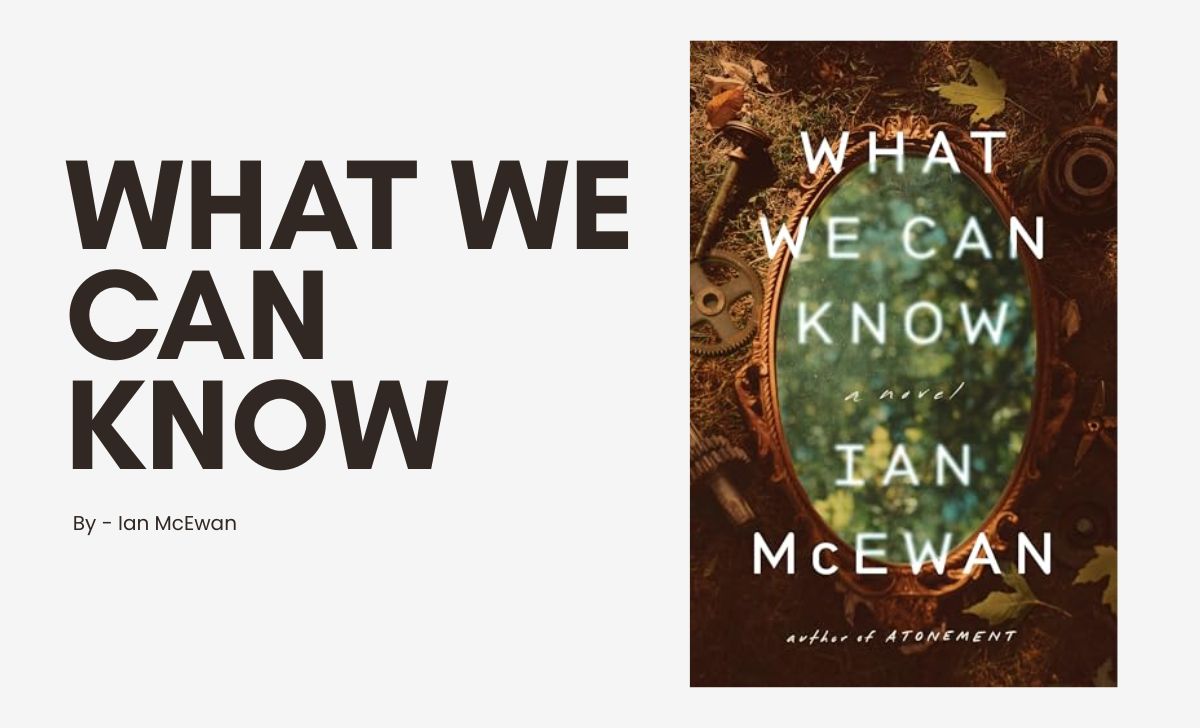
From one of contemporary fiction’s most assured voices comes a novel that explores not just what we can know—but what we won’t know; what remains hidden, ambiguous, or simply out of reach. In What We Can Know, Ian McEwan asks us to imagine a Britain almost unrecognizable a century ahead: submerged, fragmented, living with the legacy of environmental and social collapse, and yet still haunted by human desires of love, memory, and loss. It is a story at once speculative and intimate, sweeping yet grounded in emotion. In this review I’ll walk through the plot, share what resonated (and what perhaps didn’t), and assess what this novel offers both for longtime McEwan readers and for those new to his work.
Plot and Structure
The narrative architecture of “What We Can Know” is deliberately bifurcated, with each half offering radically different perspectives on the same events. Part One unfolds in 2119, nearly a century after catastrophic climate change, nuclear war, pandemics, and economic collapse—collectively known as “the Derangement”—have reshaped civilization. The United Kingdom has become a scattered archipelago of islands, with much of London and other major cities submerged beneath rising seas. The United States has fractured into warring territories controlled by feuding warlords, while Nigeria has emerged as the unexpected global superpower, preserving humanity’s digital archives.
In this diminished world, Tom Metcalfe, a literature professor at the fictional University of the South Downs, dedicates his scholarly life to studying the period from 1990 to 2030. His obsession centers on a legendary lost poem titled “A Corona for Vivien,” composed by Francis Blundy, a poet considered the equal of Seamus Heaney. The poem was read aloud only once, at an intimate birthday celebration for Blundy’s wife, Vivien, in October 2014—an event that has since been mythologized as the “Second Immortal Dinner.”
Tom’s research benefits from an extraordinary resource: thanks to Nigerian scientists who resurrected the internet, every email, text message, and digital footprint from the early twenty-first century has been preserved. Yet despite this unprecedented access to information, the actual text of the poem remains elusive, lost to time and circumstance. Tom becomes so immersed in reconstructing the lives of Blundy, Vivien, and their circle that he develops what amounts to an emotional attachment to people who died long before he was born.
His colleague and romantic partner Rose shares his academic interests but grows increasingly frustrated with Tom’s romanticization of the past and his particular fixation on Vivien. Their relationship suffers under the weight of Tom’s obsessive nostalgia for an era he never experienced—an era that, ironically, was racing toward the very catastrophes that define his own diminished present.
Part Two delivers a dramatic shift in perspective, presenting Vivien’s own account through her personal journal. This section, titled “The Confessions of Vivien,” shatters Tom’s carefully constructed assumptions about the people and events he has spent his career studying. Vivien’s narrative reveals the hidden complexities, betrayals, and secrets that the digital archive could never capture—the whispered conversations, private motivations, and intimate moments that leave no trace for future historians to discover.
Through Vivien’s eyes, readers witness the reality behind the mythologized dinner party, learning that Francis Blundy was far from the romantic figure Tom imagined. The celebrated poet emerges as narcissistic, fraudulent, and even cruel—a man who composed beautiful verses about nature while simultaneously denying climate change and living in ways that contradicted his poetic ideals. The poem itself, it turns out, may have been less a sincere expression of love than a calculated performance, “fakery” designed to manipulate and control.
Vivien’s account also exposes a web of infidelities, resentments, and even criminal acts that Tom’s archival research could never have uncovered. Her first husband, Percy, a violin maker, suffered from dementia, and his decline precipitated a series of affairs motivated by convenience, passion, and revenge. The literary circle surrounding Blundy, seemingly glamorous from a century’s distance, proves to have been rife with jealousy, betrayal, and moral compromise.
The novel’s plot takes darker turns as Vivien reveals attempted abductions, a child’s death through neglect, hidden treasures, literary sabotage, and even murder. These revelations fundamentally undermine Tom’s idealized vision of the past, forcing him to confront the uncomfortable truth that historical knowledge is always partial, always mediated, and always shaped by what survives rather than what actually occurred.
Themes and Literary Significance
McEwan employs his dual-timeline structure to explore multiple interconnected themes. Most prominently, the novel serves as an unflinching examination of climate catastrophe—not as a distant abstraction but as a lived reality with profound human consequences. By setting his narrative in a post-Derangement world, McEwan allows readers to see our current moment through the eyes of those who will inherit the consequences of our inaction.
Tom’s nostalgic yearning for the early twenty-first century creates a deeply ironic perspective. He mourns the loss of international air travel, diverse cuisine, thriving orchestras, and the simple ability to walk on dry land. His lament—”To have lived in those vibrant, tumultuous days, when the ocean remained at a respectful distance”—transforms our mundane present into a lost golden age. This narrative strategy forces readers to recognize the extraordinary abundance and possibility that characterizes contemporary life, even as we fail to adequately protect it.
The novel’s treatment of climate change transcends typical environmental messaging by framing ecological destruction as a form of betrayal—specifically, a betrayal analogous to marital infidelity. Just as the characters in 2014 profess love while conducting affairs, our civilization professes concern for the environment while pursuing policies and lifestyles that ensure its destruction. This metaphorical framework transforms an abstract global crisis into an intimate story of broken promises and moral failure.
McEwan also interrogates the nature of historical knowledge itself. The title “What We Can Know” carries multiple layers of irony. Despite having access to unprecedented quantities of data, Tom’s understanding remains fundamentally limited because so much of human experience occurs in private spaces that generate no records. The novel suggests that biography and history are necessarily incomplete, shaped as much by gaps and silences as by available evidence.
The contrast between Tom’s archival reconstruction in Part One and Vivien’s lived experience in Part Two demonstrates this epistemological limitation with devastating clarity. Tom possesses vast quantities of information—he knows what brand of apples Francis preferred, can track Vivien’s online activities, and has access to every public statement she ever made. Yet he remains ignorant of the most crucial truths about her life: her secret relationships, her private griefs, her true feelings about her marriage, and the shocking events that shaped the poem’s creation and disappearance.
The novel also examines the problem of mythologization—how individuals and eras become idealized in collective memory, stripped of their complexities and contradictions. The “Second Immortal Dinner” of 2014 has been elevated to legendary status by 2119, celebrated as a moment when great minds gathered to honor art and beauty. The reality, as Vivien reveals, was far more sordid: a gathering of flawed, selfish people pursuing their own agendas, many of them complicit in precisely the behaviors that would lead to civilizational collapse.
Among the dinner guests is Mary Sheldrake, a minimalist novelist who provocatively dismisses traditional fiction as “elevated gossip”—merely stories about “love, marriage, infidelity, and disputes over wills.” Yet the novel itself ultimately embraces precisely this kind of intimate, character-driven storytelling as the most effective way to make abstract crises comprehensible and emotionally resonant. By embedding his climate narrative within a story of adultery, deception, and personal betrayal, McEwan makes the catastrophe meaningful on a human scale.
The theme of betrayal permeates every level of the narrative. Nearly every character engages in some form of infidelity—not just sexual, but intellectual, artistic, and environmental. Mary discovers her husband Graham’s affair even as she conducts her own. Rose becomes involved with a graduate student, partly in response to Tom’s obsessive attachment to Vivien’s ghost. These personal betrayals mirror and illuminate the larger betrayal: a generation that created beautiful art celebrating nature while simultaneously destroying it through negligence and greed.
Writing Style and Craft
McEwan’s prose in “What We Can Know” exemplifies his mature style: elegant, precise, and deceptively accessible. Reviewers consistently praise the novel’s readability, noting that despite its complex themes and philosophical depth, it remains compulsively engaging. The New York Times described it as “gorgeous and awful,” producing moments of genuine laughter amid its bleak subject matter.
The novel’s two-part structure allows McEwan to demonstrate his versatility as a stylist. Tom’s sections in Part One adopt an academic, somewhat cerebral tone appropriate to a scholar reconstructing history from fragmentary evidence. The pacing in these chapters can be hypnotic, almost soporific at times, as Tom meticulously assembles details about the dinner party and its participants. Yet McEwan maintains tension through Tom’s obsessive intensity and the mystery of the missing poem.
Part Two shifts dramatically in tone and pace. Vivien’s journal entries possess an immediacy and emotional rawness that contrasts sharply with Tom’s scholarly distance. The second half moves more quickly, delivering the “stacked surprises” and plot revelations that upend everything readers thought they understood about the characters and events. This structural choice reflects the novel’s thematic concerns: archival research, no matter how exhaustive, cannot capture the visceral reality of lived experience.
Critics have noted parallels to McEwan’s earlier masterwork “Atonement,” particularly in the novel’s metafictional elements and its exploration of how imagination and memory fill the gaps left by incomplete knowledge. Both novels feature dramatic midpoint revelations that force readers to reevaluate everything they’ve read, and both examine the relationship between fiction, truth, and moral responsibility. “What We Can Know” feels, in some sense, like a mature companion piece to “Atonement,” revisiting similar concerns from the perspective of an author in his late seventies reflecting on legacy and posterity.
The novel’s world-building, while effective for its purposes, remains relatively minimal. McEwan himself describes the work as “science fiction without the science,” and several reviewers noted that the 2119 setting serves primarily as a vantage point rather than a fully realized speculative world. The future Britain of fragmented islands, protein cakes made from soil bacteria, and wooden e-bikes provides sufficient detail to establish the diminished circumstances of Tom’s era without overwhelming the story’s focus on character and theme.
Critical Reception
“What We Can Know” has received largely positive reviews, with critics praising both its ambitious scope and its emotional power. Kirkus Reviews called it “a philosophically charged tour de force by one of the best living novelists in English.” Dwight Garner of The New York Times proclaimed it “the best thing McEwan has written in ages” and “entertainment of a high order.” The novel’s reception suggests that McEwan has successfully balanced intellectual complexity with narrative accessibility, creating a work that satisfies both critics and general readers.
Multiple reviewers highlighted the novel’s dual nature, noting how it functions simultaneously as a literary mystery, a climate change narrative, an academic novel, and a domestic drama. This generic flexibility has been viewed as a strength, allowing McEwan to engage with serious philosophical questions while maintaining the forward momentum of a thriller.
Some critics expressed reservations about certain elements of the execution. A few found the first section slow-paced and overly cerebral, though most acknowledged that the investment paid off in the novel’s explosive second half. Others felt that the science fiction framing suffered from “thinly-imagined world-building” and occasional creaking of the “plot machinery.” The melodramatic plot twists in Vivien’s section were described by at least one reviewer as “cheaply melodramatic,” though this criticism was balanced by appreciation for the emotional impact these revelations create.
The novel’s treatment of climate change has been particularly noted for its restraint and nuance. Rather than preaching or catastrophizing, McEwan presents environmental collapse as a fait accompli and focuses instead on how it shapes human relationships, scholarly pursuits, and the meaning people derive from their lives. This approach allows the novel to engage seriously with climate issues without reducing characters to mouthpieces for environmental messaging.
Conclusion
“What We Can Know” represents a significant achievement in Ian McEwan’s distinguished career. By positioning readers simultaneously in the future and the past, the novel creates what McEwan himself calls “a sense of timelessness” that allows us to see our present moment with unusual clarity. The dual-timeline structure forces us to recognize both the abundance we currently possess and the fragility of the systems that sustain it.
The novel’s ultimate argument about knowledge and history is both humbling and profound. No matter how much information we accumulate, no matter how thoroughly we document our lives, future observers will inevitably misunderstand us, mythologize us, and miss the essential truths that define our existence. Yet McEwan suggests that this limitation doesn’t render the pursuit of knowledge meaningless. Tom’s scholarly obsession, however incomplete his understanding, represents a genuine attempt to honor the past and maintain continuity across the rupture of catastrophe.
By framing climate collapse as a story of betrayal—of trust broken, promises abandoned, and love professed but not honored—McEwan transforms an overwhelming global crisis into something readers can grasp emotionally and morally. The novel asks us to consider what future generations will think when they contemplate “the diminished world we left them,” and whether they will see us as brilliant creators or “idiots who were throwing it all away.”
“What We Can Know” is ultimately an elegy—for a world not yet lost but slipping away, for the possibility of truly knowing another person or era, and for the innocence of believing that good intentions can substitute for meaningful action. It is also, paradoxically, a celebration of the inexhaustible richness of human experience, the enduring power of storytelling, and the stubborn persistence of hope even in diminished circumstances. McEwan has created a work that is both a warning and a love letter, mourning what we stand to lose while insisting that something precious will survive, if only in memory and imagination.