
Have you ever heard someone describe their day as “a nightmare” or said that someone has a “heart of gold”? These aren’t literal descriptions—they’re metaphors, one of the most powerful tools in the writer’s arsenal. Metaphors have shaped literature for centuries, from Shakespeare’s sonnets to modern advertising campaigns. They transform ordinary language into something memorable, emotionally resonant, and deeply meaningful.
But what exactly is a metaphor, and why does it matter for your writing? Whether you’re crafting a blog post, writing a novel, or creating marketing copy, understanding how to harness metaphorical language can elevate your work from good to extraordinary. In this comprehensive guide, we’ll explore what metaphors are, why they work, their different types, and how you can use them to create more powerful and compelling writing.
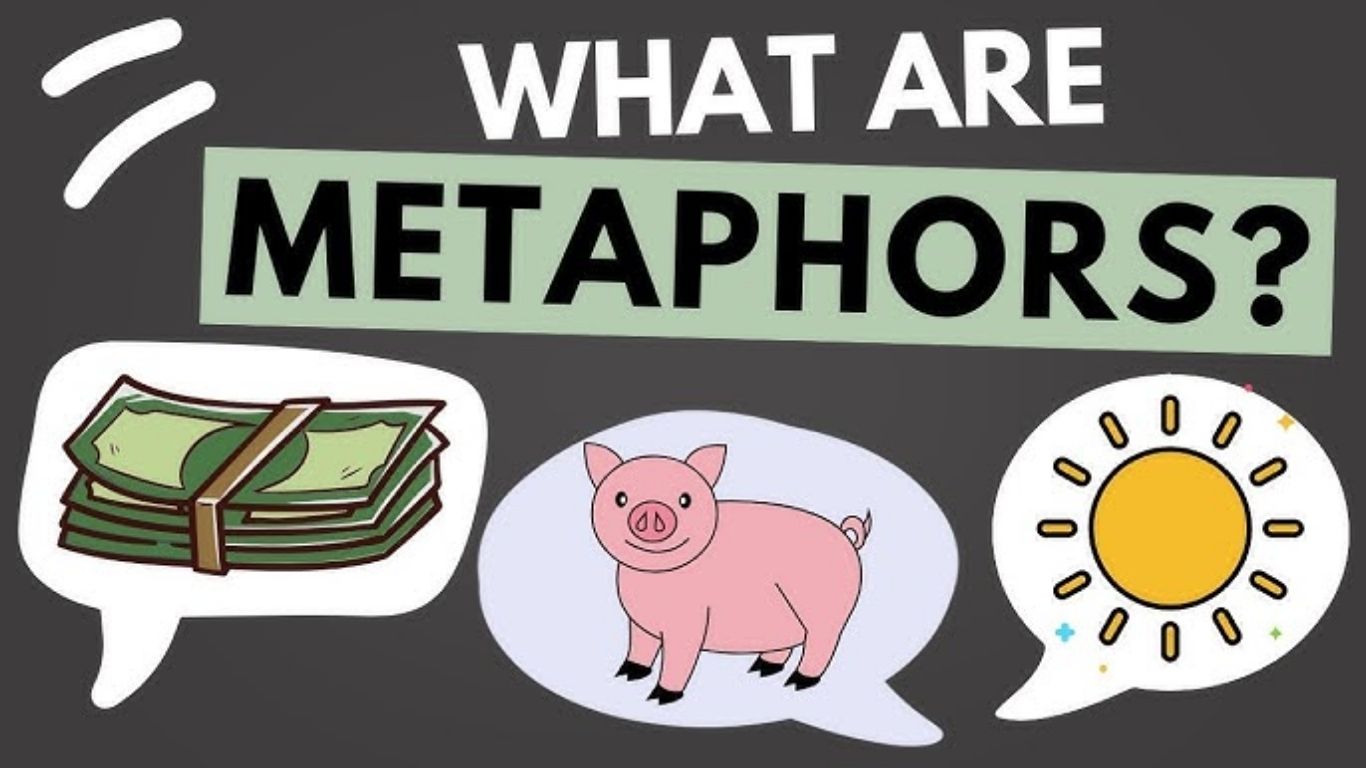
What is a Metaphor? A Clear Definition
A metaphor is a figure of speech that makes a direct comparison between two unrelated things by stating that one is the other. Unlike similes, which use the words “like” or “as” to soften the comparison, metaphors make an implicit, non-literal statement that demands the reader interpret the connection.
Breaking Down the Definition
At its core, a metaphor consists of two essential parts:
- Tenor: The thing or idea being described (the subject)
- Vehicle: The thing or idea used to describe the tenor (the comparison)
For example, in the metaphor “Life is a journey,” life is the tenor and journey is the vehicle. The metaphor suggests that the experiences, obstacles, and destinations we encounter in life are similar to the experiences of traveling.
Metaphor vs. Simile: Understanding the Difference
The distinction between metaphors and similes is crucial for writers:
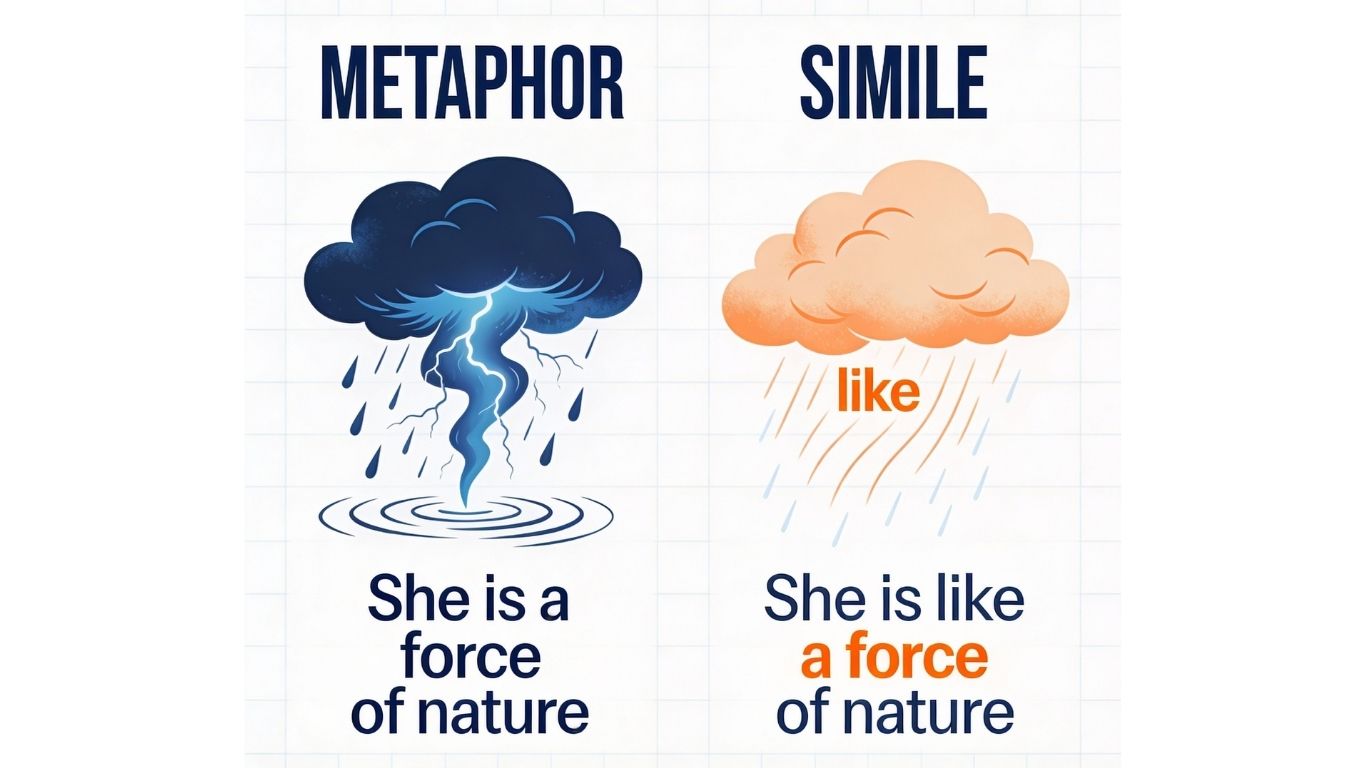
Metaphor (Direct comparison, no “like” or “as”):
- She is a force of nature.
- His words were daggers.
- Time is a thief.
Simile (Explicit comparison using “like” or “as”):
- She is like a force of nature.
- His words were like daggers.
- Time is like a thief.
Why does this matter? Metaphors are more powerful because they require the reader to do interpretive work. Rather than saying “this is similar to that,” metaphors declare “this is that,” creating a more immediate and visceral connection in the reader’s mind. A simile might say your character is “as brave as a lion,” but a metaphor declares “she is a lion,” forcing the reader to consider all the qualities of a lion—courage, strength, dominance—and apply them to the character.
Why Metaphors Matter: The Power of Figurative Language
1. Creating Vivid Imagery
Metaphors engage all five senses, transforming abstract concepts into tangible experiences. Instead of saying “I was sad,” you could write “My heart was a stone sinking to the bottom of the ocean.” Readers can feel the weight, see the darkness, and sense the despair in those words.
Consider this example from John Green’s The Fault in Our Stars:
“The sun was a toddler insistently refusing to go to bed: It was past eight thirty and still light.”
This metaphor doesn’t just describe the sun’s persistence—it creates an entire sensory and emotional landscape. We can almost see the sun’s stubbornness, feel the warm light lingering in the sky, and imagine the frustration of daylight refusing to end.
2. Communicating Complex Ideas Simply
Abstract concepts like love, time, courage, and justice are notoriously difficult to explain. Metaphors bridge this gap by comparing the abstract to something concrete and familiar.
Albert Einstein famously said: “All religions, arts, and sciences are branches of the same tree.”
Rather than writing a philosophical treatise about the interconnectedness of human knowledge, Einstein used a simple metaphor that anyone can visualize. We instantly understand that these disciplines are connected, rooted in something fundamental, yet distinct from one another—just like branches on a tree.
3. Adding Emotional Intensity
Literal language often falls flat when conveying deep emotions. Metaphors amplify emotional resonance:
- Literal: “I love you very much.”
- Metaphorical: “My love for you is a raging fire.”
The metaphor doesn’t just tell us about love—it makes us feel its intensity, chaos, and power.
4. Engaging the Reader’s Imagination
Metaphors invite readers to participate in meaning-making. They’re not handed a complete interpretation; instead, they must consider the comparison and draw their own conclusions. This active engagement makes readers feel invested in the text.
5. Creating Atmosphere and Mood
Metaphors can establish the tone and emotional landscape of an entire passage or scene:
“I finally found escape in the abandoned barn. The torrential rain was rapid machine-gun fire echoing threats of my destruction.”
Here, the metaphor transforms rain into gunfire, creating a sense of danger and siege. The atmosphere shifts from natural weather to a scene of conflict and threat.
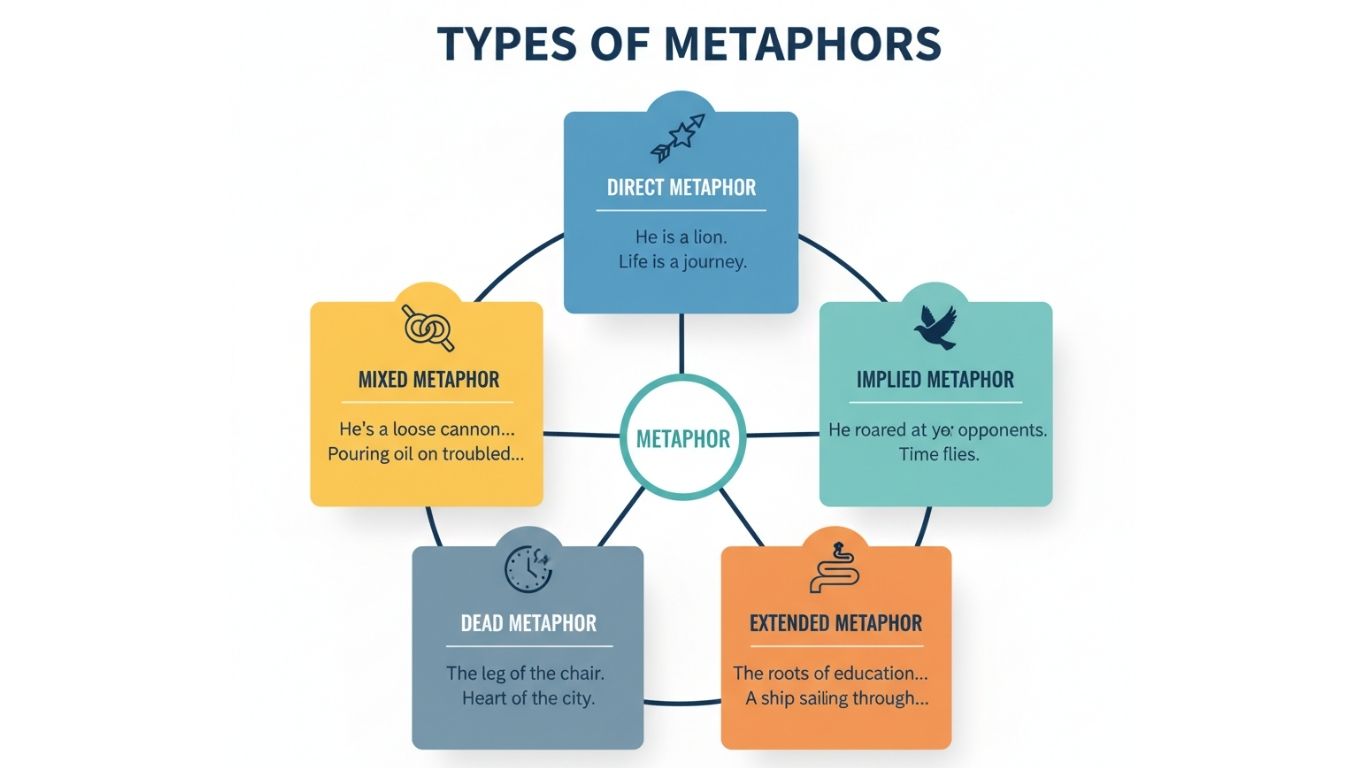
Types of Metaphors: A Comprehensive Guide
1. Direct (Standard) Metaphor
The most common type, a direct metaphor makes a straightforward “is” comparison.
Examples:
- Traffic was a beast today. (describes traffic as wild and untamable)
- That baby is a treasure! (describes the baby as precious and valuable)
- Her voice was silk. (describes the voice as smooth and luxurious)
- Work today was a nightmare. (describes work as distressing and disorienting)
2. Implied Metaphor
An implied metaphor doesn’t explicitly name the comparison—instead, it suggests the connection through action verbs or descriptive language. The reader must infer what’s being compared.
Examples:
- She hissed her warning at him. (implies she is a snake—dangerous and threatening)
- The final scene cut me to the bone. (implies the scene is like a knife or blade—sharp and wounding)
- Mr. Alvarez’s bark is worse than his bite. (implies Mr. Alvarez is dog-like—loud but not truly dangerous)
Implied metaphors are sophisticated and poetic, but they require the reader to be attentive and thoughtful.
3. Extended (Sustained) Metaphor
An extended metaphor develops a single comparison over multiple sentences, paragraphs, or even an entire work. Rather than appearing once, the comparison is woven throughout, creating a consistent symbolic framework.
Literary Example – Shakespeare’s Romeo and Juliet:
In this famous passage, Romeo compares Juliet to the sun across multiple lines:
“But soft! What light through yonder window breaks?
It is the east, and Juliet is the sun.
Arise, fair sun, and kill the envious moon,
Who is already sick and pale with grief.
Notice how Shakespeare doesn’t just say “Juliet is the sun” once. He extends the metaphor by having Romeo speak to the sun (Juliet), mention the moon (presumably Rosaline, Romeo’s previous love), and describe the moon as envious and pale. The entire passage is built on the foundation of this single metaphor.
Another Example – Langston Hughes’ “Mother to Son”:
“Life for me ain’t been no crystal stair.”
Hughes uses the extended metaphor of stairs throughout his poem, comparing life to a staircase journey—sometimes smooth, sometimes rough, sometimes dark, but always continuing upward.
4. Dead Metaphor (Cliché)
A dead metaphor is a comparison that has been used so many times that people no longer recognize it as metaphorical. It’s become a cliché—the imagery has lost its original power and freshness.
Common Dead Metaphors:
- Raining cats and dogs (heavy rain)
- Spill the beans (reveal a secret)
- Heart of gold (kind and generous nature)
- Dead end (point of no progress)
- Heart of stone (cold, unfeeling nature)
- Hold your horses (wait patiently)
The problem with dead metaphors is that readers don’t pause to consider them. They’ve become so ingrained in language that they’re understood as having a straightforward meaning. For powerful writing, you want to avoid these tired comparisons and create fresh, original metaphors instead.
5. Mixed Metaphor
A mixed metaphor combines two or more unrelated metaphors, often accidentally, resulting in a confusing or nonsensical statement. While unintentional mixed metaphors are considered writing mistakes, they can sometimes be humorous.
Example of Mixed Metaphor:
“Let’s get all our ducks on the same page.”
This mixes “get our ducks in a row” with “get on the same page.” The result is confusing—you can’t put ducks on a page!
Famous Example – Yogi Berra:
Baseball legend Yogi Berra was known for his humorous mixed metaphors:
“Even Napoleon had his Watergate.”
While technically confused, this statement somehow works by combining two failed historical endeavors.
Unless you’re deliberately aiming for humor, avoid mixing metaphors in your writing.
Real-World Metaphor Examples Across Genres
Literature and Poetry
William Shakespeare – As You Like It:
“All the world’s a stage, and all the men and women merely players. They have their exits and their entrances, and one man in his time plays many parts.”
This extended metaphor compares life to a theatrical performance, suggesting that we all play different roles throughout our lives, appearing and disappearing from the stage like actors.
Amy Tan – The Joy Luck Club:
“In her hands, I always became the pawn. I could only run away. And she was the queen, able to move in all directions, relentless in her pursuit, always able to find my weakest spots.”
Tan uses chess pieces (pawn and queen) to describe the power dynamic in a relationship, showing how one person is constrained while the other has freedom and power.
Kate Chopin – The Storm:
“Her mouth was a fountain of delight.”
This metaphor creates sensory imagery, suggesting abundance, refreshment, and pleasure.
F. Scott Fitzgerald – The Great Gatsby:
“The frosted wedding cake of the ceiling”
Fitzgerald uses this visual metaphor to describe an ornate ceiling, evoking luxury, delicacy, and decoration.
Khaled Hosseini – The Kite Runner:
“Behind him, sitting on piles of scrap and rubble, was the blue kite. My key to Baba’s heart.”
The blue kite becomes a metaphor for redemption and the path to paternal love.
Music and Popular Culture
Metaphors appear everywhere in music, often encapsulating entire emotional narratives:
- Tom Cochrane: “Life is a highway / I wanna ride it all night long” (life as a journey with freedom)
- Katy Perry: “Baby you’re a firework!” (person as explosive beauty and power)
- U2: “Love is a temple, Love a higher law” (love as spiritual and sacred)
- Stevie Wonder: “You are the sunshine of my life” (romantic partner as light and warmth)
- Taylor Swift: “Darling, I’m a nightmare dressed like a daydream” (self as beautiful but dangerous)
Speeches and Historical Rhetoric
Some of history’s most memorable moments were shaped by powerful metaphors:
Dr. Martin Luther King Jr. – “I Have A Dream”:
“But we refuse to believe that the bank of justice is bankrupt. We refuse to believe that there are insufficient funds in the great vaults of opportunity of this nation.”
King transforms justice into a financial institution, making the abstract concept of civil rights concrete and urgent. He’s saying that America has the moral and economic resources to grant equality—it’s a matter of choice, not scarcity.
Winston Churchill:
“From Stettin in the Baltic to Trieste in the Adriatic, an iron curtain has descended across the continent.”
This metaphor of an “iron curtain” captured the Cold War division between Eastern and Western Europe. The image was so powerful that it became the defining phrase of an entire historical era.
Franklin D. Roosevelt:
“I assume unhesitatingly the leadership of this great army of our people dedicated to a disciplined attack upon our common problems.”
Roosevelt uses military metaphors to frame the Great Depression as a war that Americans must fight together, uniting the nation against a common enemy.
Advertising and Marketing
Metaphors are essential in marketing because they tap into emotions and create memorable brand associations:
- Budweiser: “King of Beers” (superiority and dominance)
- Chevrolet: “The Heartbeat of America” (central to American identity and vitality)
- Exxon Oil: “Put a Tiger in Your Tank” (power, energy, and performance)
- Disney: “Experience the Magic” (wonder, transformation, and escapism)
Everyday Conversation
Metaphors aren’t limited to literature and formal writing—they permeate daily speech:
- “That comment was a knife in my back.” (betrayal)
- “He’s drowning in debt.” (overwhelmed by financial obligation)
- “She’s on fire today!” (performing exceptionally well)
- “My mind is a blank slate.” (complete emptiness of thought)
- “Time is a thief.” (time steals moments from us)
How to Use Metaphors Effectively in Your Writing
1. Use Metaphors Sparingly
While metaphors are powerful, overusing them dilutes their impact. If every sentence contains a metaphor, readers become fatigued and lose the ability to appreciate individual comparisons.
Poor example (overuse):
“Sarah danced through the room, her laughter a river of gold cascading down mountains of joy. Her smile was a lighthouse in the darkness of despair. Her eyes were diamonds glittering with the fire of passion.”
Better example (strategic use):
“Sarah danced through the room, her laughter a river of gold. Everyone around her seemed to brighten, drawn to her warmth.”
By using one strong metaphor and supporting it with literal description, you create a more powerful effect.
2. Connect the Metaphor to Your Theme
The most effective metaphors aren’t random—they reinforce your message and theme. Choose comparisons that echo and deepen your central idea.
Example:
If your story is about someone breaking free from constraints, use metaphors related to escape, flight, and liberation:
- “She shed her chains like a snake shedding its skin.”
- “Freedom tasted like fresh air after years underground.”
- “He soared on wings he didn’t know he had.”
These metaphors work together to create a coherent emotional landscape.
3. Avoid Mixed Metaphors
Keep your comparisons consistent. Mixing unrelated metaphors confuses readers:
Confusing:
“We need to dive headfirst into this project and keep our eyes on the prize.”
(Diving suggests one thing; keeping eyes on a prize suggests another)
Better:
“We need to dive headfirst into this project without losing sight of our goal.”
4. Be Original and Avoid Clichés
Dead metaphors make your writing feel tired and unoriginal. Challenge yourself to find fresh comparisons.
Clichéd:
“Her love was a rose”
Original:
“Her love was a wildfire—unpredictable, consuming, and impossible to contain”
To avoid clichés:
- Brainstorm multiple options before settling on the first metaphor that comes to mind
- Ask yourself: “Have I heard this comparison before?”
- Consider unexpected comparisons that reveal something new about your subject
5. Make Sure the Metaphor Fits Your Audience and Tone
A metaphor that works in lyrical poetry might not work in a technical manual. Consider your audience’s expectations and your writing’s formality level.
Formal/Technical Writing:
Keep metaphors minimal and clear. They should clarify, not distract.
“The immune system is the body’s security team, patrolling constantly for intruders.”
Creative Writing:
Metaphors can be more poetic and emotionally complex.
“Her heart was a bird trapped in a cage of ribs, beating frantically against the prison of her own body.”
6. Use Metaphors to Show, Not Tell
One of writing’s cardinal rules is “show, don’t tell.” Metaphors are perfect vehicles for this principle.
Tell:
“She was very sad.”
Show with Metaphor:
“Sadness was a stone in her chest, heavy enough to pull her underwater.”
The metaphor doesn’t just state the emotion; it lets readers experience it.
7. Ensure Clarity
While metaphors should make readers think, they shouldn’t confuse them. The comparison should be understandable, even if it requires a moment of reflection.
Unclear Metaphor:
“His words were the purple of forgotten Tuesdays.”
(The connection between words and purple Tuesdays is too abstract)
Clear Metaphor:
“His words were broken glass, beautiful but dangerous.”
(The connection is immediately comprehensible: words that are lovely but can hurt)
The Psychology Behind Why Metaphors Work
Understanding why metaphors are so effective can help you use them more consciously in your writing.
Cognitive Connection
According to cognitive science research, metaphors aren’t just poetic devices—they’re how our brains actually understand abstract concepts. Cognitive linguist George Lakoff argues that we understand one domain of experience (the abstract) in terms of another domain (the concrete).
For example:
- We understand time in terms of space (“we’re approaching the deadline,” “looking forward to next year”)
- We understand emotions in terms of physical sensations (“I’m feeling down,” “hurt by your words”)
- We understand relationships in terms of journeys (“we’ve hit a rough patch,” “moving forward together”)
This is why metaphors resonate so deeply—they tap into how we naturally think.
Emotional Resonance
Metaphors activate multiple parts of our brains simultaneously. When we encounter a metaphor, we don’t just process the literal words; we activate sensory, emotional, and conceptual areas of our brain. This multi-layered activation creates a richer, more memorable experience than literal language alone.
Universal Understanding
Many metaphors transcend cultural and linguistic boundaries because they’re rooted in shared human experiences: light vs. darkness, journeys, growth, death, birth, seasons, and elements.
This is why certain metaphors appear across cultures:
- Light = knowledge, goodness, hope
- Darkness = ignorance, evil, despair
- Winter = death, hardship
- Spring = rebirth, renewal
- Water = life, purification, emotion
Common Mistakes to Avoid
1. Unclear Metaphors
A metaphor should enhance understanding, not obscure it. If readers must work too hard to understand your metaphor, it’s failed its purpose.
2. Extended Metaphors That Go Too Far
While extended metaphors are powerful, they can become overwrought if you keep extending them beyond the point of clarity.
3. Metaphors That Don’t Fit the Tone
A whimsical metaphor in a serious piece can seem flippant; an overly serious metaphor in light writing can seem pretentious.
4. Metaphors Based on False Comparisons
Ensure the comparison actually works. A metaphor that doesn’t hold up under scrutiny will weaken your writing.
Weak: “Her knowledge was a book” (too literal and doesn’t capture the depth of understanding)
Stronger: “Her knowledge was a labyrinth—deep, interconnected, and easy to get lost in”
5. Overuse of Metaphorical Language
Remember: less is more. The most powerful metaphors stand out precisely because they’re surrounded by clear, direct language.
Practical Exercises: Creating Your Own Metaphors
Exercise 1: The Comparison List
Choose an abstract concept or emotion (love, anger, loneliness, joy). Brainstorm 10 concrete things it could be compared to:
Example – Loneliness:
- An empty room
- A phone that never rings
- A desert
- A closed door
- Silence after music stops
- A single star in the night sky
- An unmade bed
- Dead flowers
- An echo with no one to hear it
- A ghost in your own life
Now write metaphors using these comparisons:
- “Loneliness is an empty room where you can hear every footstep.”
- “Loneliness is a ghost in your own life, watching but never being seen.”
Exercise 2: The Sensory Approach
Choose a concept and describe it using all five senses as metaphors:
Fear:
- Sight: Fear is the darkness before dawn
- Sound: Fear is the deafening silence before a storm
- Touch: Fear is ice in your veins
- Taste: Fear is a bitter pill
- Smell: Fear is the metallic scent of danger
Exercise 3: The Unexpected Comparison
List three unlikely things to compare to your concept:
- What if love were a war? A storm? A library?
- What if failure were a teacher? A bridge? A garden?
The more unexpected the comparison, the more original your metaphor.
Exercise 4: The Extended Metaphor
Write a short paragraph (5-7 sentences) using a single extended metaphor. Develop it with specific details that reinforce the comparison:
Example – Life as a Garden:
“Life is a garden you tend from birth until death. Some seasons bring abundant growth; others are plagued by drought and weeds. You can’t control the weather, but you can decide what you’ll plant and how you’ll care for it. Some flowers bloom quickly and fade just as fast, while others take years to reach their full potential. The best gardens aren’t the ones without weeds—they’re the ones where a gardener keeps returning, season after season, to nurture what matters.”
Conclusion: The Enduring Power of Metaphors
Metaphors are far more than decorative literary devices. They’re fundamental to how we understand the world, communicate complex ideas, and connect emotionally with others. From Shakespeare’s timeless sonnets to contemporary advertising, from political speeches that shaped history to the daily language we use to describe our lives, metaphors shape how we perceive and communicate reality.
The difference between ordinary writing and extraordinary writing often comes down to one thing: the power of metaphors. When you choose a fresh, vivid, apt metaphor, you’re not just describing something—you’re inviting readers into a new way of seeing.
Whether you’re writing fiction, nonfiction, marketing copy, or poetry, the principles remain the same: use metaphors strategically to clarify complex ideas, create vivid imagery, deepen emotional resonance, and engage your reader’s imagination. Avoid clichés, ensure clarity, and remember that sometimes the most powerful writing isn’t metaphorical at all—it’s the precise balance of metaphor and direct language.
Now that you understand what metaphors are and how to use them, challenge yourself to find fresh comparisons in your next writing project. Notice the metaphors others use. Think about why they work. And most importantly, keep your readers in mind as you craft your own figurative language.
Because in the end, powerful writing isn’t about using fancy language—it’s about making your readers see what you see, feel what you feel, and understand what you understand. And there’s no better tool for that job than a well-crafted metaphor.
Key Takeaways
- A metaphor is a direct comparison between two unlike things that states one thing is another
- Metaphors differ from similes in that they don’t use “like” or “as”—they make implicit rather than explicit comparisons
- Types of metaphors include direct, implied, extended, dead, and mixed metaphors
- Metaphors work because they engage multiple parts of our brains and tap into how we naturally understand abstract concepts
- Effective metaphors are original, purposeful, clear, and used sparingly
- Metaphors appear everywhere—in literature, music, advertising, speeches, and everyday conversation
- Creating strong metaphors requires connecting concrete comparisons to abstract concepts in unexpected but meaningful ways
- Metaphors elevate writing by creating vivid imagery, communicating complex ideas simply, adding emotional intensity, and engaging readers’ imaginations