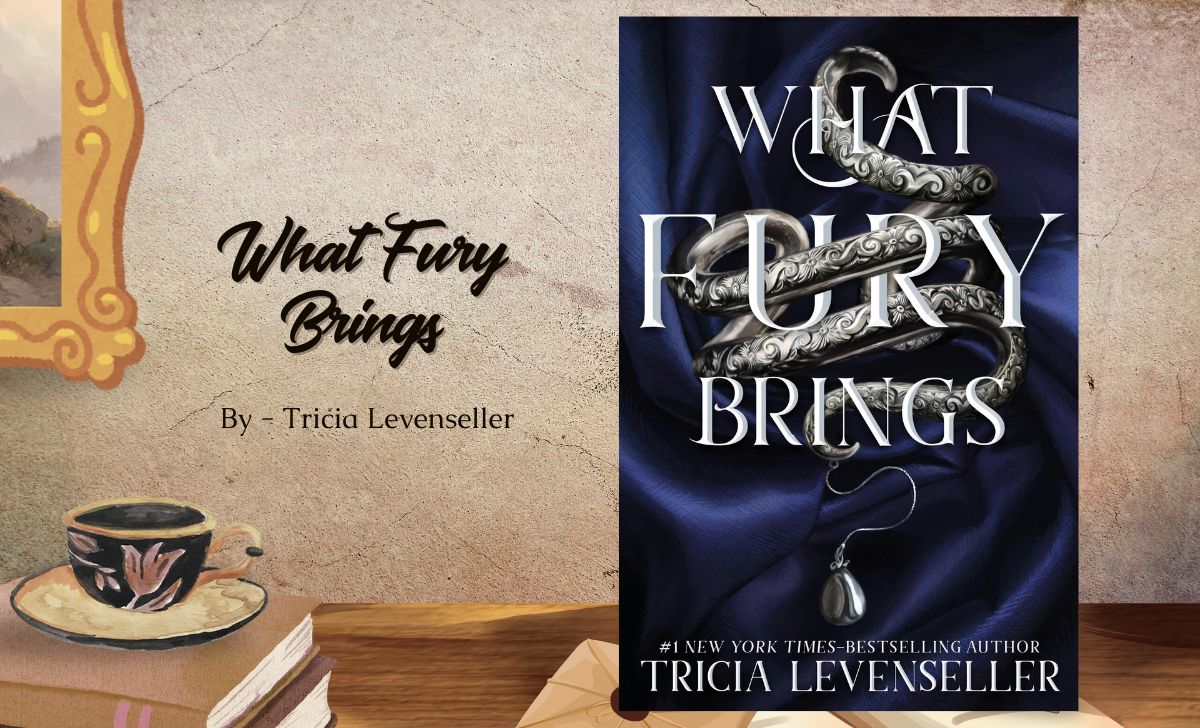
Tricia Levenseller’s What Fury Brings arrives as a brash, unapologetic romp through a matriarchal world where rage and power are currency. If you go in expecting a subtle romance, you’ll be surprised; if you expect combustible tension, political scheming, and bold role-reversal, you’ll likely find what you’re looking for. This is Levenseller’s jump to adult romantasy, and she throws everything she’s good at—snappy voice, physical action, and bawdy humor—into a story that questions power, consent, and the price of the throne.
Short Plot Overview
Olerra Corasene is a warrior and heir-apparent in Amarra, a society where women rule and possess a mystical ability—called the Goddess’s Gift—that lets them bend men to their will. To secure her claim to the throne, she plans an audacious gambit: kidnap and “train” a powerful husband who will make her unbeatable in court and on the battlefield.
Her plan goes sideways when she abducts the wrong man—Sanos, a fierce and proud prince whose temper and will make him resistant to the kind of domination she expects. As Olerra tries to bend Sanos to her needs, political rivals circle, secrets surface, and both captor and captive discover how much of their identities are shaped by a system that treats love like a tool. The book mixes battlefield strategy, palace intrigue, and an explicit enemies-to-lovers arc that’s as much about bargaining for power as it is about bargaining for intimacy.

Worldbuilding and Themes
Levenseller gives us a fully realized matriarchal society—Amarra—where social structures are inverted in surprising and often uncomfortable ways. The worldbuilding is vivid: you can feel the militarized cadence of Olerra’s life, the cultural rituals around marriage and authority, and the blunt reality of a society that weaponizes desire.
The point is not simply role-reversal for novelty; Levenseller uses the inversion to explore how systems of dominance corrupt and how trauma can calcify into entitlement or fear. At its best, the book interrogates whether reversing who holds power actually fixes injustice or merely flips the faces who inflict it.
Characters: Olerra and Sanos
Olerra is written with a confident, often amusing voice: a battle-scarred, blunt woman who trusts her sword more than her heart. She’s not designed to be purely likable—her flaws are the point—and Levenseller spends time making Olerra responsible for her ambition and the harm she’s willing to inflict to achieve it.
Sanos is a useful foil: stubborn, hot-headed, and not easily cowed. The book frames much of its sexual and emotional tension around consent, powerplay, and transformation—both characters confront how much of themselves they’ve sacrificed to the expectations of their cultures. Many readers will find the characters complex and combustible; others may bristle at scenes that push the boundaries of comfort.
Pacing, Tone, and Writing Style
Levenseller writes fast and clipped sentences when in action; she slows into darker introspection where the stakes are emotional or moral. The pace rarely stalls—the plot keeps moving with skirmishes, political plotting, and intimate scenes that are explicit and central to the story.
Tonally, the book sits somewhere between bawdy humor and grim fantasy: one moment it’s raucous, the next it’s severe. That tonal flip can be exhilarating, but it can also feel uneven for readers who prefer a steadier mood. Levenseller leans into adult content with relish, treating sex as a narrative engine rather than a decorative element.
Romance, Consent, and the “Kidnapped Husband” Trope
The kidnapped-husband trope is central here, and Levenseller does not sanitize its rough edges. The romance hinges on power negotiations: physical dominance, emotional vulnerability, and shifting control.
For readers who enjoy erotically charged power dynamics and tension as part of character growth, the book delivers. For others—especially those sensitive to coercion or ambiguous consent—the novel will be challenging. While the book seeks to interrogate power structures, it simultaneously revels in erotic dominance, a balancing act that will split readers.
Consider this a fair warning: expect explicit sexual content that’s woven into the plot, not isolated from it.
Strengths and Weaknesses
Strengths:
- Bold premise and imaginative worldbuilding that flips usual fantasy power dynamics.
- Snappy, vivid prose in action and a protagonist with agency (and messy flaws).
- Political intrigue layered beneath a spice-forward romance; the stakes feel real.
Weaknesses:
- Tonal unevenness—juggling brutal themes and flippant humor can be jarring.
- The romance’s power-play elements may not sit comfortably with all readers; at times the book flirts with glorifying coercion even as it tries to critique dominance.
Who Should Read This Book?
Pick up What Fury Brings if you enjoy romantasy that is explicit, morally thorny, and unafraid to court controversy. If you like stories that invert power dynamics—think matriarchal courts, morally ambiguous leads, and spicy scenes that matter to the plot—this will probably satisfy.
If you prefer romances where consent is always light, unambiguous, and cozy, approach with caution.
Final Verdict
Tricia Levenseller’s adult debut is audacious and frequently effective: it’s sharp in worldbuilding, vivid in action, and brave in its refusal to make its heroine comfortably virtuous. But it’s also deliberately provocative in ways that will make many readers uncomfortable, sometimes in service of critique and sometimes in service of spectacle.
Ultimately, What Fury Brings is a book that wants to be argued with. It’s built to generate hot takes, heated discussions, and mixed reactions—and for many readers, that’s part of the thrill.