The global book industry in 2026 is undergoing a significant transformation, shifting away from traditional mass production toward a model built on precision manufacturing and flexible distribution. At the center of this change is print-on-demand technology, which has reshaped independent publishing from a fringe alternative into a sophisticated, data-driven segment of the digital economy. For modern writers entering the marketplace, Understanding Print-on-Demand (POD) Economics has become a fundamental skill rather than a niche concern.
As the global print-on-demand market approaches an estimated value between USD 11 billion and USD 12.96 billion in 2026—with projections suggesting expansion beyond USD 118 billion by 2035—the financial stakes for independent creators are rising rapidly. This remarkable growth, driven by a compound annual growth rate (CAGR) of roughly 22% to 26%, reflects a broader shift toward zero-inventory fulfillment models and highly personalized consumer products.
Within this evolving ecosystem, authors who grasp the financial mechanics behind the system gain a significant competitive advantage. From base printing costs and trim-size decisions to wholesale discounts and distribution fees, each variable directly shapes Profit Margins for Self-Publishers. In a market that has moved beyond its early “gold rush” phase into a more mature and professional environment, mastering these economic principles is essential for building a sustainable and scalable self-publishing career.
The Macroeconomic Framework of Print-on-Demand in 2026
The trajectory of the POD market in 2026 is anchored by technological infrastructure, particularly in North America. The region holds roughly 37% of global market share, supported by strong digital commerce infrastructure, high consumer purchasing power, and reliable shipping logistics.
However, the fastest growth is emerging elsewhere.
The Asia-Pacific region is projected to expand at a CAGR of around 28% through 2035, driven by:
- Rapid smartphone penetration
- Growing middle-class consumer spending
- Expanding digital marketplaces for books and educational content
This shift indicates that while North America remains the technological hub of POD operations, the next wave of readership growth will likely originate in emerging digital economies.
Global Market Projections and Segment Growth
The economic architecture of POD is increasingly software-driven. Digital platforms automate the journey from manuscript file to finished physical book.
By 2026, software platforms account for about 58% of the market, underscoring the importance of systems that handle:
- automated formatting pipelines
- AI-assisted file error detection
- consumer trend analytics
- real-time printing and fulfillment integration
Market Metrics Snapshot
| Market Metric | 2025 Value | 2026 Projection | 2033–2035 Forecast |
|---|---|---|---|
| Global Market Size | USD 13 Billion | USD 11–12.96 Billion | USD 58–118.85 Billion |
| Software Market Share | ~55% | 58.0% | Dominant with integrated AI |
| North America Share | 36% | 37.0% | Steady lead |
| Asia-Pacific Growth | 26% CAGR | 28.0% CAGR | Fastest expansion |
Another driver behind this growth is sustainability awareness. Studies indicate that:
- 46% of consumers intentionally buy sustainable products
- 80% are willing to pay more for environmentally responsible goods
Print-on-demand naturally aligns with this trend because it eliminates the overproduction waste common in traditional offset printing, where unsold inventory frequently ends up discarded.
The Fundamental Unit Economics of On-Demand Manufacturing
The central advantage of POD lies in risk elimination.
Traditional publishing typically requires printing thousands of copies upfront. If sales underperform, unsold inventory becomes a financial liability.
Print-on-demand removes that risk entirely.
Books are produced only after a customer places an order, creating a pay-as-you-go production model. This allows authors to experiment with:
- multiple genres
- niche audiences
- different formats
—all without risking thousands of dollars in unsold inventory.
Breaking Down the Production Cost Formula
Printing costs are determined by physical characteristics rather than a flat rate. Each design decision affects the final margin.
Key variables include:
Trim Size and Paper Weight
Larger formats (for example, 8.5″ × 11″) require more paper and ink, increasing manufacturing costs.
Paper weight also matters. Authors can choose between:
- Standard paper (50 lb / 74 GSM)
- Premium paper (70 lb / 104 GSM)
Premium paper increases both cost and book thickness.
Ink Type
Ink choice has the biggest financial impact.
- Black and white printing remains the most economical.
- Color printing is charged across the entire book if even a single page contains color.
Binding and Cover Finish
Hardcovers significantly increase cost.
Compared with paperbacks, hardcover production typically adds USD 5 to USD 8 to printing costs.
POD Printing Cost Formula
The general production formula follows:Total Printing Cost=Fixed Base Cost+(Page Count×Per-Page Rate)
For a standard 6″ × 9″ paperback on Amazon KDP, the typical pricing structure is:
- Fixed base cost: USD 1.00–2.15
- Per-page rate: USD 0.012–0.015
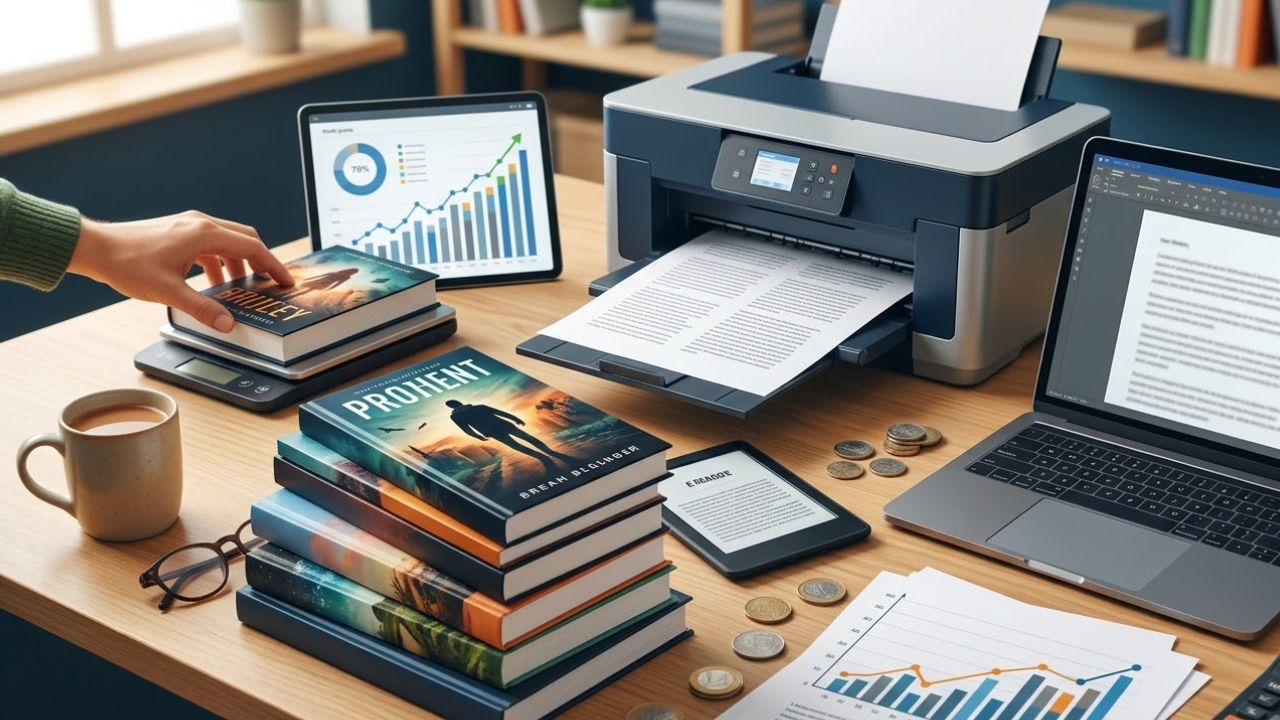
Comparative Printing Costs for a Standard Novel (2026)
For a 250-page black-and-white paperback (5″ × 8″), approximate production costs across platforms look like this:
| Platform | Fixed Base Cost | Per-Page Cost | Total Manufacturing Cost |
|---|---|---|---|
| Amazon KDP | USD 2.15 | USD 0.012 | ~$5.15 |
| IngramSpark | USD 2.25 | USD 0.015 | ~$6.00 |
| Draft2Digital | USD 1.34 | USD 0.0147 | ~$5.02 |
| Lulu Direct | USD 1.50 | USD 0.016 | ~$5.50 |
These numbers reflect raw printing cost only. Retail sales introduce additional fees such as wholesale discounts and marketplace cuts.
Platform Economics 1: The Amazon KDP Ecosystem
Amazon KDP remains the primary sales engine for independent authors, accounting for 80–100% of sales for many self-publishers.
Its business model prioritizes direct marketplace sales through Amazon’s storefront.
The 60/40 Royalty Model
When a print book sells on Amazon:
- The author receives 60% of the list price
- Printing costs are deducted from that amount.
Amazon Royalty=(List Price×0.60)−Printing Cost
Example:
- List price: $14.99
- Printing cost: $4.85
Royalty:(14.99×0.60)−4.85=4.14
Author profit: $4.14 per sale
Expanded Distribution
If the author enables Expanded Distribution, royalties drop to 40%.Expanded Royalty=(List Price×0.40)−Printing Cost
Using the same example:(14.99×0.40)−4.85=1.15
Profit drops dramatically—from $4.14 to $1.15.
Because of this difference, many experienced self-publishers disable Expanded Distribution and instead rely on IngramSpark for wider retail access.
The Kindle Unlimited Factor
While this analysis centers on print economics, digital income often funds print publishing.
In Kindle Unlimited (KU), authors earn based on pages read.
Average payout in 2026:
- ~$0.0045 per page
For high-volume genres like romance, fantasy, or science fiction, KU revenue frequently provides the capital needed to finance print editions.
Platform Economics 2: IngramSpark and the Wholesale Model
If Amazon functions as the storefront, IngramSpark operates as the global warehouse.
The Ingram network supplies:
- bookstores
- libraries
- educational institutions
worldwide.
The Wholesale Discount System
IngramSpark allows authors to set a wholesale discount between 30% and 55%.
The standard bookstore model requires 55%.
Typical breakdown:
- Bookstore share: 40%
- Ingram wholesaler share: 15%
Lower discounts increase author profit but make bookstores reluctant to stock the book.
2026 Price Adjustments and Platform Fees
As of February 1, 2026, several changes affected IngramSpark economics:
- Market access fee increased from 1.5% to 1.875%
- Color printing costs rose around 4%
- File revisions after 60 days cost $25
Even small percentage increases compound over thousands of sales.
Platform Economics 3: Aggregators and Direct Sales
Beyond Amazon and Ingram, several platforms offer different strategic advantages.
Draft2Digital
Draft2Digital offers:
- simplified formatting tools
- distribution across hundreds of smaller retailers
Typical print royalty: 45% minus printing costs
Direct-to-Consumer (DTC) Sales
Platforms like Lulu Direct and Bookvault allow authors to sell books directly from their own websites.
This eliminates retail cuts entirely.
| Selling Channel | Typical Margin | Author Earnings on $20 Book |
|---|---|---|
| Amazon KDP | 60% minus print | $7–9 |
| IngramSpark | 45% minus print | $3–4 |
| Lulu Direct | ~80% margin | $11–13 |
| Bookvault | Lowest base cost | $12–14 |
Bookvault’s split-color pricing further reduces costs by charging color ink only on pages that actually use it.
Technical Economics: Ink, Paper, and Quality
Modern POD printing technologies fall into several tiers.
Black and White Printing
Best for:
- novels
- memoirs
- text-heavy nonfiction
Fast and inexpensive.
Standard Color Printing
Suitable for:
- charts
- occasional graphics
Printed on 50 lb white paper.
Premium Color Printing
Used for:
- children’s books
- illustrated titles
Printed on 70 lb paper for better saturation.
Ultra-Premium Color
High-end laser printing for:
- photography books
- coffee-table editions.
Paper Weight and Reader Perception
Paper density affects both cost and reader experience.
| Paper Type | Weight (lb) | Density (GSM) | Best Use | Cost Impact |
|---|---|---|---|---|
| Standard White | 50 | 74–90 | Manuals, textbooks | Base price |
| Standard Cream | 50 | 74–90 | Fiction | Base price |
| Premium White | 70 | 104 | Children’s books | +20–40% |
| Coated White | 80 | 118 | Photo books | Premium |
Cream paper remains the preferred option for novels because it reduces eye strain and offers a warmer reading experience.
Hidden Production and Administrative Costs
Many first-time self-publishers underestimate the true cost of producing a professional book.
Editing Costs
For a manuscript of 80,000–90,000 words:
- Developmental editing: $0.03–0.08 per word
- Copy editing: $0.02–0.04 per word
- Proofreading: $0.01–0.025 per word
Total editing expenses typically range between $2,000 and $4,720.
Cover Design
Professional cover design averages around $930, though experienced designers may charge $1,500 or more.
Budget alternatives include premade covers costing $100–300, though these sometimes struggle to match genre expectations.
ISBN and Publishing Infrastructure
Authors who want their own publishing imprint must purchase ISBNs.
Typical pricing:
- Single ISBN: $125
- Block of ten: $295
Additional startup costs such as copyright registration and website creation often add $500–$1,500.
When to Transition from POD to Offset Printing
As book sales increase, POD’s higher per-unit costs eventually become inefficient.
Offset printing offers far lower unit prices but requires large upfront investment.
Break-Even Analysis
Crossover Quantity=POD Unit Price−Offset Unit PriceTotal Offset Setup Costs
Example scenario:
- POD cost per book: $10
- Offset cost per book: $2.50
- Setup cost: $2,500
10−2.52500=333
If an author can sell more than 333 copies, offset printing becomes more profitable.
POD vs Offset Printing Comparison
| Factor | Print-on-Demand | Offset Printing |
|---|---|---|
| Upfront Cost | Zero | $2,000–$10,000+ |
| Per-Unit Cost | High | Low |
| Speed | 2–5 days | 4–8 weeks |
| Quality | Variable | Consistent |
| Storage | None | Required |
Offset printing is often used once a book demonstrates stable demand.
Logistics and Operational Efficiency
Shipping costs increasingly affect real profit margins.
For author copies:Landed Unit Cost=Quantity(Print Cost×Qty)+Shipping+Taxes
Single-copy shipping may exceed $10, while bulk orders often reduce shipping to about $1 per book.
At live events, selling a $15 book with a $6 landed cost can generate roughly $9 profit per copy, outperforming most retail channels.
Case Studies: Strategic Success in 2026
Successful authors increasingly treat books as data-driven intellectual property assets.
One notable example describes an author publishing 148 books in 12 months, generating:
- $150,000 revenue
- $100,000 profit after expenses
The strategy involved:
- testing multiple niches
- analyzing demand
- upgrading successful titles with premium editing and design.

Multi-Format Revenue Strategy
Many authors now launch books in multiple formats simultaneously.
| Format | List Price | Production Cost | Estimated Profit |
|---|---|---|---|
| Ebook | $4.99 | $0 | $3.49 |
| Paperback | $14.99 | $4.85 | $4.14 |
| Hardcover | $24.99 | $9.20 | $5.79 |
| Audiobook | $19.95 | $0 | $8–12 |
| Premium Offset Edition | $45 | $12 | $33 |
Premium editions capture collectors and dedicated fans.
Macroeconomic Risks in 2026
Global inflation continues to affect publishing economics.
Estimated inflation: 2.8–3.5% annually
Key impacts include:
- higher paper prices
- rising printing costs
- increased shipping expenses.
Paper Cost Transmission
Raw material price increases often reach consumers 6–12 months later, which explains the recent price increases across POD platforms.
Authors who fail to adjust list prices risk shrinking royalties.
Consumer Spending Pressures
With interest rates still influencing household budgets, discretionary spending remains cautious.
As a result, successful authors rely on:
- targeted advertising
- reader data analytics
- niche marketing.
Conclusion: The Business of Professional Self-Publishing
Self-publishing profitability in 2026 depends on treating writing as both art and enterprise.
Successful authors typically follow several strategic principles:
- Select platforms strategically, combining Amazon KDP with IngramSpark distribution.
- Control production specifications to maintain strong profit margins.
- Invest in professional editing and cover design to maximize sales conversion.
- Track hidden costs carefully to avoid profit erosion.
- Transition to offset printing once a book reaches stable demand.
The global POD market continues to expand rapidly, moving toward a projected $118 billion valuation by the mid-2030s. For authors who master the economic structure behind the technology, print-on-demand remains one of the most powerful tools ever created for independent publishing.
In the modern publishing economy, success no longer depends solely on storytelling talent. It depends on understanding the economics of the story’s journey from file to finished book—and using that knowledge to turn creativity into a sustainable business.