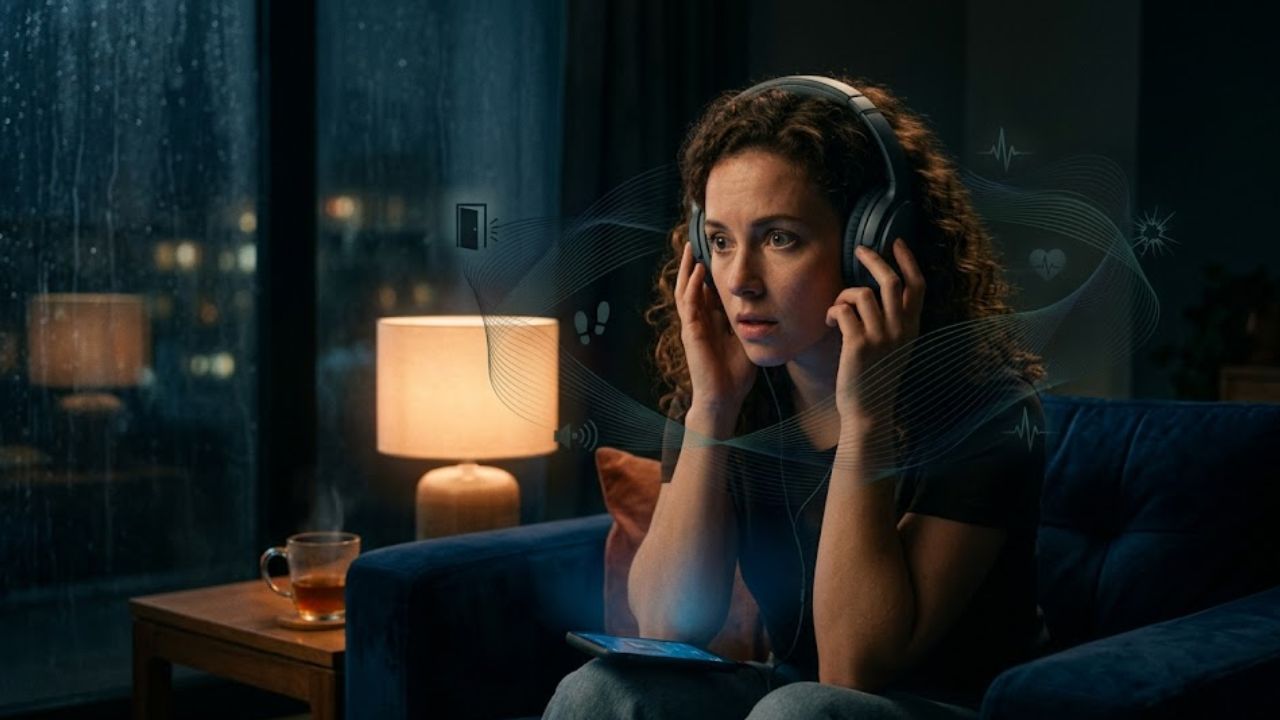
There’s a moment in a great thriller when the world outside disappears. The traffic noise fades. The phone goes ignored. Even breathing slows. That’s the magic of immersion — and for decades, it was something only prose could deliver, word by careful word. But the audiobook industry has quietly been engineering something new: a listening experience so atmospheric, so textured, that it doesn’t just tell a story. It surrounds you with one. Sound effects in audiobooks — once considered a gimmick — have become one of the most debated and transformative tools in modern thriller production. And the conversation they’re sparking goes straight to the heart of what storytelling is, and what it can become.
The Evolution of the Audiobook: From Reading Aloud to Sonic Architecture
Audiobooks began with a simple promise: a human voice reading a book. That was enough — and for years, it was everything. A skilled narrator could carry a 400-page novel on the strength of tone alone. Think of Frank Muller’s performance of Stephen King’s It, or Scott Brick’s razor-sharp delivery across dozens of thriller titles. Voice, pacing, and silence were the only instruments.
But as the industry matured — and as listeners grew more sophisticated — producers began experimenting with what lay beyond narration. Background ambience crept in quietly: the low hum of a fluorescent office, rain against glass, the murmur of a crowded bar. At first it was subtle enough that most listeners couldn’t say for certain whether it was there at all.
Then came full production — and everything changed.
Productions like Locke & Key and the BBC’s dramatized audio adaptations began introducing orchestrated soundscapes: footsteps on gravel, the creak of a door, a gunshot that made listeners instinctively pull out their earbuds. The line between audiobook and audio drama began to blur. And nowhere was that blur more potent — or more contested — than in the thriller genre.
Why Thrillers Are the Perfect Testing Ground
Not every genre benefits equally from sonic enhancement. A literary novel exploring grief or a character study set in a quiet village might feel invaded by added sound. But thrillers? Thrillers were practically designed for it.
The thriller genre lives and dies by tension — the tightening of the chest as danger approaches, the hyperawareness of every detail in a high-stakes scene, the way a single sound (a footstep overhead, a phone ringing in a dead house) can collapse a reader’s entire sense of safety. These are auditory experiences by nature. They operate on the same psychological machinery as fear itself.
Consider the mechanics of dread. When we are genuinely afraid, our hearing sharpens. We listen for threats. Sound becomes loaded with meaning. A thriller writer exploits this by making readers “hear” the story — describing sounds with unusual specificity, using silence as punctuation, letting the rhythm of sentences mimic a racing heart.
Sound design in thriller audiobooks doesn’t just complement this tendency; it amplifies it through a direct channel. When a reader imagines a door slamming, the brain processes it abstractly. When a listener hears that slam — timed precisely to the narrative moment — the amygdala responds as if it were real. The distinction matters enormously.

What Sound Design Actually Does to the Brain
The neuroscience here is fascinating and worth understanding, because it explains why this technique lands so differently than critics of “gimmick audio” might expect.
Binaural presence is the starting point. When sound is mixed in stereo or binaural (designed for headphone listening), the brain localizes it spatially. Footsteps behind you sound behind you. A whisper to the left ear arrives to the left. This creates a phenomenon called presence — the subjective sense of being in an environment, rather than observing it from outside. Thriller writers spend thousands of words trying to manufacture this sensation. Sound designers can achieve it in seconds.
Emotional priming is the second mechanism. Music and ambient sound bypass the rational, analytical brain and land directly in the limbic system — the seat of emotion and memory. A low, sub-bass rumble heard in early childhood correlates with danger across almost all cultures. A minor key melody triggers melancholy before the conscious mind processes a single note. Thriller sound designers exploit this ruthlessly: the barely perceptible drone under a chase sequence doesn’t just accompany tension, it generates it in the body before the narrative has even escalated.
Cognitive load reduction is the third, and perhaps most underappreciated, effect. Reading — even listening — requires the brain to construct an imaginary world from raw symbolic information. Sound effects hand the brain some of that construction work pre-done. When a listener hears rain, they don’t need to build rain from the words “the rain fell heavily.” The scene is already there. This frees cognitive bandwidth for what matters in a thriller: tracking plot, anticipating danger, absorbing character.
The cumulative effect? Deeper, longer, more emotionally intense immersion.
Case Studies: When Sound Design Elevates the Thriller
The Chain by Adrian McKinty — Audible Production
Adrian McKinty’s bestselling thriller about a mother pulled into a horrifying kidnapping chain was already a propulsive read. But Audible’s production added a layer that turned it into an experience. The sound design — metallic, industrial, cold — ran beneath the narration during the most harrowing sequences. The sound of chains (subtle, almost subliminal) appeared at key psychological moments, linking the sonic and the thematic in a way that print could never achieve.
Listeners who reviewed the two versions consistently described the audio production as “harder to shake,” noting that the images stayed with them longer. This is not anecdotal fluff; it maps directly to what we know about emotionally charged memories and sound-linked encoding.
BBC Audio Drama — And Then There Were None
Agatha Christie’s classic was given a full-cast, full-sound-design treatment by the BBC that redefined what the source material was capable of. The isolated island — so important to the novel’s claustrophobia — was heard: wind, crashing sea, the echoing emptiness of a large house. Each death was scored not with melodrama, but with restraint. A single sustained note. Silence. Then the sound of water.
Critics who had read the novel multiple times reported finding the audio production genuinely unsettling in a way the written text no longer was, simply because they could no longer choose the pace of revelation. Sound pinned them to the moment.
Dracula — Dedrm Productions Full-Cast Audio
The full-cast audio version of Bram Stoker’s Dracula — itself an epistolary thriller of the first order — is perhaps the definitive argument for immersive audio in horror-adjacent fiction. Multiple voice actors, 19th-century ambient sound, and a score that understood restraint combined to create a production that routinely tops “best audiobook” lists decades after its release. The sound of a ship’s log being read against actual sea sounds. The near-silence of Jonathan Harker’s imprisonment. These are not decorations. They are architecture.
The Narrator’s Relationship with Sound Design
Here’s where the craft conversation gets genuinely complex. A narrator isn’t just a voice — they’re a performance. They make choices about pace, breath, emphasis, silence. They embody the prose. And sound effects, if handled poorly, can work against this performance rather than with it.
The most common failure mode is what producers call “double-doing” — adding a door-slam sound effect right as the narrator reads “the door slammed.” This creates redundancy, and worse, it signals to the listener that they are being managed, that the emotional beat is being underlined with a marker they didn’t ask for. It breaks immersion precisely by trying too hard to create it.
The best sound designers understand that their work must sit underneath the narrator, not beside them or ahead of them. Sound should prime the atmosphere before the narrative arrives, or linger after it moves on — but it should never interrupt the voice’s dominion over the scene.
Skilled thriller narrators have spoken openly about the adjustment required when working in soundscaped productions. Simon Vance, one of the most decorated audiobook narrators in the world, has noted that narrating for layered productions requires a different calibration of stillness — you trust the environment to carry atmospheric weight you might otherwise have supplied through pacing alone. It’s a collaboration, and like all collaborations, it demands surrender as much as skill.
The Purist Argument — And Why It Deserves Respect
Not everyone is convinced, and the skeptics make arguments worth taking seriously.
The strongest objection is philosophical: literature, at its core, is a partnership between writer and reader. The writer provides the words; the reader provides the imagination. That imaginative contribution — the reader’s own vision of a face, a room, a sound — is not a deficiency in the medium. It is the point. It is what makes a book yours in a way that a film can never be.
Sound effects, by this argument, don’t enhance imagination — they replace it. They tell the listener what rain sounds like instead of letting them hear their own rain. They choose a footstep when every reader carries within them footsteps that frighten them specifically, tuned by their own history and memory. Standardized sound is, in this view, a narrowing of the experience, not an enrichment.
There is also the practical concern about quality disparity. Sound design done badly — intrusive, clichéd, poorly timed — doesn’t just fail to help. It actively destroys immersion. The wrong musical sting at the wrong moment signals the emotional beat the author wanted to earn through language. The listener feels manipulated rather than moved. This is not a hypothetical risk; there are plenty of poorly produced soundscaped audiobooks that demonstrate it vividly.
These concerns have merit. They explain why sound design must be considered a potential tool, not a universal improvement. Context, quality of execution, and authorial intent all matter enormously.
Accessibility, Inclusivity, and New Audiences
One dimension of this conversation that often goes undiscussed is what immersive audio production means for readers who encounter traditional text differently.
For listeners with dyslexia, ADHD, visual impairments, or cognitive processing differences, audiobooks are not an alternative format — they are often the primary format through which literature is experienced. Sound design in this context does something profound: it reduces the cognitive effort required to stay anchored in a complex narrative. The ambient environment holds the story’s world in place while the listener tracks plot and character without having to continuously reconstruct setting from words alone.
Several educators working with neurodiverse learners have noted that soundscaped audiobooks dramatically improve retention and engagement among students who struggle with standard text. A thriller read by a student who disengages from text becomes a thriller that student finishes — and discusses, and remembers, and returns to.
The question of who gets to access the full experience of literature is not separate from the sound design question. For many listeners, it is the sound design question.

The Future: Adaptive Audio, AI, and Personalized Immersion
Looking forward, the trajectory of audiobook sound design is heading somewhere genuinely remarkable: personalization.
Several production companies are already experimenting with AI-generated ambient soundscapes that can be adjusted in real time — increasing the intensity of sound effects during action sequences detected by the text, softening them during interior monologue, or removing them entirely based on listener preference settings. Imagine being able to choose your immersion level: “minimal ambience,” “full soundscape,” or “adaptive thriller mode” that ratchets up sound design as narrative tension escalates.
This development would resolve the purist objection almost entirely. If the listener controls the degree of sonic augmentation, the imaginative partnership of reader and text is preserved for those who want it while enriching the experience for those who prefer accompaniment.
Spatial audio is the other frontier. As binaural and 3D audio technology becomes standard in consumer headphones, sound designers working on thrillers will be able to position sounds in full three-dimensional space — the villain’s voice behind and above, the protagonist’s heartbeat centered and intimate, a car approaching from the left with perfect spatial accuracy. This is not science fiction. It is actively in production at several major audio studios right now.
The thriller audiobook of 2030 may be less like “a book being read to you” and more like “a story happening around you.” Whether that is a continuation of literary tradition or a departure from it is a question the industry — and its listeners — are only beginning to answer.
Conclusion: Immersion Is the Point
At the end of every argument about sound design in audiobooks — every aesthetic debate, every accessibility question, every technical discussion — one thing remains constant: the goal of a thriller is immersion. To pull you in. To make the danger feel real. To hold you so completely that the world outside ceases, briefly, to exist.
Sound effects, wielded with craft and intentionality, do not threaten that goal. Done well, they pursue it through a route that written language has never had access to — straight into the body, below the threshold of analysis, into the place where fear lives.
The best thriller audiobook isn’t the one with the most sound effects, or the fewest. It’s the one that makes you forget you’re listening. The one that makes you glance over your shoulder.
The one that makes you reach for the lights.