
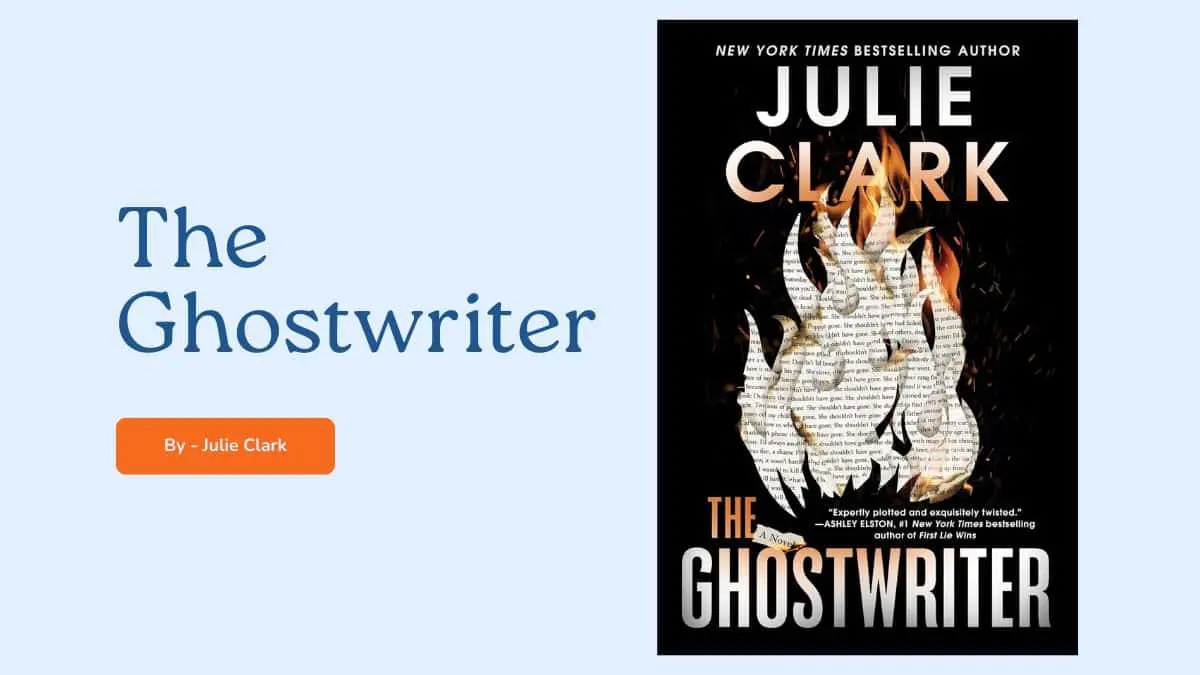
Julie Clark’s The Ghostwriter is a gripping psychological thriller that delves into the complexities of memory, family secrets, and the narratives we construct to make sense of our past. Set against the backdrop of a decades-old unsolved murder, the novel intertwines a suspenseful mystery with an emotional exploration of a fractured father-daughter relationship.
Plot Overview
In June 1975, the Taylor family is devastated when teenage siblings Danny and Poppy are found dead in their home in Ojai, California. Their older brother, Vincent, becomes the prime suspect but is never charged. The tragedy remains unsolved, casting a long shadow over the family. Vincent goes on to become a renowned horror novelist, while his daughter, Olivia Dumont, distances herself from her father’s infamous past.
Years later, Olivia, a professional ghostwriter facing financial ruin, is offered a lucrative job: to ghostwrite her father’s final book. Reluctantly returning to Ojai, she discovers that Vincent, now suffering from Lewy body dementia, intends to use the book to reveal the truth about the 1975 murders. As Olivia delves into her father’s memories, she must navigate the blurred lines between fact and fiction to uncover what really happened that fateful night.
Dual Timelines and Narrative Structure
Clark employs a dual timeline narrative, alternating between the present-day collaboration between Olivia and Vincent and flashbacks to the events leading up to the 1975 tragedy. This structure allows readers to piece together the mystery alongside Olivia, creating a compelling and immersive reading experience. The use of multiple perspectives, including those of Danny and Poppy, adds depth to the narrative and highlights the unreliability of memory.
Themes and Character Development
At its core, The Ghostwriter explores themes of memory, truth, and the stories we tell ourselves. Vincent’s deteriorating mental state raises questions about the reliability of his recollections, while Olivia grapples with her own memories and the impact of her father’s legacy on her identity. The novel also examines the complexities of familial relationships, particularly the strained bond between Olivia and Vincent, and the ways in which unresolved trauma can reverberate through generations.
Critical Reception
The Ghostwriter has received widespread acclaim for its intricate plotting, emotional depth, and suspenseful storytelling. Publishers Weekly praised the novel as a “deeply satisfying shocker,” noting Clark’s skill in keeping readers guessing about Vincent’s motives and guilt. Ashley Elston, #1 New York Times bestselling author, lauded the book as “expertly plotted and exquisitely twisted,” highlighting Clark’s mastery in weaving together a daughter’s suspicions and her father’s secrets.
Reviewers have also commended the novel’s exploration of memory and narrative. The Book Grind described it as “a masterful exploration of memory, family secrets, and the stories we tell ourselves to survive,” while Mosaic Movie Connect Group emphasized its “nuanced examination of memory and narrative,” noting how time can distort our recollections.
Conclusion
Julie Clark’s The Ghostwriter is a compelling blend of psychological thriller and family drama that delves into the complexities of memory, truth, and the narratives we construct to make sense of our past. With its dual timelines, intricate plotting, and emotional depth, the novel offers a suspenseful and thought-provoking reading experience. Clark’s skillful storytelling and exploration of the human psyche make The Ghostwriter a standout addition to the thriller genre.
Also Read: Death Row: By Freida McFadden (Book Review)