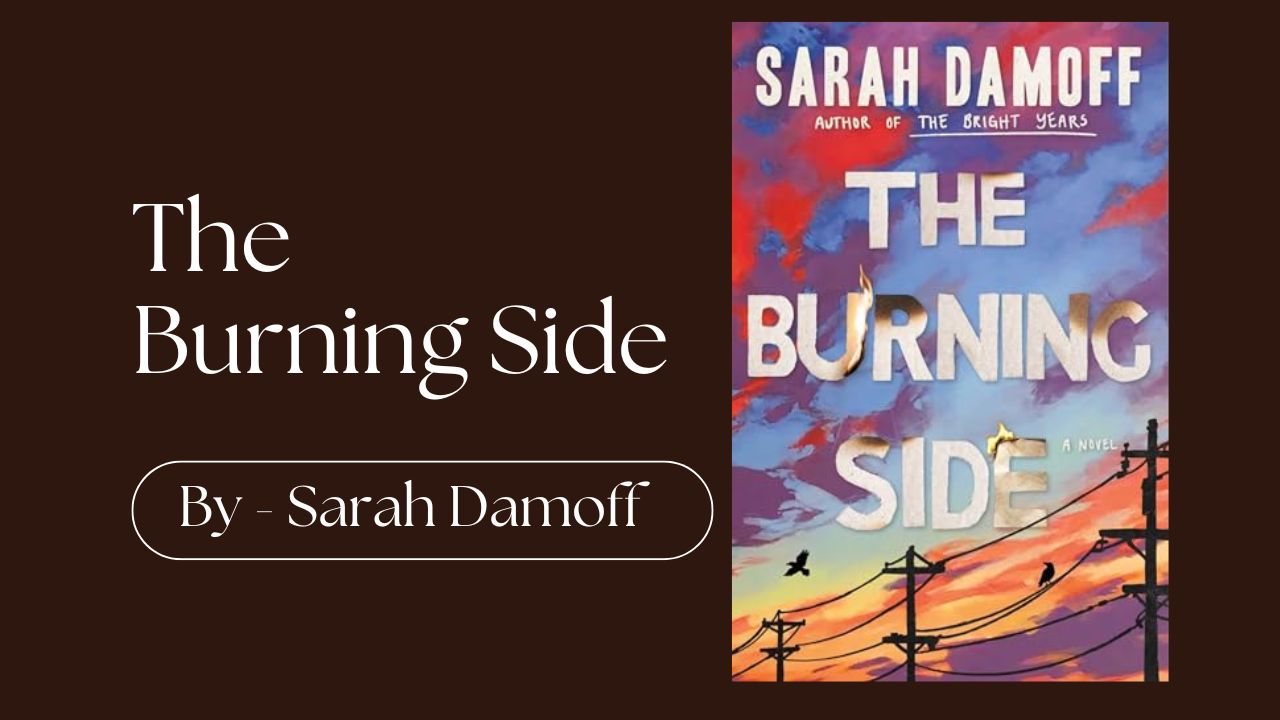
Some novels rely on shocking twists to keep readers turning pages. The Burning Side doesn’t need that. It grips you through emotional honesty — through the uncomfortable silence between spouses, the exhaustion of parenthood, the ache of old family wounds, and the terrifying realization that sometimes a house is easier to rebuild than a marriage. Sarah Damoff’s second novel opens with literal flames, but the real destruction has already begun long before the fire starts.
A Story About More Than Just a Fire
The novel follows April and Leo Torres, a married couple whose relationship is already crumbling when their home catches fire in the middle of the night. Escaping with their children, they move into April’s childhood home in Dallas, where the emotional wreckage becomes impossible to ignore.
What makes the premise so compelling is that the fire is never treated as mere spectacle. It becomes a metaphor for everything in the story: resentment, buried guilt, generational trauma, and the slow destruction that happens when people stop truly seeing each other.
Damoff doesn’t write dramatic confrontations every few pages. Instead, she builds tension through small moments — awkward dinners, exhausted conversations, memories resurfacing at the wrong time. The emotional realism feels painfully familiar.

The Strength of the Multiple Perspectives
One of the novel’s biggest strengths is its shifting points of view. The story alternates mainly between April, Leo, and Deb (April’s mother), while also weaving in flashbacks that trace the history of April and Leo’s relationship.
This structure gives the novel remarkable emotional depth.
April’s sections are filled with guilt, self-blame, and the crushing mental load of motherhood. Leo’s chapters reveal a man shaped by abandonment and loneliness, someone who has spent his entire life trying to earn stability without ever believing he deserves it. Deb’s perspective adds another layer entirely, especially as she deals with her husband’s Alzheimer’s diagnosis and the fear of slowly losing the person she loves.
What’s impressive is how Damoff refuses to simplify any of them into heroes or villains. Every character is flawed. Every character hurts someone they love. Yet the novel still treats them with compassion.
That balance is difficult to pull off, and The Burning Side handles it beautifully.
Sarah Damoff’s Writing Feels Intimate and Lived-In
Damoff’s prose has a quiet elegance to it. She doesn’t overwrite emotional scenes or force sentimentality onto the reader. Instead, she trusts ordinary moments to carry emotional weight.
A backyard conversation.
A child asking an innocent question.
A spouse choosing not to say what they really mean.
Those scenes land harder than melodrama because they feel real.
Several early reviewers have praised how emotionally authentic the novel feels, especially in its portrayal of grief, marriage, and family strain. And that authenticity is really the book’s greatest achievement. The characters don’t feel “written.” They feel observed.
The Texas setting also adds warmth and texture to the story. Dallas is not simply a backdrop here — it shapes the family dynamic, the atmosphere, and the sense of memory tied to home.
The Novel’s Biggest Theme: What Makes a Home?
At its core, The Burning Side asks a difficult question: What actually keeps a family together?
Is it love?
History?
Obligation?
Habit?
Forgiveness?
The novel circles these questions constantly without offering simplistic answers. It understands that long-term relationships are rarely sustained by passion alone. Sometimes they survive because people choose each other again and again despite disappointment, resentment, and exhaustion.
That emotional complexity is where the book shines brightest.
The story also explores inherited pain — how childhood experiences quietly shape adult relationships. Leo’s fractured upbringing contrasts sharply with April’s relatively stable family life, and Damoff uses that contrast to examine how differently people understand love, conflict, and emotional safety.
Not a Fast-Paced Read — But That’s the Point
Readers expecting a thriller built around a house fire may struggle with the novel’s deliberate pacing. This is literary family drama through and through. The focus remains firmly on character psychology and emotional aftermath rather than plot twists.
The narrative also spends considerable time with the extended family dynamics, which may feel slow for readers looking for constant momentum. Some reviewers noted that the emotional resolution arrives a little too quickly near the end.
Still, the slower pacing ultimately works in the novel’s favor because it allows the emotional tension to simmer naturally.
This is the kind of book that hurts quietly rather than loudly.
Final Verdict
The Burning Side is an emotionally intelligent and deeply human novel about marriage, family, memory, and survival. Sarah Damoff takes a familiar setup — a family crisis — and transforms it into something intimate, layered, and emotionally piercing.
It’s not a story about whether a house can be rebuilt.
It’s about whether people can.
Fans of literary family sagas, emotionally driven contemporary fiction, and character-focused storytelling will likely find this novel unforgettable. And if Damoff’s debut established her as a promising writer, The Burning Side confirms that she is becoming one of the most compelling voices currently writing modern family drama.

The Burning Side: By Sarah Damoff
Summary
The Burning Side by Sarah Damoff is a deeply emotional literary family drama that explores marriage, grief, generational trauma, and the meaning of home. Through beautifully layered perspectives and intimate storytelling, the novel transforms a house fire into a powerful metaphor for fractured relationships and emotional survival. Damoff’s writing feels raw, compassionate, and painfully real, making this a moving read for fans of character-driven fiction.