

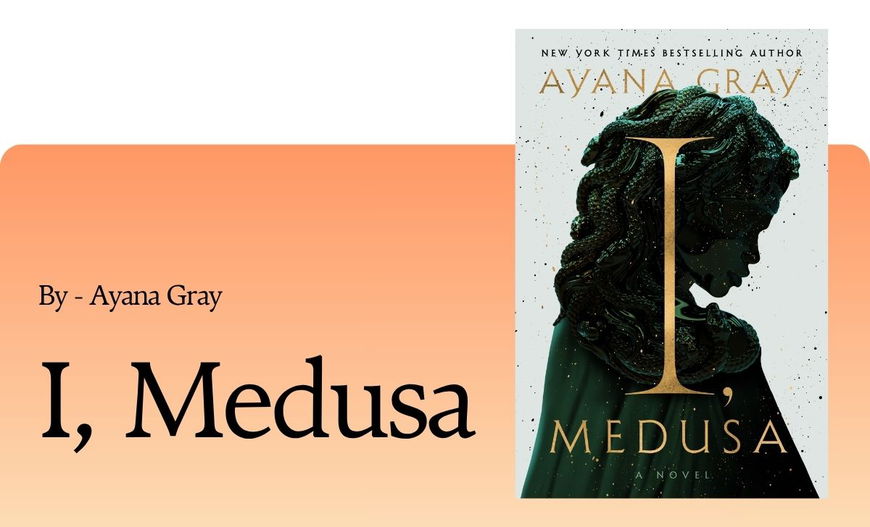
Ayana Gray’s I, Medusa is a bold retelling that takes a figure long relegated to the margins of myth and gives her interiority, agency, and a moral complexity the original stories rarely bothered to imagine. This is not merely a re-run of ancient episodes; it’s a deliberate remolding of the Medusa we think we know into a character whose choices — and the costs of those choices — make us reckon with what it means to be branded a monster. The novel balances elegiac moments with brutal clarity as it charts one woman’s transformation from wronged mortal to feared legend.
Plot overview — what happens (spoiler-aware)
At its heart, I, Medusa places readers in Medusa’s point of view and traces the arc that turns her life into the story later generations will whisper about. The book opens in a world shaped by gods and human ambition, where Medusa is positioned among other women whose bonds and betrayals shape much of what follows. As she navigates relationships with friends, lovers, and powerholders — both divine and mortal — we watch the cumulative weight of exploitation, grief, and survival tilt her toward the monstrous image history preserves.
The narrative pays close attention to the sequence of events that result in Medusa’s curse and eventual renown: personal betrayals, the manipulation of the gods, and an escalating series of choices that end with Medusa fully embracing the terrifying power that will define her. Plot points include emotional manipulation, coercion, and complicated relationships of trust and pain, culminating in a climactic act that reorients the mythic record. The story foregrounds cause and consequence rather than random mythic happenstance.
Voice, structure, and pacing
Gray writes with a deliberate lyricism that leans into the mythic while keeping the narrative intimate. The book avoids an overly ornate antique voice; instead, Gray opts for modern clarity with poetic touches that underscore Medusa’s interior world. The pacing is steady, giving space to quieter scenes of sisterhood and grief as well as to the mounting tension that leads to violent transformation. Many readers have noted that Gray’s handling of tone — combining tenderness and brutality — is one of the novel’s major strengths, drawing readers into a character who is both sympathetic and dangerous.
Themes and what the retelling does differently
Several themes thread through Gray’s retelling: the weaponization of female bodies, the destructive afterlives of betrayal, and the ways communal stories erase nuance in favor of simple moral labels. Rather than portraying Medusa as an irredeemable monster or an unalloyed victim, Gray presents a protagonist whose anger is understandable, whose moral calculus is complicated, and whose actions are sometimes righteous and sometimes terrifying.
The book also centers relationships between women — friendships, mentorships, rivalries — treating them as meaningful forces in Medusa’s life and choices. Gray interrogates how both humans and gods manipulate power, showing how mythology itself becomes an instrument of control. Through these thematic choices, the novel becomes a conversation about culpability, vengeance, and survival rather than a straightforward moral fable.
Character work — Medusa and those around her
Medusa emerges as a fully realized protagonist: not only a symbol but a person with desires, failures, and defenses. Gray gives the supporting cast enough substance to make Medusa’s bonds feel emotionally credible. Lovers, friends, and rivals shape her sense of self and her descent into the identity history assigns to her. Some readers may find certain supporting relationships underexplored or the pacing uneven in those secondary arcs, but the emotional core of Medusa’s attachments remains one of the novel’s strongest elements.
The tension between empathy for Medusa and acknowledgment of the harm she causes is handled with care. Gray rarely offers easy absolution; instead, she leans into the discomfort of a heroine who is both harmed and capable of harm.
Strengths and possible weaknesses
Strengths:
- A powerful and resonant reimagining of a familiar myth with a refreshed moral complexity.
- Prose that balances accessibility and lyrical emotion.
- A strong emotional through-line tracing the impact of trauma, anger, and self-determination.
Possible weaknesses:
- Readers seeking a strictly traditional or historically faithful retelling may find the modern tone unexpected.
- A few side relationships and arcs may feel less polished than Medusa’s central narrative.
Who should pick up this book
Readers who enjoy mythological retellings that challenge conventional interpretations will likely connect with I, Medusa. Those who appreciate character-driven stories with emotional intensity, morally complex protagonists, and explorations of power dynamics will find the novel compelling.
Because the book includes themes of coercion and emotional manipulation, readers sensitive to such topics should be aware—they are essential to the plot and handled with intentionality. Fans of contemporary myth reimaginings that prioritize emotional truth over strict adherence to ancient texts will feel right at home with Gray’s approach.
Final verdict
I, Medusa is a vivid, emotionally charged reclamation of a mythic figure who has long been flattened by legend. Gray does not simply invert the myth or assign easy blame; instead, she places the reader inside the lived experience of a woman pushed to the edge and reshaped by forces beyond her control. The result is a novel that is fierce, haunting, and reflective — a story about pain, power, and the making of a legend.