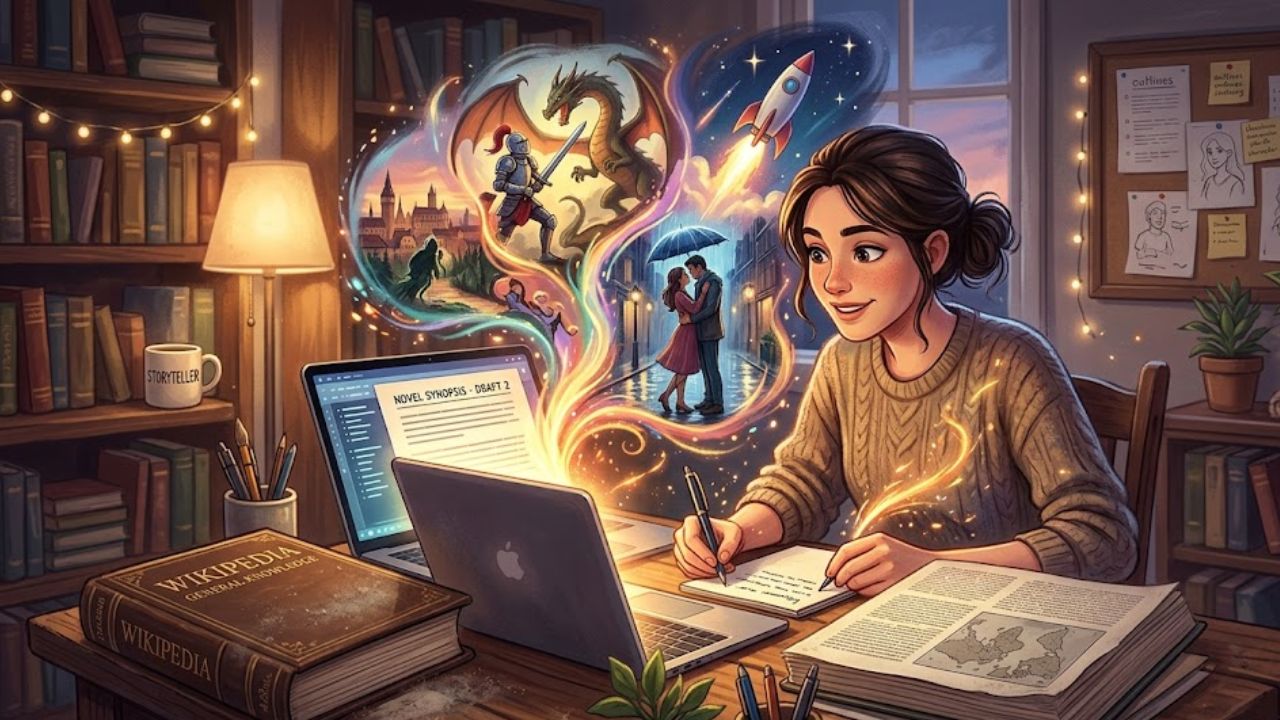
You’ve spent two years writing a novel. You’ve cried over it, rewritten the ending four times, and named a character after your least-favorite coworker purely for catharsis. And now, some agent wants you to squeeze your entire soul into a two-page document that reads like a press release. Welcome to the synopsis — the literary equivalent of describing a sunset by listing the wavelengths of light.
Most writers treat the synopsis as a punishment. They dash it off in an afternoon, mechanically listing what happens in each chapter, and wonder why agents respond with form rejections. The dirty secret is this: the synopsis isn’t just a plot summary. It’s a demonstration that you understand your own story — the shape of it, the emotional stakes, why it matters. Done well, it can be the thing that gets your manuscript actually read.
This guide is for writers who want to do it well.
Understand What a Synopsis Actually Is
Before you write a single word of your synopsis, you need to disabuse yourself of a common misconception: a synopsis is not a chapter-by-chapter summary. It’s not a plot outline. It’s not a movie trailer. A synopsis is a narrative document — meaning it tells a story, just a compressed one.
An agent reading your synopsis is asking a specific set of questions: Does this story have a clear protagonist with a clear want? Is there escalating conflict? Does it go somewhere? Does it resolve in a way that feels earned? They are not checking whether you’ve included every subplot and supporting character. They are reading for story logic and emotional coherence.
A synopsis proves you know the difference between what happens in your book and what your book is about.
That distinction — between plot and story — is everything. Plot is the sequence of events. Story is the meaning those events create. Your synopsis must capture both, in roughly one to two pages (single-spaced), or two to four pages (double-spaced). Different agents specify different lengths, so always check submission guidelines. But the principle remains: be ruthless, be purposeful, and never confuse activity with significance.
Start With Your Story’s Beating Heart
Before drafting the synopsis, do this exercise first: write one sentence that captures the emotional arc of your novel. Not the plot arc. The emotional arc. What does your protagonist want, what stands in the way, and what do they learn about themselves or the world by the end?
The Emotional Arc Sentence
Try this template: “[Character] wants [concrete goal], but [obstacle] forces them to confront [deeper truth], ultimately [emotional outcome].”
This sentence becomes your compass. Every element in your synopsis should serve it. If a plot point doesn’t connect to this core, cut it without mercy.
Example: “Estranged archaeologist Mara wants to prove her discredited father’s theory right, but uncovering the truth means destroying the career she built on dismissing him — ultimately forcing her to choose between legacy and love.”
This heart-sentence isn’t your opening line — it’s your internal orientation device. Once you have it, you’ll find it dramatically easier to decide what belongs in the synopsis and what doesn’t.
Write It in Third Person, Present Tense — Always
Industry standard: synopsis is written in third person, present tense, regardless of what POV or tense your novel uses. This creates a clean narrative voice and matches the conventions that agents expect. Non-negotiable.
✗ Not this
“In my novel, I chose to follow Lena’s journey because I wanted to explore grief. Lena had grown up by the sea and felt haunted by the loss of her sister, which I based on a personal experience.”
✓ This
“Lena has spent three years running from the memory of her sister’s drowning. When their childhood home is sold, she returns to a coastal town that remembers everything she’s tried to forget.”
Notice what the second version does that the first doesn’t: it puts us inside a story. It has momentum. It creates a character with a specific wound and a triggering event. The author’s presence has been completely erased, which is exactly what you want.
The Three-Act Skeleton (Use It, Don’t Worship It)
Most synopses follow the shape of the story itself: a setup, a rising middle with escalating complications, and a resolution. You don’t need to label these as “Act One” and so on — just understand that a synopsis that’s all beginning, no middle, is a synopsis that telegraphs a structurally weak novel.
The Synopsis Anatomy
▸ Opening: Introduce protagonist + world + inciting incident (1–2 paragraphs)
▸ Rising conflict: Escalating choices, turning points, raises stakes (largest section)
▸ Climax: The moment of highest tension and confrontation
▸ Resolution: How it ends — yes, spoil it. That’s what a synopsis is for.
That last point bears repeating: spoil your ending. Writers often resist this — they want to preserve the surprise. But agents are not reading your synopsis for pleasure. They are evaluating your craft. An agent who can’t see your ending cannot evaluate whether your novel works. “Find out how it ends!” is not a hook. It’s a red flag.

The Voice Problem — and How to Solve It
Here’s what separates forgettable synopses from memorable ones: voice. Most writers strip every trace of their authorial voice out of their synopsis, leaving behind something that reads like a Wikipedia entry for a film that doesn’t exist. Technically accurate. Completely inert.
Your synopsis doesn’t need to replicate your novel’s voice exactly — it’s a summary document, and the register will naturally be more compressed. But it should feel as though it was written by the same person who wrote the book. If your novel is dark and literary, your synopsis shouldn’t sound breezy. If your novel is propulsive and commercial, don’t write a synopsis in the style of a Booker Prize acceptance speech.
✗ Flattened voice
“Thomas goes to the island. He finds a journal. He reads it and discovers that the lighthouse keeper was his grandfather. He confronts his mother about this. She explains the family history.”
✓ Voice preserved
“On an island his family hasn’t visited in thirty years, Thomas discovers a lighthouse keeper’s journal — and begins to understand why his grandfather’s name was never spoken aloud. What follows is a confrontation that his mother has been rehearsing for three decades, and wasn’t ready for.”
The second version isn’t longer — it’s denser. It uses word choice (“never spoken aloud,” “rehearsing for three decades”) that creates texture and intrigue. It makes the reader want to know what the mother says next. That pull — that little hook in the throat — is what a synopsis with voice does that a plot summary can’t.
The Character Problem — Who Actually Needs to Be Here
One of the most common synopsis mistakes is overcrowding. Writers feel obligated to introduce every significant character — the best friend, the mentor, the love interest, the antagonist’s henchman — and the synopsis quickly becomes an unnavigable roster of names.
The Name Test
For a standard one-to-two page synopsis, aim for no more than four to five named characters. Your protagonist always gets a name. Your antagonist almost always gets a name. After that, ask: does this character drive a plot turn that cannot be summarized without naming them? If yes, name them. If not, they become “a childhood friend,” “her supervisor,” or “the detective.”
Unnamed supporting characters in a synopsis aren’t disrespectful to your characters — they’re respectful to your reader’s attention.
When you do introduce a character, give them a single defining detail that earns them their place on the page. Not: “Marcus, 34, an architect who grew up in Philadelphia.” But: “Marcus, an architect who rebuilds other people’s homes while letting his own marriage quietly collapse.”
That second version tells us who Marcus is in the story, not just who he is as a data point.
Stakes, Stakes, Stakes
The single most common weakness in amateur synopses is unclear stakes. Events happen — characters go places, discover things, confront each other — but the reader never understands what failure would actually mean. A synopsis without articulated stakes is like a chess game without knowing the rules: technically you can watch the pieces move, but you have no idea why any of it matters.
Stakes operate on multiple levels simultaneously. Your protagonist likely has external stakes (will they achieve the goal?) and internal stakes (will they become the person they need to be?). Your synopsis should establish both — and make clear how they’re connected.
✗ No stakes
“Nina must find the missing data before the company shuts down. She searches through archives and interviews former employees. Eventually she locates the files.”
✓ Stakes established
“Nina has seventy-two hours to find the buried data before it’s legally destroyed — and with it, the only evidence that her late father’s conviction was orchestrated by the company she now works for. Finding the truth means destroying her career. Not finding it means living with a lie she’ll spend her life propping up.”
Stakes should escalate as your synopsis progresses, mirroring the story itself. By the time you reach the climax of your synopsis, the reader should feel the pressure. If they don’t feel something, your synopsis isn’t doing its job.
Subplots: A Ruthless Taxonomy
Your novel likely has subplots. Secondary romances, workplace tensions, backstory threads, thematic parallels. The question isn’t whether to include them — it’s which ones have earned their sentence in the synopsis.
- Include the subplot if it directly causes a plot turn in the main story, or if it’s the vehicle for the novel’s core theme.
- Include the subplot if omitting it makes the resolution of the main story incomprehensible.
- Cut the subplot if it enriches the reading experience but doesn’t change the structure of events.
- Cut the subplot if it can be implied through the main character’s behavior without being spelled out.
- Mention it obliquely if it establishes important context: “while managing her deteriorating marriage, Elena pursues…” and then move on.
Apply this taxonomy without sentiment. Your subplot may be brilliant. It may be the thing your beta readers loved most. But the synopsis is not a love letter to your own book — it’s a business document with a literary soul.
Common Phrases That Kill a Synopsis
Certain constructions have infected synopsis-writing culture like a literary virus. They’re everywhere. They communicate nothing. They signal a writer who hasn’t done the hard work of articulating what actually happens.
Phrases to Eliminate on Sight
“Will [protagonist] be able to…” — Your synopsis should show how the story ends, not ask questions about it.
“…and that’s when everything changes.” — Show what changes. Specifically.
“…in ways she never expected.” — If she expected it, it wouldn’t be a story. Cut this and describe what actually happens.
“…a story about love, loss, and redemption.” — If your synopsis has earned these words through concrete narrative, they’ll be implied. Stating themes bluntly is the synopsis equivalent of a punchline that has to explain itself.
“…dark secrets from the past.” — Name the secret. Or at least characterize it precisely enough that “dark secrets” doesn’t have to do all the work.
These phrases aren’t just weak — they’re a form of evasion. They let you gesture at significance without creating it. Train yourself to notice them, and whenever you write one, ask: what specifically is this phrase trying to say, and why haven’t I said that instead?
The Revision Process: Reading Your Synopsis Like a Stranger
Once you have a draft, the real work begins. Print it out and read it as though you’ve never heard of this novel. You’re an agent with forty submissions to read today. You’ve had your coffee. You’re not hostile, but you’re not patient either.
- Does the protagonist want something specific by the end of paragraph one?
- Can you feel the conflict escalating, or does it feel like a sequence of flat events?
- Is the ending satisfying — not just conclusive, but earned by what came before?
- Is any character introduced without being given something to do in the story?
- Is there any sentence that could be cut without losing plot or emotional logic?
- Does it sound like a human wrote it, or like a machine summarized a plot?
The last question matters most. Read your synopsis aloud. When you find yourself stumbling or rushing, that’s usually a sign that the prose is either clunky or dishonest — it’s obscuring a gap in the story logic rather than illuminating it. Tighten. Clarify. Make it sing, even at this register.

A Word on Genre Conventions
Different genres have slightly different synopsis expectations, and reading the room matters.
Literary fiction: Lean into interiority. Agents expect to see psychological complexity on the page, even in summary form. If your novel’s tension is primarily internal, your synopsis needs to make that internal conflict feel as propulsive as an external thriller would.
Genre fiction (thrillers, mysteries, SFF, romance): Pacing and plot mechanics matter more here. Make sure each cause-and-effect beat is legible. The emotional core still matters — but agents also need to see that the plot machinery works.
Historical fiction: Introduce your setting efficiently, but don’t let world-building crowd out character and conflict. A paragraph describing the historical context is usually enough — then get to the story.
Whatever your genre: read synopses of successfully published novels in your category. Not to imitate them mechanically, but to calibrate your instincts about what belongs and what doesn’t.
✦ ✦ ✦
Writing a good synopsis is genuinely difficult — arguably more difficult than any single chapter of your novel — because it asks you to be simultaneously inside and outside your own story. You have to love it enough to distill it, and trust your own judgment enough to decide what matters.
The writers who do it well aren’t the ones who’ve mastered some secret formula. They’re the ones who’ve read enough to understand what a story is, revised enough to know what their story actually is, and cared enough to write the synopsis with the same intention they brought to every other page.
You’ve already done the hard part. Now go write a synopsis worthy of it.