Picture two rooms. In the first, a council of bickering, beautiful, deeply petty immortals argue over who gets credit for starting a war. They cheat on their spouses, turn rivals into spiders, and occasionally save humanity mostly by accident. In the second room, a celestial bureaucracy processes the affairs of the cosmos with the solemn efficiency of a heavenly government — assigning officials to every river, every star, and every door hinge in the known world. Both rooms are “heaven.” But they couldn’t be more different.
When most of us in the modern world think of mythology, we tend to reach for the familiar — Zeus hurling lightning bolts, Athena springing fully formed from a forehead, Achilles sulking heroically in his tent. Western mythology, drawn from the rich traditions of ancient Greece, Rome, and the Norse world, has been so thoroughly embedded into literature, art, and popular culture that it’s easy to mistake it for the universal template for how people across history imagined their gods.
It isn’t. Not even close.
“Chinese mythology didn’t produce gods who were jealous of humanity. It produced a heaven that was, in some ways, humanity writ large — flawed administrators, promoted mortals, and a bureaucracy that mirrored the empire below.”
Chinese mythology — a vast, layered tradition blending Taoist cosmology, Confucian morality, Buddhist philosophy, and thousands of years of folk religion — operates from a fundamentally different set of assumptions about what gods are, what they want, and how they relate to the world of humans. Understanding those differences doesn’t just teach us about ancient China or ancient Greece. It tells us something profound about how two great civilizations answered the same impossible question: What does the universe owe us?
Chaos, Clay, and the Cosmic Egg
How creation stories reveal fundamentally different cosmologies
🐉Chinese Tradition
Pangu and the Cosmic Egg
In one of the oldest Chinese creation accounts, the universe begins as a formless egg of chaos. Inside it, Pangu — a primordial giant — sleeps for eighteen thousand years. When he wakes, he cracks the egg open with a great axe. The light, clear elements rise to become the sky; the heavy, dark elements sink to become the earth. Pangu stands between them, growing taller every day to keep them apart. When he finally dies, his body becomes everything: his breath becomes wind, his voice becomes thunder, his eyes become the sun and the moon, his flesh becomes soil, his blood becomes rivers.
There is no divine ego in this story. No competition. Pangu doesn’t create the world for glory — he becomes it. Creation is an act of selfless dissolution, a transformation rather than a command.
⚡Western Tradition
Chaos, Titans, and the Olympian Takeover
Greek creation mythology is a story of power — and power taken by force. Before the gods, there is Chaos. From it emerge primordial beings: Gaia (Earth), Tartarus (the deep underworld), Eros. Then the Titans reign. Then Zeus and the Olympians overthrow them in a catastrophic war, claiming sovereignty over the cosmos by right of conquest. The Norse tradition tells a similar tale: from the ice and fire of Ginnungagap, Ymir the frost giant is formed and then slaughtered, his body used as raw material for the world. These are stories about authority being seized, about younger generations deposing older ones, about the world as something conquered rather than something organically emerged from a being’s surrender. They carry within them the DNA of every dynasty, every revolution.
That cosmological difference matters because it sets the tone for everything that follows. If the world is born from a being who becomes it willingly, then creation is continuous, organic, and intimate — the gods and the cosmos are made of the same stuff as everything else. If the world is the spoils of war, then authority is inherently contested, power must be defended, and the gods are fundamentally separate from and above the natural world they rule. One leads to a heaven that looks like a courtroom. The other leads to a heaven that looks like a battlefield.
Immortal Bureaucrats vs. Divine Aristocrats
The most radical difference between the two traditions
🏮Chinese Tradition
Heaven as a Celestial Government
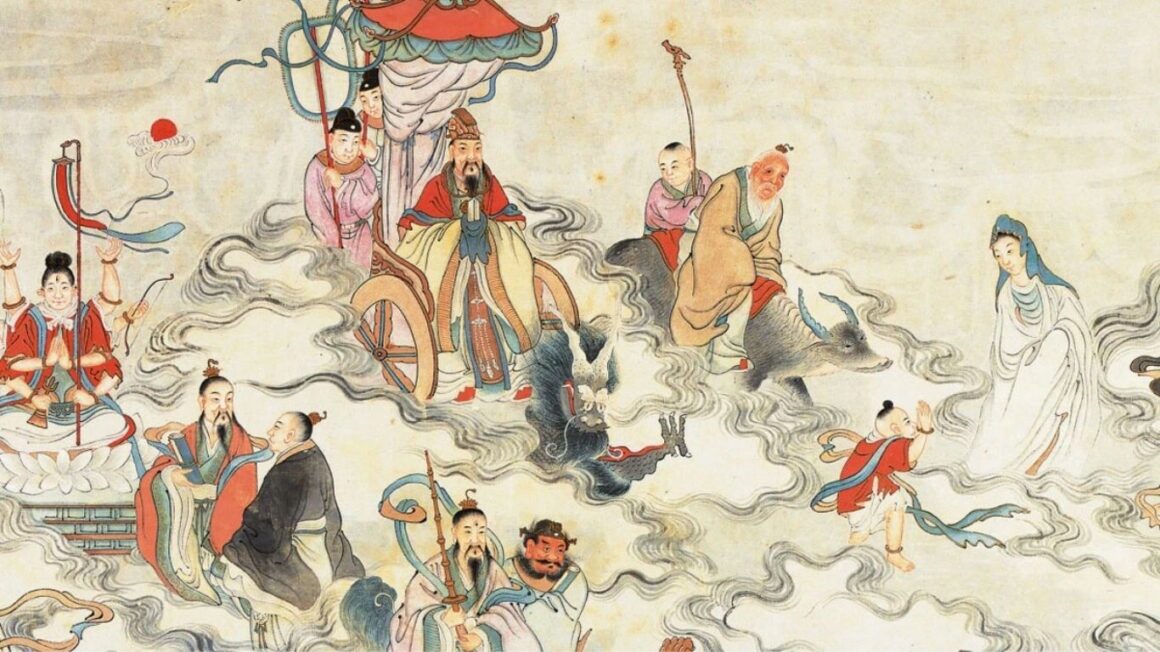
In the Chinese pantheon — particularly as it crystallized during the Taoist and folk religion traditions — heaven is, quite literally, a bureaucracy. The Jade Emperor (玉皇大帝, Yù Huáng Dàdì) sits at its head not because he was born supreme, but because he earned his position through millennia of self-cultivation and virtuous deeds. Below him is an elaborate hierarchy of gods, each responsible for a specific domain: the God of the Kitchen reports on family behavior each year, River Gods manage their rivers, the City God oversees a particular town.
And critically — gods in the Chinese tradition can be demoted, promoted, fired. A god who neglects their duties can be replaced. A virtuous mortal who dies can, through veneration and merit, ascend to divine office. The boundary between human and divine is permeable in a way that would be completely alien to the Greek tradition.
🏛️Western Tradition
Heaven as an Aristocracy
The Olympians aren’t administrators — they’re aristocrats. They were born divine (or occasionally created), they rule by birthright, and while Zeus may be threatened by prophecies about his overthrow, no one can simply vote him out. The Greek gods have domains too — Poseidon gets the sea, Demeter the harvest — but these are territories of a noble house, not job descriptions in an organizational chart. They are above the law, frequently above morality, and answerable to no one except, vaguely, the concept of Fate (the Moirai). Norse gods are even more beleaguered — they know Ragnarök is coming and are essentially going through the motions until the apocalypse swallows them. But they too are a divine bloodline, not a meritocracy. You are born Aesir, or you are not.
The Mortal Who Became a God
One of the most revealing characters in the entire Chinese tradition is Guan Yu (關羽) — a historical general from the Three Kingdoms period (220–280 CE) who, over the centuries following his death, was progressively elevated through popular veneration until he became a full deity: the God of War, God of Business, and protector of the righteous. He wasn’t mythologized the way Heracles was — as a demigod born of a divine father’s indiscretion. He was promoted. The people petitioned heaven, and heaven, being a functional bureaucracy, processed the paperwork.
The contrast with the Greek tradition couldn’t be sharper. When a mortal achieves greatness in Greek mythology, they might become a constellation or descend to Elysium — honored, but still separate from the divine order. Heracles, the greatest of Greek heroes, does eventually achieve Olympus, but it’s the exception that proves the rule, and it requires literally being the son of Zeus. The Chinese tradition, by contrast, treats divine appointment as something that can be earned by anyone with sufficient virtue and popular support.
Hubris, Harmony, and the Problem of Punishment
Why Chinese gods rarely smite you for pride, and Western ones rarely don’t
Ask someone who’s read a bit of Greek mythology why the gods punish humans, and they’ll probably give you one word: hubris. Pride. The mortal who presumes to be equal to or greater than the divine. Arachne weaves too well and gets turned into a spider. Niobe brags about her children and loses them all. Actaeon sees Artemis bathing and becomes a stag. The Greek gods are extraordinarily sensitive to human ego, and they punish it with operatic cruelty.
This reflects something fundamental about the Greek worldview: the distance between human and divine must be maintained. The gods’ power depends, in part, on their exclusivity. Humans who blur that line threaten the entire cosmic order — and the gods’ response is proportionally extreme.
“In Chinese mythology, the worst sin isn’t pride — it’s disorder. Breaking cosmic harmony is more offensive than offending a god’s ego.”
Chinese mythology operates on a different moral axis. The central ethical concept isn’t pride versus humility — it’s harmony versus disorder. The Chinese cosmos is in a constant state of delicate balance, maintained through proper relationships, righteous behavior, and adherence to one’s role in the cosmic order. The worst thing a god, a mortal, or a spirit can do isn’t claim to be equal to heaven — it’s disrupt the natural flow of things.
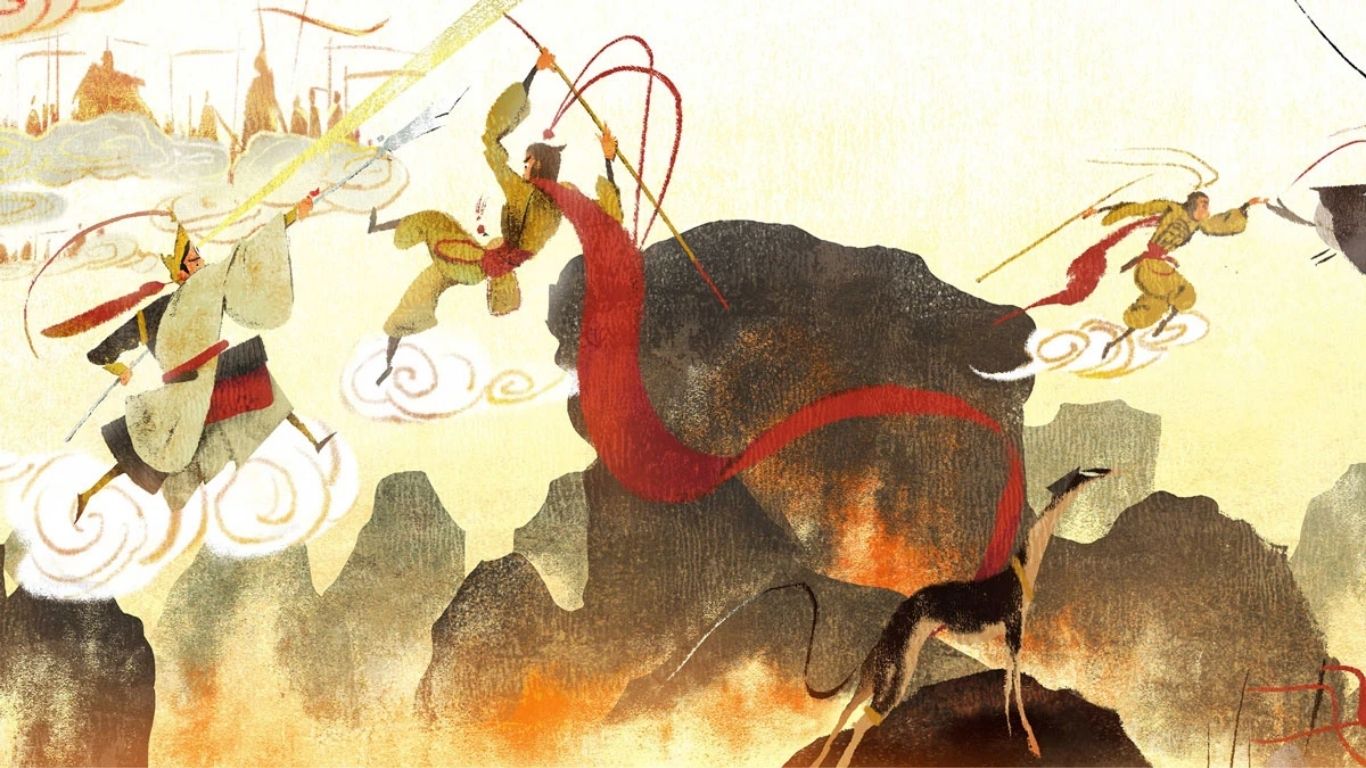
Sun Wukong (孫悟空), the Monkey King from Journey to the West, is perhaps the most beloved character in Chinese mythology, and his story perfectly illustrates this difference. He storms heaven, claims the title of “Great Sage Equal to Heaven,” wreaks chaos across the celestial bureaucracy, and is only defeated by the Buddha himself — who traps him under a mountain for five hundred years. Notably, he is not destroyed. He is reformed, given a job (protecting the monk Xuanzang on his pilgrimage), and eventually achieves Buddhahood. His punishment is corrective, not annihilating. The system doesn’t destroy disorder; it absorbs and redirects it.
Myth Spotlight — Two Stories of Rebellion
Chinese Mythology
Sun Wukong: The Monkey King
Born from a stone, Sun Wukong learns immortality, steals the Jade Emperor’s peaches of immortality, drinks the Elixir of Life, and declares himself equal to heaven. He defeats every army sent against him. Only the Buddha can stop him — by trapping him under Five Elements Mountain. But the story doesn’t end there. After five centuries, he is released, becomes a pilgrim’s guardian, and earns enlightenment. His rebellion is acknowledged, channeled, and ultimately transformed into virtue. The cosmos has room for him, once redirected.
Greek Mythology
Prometheus: The Titan Who Gave Fire
Prometheus steals fire from the gods and gives it to humanity. For this, Zeus chains him to a rock where an eagle devours his liver every day — and it grows back each night, so the torment is eternal. He is eventually freed by Heracles, but the punishment reveals everything: the gods’ wrath is personal, consuming, and extraordinarily disproportionate. The offense wasn’t disorder — it was insubordination. Prometheus helped humans without permission. In the Greek cosmos, that alone is sufficient reason for eternal suffering.
How Gods Relate to the People Below Them
Indifference, investment, and the terms of divine attention
🧧Chinese Tradition
A Transactional Relationship of Mutual Responsibility
In Chinese folk religion and mythology, the relationship between humans and gods is almost contractual. Mortals offer incense, food, and prayer; gods provide protection, fortune, and intercession. If a god fails their worshippers — if the Dragon King sends no rain, if the God of Wealth fails to bring prosperity — worshippers might publicly shame the god’s statue, parade it through the streets in the hot sun, or even stop making offerings entirely. The relationship goes both ways.
This creates a mythology where gods are responsive, even accountable. They’re not remote and arbitrary; they’re embedded in the community, serving a function that can be judged by its results. A Chinese village god who doesn’t protect his village isn’t being worshipped wrong — he’s failing at his job.
🏺Western Tradition
Favour Given on Divine Whim
Greek gods notice humans when humans amuse them, offend them, or happen to be related to them. The favor of Athena doesn’t mean Odysseus has a right to come home safely — it means Athena has decided, for her own reasons, to take an interest. The Trojan War is essentially fought because three goddesses had a beauty contest and a mortal was asked to judge it. The humans are collateral damage in divine ego dramas.
There is worship in Greek mythology, certainly — temples, sacrifices, festivals. But there’s no sense that the gods owe the worshippers anything in return. They accept the offerings and do as they please. A god who ignores your prayers isn’t failing a divine duty; they simply have other things on their mind. Human fate depends entirely on whether you happen to be interesting to a god this season.
The Core Distinctions
A comparative framework across seven key dimensions
| Dimension | 🐉 Chinese Mythology | ⚡ Western Mythology (Greek / Norse / Roman) |
|---|---|---|
| Divine Structure | Celestial bureaucracy with ranks, duties, and performance reviews | Divine aristocracy ruled by birthright and conquest |
| God-Human Boundary | Permeable — mortals can become gods through virtue and veneration | Largely fixed — divinity is a bloodline, not an achievement |
| Primary Ethical Concern | Harmony, order, and right relationships (禮, lǐ) | Hubris, fate, and the proper boundary between mortal and divine |
| Gods’ Motivation | Duty, cosmic maintenance, and governance | Personal glory, desire, jealousy, and revenge |
| Relationship with Humans | Contractual — gods are accountable and can be criticized | Capricious — humans depend on divine favor that can be withheld or withdrawn |
| The Afterlife | Hell as a judicial system (courts of King Yama) that processes souls and assigns reincarnation | A destination (Hades, Elysium, Valhalla) shaped by how you lived and died |
| Cosmological Tone | Cyclical, harmonious, restorative — disorder is corrected, not annihilated | Linear, apocalyptic — Greek myths end in tragedy, Norse myths end in Ragnarök |
The Underworld as Courtroom vs. the Underworld as Landscape
How both traditions imagined what happens when we die
Both Chinese and Western mythologies have elaborate afterlives — but the differences in how they’re structured reveal everything about the moral frameworks behind each tradition.
In the Chinese tradition, the afterlife (冥界, Míng Jiè, or the realm of the dead) is managed by the Ten Kings of Hell, presided over by Yanluo Wang (閻羅王), the Chinese equivalent of a divine judge. When you die, your soul is not simply dispatched to a pleasant or unpleasant destination based on whether you were good or bad. It is processed. Bureaucratically. Your life is reviewed in a trial before divine magistrates who consult the Book of Life and Death. Punishments for specific sins are administered in specific chambers. Eventually, you drink a soup of forgetfulness and are reincarnated, your next life shaped by your behavior in the previous one.
“Chinese Hell is not a place of eternal punishment — it’s more like a correctional facility attached to a courthouse. The goal is eventual reform and reincarnation.”
This is a profoundly different afterlife than the one Greek mythology imagines. Hades is a place, not a process — a shadowy realm where most souls wander as pale shades, neither punished nor rewarded, simply existing in a grey twilight. The particularly virtuous go to Elysium; the truly wicked go to Tartarus. But the majority of the dead don’t go anywhere particularly interesting. They just… fade. Norse mythology offers Valhalla for the heroically slain — a warrior’s paradise where Odin gathers his army for Ragnarök — and Hel for everyone else. Again, a destination determined by how you died, not necessarily by the quality of your moral choices.
The Chinese afterlife, with its trial system and eventual reincarnation, carries within it a fundamentally more optimistic view of cosmic justice. No soul is permanently damned; everyone gets processed, purified, and given another chance. It’s a system built on Confucian notions of moral accountability and Buddhist concepts of karma and rebirth — and it has far more in common with a courthouse than with a Greek underworld that basically just warehouses the dead.
Six Reasons the Gap Runs Deep
The differences aren’t accidents — they reflect entirely different civilizational assumptions
🧿
The Nature of Divinity
Western gods are beings of will and passion — divine because of what they are. Chinese gods are beings of function and virtue — divine because of what they do and what they’ve earned.
☯️
Harmony as the Highest Value
Chinese cosmology is built on balance between Yin and Yang, between Heaven and Earth, between the individual and the collective. Western mythology is built on individual will clashing against fate.
📜
Confucian Influence
Confucian values — hierarchy, duty, filial piety, proper roles — are baked directly into the structure of the Chinese pantheon. The heavenly court mirrors the imperial court; it couldn’t be otherwise.
🔄
Cyclical vs. Linear Time
Greek and Norse myths move toward endpoints — Troy falls, Ragnarök comes. Chinese cosmology is cyclical: dynasties rise and fall, souls reincarnate, the cosmic wheel keeps turning. There is no final chapter.
🏛️
Empire as Template
The Chinese imperial system — with its civil examinations, its bureaucratic hierarchies, its mandate of heaven — was so successful and so central to Chinese civilization that it became the template for heaven itself.
🌊
Synthesis, Not Conflict
Chinese mythology absorbed Buddhism and Taoism into its folk traditions without destroying any of them. Western traditions tended to compete — Greek vs. Roman vs. Christian — replacing each other rather than blending.
Same Sky, Different Heavens
There’s something quietly wonderful about comparing mythologies — not to rank them or to privilege one over the other, but to see what each one reveals about the civilization that produced it. Both Greek and Chinese mythology were doing the same fundamental work: trying to make sense of a universe that doesn’t obviously make sense. Trying to explain why things go wrong, who is in charge, what happens after death, and how a person is supposed to live.
But the answers they arrived at are so different that they might as well have been answering different questions. The Greeks imagined gods who were essentially super-powered humans with super-powered emotions — vain, brilliant, jealous, generous, catastrophically petty. It’s a mythology that validates human passion and human ego as the central force in the cosmos. The Chinese imagined a heaven that was, in its own way, a kind of ideal state — a perfectly functioning government of virtue, where everyone has a role, where merit is rewarded, where chaos is always eventually brought back into order.
Neither tradition got it “right,” of course — mythology was never in the business of being right. It was in the business of being meaningful. And that’s perhaps the deepest thing both traditions share: the conviction that the universe is not random, that it has a structure, and that understanding that structure is the most important work a human being can do.
Whether the structure looks like a celestial bureaucracy or a council of squabbling Olympians probably says more about us than it does about the cosmos.