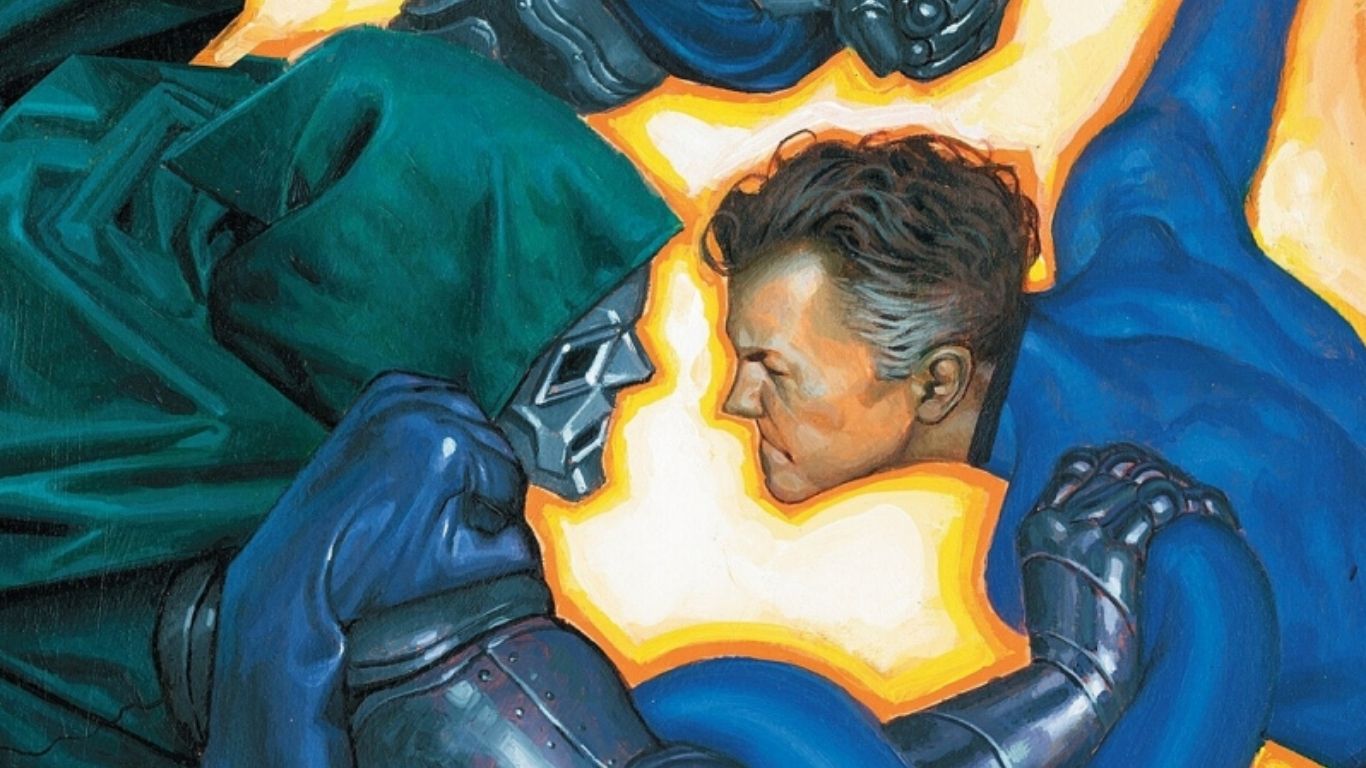
Every great rivalry needs an origin, and few rivalries in comics run as deep, as personal, or as tragic as the one between Victor Von Doom and Reed Richards. Challenges of Doom: Mr. Fantastic #1, written by Al Ewing with art by Mike Henderson and colors by Mattia Iacono, peels back the armor to show us exactly how a heartbroken boy from Latveria became the sorcerer-scientist tyrant we know as Doctor Doom — and how the man who would become his greatest foe was there at the very beginning, close enough to almost stop it from happening.
This issue opens with a framing device that tells us exactly what we’re in for: two boys, on two different paths, whose lives were destined to collide. One was born to a poor nomad and an ill-fated witch, and used sorcery and science to conquer a nation. The other was a brilliant scientist who would brave the cosmos and come home wearing incredible power for good. This is the story of how their legendary rivalry began.
VICTOR VON DOOM
Son of a healer and a witch. Orphaned by cruelty and bureaucracy. Brilliant beyond measure, and utterly convinced of it.
REED RICHARDS
A scholarship student at State University. Curious, generous, and just as gifted — but humble about it, to Victor’s disgust.
Act One: The Fire That Never Goes Out

The story actually begins near its own ending — a flash-forward to a hooded figure standing before a massive, demonic-faced furnace, screaming for his acolytes to stoke “the secret fire” hotter, hotter, hotter, because the flames must be “as hot as the Devil’s own.” This is Victor, already deep into his transformation, presiding over red-robed monks as they forge the first piece of his armor. He tells them that in this temple they’ve studied dark alchemy for centuries, yet he — their student turned master — has taught them alchemies they never dreamed of. Science and sorcery are united in his blood, inherited from a father who knew medicine and a mother who knew the forces of nature. “Today,” he declares, “I create myself anew.” When a monk worries the hot metal might cause him pain, Victor simply says: “Pain? That is for lesser men.” It’s a chilling cold open — we know where this story ends before we even know how it started.
Act Two: The Boy Who Buried His Father
The story rewinds further, to “years earlier” in Latveria. A young Victor, dressed in a flat cap and modest clothes, is grieving with his adoptive sister Valeria over the death of his father, Werner Von Doom. Victor’s mother, we learn, died when he was very young — “my heart already died with her,” he says — and now his father is gone too. Werner was a humble village healer, a genuinely good man who was dragged like a slave to Baron Fortunov’s castle to save the Baron’s dying wife. He arrived too late to save her, and for that failure, the Baron’s men hunted him to death, leaving him buried in rags while his murderers wore fine silks.

Sorting through his father’s meager belongings, Victor finds an old wooden box marked with strange symbols he half-remembers — it belonged to his mother, Cynthia Von Doom. Inside are relics of witchcraft: jars, sigils, and remnants of a life dedicated to the old, dark arts. This box is the seed of everything that follows.
“Like an animal! That is what kindness brings — buried in tatters and rags, while his murderers wear the finest…”
First Blood: The Grenade of Science and Sorcery
Not long after, we see Victor already putting his mother’s grimoire to violent use. He confronts one of Baron Fortunov’s military patrols in the woods, invoking his mother’s name and her spell — “summoning of water and banishing of fire,” in his words, “the simplest of elemental manipulations” — to entomb soldiers in solid ice. What’s most unsettling isn’t the magic itself, but how casually Victor has already begun industrializing it: he’s automated the spell into a handheld device, a magical grenade he can simply toss. “Science and sorcery, gentlemen,” he says, almost bored. Before finishing the job, he tells a terrified, freezing soldier to relay a message to his mother, wherever the ice sends him: that Victor hasn’t forgotten her, and he’s sorry it’s taking so long to avenge her.
Back at the Romani camp where he lives with Valeria and their people, Victor explains his impossible situation — Baron Fortunov believes his father let the Baron’s wife die on purpose, and won’t rest until the entire Von Doom bloodline is extinguished. Victor is the last of that line. Just as he wonders where he could possibly flee to, a visitor arrives: an American government agent, who’s heard remarkable things about the young man’s scientific gifts. He offers Victor something no one else has: an escape, a doctorate, and a future — courtesy of the United States government.
Act Three: Enter Reed Richards
The story jumps to New York, where Victor arrives at State University — a school the agent claims rivals MIT and Caltech. Before leaving him to his studies, the agent jokes that Victor should meet “Uncle Sam’s other scholarship boy,” a fellow prodigy who’s “into everything but weapons.” His name, we’re told with weighty foreshadowing, is Richards.

Victor tracks him down to a cluttered dorm room covered in chalkboards full of equations, and the two brilliant young men size each other up instantly. Reed is warm, curious, and immediately fascinated by the rumors surrounding Victor’s work — “it’s almost like the laws of physics don’t even apply,” he says, hoping they might collaborate. Victor is standoffish but can’t resist showing off: glancing at Reed’s ionic-propulsion engine blueprint, he identifies a flaw in seconds, eliminating unnecessary variables that had been causing Reed’s mental simulations to end in explosions. Reed is thrilled — genuinely, humbly grateful — and even offers to room together. Victor, unable to accept the idea of needing anyone, coldly rebuffs him and walks out.
Cheeseburgers and Self-Actualization
Their next encounter, in the university cafeteria, is the philosophical heart of the issue. Over a “cheeseburger” (a novelty to Victor), Reed brings up Maslow’s hierarchy of needs — food, safety, belonging, esteem, and finally self-actualization, the search for one’s authentic self. Victor scoffs at the idea of needing friendship or belonging at all, insisting he has no need for anyone; he’s survived starvation and danger without help before. When Reed mentions his football-playing, astronaut-hopeful roommate Ben Grimm with genuine affection, Victor sneers that to minds “like ours,” an ordinary smart person is just “a primate swinging a rock.” Reed pushes back hard — for the first time in the issue, someone challenges Victor to his face, arguing that treating other people as beneath him is a trap that will keep Victor from ever achieving true greatness. Victor, stung, throws Reed’s sandwich and nearly storms off — but stays, intrigued despite himself.
“You’re going to spend your life limiting yourself so that your lessers find you amenable, until all greatness in you dies from lack of use. Walking on eggshells when you could be sprinting.”
The conversation deepens over dinner at a Romanian restaurant, where the two swap real theories about dimensional travel and non-Euclidean space — Victor dreams of a “junction to everywhere,” doorways to realities beyond their own, “for us all, not just for the few.” For a moment, it looks like the beginning of a genuine friendship: two orphaned, brilliant young men, drawn together by loss and ambition, finally speaking to someone on their level. Victor even opens up about his mother’s death and his father’s disappearance — a rare crack in his armor of superiority.
Act Four: The Séance That Broke Everything
That fragile friendship shatters the moment Reed sees what Victor has actually been building in his dorm room: a candlelit ritual chamber, ringed with occult sigils and centered on a bizarre machine mounted with a strange helmet. Victor admits he’s been secretly experimenting with what he calls an “older technology” — older than Latveria, older than Earth itself — a device meant to let him mentally project into another dimensional plane and speak to his dead mother once more.

Reed, horrified, calls it madness — and for once, points out a genuine, verifiable flaw: a misplaced decimal point in Victor’s calculations, a small mathematical error that could prove catastrophic given the amount of energy involved. Victor’s pride cannot bear this. He explodes with rage, dismissing Reed’s correction as pure jealousy, and violently throws him out of the dorm — insisting he doesn’t make mistakes, except in ever letting Reed inside in the first place.
The Machine Ignites
Alone, and utterly certain of his own genius, Victor straps himself into the device anyway. “I’m coming, Mother,” he says softly, activating it — and the “netherworld” answers. A monstrous, horned, fire-wreathed entity fills the sky, greeting him by name: “Hello, Victor.” It’s not his mother. Whatever this being is, it’s malevolent, and the machine detonates in a catastrophic burst of green energy, hurling Reed across the room and engulfing Victor in flame and electricity as he screams.
Act Five: The Face No One Will Ever See Again
Victor survives — barely. He wakes in a hospital, bandaged head to toe, and is bluntly told by the dean that Reed Richards’ quick thinking is the only reason he’s alive. Rather than gratitude, Victor receives expulsion: the dean, furious and unmoved by government backing, bans him from the school and vows to ruin his academic reputation. Alone that night, Victor unwraps his bandages to see his face for the first time since the accident — and the horror of what he finds sends him smashing through a mirror in anguish, screaming Reed’s name and demanding to know what was done to him.

Broken, scarred, and consumed by blame, Victor treks alone across the world and up a “nameless mountain,” searching for legends of an order of healers who can repair any wound. What he finds instead are the Vengeful Ones — red-robed monks devoted to healing the wounds of the spirit through vengeance. Impressed by his will to survive the climb with nothing to guide him, they accept him, and his training begins.
Act Six: The Mask
The story returns full circle to its opening image: Victor, now the temple’s master rather than its student, commands the forging of his armor piece by piece. When the mask itself is finally ready — still glowing, not yet cooled — Victor refuses to wait even a moment longer. He presses the white-hot metal to his own scarred face, hissing in agony, and declares that no mortal eyes will ever again gaze upon the “hideous countenance” of Victor Von Doom. From this moment on, there is no Victor Von Doom — only what he has become. Asked what the world should call him now, he answers with total, unshakable certainty: what has been earned through fire and blood should be flaunted. There is only one title he will accept.

Call Me... Doctor.
In the issue's final, iconic image, the fully armored figure — green cloak, silver gauntlets glowing with power, the cold mask now permanently fused to his face — rises before his kneeling acolytes in the ruins of the temple. The transformation is complete. The scientist who once shared cheeseburgers and dreams of interdimensional travel with Reed Richards is gone. In his place stands a monarch of science and sorcery who blames his rival, and the whole world beneath him, for the fire that remade him. "The Beginning..." reads the final caption box — because for Doctor Doom, this isn't an ending.