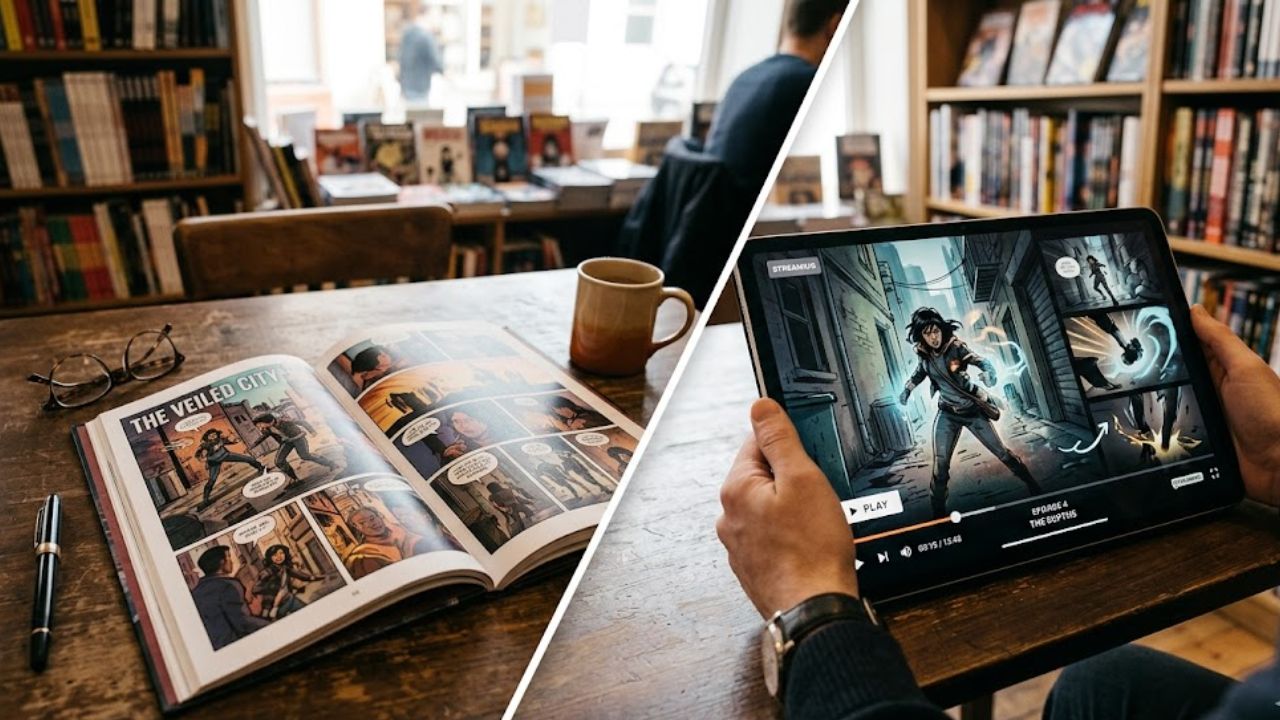
There’s a moment in the third episode of Loki Season 2 where the show pauses — genuinely pauses — to let a character sit with grief. No explosions, no twists, just a man watching timelines collapse and processing what that means for him personally. It was quiet, almost literary. And it almost certainly wouldn’t have existed in a two-hour theatrical cut. Streaming changed that. And in doing so, it changed something more foundational: the way stories from comics are actually told.
The Problem with Two Hours
For decades, adapting a comic book meant compression. You took source material that had spent years developing relationships, mythologies, and emotional textures — and you squeezed it into 120 minutes. Studios had to pick what mattered. Usually, that meant action. Character moments, supporting arcs, moral ambiguity, and worldbuilding were the first casualties.
Think about how much was left on the cutting room floor in early superhero films. The X-Men films barely scratched the surface of what made those characters compelling on the page. The 2003 Daredevil film stripped out the Catholic guilt, the courtroom drama, the moral complexity that made Matt Murdock one of Marvel’s most interesting figures. Everything that made him interesting was deemed too slow for a blockbuster.
“Streaming gave comic adaptations something they’d never really had before: time. And time, it turns out, is the secret ingredient that makes a comic book story actually work.”
When the Episode Count Matches the Story
Comics are serialized by nature. Issues come out monthly, stories breathe across years, characters grow in ways that take real time to feel earned. It was always a strange thing, forcing that format into a single film. The medium mismatch was baked in from the start.
Streaming series — particularly the kind structured around a single narrative arc per season — map onto comic book storytelling with an almost uncanny fit. Six to nine episodes gives you room. Room for the villain to be more than a monologue. Room for the hero to be wrong about something. Room for the city itself to feel like a character.
Case Study

Daredevil on Netflix remains one of the clearest examples of this shift. The show didn't just retell familiar stories — it translated the moral and tonal weight of Frank Miller's run into a format that could actually hold it. Wilson Fisk didn't feel like a movie villain. He felt like a novel antagonist, built slowly, made human in uncomfortable ways. That's not a two-hour achievement.

The Rise of the B-Story
One of the most meaningful structural gifts streaming gave comic adaptations is the space for secondary storylines. In a film, every scene has to justify its existence against the ticking clock of the runtime. In a streaming series, an episode can afford to spend fifteen minutes with a character who isn’t the lead — and those fifteen minutes can be the most memorable thing about the whole season.
Andor did this almost radically. Scenes set entirely within the Imperial bureaucracy — people processing paperwork, arguing about resource allocation — had no direct bearing on the action plot. And yet they built the texture of oppression so precisely that when the resistance eventually strikes back, it lands with weight that no three-act film structure could manufacture. The show trusted its audience to sit with infrastructure.
That trust, historically, was not something superhero adaptations extended to their viewers. Streaming changed the calculus. When you’re not competing for a single opening weekend, you can afford to be patient.
Pacing as a Storytelling Tool
In film, pacing is almost always urgent. Studios fear the sag in the middle of the second act like a structural problem to be engineered away. But comics have always known that the pause between action beats is where emotional meaning lives. The panel before the punch. The page turn that delays the reveal. The silence after someone says something they can’t take back.
Streaming series have begun to reclaim that pacing. Not all of them — plenty of streaming content still operates on blockbuster logic, just stretched thinner. But the best ones understand that variation in rhythm is itself a form of storytelling. An episode that is almost entirely conversation can reorient everything that follows. A quiet scene in the rain can do more work than three action sequences combined.
Worth noting

This isn't unique to superhero content. Invincible on Amazon uses the slower-burn potential of animation serialization to build a genuinely affecting father-son story before detonating it. The show understands that shock only lands when you care, and making you care takes time that the original theatrical format never had.
The Drawback Nobody Talks About Enough
It would be dishonest to tell this story without acknowledging what streaming has also broken. The pressure to produce content at volume — to fill release schedules, to maintain subscriber numbers — has produced a very specific kind of storytelling problem: padding.
When a story that could be told in four tightly constructed episodes is stretched to eight because eight is the standard order, the result isn’t richer storytelling. It’s the same story diluted. Subplots introduced not because they’re necessary but because something has to fill episode five. Character reversals that exist because the episode count demands something to happen, not because the story has earned them.
Several of the Disney+ Marvel series were critically diagnosed with exactly this problem. The freedom to expand became the obligation to fill, and the result sometimes felt less like a comic book story and more like a comic book story with extra scenes inserted between the actual scenes. The format offered space; the mandate turned that space into footage.
“The best streaming adaptations don’t just use the runtime — they justify every minute of it. That’s a discipline, and not every showrunner has learned it yet.”
What the Best Ones Get Right
The streaming adaptations that truly honor their comic book origins share a few qualities. They treat the source material as a starting point rather than a blueprint — using the emotional DNA while rethinking structure for the new format. They employ writers who understand that visual storytelling in prose-heavy episodes requires different muscle than action choreography. And they resist the temptation to make every episode feel like a miniature film.
Comics have always been a hybrid form — images and words in dialogue, silence as syntax, negative space as meaning. The best streaming adaptations have found ways to translate that hybridity into a different medium without losing what made it work. Not by copying the page, but by asking: what does this story need, and what does this format uniquely allow?

The Future of the Panel
We’re still early in understanding what streaming truly enables for comic book adaptation. The experiments happening right now — in animation, in limited series, in long-form anthology formats — are beginning to sketch the outline of something genuinely new. A form of visual storytelling that owes debts to cinema, to television, to comics, and to none of them entirely.
For readers who grew up with the monthly ritual of a new issue, there’s something satisfying about watching that rhythm find its equivalent in the weekly episode drop, the season-long arc, the multi-year franchise built with patience rather than urgency. The medium has changed. The stories — at their best — have only gotten bigger.
Comics always understood that the most important thing isn't what happens in the panel — it's what the reader imagines in the space between panels. Streaming, at its best, has found its own version of that gutter. The pause before the next episode. The week of speculation. The story that lives, for a moment, entirely in the mind of the audience waiting to find out what happens next.