
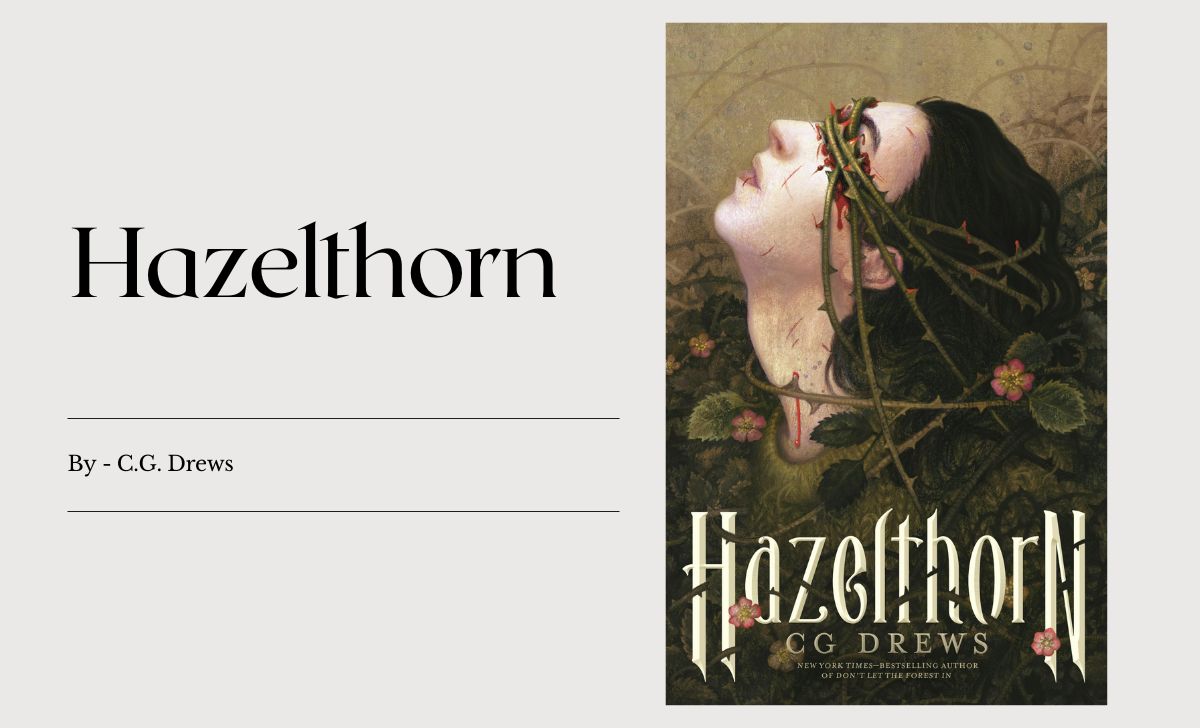
CG Drews’s Hazelthorn doesn’t knock politely — it curls in like a creeping vine and refuses to be ignored. Part gothic horror, part toxic romance, and part identity search, the book blends the soft ache of yearning with the sharp sting of fear. Readers walk into Hazelthorn expecting a haunted house. What they get is a living threat — a garden that watches, reacts, and remembers. It’s a story that won’t settle neatly into one box, and that refusal is exactly what gives it teeth.
Plot: A Garden With a Grudge
Evander has grown up in Hazelthorn estate, a place wrapped in rules:
Never leave the estate.
Never enter the gardens.
Never be alone with Laurie.
Laurie, the grandson of the estate’s late master, is equal parts danger and magnetism — a walking contradiction Evander can’t look away from, no matter how badly things have gone between them. The house is infected by its own greenery — vines writhing behind walls, pollen that seems to whisper.
Evander’s memories hold as many secrets as the Hazelthorn soil. Bit by bit, he learns the truth about his past, the estate’s monstrous legacy, and why the plants behave like predators. The story shifts from eerie domestic suspense to sharp, shocking horror — the kind that sinks roots into the body as well as the brain.
There’s obsession. There’s longing. There’s violence. And beneath it all, a desperate search for autonomy in a place where control is a tradition.
Writing Style: Sharp Cuts & Poisoned Petals
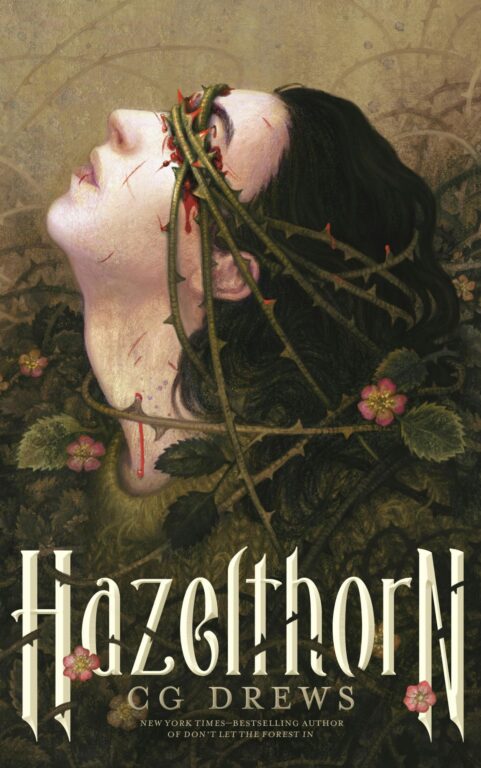
Drews’s prose is both efficient and indulgent — brisk in dialogue, richly atmospheric in horror. Quick sentences deliver punches. But when the novel turns toward the monstrous gardens, readers are treated to lush botanical terror: vines like veins, petals like open wounds, roots that behave like restraints.
Every sensory detail matters — the texture of moss on skin, the metallic taste of fear, the scent of something blooming that shouldn’t. The writing plays with contrast: beauty and revulsion blooming side-by-side.
It’s stylish without slowing down. Elegant without losing bite.
Characters: Hurt People, Hungry Hearts
Evander is not the typical brave YA hero. He’s vulnerable and scarred — physically, emotionally, psychologically. Survival has shaped him more than choice. Watching him fight to reclaim his narrative becomes a core emotional hook.
Laurie is both toxic temptation and tragic figure — unsettling yet impossible to dismiss. Their connection is the book’s loudest heartbeat. Attraction here is not soft, healthy swooning — it’s sharp, risky, and forged under threat. Drews refuses to sanitize the relationship into something cute. It’s fraught, messy, and believable.
Secondary characters — especially the adults policing the estate — act like ghosts in their own home. Their silence is as frightening as any monster.
Even the garden is a character. It reacts. It punishes. It seduces. It hungers.
Atmosphere & Horror: Where Romance Meets the Rot
Hazelthorn isn’t a jump-scare horror novel — it unnerves you slowly, tenderly. Its terror grows out of intimacy: touch that turns threatening, trust that turns poisonous.
Body horror is the book’s boldest card — skin and roots almost swapping roles. The fear comes from vulnerability: the idea that your body can betray you as quickly as a loved one can.
The setting is claustrophobic — a gorgeous prison filled with living traps. Readers who love atmospheric creepiness will find plenty to savor here.
But this darkness isn’t sensational. It’s thematic. It asks painful questions:
How much of you belongs to others?
What does love cost
when control is part of the deal?
Pacing & Structure: Swift & Suffocating
Hazelthorn is compact — no wandering subplots, no filler chapters. That leanness is a strength as tension keeps ratcheting upward. There’s rarely a moment to breathe; the story pushes forward with purpose.
Some readers may crave a longer runway at the end — the final revelations explode fast, and the aftermath is not over-explained. But the lingering ambiguity suits a story built on secrets that refuse to die neatly.
When a book unnerves you, should the ending feel tidy? Hazelthorn doesn’t think so.
Themes: Control, Trauma & the Right To Be Free
At its core, Hazelthorn is about ownership — of place, of memory, of your own body. Inheritance and trauma are threads knotted into every page. Evander’s journey is not just survival — it’s reclamation.
Romance here explores the knife-edge between desire and danger — when affection becomes obsession, when protection becomes possession.
The representation also stands out: queerness is baked into the story’s bones, treated with nuance rather than spotlighted as a marketing bullet point.
Who Will Love This Book
✅ Readers who want queer-centered gothic fiction
✅ Fans of botanical horror and living-environment settings
✅ Anyone who wants romance that bruises instead of flatters
✅ Readers drawn to psychological tension and character pain
Who Might Struggle
⚠️ Those uncomfortable with body horror
⚠️ Readers who need clean moral binaries
⚠️ Fans of happy-ever-afters wrapped in bows
This is not a gentle story — and that’s the point.
Final Verdict
Hazelthorn is sharp, seductive storytelling. It wraps romance in thorns and dares you to hold on anyway. Some elements will divide readers — especially the heavier body horror and the ending that leaves scars — but Drews embraces risk where many YA romances reach for comfort.
It’s a book that feeds on fear and blooms from longing, and it refuses to apologize for either. Love it or resist it, Hazelthorn will leave its mark.
This garden bites back — and it’s hard not to want more.