


Imagine walking into a room full of your ideal readers and hearing every single question they whisper to each other before they Google something. That’s essentially what AnswerThePublic offers — a window into the raw, unfiltered curiosity of your audience. In this guide, you’ll learn not just how to use the tool, but how to think strategically about what it shows you — so you can create content that genuinely fills the void rather than adding to the noise.
What Is AnswerThePublic — and Why Does It Matter?
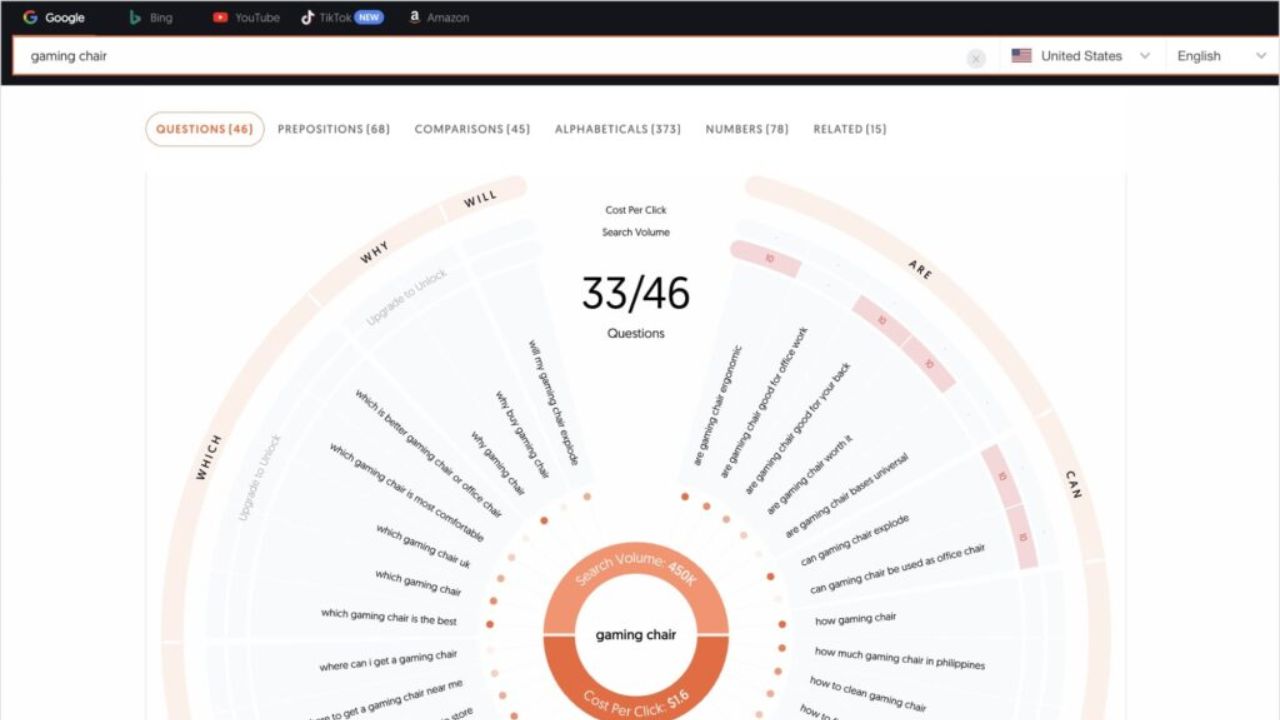
AnswerThePublic is a keyword research and content discovery tool that visualizes the questions, prepositions, comparisons, and alphabetical variations that people type around any given topic or keyword. Unlike traditional keyword tools that give you flat lists of phrases with search volumes, ATP organizes queries into the natural structure of human curiosity.
At its core, it pulls autocomplete data from search engines — primarily Google and Bing — to show you what real people are already asking. It was built by the team at Neil Patel Digital and has since become a staple in the content marketer’s toolkit.
Why This Tool Stands Apart
Traditional keyword tools tell you how many people search for something. AnswerThePublic tells you exactly how they’re phrasing the question — which is the difference between ranking and connecting.
The real magic is in what it reveals about intent. When someone types “why does my sourdough bread collapse” into Google, they’re not just searching for bread tips — they’re frustrated, probably at 6am, and need a fast, compassionate answer. ATP helps you see your content through those emotional lenses.
Step-by-Step: Using AnswerThePublic Effectively
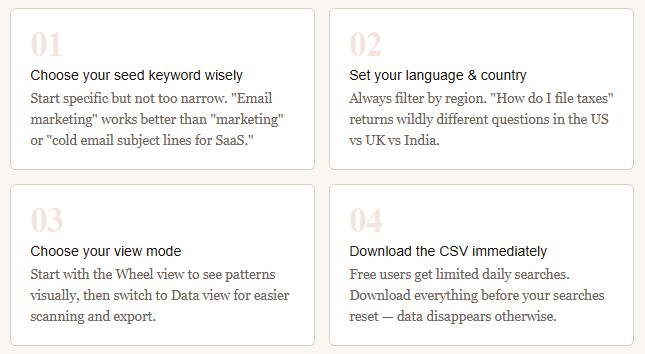
Let’s walk through the full workflow — from entering your first search to turning raw data into a content goldmine.
Understanding the Six Question Categories
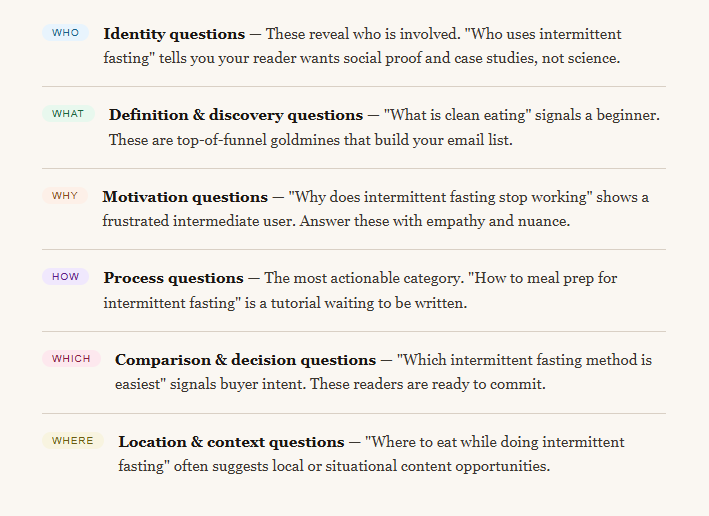
ATP organizes questions into groups based on the trigger word. Each category reveals a different kind of reader intent:
Finding the Truly Unmet Questions
Here’s where most people go wrong: they see a list of questions and immediately start writing content for the ones with obvious answers. But the real opportunity lies in the questions that are being asked frequently yet answered poorly everywhere on the internet.
Finding these requires a three-part filter:
Filter 1 — The SERP Satisfaction Check
Take the most interesting questions from your ATP export and search them directly on Google. Ask yourself honestly: Are the top results actually satisfying? Do they answer the question fully, or do they dance around it? Do they feel outdated, thin, or written by someone who doesn’t really understand the reader’s situation?
If the results feel unsatisfying even to you — someone who has never searched this before — imagine how frustrated a reader who desperately needed the answer felt.
Pro Tip — The “People Also Ask” Loop
When you search a question from ATP and see Google’s “People Also Ask” box, those additional questions are dynamically generated based on user behavior. They represent questions searchers actually ask after reading the top result — meaning the top result didn’t fully satisfy them. These are your content gap jackpots.
Filter 2 — The Emotional Specificity Test
Generic questions like “what is SEO” are already answered to death. But emotionally specific questions like “why does my SEO work for a month then tank” reveal real pain that most sanitized how-to guides ignore entirely.
Look through your ATP results for questions that carry emotional weight — words like “still,” “keep,” “always,” “never,” “why won’t,” or “how come” signal a frustrated searcher who has already tried the obvious answer and it didn’t work.
The question nobody has answered well is not the question nobody is asking — it’s the question everyone is afraid to really dig into.
Filter 3 — The Expertise Asymmetry Gap
Some questions appear in ATP that require genuine specialist knowledge to answer properly. The current results may be written by generalist bloggers who got it partially right or used heavily hedged language that doesn’t actually help anyone.
If you or your ghostwriter has real expertise in an area, scan the ATP results for questions where the correct answer requires nuance that shallow content typically misses. These are your highest-authority content opportunities.
Turning the Data Into a Content Gap Matrix
Once you’ve filtered your ATP questions, organize them into a simple matrix that maps intent against content opportunity. Here’s an example for the keyword “freelance writing”:
| Question from ATP | Intent Level | SERP Quality | Content Type |
|---|---|---|---|
| How to start freelance writing with no experience | Beginner | Saturated | Skip or differentiate sharply |
| Why do freelance writers get ghosted by clients | Intermediate | Weak / generic advice | Empathy-first essay + practical steps |
| Which freelance writing niches pay the most in 2025 | Research | Outdated or anecdotal | Data-driven roundup with real rates |
| How to raise your freelance writing rates without losing clients | Advanced | Very thin / no real script | Step-by-step guide with email templates |
| Can freelance writers get health insurance | Practical | Outdated / US-only | Comprehensive guide by country |
This matrix becomes your editorial calendar backbone. You’re not randomly brainstorming posts anymore — you’re surgically targeting questions where reader demand exists and current supply is inadequate.
Advanced ATP Techniques Most Creators Ignore
The Comparison and Preposition Goldmines
Beyond question words, ATP also shows preposition-based queries (“freelance writing for beginners,” “freelance writing without a degree”) and comparison queries (“freelance writing vs copywriting”). These are incredibly valuable because they reveal how your reader is contextualizing their situation — and often these pages face far less competition than pure informational posts.
Run Multiple Seed Variations
Don’t just enter your main keyword. Enter the problem your reader is experiencing. If your topic is “accounting software,” also run “reconciling accounts problem,” “bookkeeping mistake,” and “small business tax confusion.” The question landscape changes dramatically when you enter through the reader’s frustration rather than the product name.
The Frustration First Method
Before entering your keyword, write down the sentence a stressed reader would whisper to themselves before they open Google. That sentence — or its core noun — often produces far richer ATP results than the clinical topic name you’d normally search.
Track the Same Keyword Over Time
ATP Pro users can save searches and compare them over months. This is particularly powerful in trending niches — the questions people ask about AI tools, for example, evolved dramatically between 2023 and 2025. New questions appear as the audience matures, and early movers who publish content for emerging questions capture enormous SEO momentum before competition materializes.
Use ATP for Video and Podcast Content
This tool isn’t just for blog posts. YouTube video titles that directly mirror how a question is phrased in ATP tend to perform extremely well because they match the exact vocabulary the viewer was already using. The same applies to podcast episode titles. ATP essentially gives you a script for how your audience talks — use it everywhere your content appears.
From Question to Content — The Writing Framework
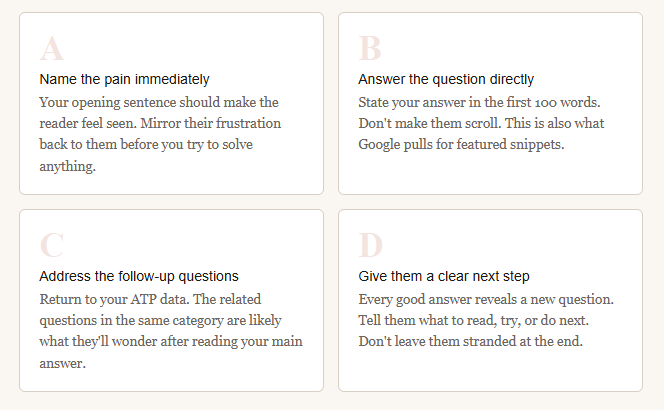
Finding the question is only half the equation. The post you write must genuinely deserve to rank above everything else. Here’s the structure that works for question-based content:
Common Mistakes to Avoid
Even with a great tool, bad habits will dilute your results. Watch out for these:
Chasing volume over void. A question asked by 500 people monthly with terrible existing answers is more valuable than a question asked by 5,000 people that has three brilliant posts already answering it perfectly. Assess supply quality, not just demand size.
Writing for the keyword, not the person. ATP gives you the exact phrasing of the question, but your content should feel like it was written by someone who truly understands why that question exists — not someone who just wants to rank for it.
Ignoring the long tail. The alphabetical section of ATP — where it fills in A through Z after your keyword — often surfaces hyper-specific queries that have very little competition but very high buying intent. “Email marketing automation for dentists” will never have ATP’s highest volume but could be the most valuable piece you ever publish.
Stopping at one search. Your first seed keyword is just the beginning. Let each piece of ATP data inspire the next search. Good content research is recursive — one question leads to three more, and somewhere in that third layer is a post nobody has written yet.

Building a Sustainable Question-First Content Strategy
The ultimate goal isn’t to use ATP once and write ten posts. It’s to build a system — a repeatable process where every new piece of content begins with real evidence of reader curiosity rather than your own assumptions about what might be interesting.
Set a monthly cadence: run 10 ATP searches, filter the results through your three-part test, populate your content gap matrix, and assign the strongest opportunities to your editorial calendar. In six months, you’ll have built something rare in content marketing — a library of posts that genuinely answer questions readers couldn’t find good answers to anywhere else.
That reputation compounds. Readers share what helped them. Search engines reward what satisfies intent. And the questions that once went unmet become the foundation of an audience that trusts you — not because you showed up first, but because you showed up fully.