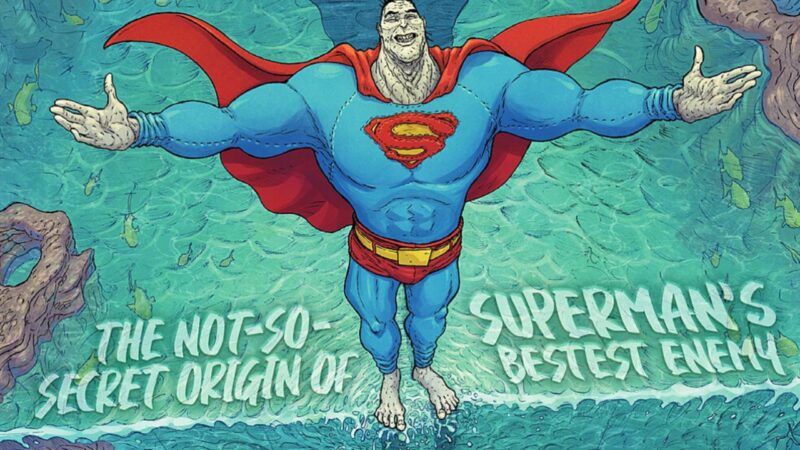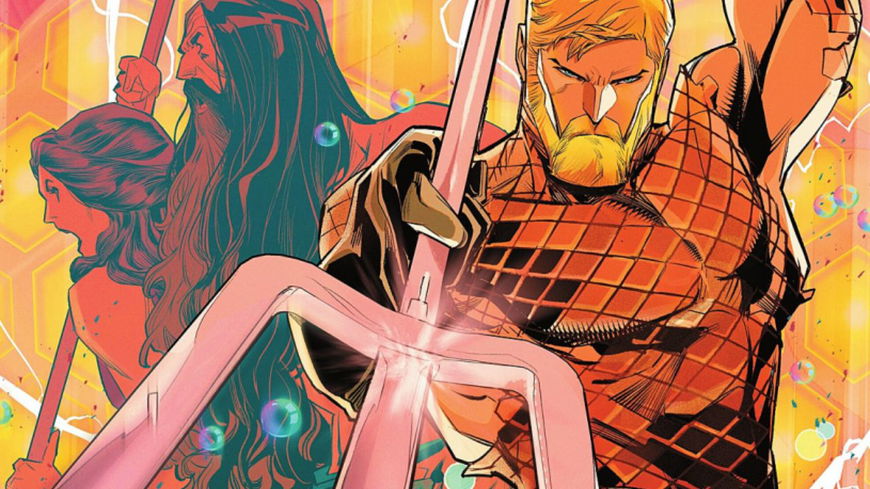

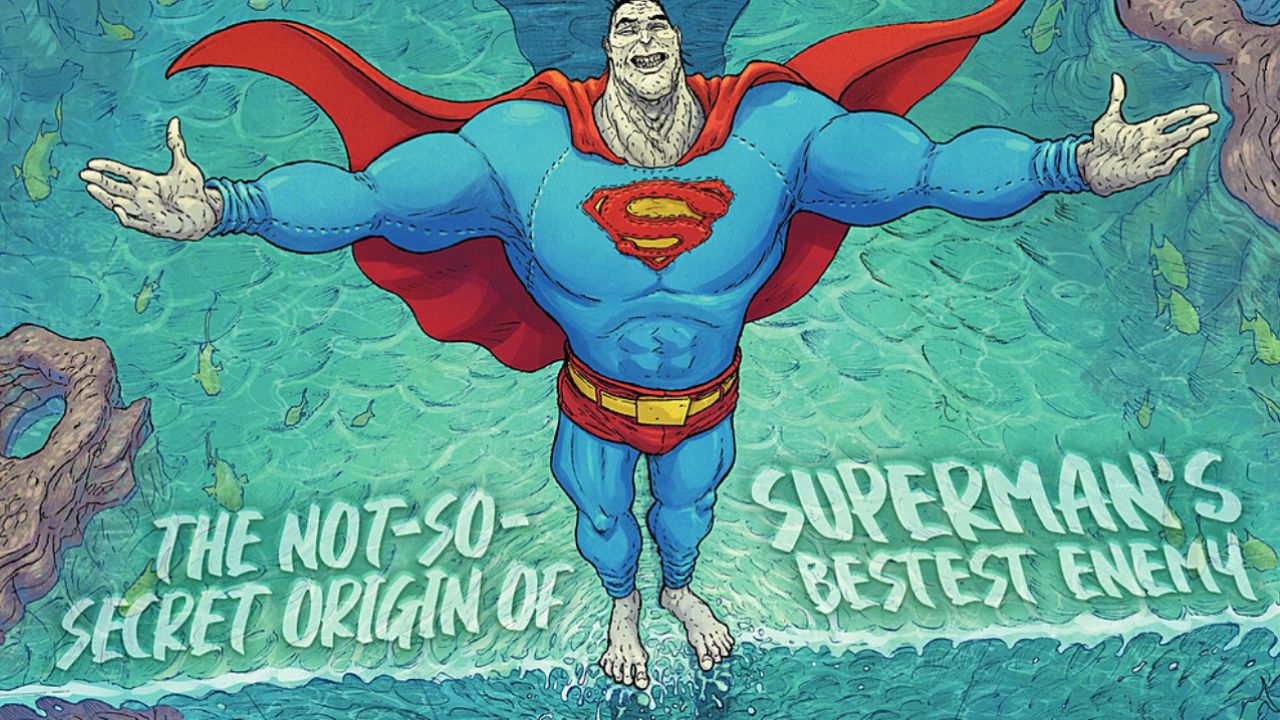
The world of DC Comics is no stranger to the multiversal and the macabre, but every so often, a story comes along that leans into the sheer, unadulterated absurdity of its own lore. Bizarro – Year None #1 (2026), written by the duo of Eric Carrasco and Kevin Smith with art by Nick Pitarra, is exactly that—a surrealist, comedic, and slightly existential journey into the “not-so-secret origin” of Superman’s most backward adversary. This blog post will take you through the cosmic creation of a twisted reality to the moment we realize that in this world, God isn’t just real—he’s a complete jerk.
In the Beginning: A Newspaper in the Void
The story opens not with a bang, but with a biblical parody. The narration echoes the Book of Genesis: “In the beginning, God created the heavens and the earth”. But instead of the void being filled with stars and planets, the “light” that appears is revealed to be something far more mundane yet significantly more important to this specific story: a rolled-up copy of the Daily Planet newspaper floating through the vacuum of space.
This “Holy Relic,” as we later learn, is the seed from which an entire reality will grow. It’s a brilliant opening that sets the tone for the issue: high-concept cosmic stakes met with the grounded, gritty, and often hilarious reality of the journalism world.
Chaos at the Planet: The Point Comes Home
We shift from the cosmic to the literal “point” of the story. In Metropolis, eighteen months after Superman’s arrival, things are as chaotic as ever. Perry White, the legendary, cigar-chomping Editor-in-Chief of the Daily Planet, is known for giving his reporters a simple note: “Get to the point”. On this day, the point literally comes to him.
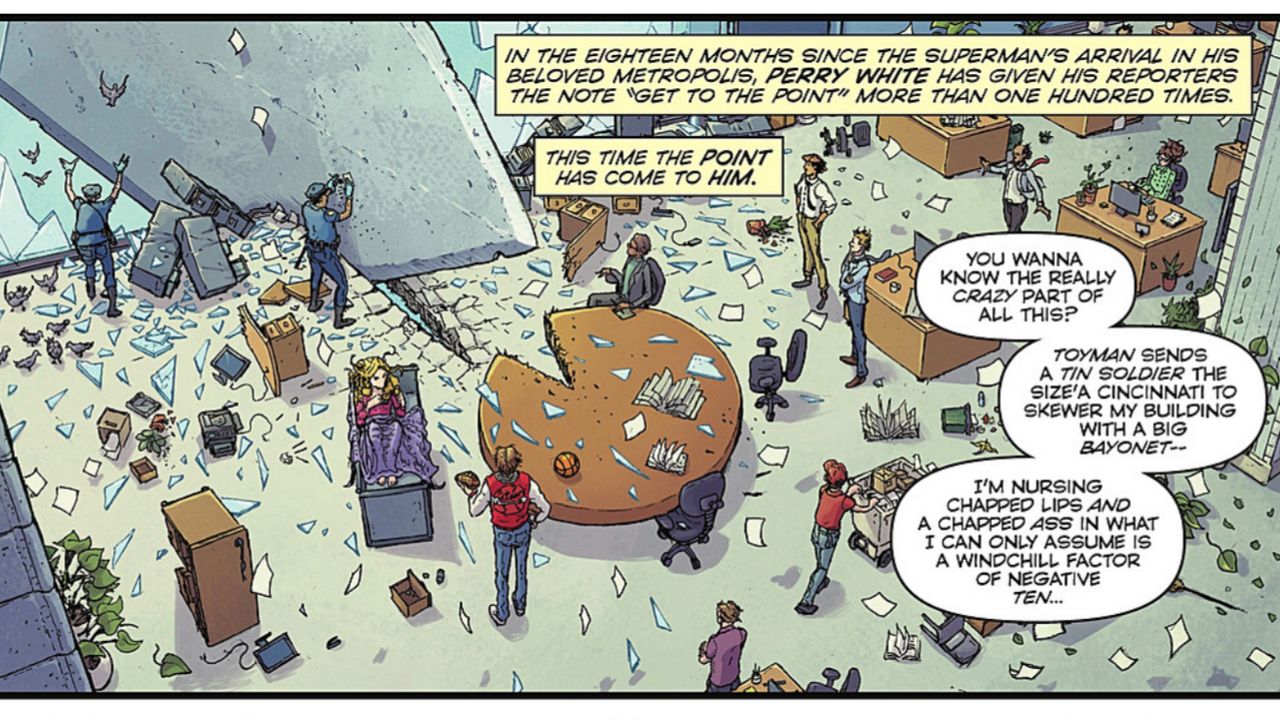
The Toyman has launched an attack on the city using a “tin soldier the size’a Cincinnati”. The soldier has skewered the Daily Planet building with a massive bayonet, leaving the newsroom in shambles, glass shattered everywhere, and the staff nursing chapped lips in a negative-ten-degree windchill caused by the massive hole in the wall.
In typical Perry White fashion, he isn’t worried about the structural integrity of the building or the giant robot outside; he’s furious that he’s still waiting for his coffee.
The Newsroom Dynamics: Old School vs. New Media
While the city deals with the Toyman, the Daily Planet staff tries to function amidst the wreckage. We see the classic ensemble:
- Perry White is adamant that the news doesn’t stop for “terrorists”.
- Lois Lane and Clark Kent are notably absent, having been sent to Washington D.C. for the White House Correspondents’ Dinner—a move Perry now regrets because “hard news is stabbing our conference room”.
- Ron (likely Troupe) plays to Perry’s ego, while Cat Grant pushes for a story on a local scientist.
- Steve Lombard is focused on the sports angle, wondering if the Toyman attack means the Little League season is canceled.
Cat Grant pitches a story on David Dalton, a professor conducting a “duplication experiment” in Hob’s Bay. Perry immediately shoots it down. A year prior, Perry gave Dalton front-page coverage for his “Duplicator Ray,” only for the machine to “cremate” the newspaper and take Perry’s credibility with it. Perry is done with Dalton, but as the reader knows from the opening pages, Dalton’s “failure” was actually the birth of something much bigger.
Superman and the Coffee Boy
As Superman arrives to handle the Toyman—promised by the hopeful citizens looking at the sky—the focus shifts to a more personal conflict within the Planet. Jimmy Olsen, often dismissed as the “coffee boy,” wants a real job.
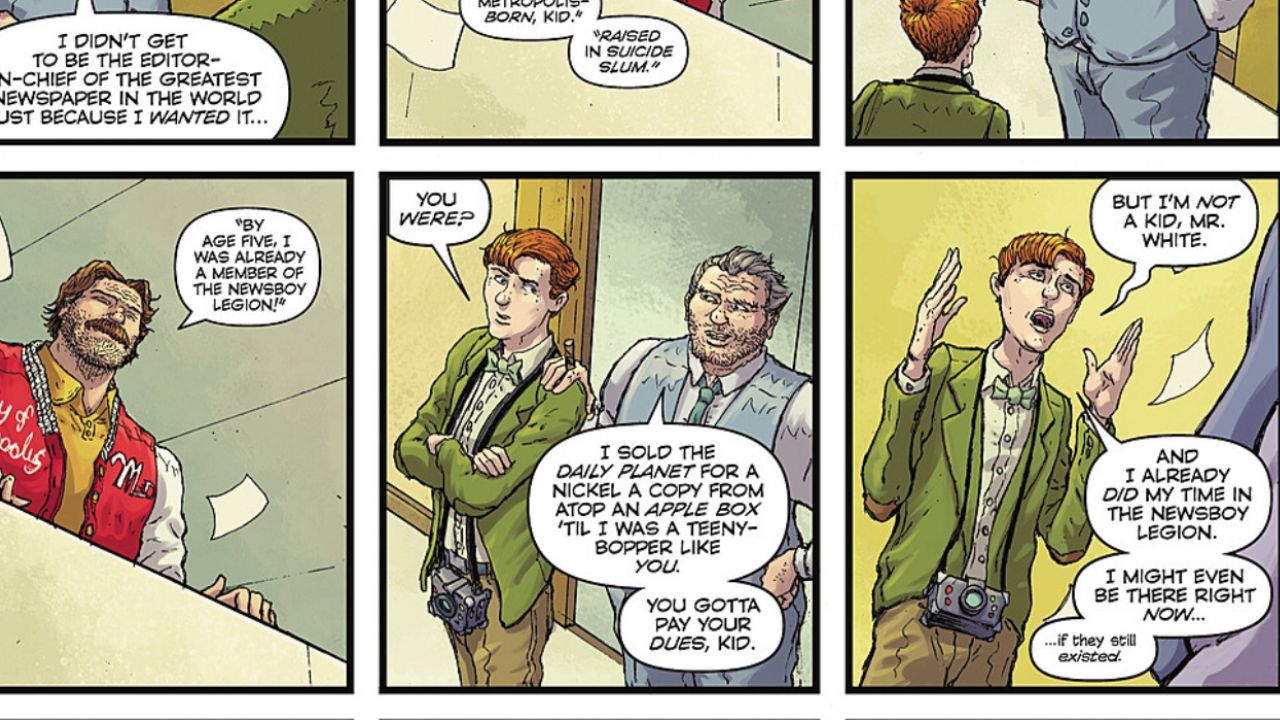
Jimmy argues that he was born to be a “Planeteer” (a term Perry hates), mentioning that his grandfather ran the Planet printing press in the ’70s. Perry dismisses him as a kid with no experience, but Jimmy counters that the paper is becoming “cringe” and “sensationalized,” reading like “Clint Eastwood telling a kid to get off his lawn”.
Jimmy presents himself as the contemporary voice the paper needs. He’s been out on the streets, filming videos and capturing moments like an old lady flipping off Lex Luthor. He even uses the handle “Superman’s Pal… Jimmy Olsen”. Perry, however, is unmoved. He regales Jimmy with stories of his own youth in the Newsboy Legion, selling papers for a nickel atop an apple box in Suicide Slum. To Perry, journalism is earned through grit, not through “likes” on a video.
The Experiment in Hob’s Bay
While Perry and Jimmy debate the future of journalism, the “failed” Professor David Dalton is back at it in Hob’s Bay. He explains that his Duplicator Ray works by creating a breach: he throws something in, and the breach spits it out along with a copy.
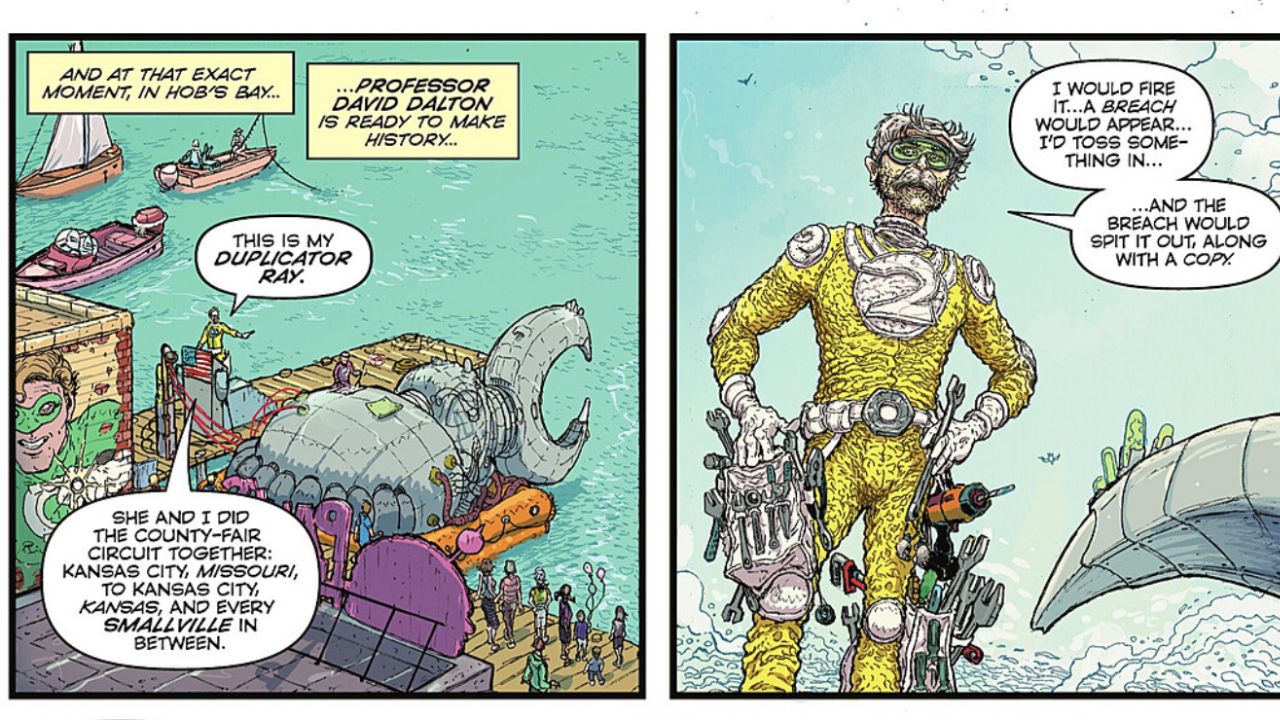
He admits the ray failed exactly once—in Metropolis—when the object he threw in (the Daily Planet newspaper from the intro) never came out. Today, he intends to find out what “swallowed” it. As he fires the ray again, a massive energy surge (“CLK FATHWOOOOON”) erupts.
The Breach and the Strange Visitor
The energy from Dalton’s experiment tears through reality, appearing right in the middle of the Daily Planet newsroom where Perry and Jimmy are still arguing. With a “CORP FWOODOSH SHWAMMP,” the environment shifts.
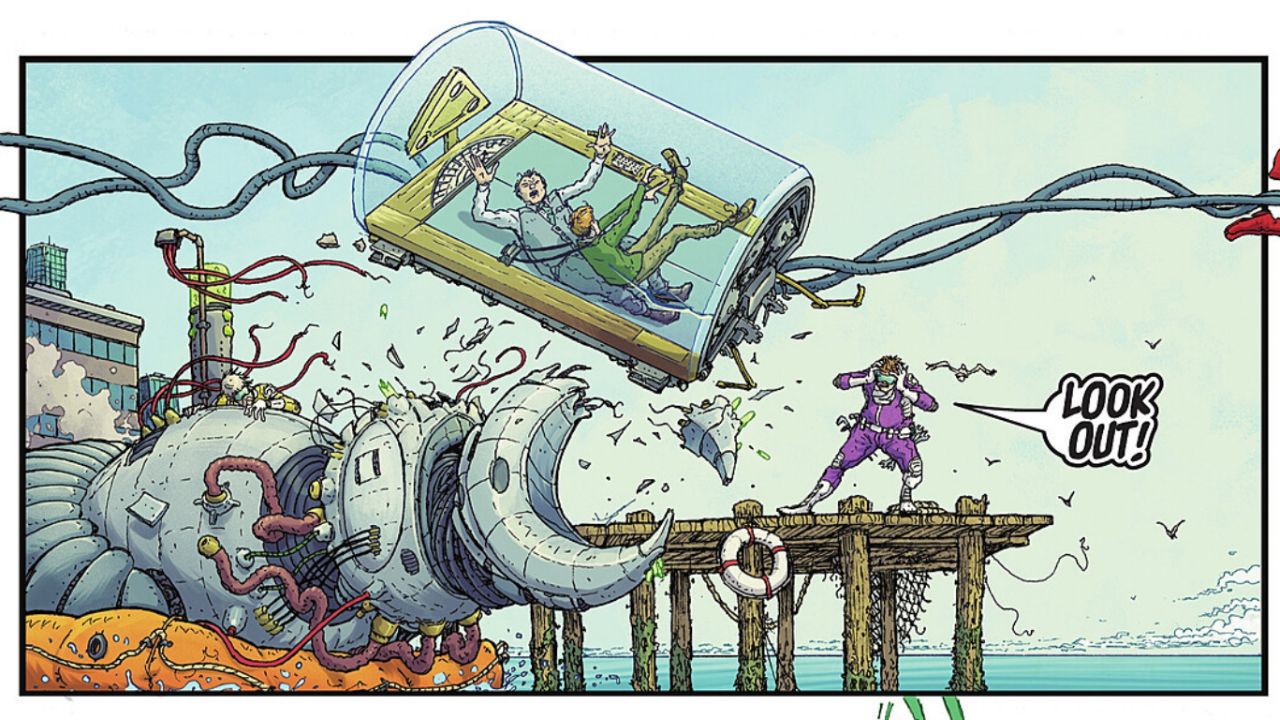
Perry and Jimmy find themselves not in Metropolis, but in a parallel reality. A voice booms, welcoming the “strange visitors from another planet”. The figure reveals himself as a “twelfth-level intelligence” from a parallel reality known as “FIZZZKTKRGGE”.
This is Bizarro. But he isn’t the lumbering, simple-minded brute often depicted in comics. This Bizarro is articulate, arrogant, and seemingly god-like. He explains that his reality was once a “shapeless, formless tumult” until the day Perry’s newspaper—the one Dalton “vaporized”—fell into his prison cell.
The Shrine of the Holy Relic
Bizarro didn’t just read the paper; he worshipped it. He built a “shrine of the Holy Relic” and used the information within to shape his entire reality. He learned of Metropolis and the Kryptonian Superman, a world of “truth” that he wanted to replicate.
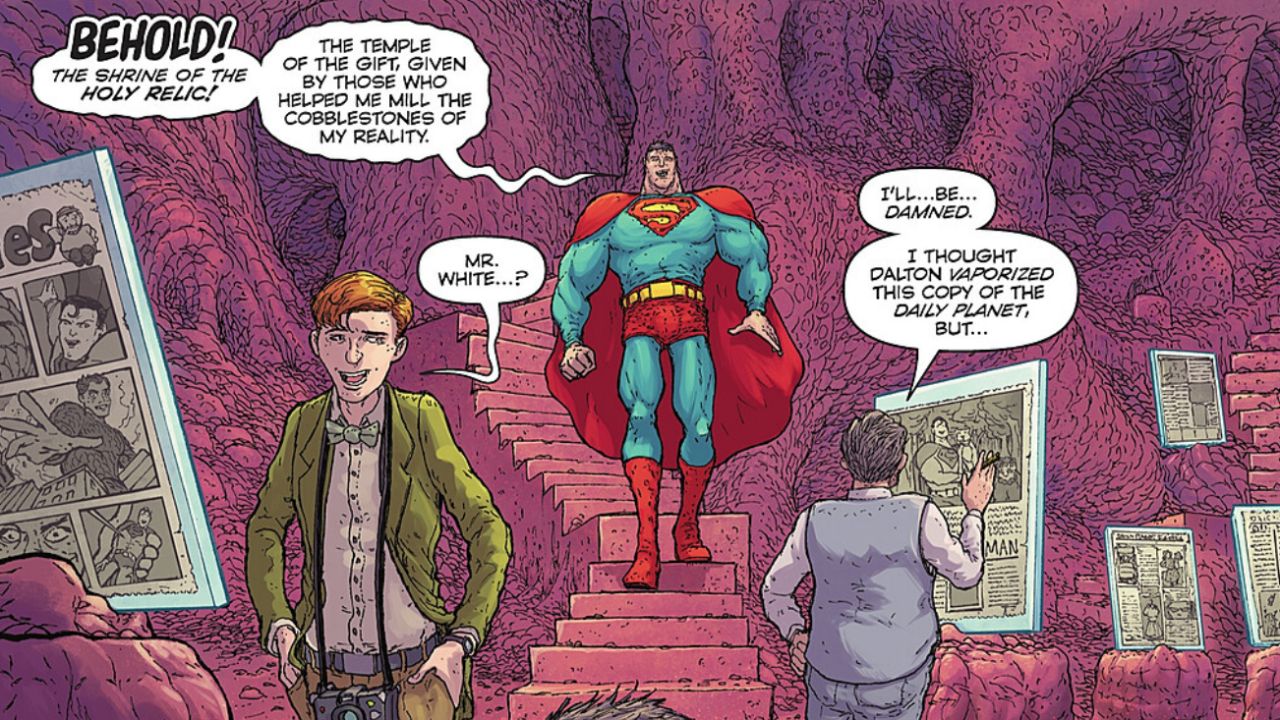
“I made a world—and people—in your paper’s image,” Bizarro explains. He built his own Metropolis, but he claims he isn’t Superman—he’s just a “super fan”. However, his version of Metropolis is a twisted, backwards reflection. His staff members argue about maternity leave and “woke jokes,” with Steve Lombard making sexist remarks about a “woman’s place”.
The Ultimate Promotion
Bizarro’s reason for abducting Perry and Jimmy is simple: he wants them to teach his reporters “how to make news like the real Daily Planet”. Perry is outraged by the abduction and the “copycat world,” calling it “backwards thinkin'”.
This triggers Bizarro, who begins to glitch. His speech breaks down as he struggles to hold his story together, muttering about margins moving and columns breaking. He snaps back into a state of chilling clarity and decides to shake up the hierarchy.
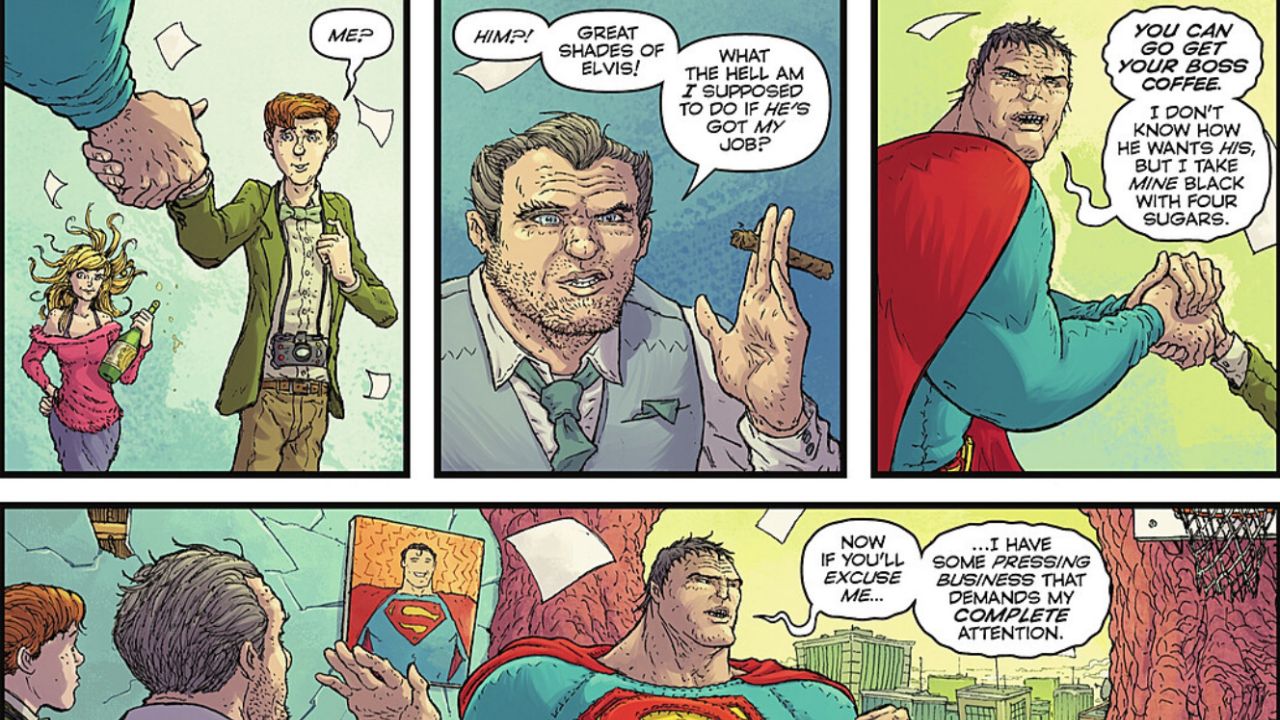
In Bizarro’s Metropolis, seniority doesn’t matter. He asks Jimmy for his name and immediately makes a life-changing declaration: “Olsen Jimmy Olsen… I’m making you the Editor-in-Chief of the Daily Planet”.
The roles are completely reversed. Perry White, the man who demanded Jimmy “pay his dues,” is told he can now go get his new boss coffee. Bizarro even specifies his own order: black with four sugars.
Conclusion: The God of the Bizarro World
As the first chapter draws to a close, Bizarro flies off to attend to “pressing business,” leaving a stunned Jimmy Olsen in charge and a humiliated Perry White as the office “coffee guy”.
The narrator reflects on the age-old human question: “Is there a God?”. On this strange, new, backwards world, the answer is a resounding yes. But as the story concludes, we are left with a sobering realization about this twelfth-level creator:
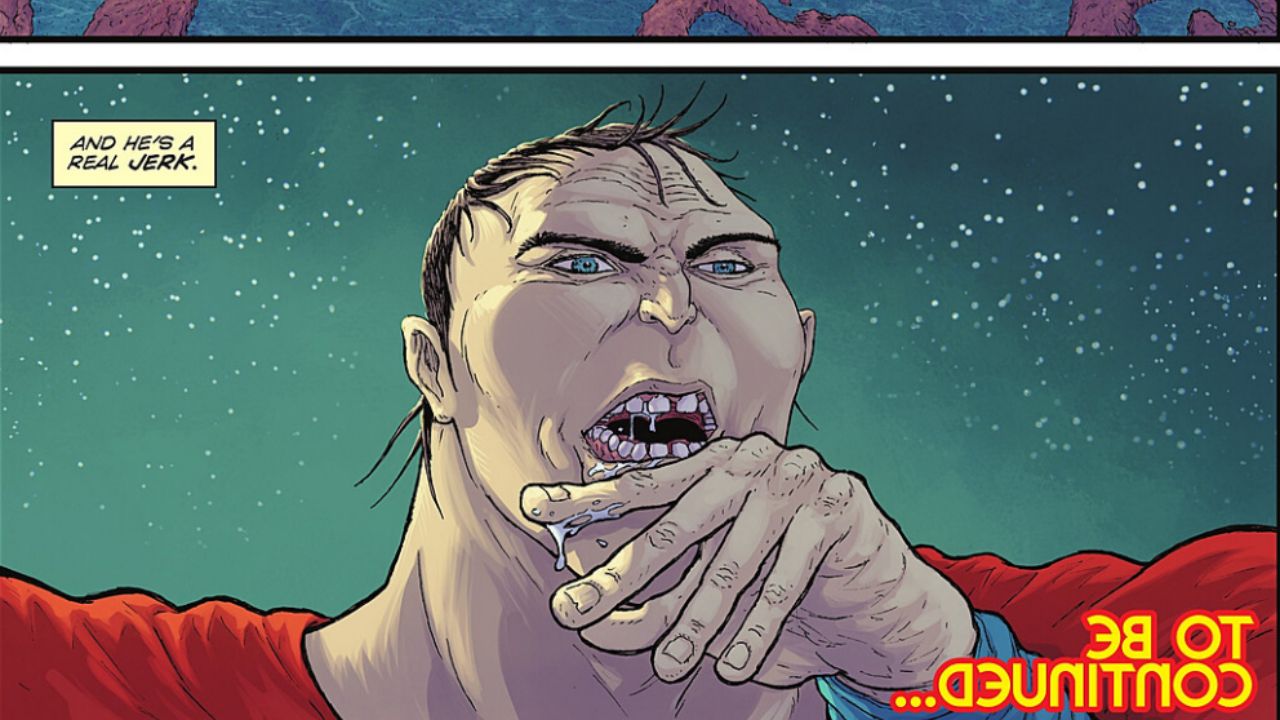
“AND HE’S A REAL JERK”.